A Pinch of Snuff by Reginald Hill

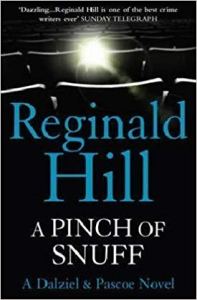
A Pinch of Snuff

HarperCollins|2003|362 pages|Paperback|my own copy|4* 

A Pinch of Snuff is Reginald Hill’s fifth Dalziel and Pascoe novel, first published in 1978. It was televised in 1994 by Yorkshire Television, two years before the BBC series began. The characters of Dalziel and Pascoe were played by comedians Gareth Hale and Norman Pace, with Christopher Fairbank as Sergeant Edgar Wield. It was not a success and Reginald Hill was said to have been unhappy with the series. Subsequently the Dalziel and Pascoe books were adapted for BBC television from 1996 to 2007 with the actors Warren Clarke and Colin Buchanan in the lead roles.

I finished reading A Pinch of Snuff just before Christmas and didn’t have time to review it then, so these are just a few notes of what I thought about it. It is better than the earlier books, almost as good as the later books and I enjoyed it very much. It begins as Jack Shorter, Pascoe’s dentist, tells him that he thinks that in one of the blue movies shown at the Calliope Club, an actress wasn’t acting but that she really was beaten up and that her teeth were actually broken. However, when Pascoe begins to investigate his dentist’s allegations it seems that the dentist’s fears were unfounded as the actress in question assures Pascoe that she was acting and certainly wasn’t hurt. But then the cinema is wrecked and its owner killed. Shorter, meanwhile, is accused of molesting an underage patient and is allegedly responsible for getting her pregnant.

All in all, this is a complicated book involving child abuse, pornography, violence towards women and snuff films. It starts slowly, but as the various twists and turns crop up the pace quickens. The events are shown through Pascoe’s eyes and we see his relationships with Dalziel and Sergeant Wield develop.  Elly, Pascoe’s wife, still doesn’t get on with Dalziel, and her feminism comes to the fore in her antagonism against him. 

The 6th book in the series is A Killing Kindness and I shall be reading that very soon.

These are the Dalziel and Pascoe books I’ve read so far:

1. A Clubbable Woman (1970) 
2. An Advancement of Learning (1971)
3. Ruling Passion (1973)
4. An April Shroud (1975) 
8. Exit Lines (1984)
11. Bones and Silence (1990) 
14. Pictures of Perfection (1993) – read, no post
17.On Beulah Height (1998) 
20. Death’s Jest Book (2002) 
21. The Death of Dalziel (2007)

Six Degrees of Separation: from Daisy Jones and The Six to Thirteen

I love doing Six Degrees of Separation, a monthly link-up hosted by Kate at Books Are My Favourite and Best. Each month a book is chosen as a starting point and linked to six other books to form a chain. A book doesn’t need to be connected to all the other books on the list, only to the one next to it in the chain.

Daisy Jones

This month the chain begins with Daisy Jones and The Six by Taylor Jenkins Reid,  a novel about the rise and fall of a fictional 70s rock band inspired by Fleetwood Mac.

There are always several ways to go when compiling these Six Degree chains and at first my mind went blank  but looking at the books we got for Christmas I decided that Face It: a Memoir by Debbie Harry was just the right book for my first link, a book about a real rock band. Debbie Harry is the best known face of Blondie; she and the band forged a new sound that brought together the worlds of rock, punk, disco, reggae and hip-hop to create some of the most beloved pop songs of all time.

The Ballad of Jethro Tull: The official illustrated oral history is another book we got for Christmas. It’s Jethro Tull’s story told by Ian Anderson, band members past and present and the people who helped Tull become one of the most successful bands in rock history.

And then I thought my chain needed a change of genre, but sticking with the word ‘ballad’ I thought of Dreamwalker: The Ballad of Sir Benfro: Book 1 by James Oswald, a magical tale of the young dragon, Benfro, inspired by the language and folklore of Wales. It follows the adventures of a young dragon, Sir Benfro, in a land where his kind have been hunted near to extinction by men.

For the next link I turned to crime fiction and to one of James Oswald’s Inspector McLean novels, set in Edinburgh – The Hangman’s Song. It’s a dark, tense novel with elements of the supernatural  and parapsychology thrown in. It’s not a book for the faint-hearted or the squeamish as there are details of some gruesome deaths, murders and beatings that the characters go through. 

James Oswald is a Scottish author and so my last link is to another Scottish author – Chris Brookmyre, who has written The Way of all Flesh, under the pseudonym of Ambrose Parry with his wife, Dr Marisa Haetzman a consultant anaesthetist. It is set in Edinburgh in 1847 as Dr James Young Simpson, a professor of midwifery, discovered the anaesthetic properties of chloroform. It combines fact and fiction most successfully, the social scene, historical and medical facts slotting perfectly into the plot. It was on the Longlist for the 2019 Theakston Old Peculier Crime Novel of the Year.

But the winner was Thirteen by Steve Cavannagh, an Irish author. It’s the fifth book in the Eddie Flynn series of crime thrillers, ‘serving up a delicious twist to the traditional courtroom thriller, where in this instance the real killer is not the one on trial, but a member of the jury!’ I have a copy but haven’t read it yet. And quite by chance I see that it also links back to Daisy Jones and the Six as it has a number in the title.

From a fictional rock band to two real rock bands my chain also links up books of ballads and three crime fiction novels.

Next month (1 February 2020), we’ll begin with Fleishman is in Trouble by Taffy Brodesser-Akner.

Calendar of Crime Wrap-Up Post

The Calendar of Crime is a reading challenge hosted by Bev at My Reader’s Block. It allows mystery readers to include any mystery regardless of publication date. If it falls in a mystery category (crime fiction/detective novel/police procedural/suspense/thriller/spy & espionage/hard-boiled/cozy etc.), then it counts and it does not matter if it was published in 1892 or 2019.

The Challenge ran from January 1, 2019 to December 31, 2019. I really enjoyed doing this and completed 42 of the 108 categories as shown in the chart and listed below:

Calendar of C 2019 2

January:

February:

March:

April:

May:

  • The Lying Room by Nicci French author’s birth month (Sean French)
  • The Seeker by S G Maclean – original publication month
  • Who Killed Ruby? by Camilla Way – mother has a major role
  • Wild Fire by Ann Cleeves – action takes place this month

June:

July:

August:

September:

October:

November:

  • The Stranger Diaries by Elly Griffiths – primary action takes place in this month
  • The Lost Man by Jane Harper – Family relationships play major role
  • Not Dead Enough by Peter James – book title has word beginning with ‘N’

December:

And now I’m looking forward to taking part in this year’s challenge – you can sign up too on Bev’s blog My Readers Block.

Wild Fire by Ann Cleeves

Wild Fire

Macmillan|6 September 2018|417 pages| paperback|4*

Wild Fire is the 8th and last book in Ann Cleeves’ Shetland series. I have loved this series ever since I read the first book, Raven Black, back in 2010. And because I began reading the books before they were televised my picture of Inspector Jimmy Perez is drawn from them rather than from the dramatisations. There are some significant changes  between the TV dramatisations and the books – notably in the characters of Cassie, Fran’s daughter who is still a child in the books is older in the TV stories, and the relationship between her father, Duncan Hunter and Perez is different. And Douglas Henshall, who plays the part of Perez, is not physically like Jimmy Perez – Perez has long dark hair with Spanish ancestry in his blood, whereas Douglas Henshall is a redheaded Scot.

It’s not necessary to have read the earlier books in the series as each one works well on their own, but I think it helps enormously if you have as the personal stories of the main characters form a continuous thread.

Wild Fire is set in Deltaness, an invented village in Northmavine where the Fleming family, Helen, a knitwear designer, her architect husband, Daniel, and their children, autistic Christopher, and Ellie,  have recently relocated from London. They are finding it hard to settle and matters were only made worse when the previous owner of their house is founding hanging in their barn. But they have made friends with the Moncrieff family, Belle, her husband Robert the local doctor and their four children – the eldest two,Martha and Charlie are teenagers, with a younger brother and sister. 

Things go from bad to worse for the Flemings when Christopher discovers the hanged body of the Moncrieff’s nanny, Emma Shearer in the barn. Suspicion immediately falls on Daniel and Helena as the rumours spread like wild fire that Emma and Daniel had been having an affair. Chief Inspector Willow Reeves, Jimmy’s boss returns to Shetland to lead the investigation and it is immediately obvious that they have personal issues to resolve as well as finding the murderer.

But of course it is not that straight forward. Emma comes from a dysfunctional family and has issues of her own to work through, and the Moncrieffs are also suspects. In fact there are plenty of people who bear grudges against the incomers and they become a focus of resentment and jealousy. Emma’s boyfriend Magnie Riddell and his mother Margaret are two more people whose motives and movements come under suspicion.

The main interest for me is the relationship between Jimmy and Willow and how Jimmy reacts to her news. It causes him to question what he really feels and what form his life will take for the future. I don’t think it is giving away any spoilers, as this is the last book in the series, to say that things are about to change for them both. As in all the Shetland books it is Ann Cleeves’ beautiful descriptions of the islands that stand out – that and the characters themselves who have become like real people to me and I shall miss reading about them. But then, I can always re-read the series!

Reading Challenges – Calendar of Crime (the main action takes place in May), and Mount TBR 2019 (a book I’ve owned for 2 years)

As it is the last day of the year, this is my last post in 2019 (you may have noticed that I’ve written three posts today to complete my entries in the two Reading Challenges above).

And now I’m looking forward to the start of a new decade and lots of books to read.


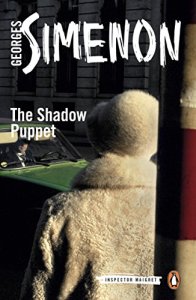
The Shadow Puppet by Georges Simenon

The Shadow Puppet

Penguin Classics|2 October 2014|160 pages|Paperback|4*

Georges Simenon wrote his 13th Maigret book, The Shadow Puppet in December 1931 at the villa Les Roches Grises at Antibes (Alpes-Maritimes) on the French Riviera. It was first published in 1932 under the title L’Ombre chinoise. 

It’s the second Maigret book I’ve read in the last two days and I think this is better than the other one I read, The Saint-Fiacre Affair. It is a more typical murder mystery – a man is shot dead in his office in the Place des Vosges in Paris and Maigret uncovers a tragedy involving desperate lives, unhappy people, addiction and an all-consuming greed. He gets to the truth through careful examination of the facts, questioning those involved and applying his knowledge and understanding of human nature.

One evening Raymond Couchet, the owner of a serum company in the Place des Vosges, was shot dead, seated at his desk, and the safe behind him was empty, the 3600 francs that should have been there have gone. The building contains Couchet’s medical laboratory  as well as residential apartments, set around a central courtyard. Called to the scene Maigret notices the shadowy figures in the lighted windows of the building and suspects that the murderer could be one of the residents of the apartments where Couchet’s first wife, Juliette Martin and her husband live. Then there is his son, Roger, a drug addict living in the Hôtel Pigalle, and in the next room to him, Couchet’s girlfriend, Nine Moinard, a dancer at the Moulin Bleu.

It is an entertaining mystery and Maigret finds himself getting to really like Couchet as the details of his life emerge – and equally disliking both his son and his bitter ex-wife. What I like about these Maigret books are that they are concise and tightly structured yet convey such convincing characters and depths of perception. In this particular book Maigret comes across feelings of enmity, greed, class distinction, hatred and paranoia in the course of his investigations.

Reading Challenges – Calendar of Crime (the setting is a place of employment), and Mount TBR 2019 (a book I’ve owned for 2 years)

The Saint-Fiacre Affair by Georges Simenon

The Saint-Fiacre Affair

Penguin Classics|6 November 2014|160 pages|Paperback|3*

The Saint-Fiacre Affair by Georges Simenon was first published in January 1932, under the title Maigret Goes Home. My copy is one of the Penguin Classics publications in new translations.

Saint-Fiacre is where Maigret was born and grew up. His father had been the steward of the château there for thirty years. So when an anonymous note predicting a crime during All Souls’ Day mass at the church is handed in to the Moulins police office, Maigret went back there for the first time since his father had died. It is a melancholy visit for as well as a death to investigate, Maigret finds so much had changed and the atmosphere was oppressing him – he had never imagined that he would find the village in such a sorry state.

The predicted death took place in the church whilst Maigret was attending the the first Mass on All Soul’s Day – the old Countess of Saint-Fiacre died during the mass, of heart failure.  But Maigret soon discovers that the heart attack had been brought on when the Countess read a fake newspaper story of her son’s suicide that had been planted in her missal. Maigret suspects a number of people could have been responsible – her son, Maurice, her secretary/lover, Jean, the steward, Ernest and his son, Emile.

I enjoyed this book, although I found it rather disjointed and at times couldn’t follow very easily who was speaking, so it was a bit difficult keeping track of what was going on – maybe that was my problem, I’m not sure. But I thought the melancholy atmosphere and the descriptions of the chateau and Maigret himself were well done and it is packed with drama and tension. The denouement in which Maigret reveals the truth reminded me of the way Poirot rounds up all the people involved and explains who had done the deed and why, and why it was a crime that was not punishable by the law. 

 Reading ChallengesCalendar of Crime (winter scene on the cover), and Mount TBR 2019(a book I’ve owned for 2 years)