Six in Six: 2018

I’m pleased to see that Jo at The Book Jotter  is running this meme again this year to summarise six months of reading, sorting the books into six categories – you can choose from the ones Jo suggests or come up with your own. The same book can obviously feature in more than one category.

Here are my six categories (with links to my reviews):

Six books I have enjoyed (just some of the 5* books I’ve read this year)

  1. After You’d Gone by Maggie O’Farrell
  2. The Toymakers by Robert Dinsdale
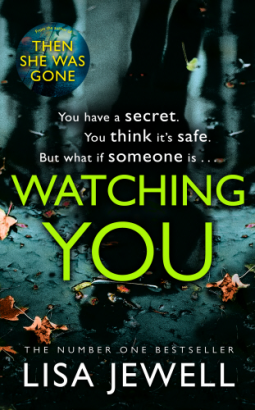
  3. Watching You by Lisa Jewell
  4. Munich by Robert Harris
  5. The Ashes of London by Andrew Taylor
  6. The Grapes of Wrath by John Steinbeck

Six new authors to me

  1. Notes From An Exhibition by Patrick Gale
  2. Force of Nature by Jane Harper
  3. The Nightingale by Kristin Hannah
  4. The Smiling Man by Joseph Knox
  5. The Good Liar by Catherine McKenzie
  6. Major Pettigrew’s Last Stand by Helen Simsonson

Six books from the past that drew me back there

  1. The Wicked Cometh by Laura Carlin
  2. The Tuscan Child by Rhys Bowen
  3. The Western Wind by Samantha Harvey
  4. The Tenderness of Wolves by Stef Penney
  5. Her Hidden Life by V S Alexander
  6. The Fire Court by Andrew Taylor

Six Non-British Authors

  1. Only Child by Rhiannon Navin
  2. The Midnight Line by Lee Child
  3. Time is a Killer by Michel Bussi
  4. A Dying Note by Ann Parker
  5. The Three Evangelists by Fred Vargas
  6. The Hunger by Alma Katsu

Six  Golden Age Mysteries

  1. The Secret Vanguard by Michael Innes
  2. Bump in the Night by Colin Watson
  3. Portrait of a Murderer by Anne Meredith
  4. The Daffodil Affair by Michael Innes
  5. Bats in the Belfry by E C R Lorac
  6. Fire in the Thatch by E C R Lorac

Six authors I read last year – but not so far this year and their books I hope to read

  1. Colin Dexter – The Riddle of the Third Mile
  2. Peter May – Coffin Road
  3. Beryl Bainbridge – Another Part of the Wood
  4. Gillian McAllister – No Further Questions (to be published in October)
  5. Ann Cleeves – Wild Fire (to be published in September)
  6. Ian Rankin – In a House of Lies (to be published in October)

How is your reading going this year? Do let me know if you take part in Six in Six too.

Watching You by Lisa Jewell


Random House UK Cornerstone|12 July 2018|496 pages|e-book |Review copy|5*

Six Degrees of Separation from Tales of the City to Fear in the Sunlight

I love doing Six Degrees of Separation, a monthly link-up hosted by Kate at Books Are My Favourite and Best. Each month a book is chosen as a starting point and linked to six other books to form a chain. A book doesn’t need to be connected to all the other books on the list, only to the one next to it in the chain.

Tales of the City (Tales of the City, #1)

Completely Unexpected TalesDon't Look Now and Other StoriesThe Man in the PictureThe Picture of Dorian GrayOscar Wilde and the Candlelight MurdersFear in the Sunlight (Josephine Tey, #4)

This month the chain begins with Tales of the City, the first in a series by Armistead Maupin – yet another book I haven’t read or even heard of before! But it brought to my mind another book of tales –

Completely Unexpected Tales by Roald Dahl, described on the back cover as a collection of macabre tales of vengeance, surprise and dark delights. I used to enjoy these tales in the TV series, Tales of the Unexpected, years ago.

That takes me to the second link in the chain which is another collection of short stories, Don’t Look Now and Other Stories  by Daphne Du Maurier. The title story is a supernatural tale involving a British couple on holiday in Venice to escape the pain of their young daughter’s recent death.

Another book set in partly in Venice is The Man in the Picture: a Ghost Story by Susan Hill . The narrator is having a meal with his old college professor one bitterly cold January evening in  Cambridge, listening to a strange tale of a Venetian painting, of death and damnation.

And so to the fourth link both by its title and its subject – a story of the supernatural, The Picture of Dorian Gray by Oscar Wilde, a Gothic horror story in which Dorian Gray exchanges his soul for eternal youth and beauty.

Oscar Wilde is the main character in Oscar Wilde and the Candlelight Murders by Gyles Brandreth, a detective story of corruption and intrigue in which Wilde and Arthur Conan Doyle investigate a murder. This is a book that mixes fact and fiction by using real people as characters. As does my last book –

Fear in the Sunlight by Nicola Upson, set in the 1930s, in which writer Josephine Tey joins her friends in the holiday village of Portmeirion to celebrate her fortieth birthday. Alfred Hitchcock and his wife, Alma Reville, are there to sign a deal to film Josephine’s novel, A Shilling for Candles.

 ~~~

My chain is made up of a mixture of books that I’ve read or are on my TBR shelves and a mix of short stories, ghost and horror stories and crime fiction. Books about the supernatural, books set in Venice and books  that mix fact and fiction.

Next month (August 4, 2018), we’ll begin with Atonement by Ian McEwan. Hurrah – a book I’ve read and loved!

The Grapes of Wrath by John Steinbeck

‘… in the eyes of the hungry there is a growing wrath. In the souls of the people the grapes of wrath are filling and growing heavy, growing heavy for the vintage.’

The Grapes of Wrath

Shocking and controversial when it was first published in 1939, Steinbeck’s Pulitzer Prize-winning epic remains his undisputed masterpiece.

Set against the background of dust bowl Oklahoma and Californian migrant life, it tells of the Joad family, who, like thousands of others, are forced to travel West in search of the promised land. Their story is one of false hopes, thwarted desires and broken dreams, yet out of their suffering Steinbeck created a drama that is intensely human yet majestic in its scale and moral vision; an eloquent tribute to the endurance and dignity of the human spirit. (Amazon)

I loved The Grapes of Wrath. It’s a book that totally surprised me by how much I loved it and I’m sure that whatever I write about it will not do it justice – my post merely skims the surface of this brilliant book. My copy has an Introduction by Robert DeMott, who is an American author, scholar, and editor best known for his influential scholarship on John Steinbeck and in it he writes that The Grapes of Wrath is the greatest of Steinbeck’s seventeen novels.

Steinbeck’s aggressive mixture of native philosophy, common sense politics, blue-collar radicalism, working class characters, folk wisdom, and home-spun literary form – all set to a rhythmic style and nervy, raw dialect – qualified the novel as the ‘American book” he set out to write. (page 1)

Cannery Row was the first of Steinbeck’s novels that I read and I thought then that Steinbeck’s style is perfect for me. With both books I felt that I was there in the thick of everything he described. His writing conjures up such vivid pictures and together with his use of dialect I really felt I was there in America in the 1930s travelling with the Joad family on their epic journey from Oklahoma to California. What a long, hard journey with such high hopes of a better life and what a tragedy when they arrived to find their dreams were shattered, their illusions destroyed and their hopes denied.

I liked the structure of the book with chapters advancing the story of the Joad family’s journey interspersed with general chapters about the current situation in the country giving snapshots of living conditions. But it’s the landscape and the characters (so many of them) together that made such an impression on me. I liked all the details Steinbeck gives, for example how everything, no matter how small has meaning and memories attached, how to decide what to leave and what to take as the Joads packed up to leave their home. Their belongings and their land is their whole being:

How can we live without our lives? How will we know it’s us without our past? No. Leave it. Burn it. They sat and looked at it and burned it into their memories. How’ll it be not to know what land’s outside the door? How if you wake up in the night and know—and know the willow tree’s not there? Can you live without the willow tree? Well, no, you can’t. The willow tree is you. The pain on that mattress there—that dreadful pain—that’s you. (page 93)

Throughout the book, Steinbeck shows the inhumanity of man to man and also the dignity and compassion, the essential goodness and perseverance of individuals against such appalling conditions and inhumane treatment. Inevitably, I found myself comparing it to the situation today with the influx of migrants and refugees and the problems of illegal immigrants.

Steinbeck’s first wife, Carol chose the novel’s title from Howe’s ‘Battle Hymn of the Republic’ –  Mine eyes have seen the coming of the glory of the Lord, He is trampling on the vintage where the grapes of wrath are stored… , which in turn is taken from the Book of Revelation Ch14:19-20: ‘So the angel swung his sickle on the earth, gathered its grapes, and threw them into the great winepress of God’s wrath.'(NIV)

~~~

This book slots into the only reading challenge I’m doing this year – What’s in a Name 2018. It fits into the category of a book with a ‘fruit or vegetable‘ in the title. It is also one of my TBR books (a book I’ve owned prior to 1 January 2018) and also a book on my Classics Club list.

  • Format: Paperback
  • Print Length: 476 pages
  • Publisher: Penguin Modern Classics 2000 (first published 1939)
  • Source: A present
  • My Rating: 5*

First Chapter First Paragraph: Don’t Look Now by Daphne du Maurier

Every Tuesday First Chapter, First Paragraph/Intros is hosted by Vicky of I’d Rather Be at the Beach sharing the first paragraph or two of a book she’s reading or plans to read soon.

This week’s book is Don’t Look Now: Short Stories by Daphne du Maurier, a book I’m about to start reading.

Don't Look Now and Other Stories

‘Don’t look now,’ John said to his wife, ‘but there are a couple of old girls two tables away who are trying to hypnotise me.’

Laura, quick on cue, made an elaborate pretence of yawning, then tilted her head as though searching the skies for a non-existent aeroplane.

‘Right behind you,’ he added. ‘That’s why you can’t turn round at once – it would be much too obvious.’

Blurb (Amazon):

John and Laura have come to Venice to try and escape the pain of their young daughter’s death. But when they encounter two old women who claim to have second sight, they find that instead of laying their ghosts to rest they become caught up in a train of increasingly strange and violent events.

The four other haunting, evocative stories in this volume also explore deep fears and longings, secrets and desires: a lonely teacher who investigates a mysterious American couple, a young woman confronting her father’s past, a party of pilgrims who meet disaster in Jerusalem and a scientist who harnesses the power of the mind to chilling effect.

~~~

After I’ve read it I shall watch the film – Julie Christie and Donald Sutherland play the parts of Laura and John in the 1973 film.

Don't Look Now  (Digitally Restored) [DVD] [1973]

I wonder how well it follows the original story? And will it infuriate me if it doesn’t? I hope not.

My ABC of TBRs

For the past few months I’ve been taking a look at my TBR shelves, to encourage me to read them, or maybe even to recycle a few (click on the headings to see my original posts on my TBRs). These are all, with the exception of 2 e-books, physical books on my bookshelves.

As a result I’ve read just 4 of these books – could do better, I think – and found a few that I’ll probably recycle). But it has been an enjoyable exercise and I’m thinking of trawling through my e-books in a similar way.

A, B and C

TBRs abc_edited

I haven’t started any of these three, but they are all books I still want to read:

  • The Appeal by John Grisham – now I have another Grisham to read – Camino Island. It too, sounds good –  ‘Valued at $25 million (though some would say priceless) the five manuscripts of F Scott Fitzgerald’s only novels are amongst the most valuable in the world. After an initial flurry of arrests, both they and the ruthless gang of thieves who took them have vanished without trace.’
  • The Blood Doctor by Barbara Vine – small font
  • The Children’s Book by A S Byatt – a long book that’s quite heavy to hold

D, E and F

I’ve read one of these!

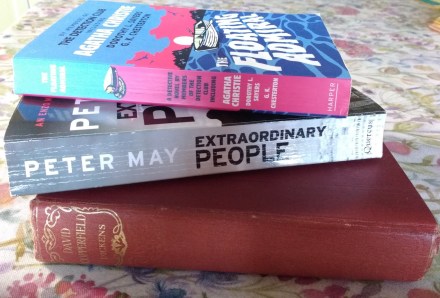
  • David Copperfield by Charles Dickens
  • Extraordinary People by Peter May –READ – I liked it, but not as good as his Lewis trilogy
  • The Floating Admiral by Members of the Detection Club

G, H and I

a-z tbrs ghi P1020304

The problem with these three is that they are all in a small font – hard on the eyes!

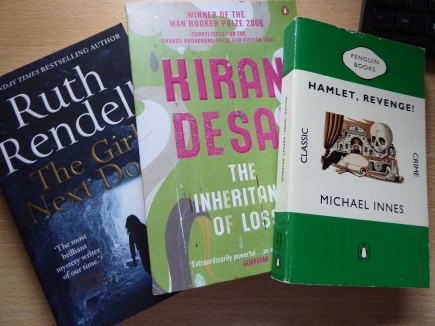
  • The Girl Next Door by Ruth Rendell
  • Hamlet, Revenge! by Michael Innes
  • The Inheritance of Loss by Kiran Desai

J, K and L

TRBs jkl

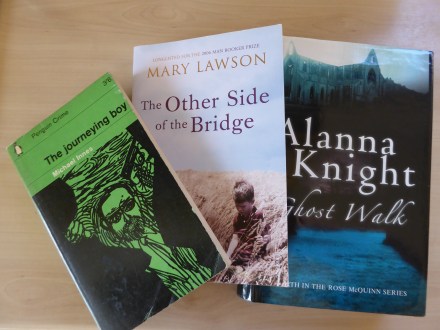
  • The Journeying Boy by Michael Innes –  will probably not read this, some of those who commented were in favour, but others were not.
  • Ghost Walk by Alanna Knight
  • The Other Side of the Bridge by Mary Lawson – READ and loved this one!

M, N and O

MNO bks P1020320

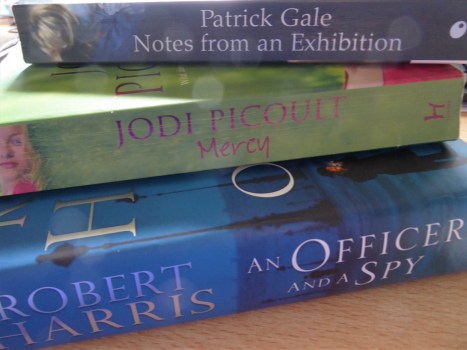
  • Mercy by Jodie Picoult – doubtful that I’ll read this.
  • Notes from an Exhibition by Patrick Gale – READ – Café Society sang the praises of this book, and I’m pleased to say she was right and I loved it.
  • An Officer and a Spy by Robert Harris – Helen commented that this is probably her favourite Robert Harris book so far, so I’m very keen to read this one soon.

P, Q and R

The Power HouseThe Queen's ManResistance

All these received favourable comments!

  • The Power House by John Buchan – a short book, should be a quick read.
  • The Queen’s Man by Sharon Penman (Kindle) – loved her Sunne in Splendour – why haven’t I read this one before now? As a result of comments I now have added Welsh Princes books, especially Here Be Dragons – love that title!
  • Resistance by Owen Sheers – apparently this is not an easy read, but some people recommended it.

S and T

IMG_20180308_091608245_HDR.jpg

  • The Stranger House by Reginald Hill – I’ll definitely read this one.
  • Slipstream: A Memoir by Elizabeth Jane Howard
  • The True Deceiver by Tove Jansson – Simon T  thinks this ‘is one of her best – much starker and darker than most of her others (dark in atmosphere – not gory or anything) but so brilliantly written.’
  • The Tenderness of Wolves by Stef Penney – READ – I was encouraged by the comments on this. I did enjoy it, particularly the descriptions of the landscape and climate that set it in geographic context, but it just took so long to read particularly with so many sub-plots to hold in my head! I think some of the sub-plots that don’t contribute much to the story could easily have been developed into books in their own right. And the ending seemed so abrupt. I’m not sure I want to read any more of Stef Penney’s books.

U, V and W

U V W books

  • The Unlikely Pilgrimage of Harold Fry by Rachel Joyce – I’m put off by the title – too gimicky, but I will at least begin this book – sometime.
  • The Various Flavours of Coffee by Anthony Capella – this one may get recycled.
  • The Water Horse by Julia Gregson – definitely a book to read.

X, Y and Z

IMG_20180517_155637127_HDR.jpgimg_20180610_124437297_hdrimg_20180610_124417342

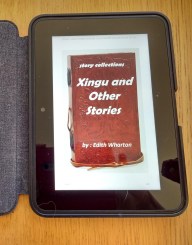
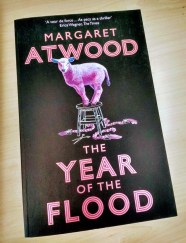
I’m still hoping to read these, especially Margaret Atwood’s book after watching the BBC One programme Imagine where she talks to Alan Yentob in Toronto.

  • Xingu and other stories by Edith Wharton (Kindle)
  • The Year of the Flood by Margaret Atwood
  • Zoo Time by Howard Jacobson