
Top Ten Tuesday is a weekly meme created by The Broke and the Bookish and now hosted by Jana at That Artsy Reader Girl.
The rules are simple:
- Each Tuesday, Jana assigns a new topic. Create your own Top Ten list that fits that topic – putting your unique spin on it if you want.
- Everyone is welcome to join but please link back to That Artsy Reader Girl in your own Top Ten Tuesday post.
- Add your name to the Linky widget on that day’s post so that everyone can check out other bloggers’ lists.
- Or if you don’t have a blog, just post your answers as a comment.
This week’s topic is Books I Meant to Read In 2018 but Didn’t Get To. Oh, dear there were lots – here are ten of them, in no particular order of preference. They are all books I really wanted to read as soon as I got them, but then other books got in the way! They are by authors whose books I’ve read before, with the exception of the last book, and most are books I bought in 2017 or 2018.

 I loved Peter May’s Lewis Trilogy and I’m sure this will be as good – it’s Coffin Road, a standalone book set on the Hebridean Isle of Harris where a bewildered man is standing on a beach, wondering why he is there – and even more worrying, he is not able to remember who he is. His only clue is a folded map of a path named the Coffin Road.

 My second book is also by Peter May – I’ll Keep You Safe and is also set in the Hebrides. Niamh and Ruairidh Macfarlane co-own the Hebridean company Ranish Tweed. On a business trip to Paris to promote their luxury brand, Niamh learns of Ruairidh’s affair, and then looks on as he and his lover are killed by a car bomb. She returns home to Lewis, bereft.
Next,  An Advancement of Learning by Reginald Hill – the second in his Dalziel and Pascoe series.
 I’ve been reading this series completely out of order and so am now trying to fill in the gaps. This one is about the discovery of a dead body found buried under a statue in the grounds of Holm Coultram College. As soon as they think they have solved the problem more bodies are discovered.

 I really should have read The Dry by Jane Harper before now. I’ve read both her second and third books and loved them. I’ve never been to Australia, but her description of of the outback makes me feel as though I am there in the places she describes. In this, the first Aaron Falk book, the farming community of Kiewarra is in the grip of the worst drought in a century and people are facing life and death choices daily – then three members of a local family are found brutally slain – it appears that Luke Hadler has shot his wife and young son, and then killed himself.

 Ann Cleeves is one of my favourite writers and I love her Vera and Shetland books, but somehow I have got behind with reading her last two Shetland books – book 7, Cold Earth and book 8, Wildfire. So both these books are high on my list of books to read this year.
Cold Earth begins with a landslide during the funeral of Magnus Tait and in the resulting wreckage the body of a dark-haired woman wearing a red silk dress is found. DI Jimmy Perez thinks that she shares his Mediterranean ancestry and he becomes obsessed with tracing her identity.
 Wildfire, the final book in this series,is about the Flemings -designer Helena and architect Daniel, who move into a remote community in the north of Shetland. They think it’s a fresh start for themselves and their children, but their arrival triggers resentment, and Helena begins to receive small drawings of a gallows and a hanged man. Gossip spreads like wildfire.

 A Deadly Thaw by Sarah Ward is her second book. I loved her first book, In Bitter Chill, and I have a few to catch up with as she has now written books three and four in her DC Childs series. A Deadly Thaw is set in the fictional town of Bampton in Derbyshire. Lena Fisher was convicted of he husband’s murder, but within months of her release nearly two decades later, his body is found in a disused morgue, recently killed. Who was the man she killed before, and why did she lie about his identity?


Another favourite author is Anthony Horowitz and I really should have read Moriarty, his second Sherlock Holmes book, before now as I enjoyed his first one, The House of Silk – and also his more recent books, Magpie Murders, The Sentence is Death, and The Word is Murder. It’s 1891, Holmes and Moriarty are dead and London is in the grip of a fiendish new criminal mastermind. Frederick Chase, a Pinkerton agent and Inspector Athelney Jones are faced with finding a brutal murderer.

 I loved We Have Always Lived in the Castle, so have great expectations for The Haunting of Hill House by Shirley Jackson. Four people visit Hill House searching for evidence that is haunted. At first, their stay seems destined to be merely a spooky encounter with inexplicable phenomena. But Hill House is gathering its powers—and soon it will choose one of them to make its own. I’m expecting this to be just as strange, spooky and disturbing as We Have Always Lived in the Castle.

And finally, The Salt Path by Raynor Winn. It’s her first book and it was shortlisted for the 2018 Costa Biography Award and the Wainwright Prize. I want to read it because it’s a true story about a couple, Raynor and Moth, her husband who is terminally ill, who had lost their home and their business. Faced with this terrible situation they decided to buy a tent and walk the Salt Path, the south-west coastal path, from Minehead in Somerset to Poole in Dorset, via Devon and Cornwall.
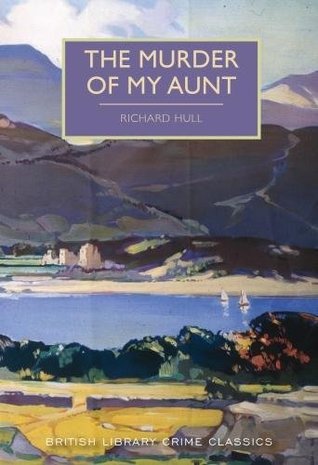 Poisoned Pen Press|4 September 2018 |227 pages|e-book |Review copy|5*
This edition, published in association with the British Library, has an introduction by Martin Edwards. It was first published in 1934 by Hamish Hamilton. It was Richard Hull’s first novel. His real name was Richard Henry Sampson (1896 – 1973) and up until 1934 he had worked as a chartered accountant. With the success of The Murder of My Aunt he devoted himself to writing.
The Murder of My Aunt is one of the best of the classic crime fiction novels from the Golden Age that I’ve read. On the face of it has a straightforward plot as Edward Powell, the narrator for most of the book, plots to murder his Aunt Mildred. They live in a house called Brynmawr on the outskirts of the Welsh town of Llwll. Mildred is his guardian, his parents having died in mysterious circumstances when Edward was very young. He detests living in Lwll and he also detests his aunt. It’s a contest of wills as Mildred finds Edward a great trial, she sees all his faults – he is selfish, self-centred, vain and lazy and foppishly effeminate – and she constantly nags him to change his ways, or she will ‘have to take action’. Edward, though decides that he will take action, thinking his life would be so much better without Mildred and he sets out to find a way to arrange her death so that no suspicion will fall on him. He makes copious notes of various methods and the steps he plans to take and that’s more difficult than he expected as his attempts keep failing.
But it’s the writing that lifts this book from the ordinary to an original and funny murder mystery and, whilst not laugh-out-loud funny, I thought it was brilliant. It’s witty and ironic from the start as Edward pontificates on the pronunciation of the word ‘Lwll’. Neither Edward nor Mildred come across as caricatures, but as real people, both of them with their own faults. Edward is just so insufferably awful that I felt on Mildred’s side in their battle of wits, even though she shows him up in front of the whole village – and after all she had brought him up.
Once I started to read The Murder of My Aunt I was captivated and I had to read it quickly, anxious to find out if Edward did manage to kill his aunt. It makes very entertaining reading and I loved the ending, which took me by surprise and I thought was so clever – definitely a 5* read for me!
Now I’m looking forward to reading more of Richard Hull’s books and have Excellent Intentions lined up to read soon.
My thanks to the publishers, Poisoned Pen Press, for my review copy via NetGalley.
This is qualifies for the Mount TBR Challenge and for the Calendar of Crime Challenge for March in the category of a book in which money/fortune/inheritance has a major role.
Poisoned Pen Press|4 September 2018 |227 pages|e-book |Review copy|5*
This edition, published in association with the British Library, has an introduction by Martin Edwards. It was first published in 1934 by Hamish Hamilton. It was Richard Hull’s first novel. His real name was Richard Henry Sampson (1896 – 1973) and up until 1934 he had worked as a chartered accountant. With the success of The Murder of My Aunt he devoted himself to writing.
The Murder of My Aunt is one of the best of the classic crime fiction novels from the Golden Age that I’ve read. On the face of it has a straightforward plot as Edward Powell, the narrator for most of the book, plots to murder his Aunt Mildred. They live in a house called Brynmawr on the outskirts of the Welsh town of Llwll. Mildred is his guardian, his parents having died in mysterious circumstances when Edward was very young. He detests living in Lwll and he also detests his aunt. It’s a contest of wills as Mildred finds Edward a great trial, she sees all his faults – he is selfish, self-centred, vain and lazy and foppishly effeminate – and she constantly nags him to change his ways, or she will ‘have to take action’. Edward, though decides that he will take action, thinking his life would be so much better without Mildred and he sets out to find a way to arrange her death so that no suspicion will fall on him. He makes copious notes of various methods and the steps he plans to take and that’s more difficult than he expected as his attempts keep failing.
But it’s the writing that lifts this book from the ordinary to an original and funny murder mystery and, whilst not laugh-out-loud funny, I thought it was brilliant. It’s witty and ironic from the start as Edward pontificates on the pronunciation of the word ‘Lwll’. Neither Edward nor Mildred come across as caricatures, but as real people, both of them with their own faults. Edward is just so insufferably awful that I felt on Mildred’s side in their battle of wits, even though she shows him up in front of the whole village – and after all she had brought him up.
Once I started to read The Murder of My Aunt I was captivated and I had to read it quickly, anxious to find out if Edward did manage to kill his aunt. It makes very entertaining reading and I loved the ending, which took me by surprise and I thought was so clever – definitely a 5* read for me!
Now I’m looking forward to reading more of Richard Hull’s books and have Excellent Intentions lined up to read soon.
My thanks to the publishers, Poisoned Pen Press, for my review copy via NetGalley.
This is qualifies for the Mount TBR Challenge and for the Calendar of Crime Challenge for March in the category of a book in which money/fortune/inheritance has a major role.




 I loved Peter May’s Lewis Trilogy and I’m sure this will be as good – it’s


 that she shares his Mediterranean ancestry and he becomes obsessed with tracing her identity.


