Spell the Month in Books – September 2026

Spell the Month in Books is a linkup hosted by Jana on Reviews From the Stacks on the first Saturday of each month. The goal is to spell the current month with the first letter of book titles, excluding articles such as ‘the’ and ‘a’ as needed. That’s all there is to it! Some months have additional themes, but feel free to participate however you’d like!
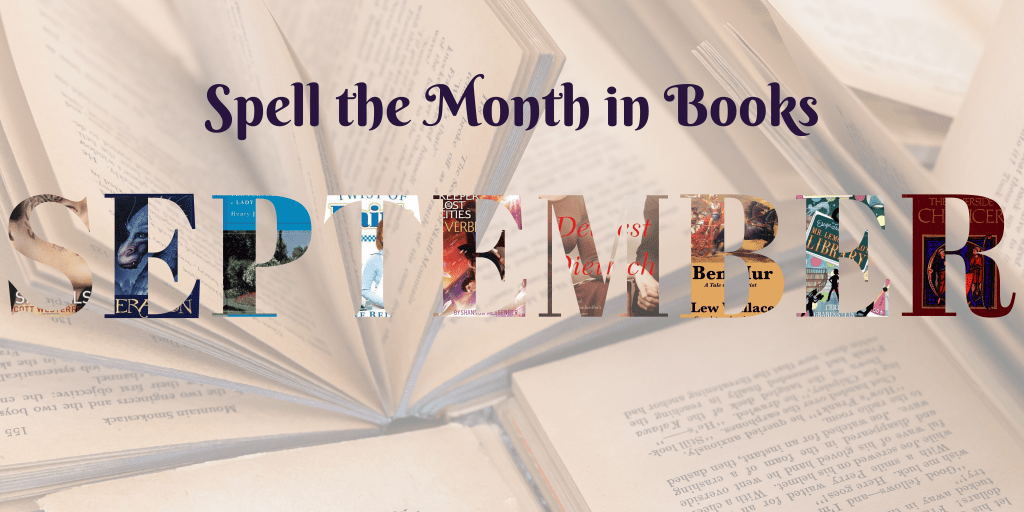
Currently Jana is not assigning themes, so for September I’ve chosen to feature some of the Classic books that I have read. The links in the titles of each book go to my posts, where they exist.

The more Spell the Month books I do, the harder it becomes to use book titles beginning with the letter E as I prefer to use ones I haven’t already used in earlier posts – but I have managed it this time. I think the last three months of the year will be challenging!
S is for Silas Marner by George Eliot, set in the early years of the 19th century (Eliot was writing the book in 1861) 

The story revolves around Silas Marner, a weaver living in Raveloe, a village on the brink of industrialisation. He was wrongly accused of theft and left his home town to live a lonely and embittered life in Raveloe where he became a miser, hoarding his gold and counting it each night. Until one night his life is changed by the theft of his money and a little girl who came to live with him, having been abandoned in the snow.

It took me a while to settle into George Eliot’s style of writing, with her long, long sentences – some so long I had forgotten how they had started, before I got to the end. But once my mind had adjusted to the rhythm of her writing I enjoyed this short book 

E is for Ethan Frome by Edith Wharton, first published in 1911 this is in contrast to some of her other books about the New York society of the 1870s to 1920s. It’s a rural tragedy of inevitable suffering and sadness that reminded me of Thomas Hardy’s books.

It’s a beautifully told tale – a tragedy, signalled right from the beginning of the book, when the unnamed narrator first saw Ethan Frome and was told he had been disfigured and crippled in a ‘smash up’, twenty four years earlier. Life had not been good to him.

I enjoyed it very much.  As well as striking and memorable characters the setting is  beautifully described – a ‘mute and melancholy landscape, an incarceration of frozen woe‘, in the isolated village of Starkfield (a fictional New England village). Even though Ethan Frome is a tragedy there is light to contrast the darkness, and there is love and hope set against repression and misery. I hoped the ending would be a happy one, although I knew it couldn’t be. 

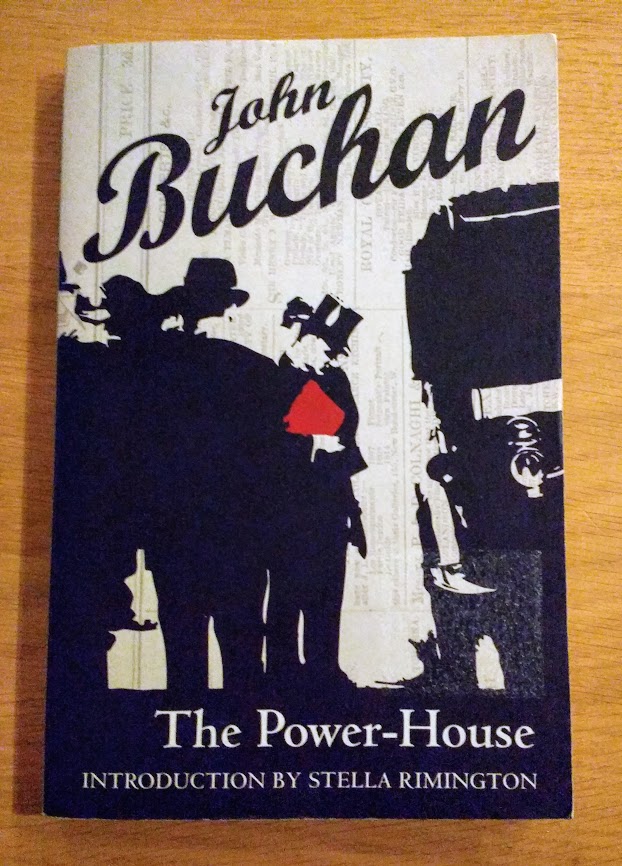
P is for The Power-House by John Buchan, written in 1913 when it was serialised in Blackwood’s Magazine and then published in book form in 1916.

Buchan tells a good story, even if I had little idea what the Power-House really was. It’s an international anarchist network, but who they were, what they were actually after, or how they hoped to achieve their ends was never clear to me. But I really enjoyed this book. As Stella Rimington says it has an ‘intoxicating blend of madness with scents of home and countryside.’ 

It has some interesting thoughts on the nature of civilisation, and of power and comments on the ‘the business of Government. When all is said, we are ruled by amateurs and the second-rate. The methods of our departments would bring any private firm to bankruptcy. The methods of Parliament – pardon me – would disgrace any board of directors.’
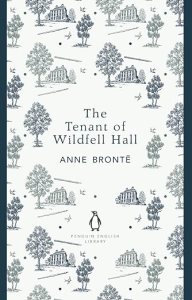
T is for The Tenant of Wildfell Hall by Anne Bronte, first published in 1848 under the pseudonym Acton Bell.

I read this years ago before I began blogging, so I have no record of what I thought of it, other than that I loved it.

In this sensational, hard-hitting and passionate tale of marital cruelty, The Tenant of Wildfell Hall sees a mysterious tenant, Helen Graham, unmasked not as a ‘wicked woman’ as the local gossips would have it, but as the estranged wife of a brutal alcoholic bully, desperate to protect her son. Using her own experiences with her brother Branwell to depict the cruelty and debauchery from which Helen flees, Anne Brontë wrote her masterpiece to reflect the fragile position of women in society and her belief in universal redemption, but scandalized readers of the time.
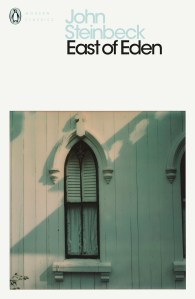
E is for East of Eden by John Steinbeck, first published in 1952.

This is the story of two family, the Trasks and the Hamiltons, whose generations helplessly re-enact the fall of Adam and Eve and the poisonous rivalry of Cain and Abel. I enjoyed this beautifully written book, which begins slowly, but not as much as The Grapes of Wrath, which I thought was amazing. It’s long – too long really – and to my mind it reads like a morality tale of good versus evil. There are many parallels to the Bible stories, with surely one of the most evil characters ever in Cathy. I liked the way Steinbeck set out the moral dilemmas and gave the characters personal choice using the Hebrew word ‘timshel‘, meaning ‘thou mayest’.
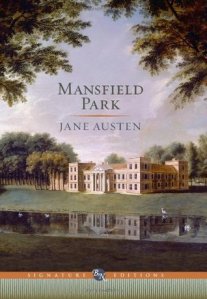
M is for Mansfield Park by Jane Austen

On the surface this is a simple story about a family and their relationships. Fanny Price, as a child of 10 goes to live with her wealthy aunt and uncle, Sir Thomas and Lady Bertram at Mansfield Park, where as the poor relation she is not treated badly, but not as cared for or as kindly as her cousins, but more as an unpaid servant dependent on the family for her welfare – a sort of Cinderella story. But through the story, Jane Austen reveals the complicated interaction of society, shows the development of Fanny’s character and the depiction of a heroine who is good and gentle who matures throughout the novel. 

It’s full of detail of everyday life, its boredom as well as its entertainments and pleasures, the  balls and dinners. There is much in it about the houses and gardens, not only of the wealthy but also of the lower classes, such as Fanny’s parents home in Portsmouth – but they have servants themselves, so it is only comparative poverty. Seen mainly through Fanny’s eyes, it’s a study of morals, the damage caused by being unwanted and unloved. There is also a gentle strain of humour and satirical observations about contemporary values, and even, with Mary Crawford’s pun on ‘Rears and Vices‘, a bawdy note.

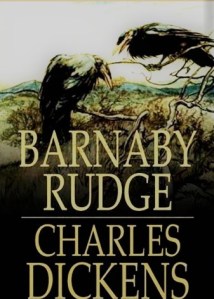
B is for Barnaby Rudge by Charles Dickens, first published in 1841, a murder mystery as well as a historical novel, mainly concerning the events surrounding the Gordon Riots of 1780. It’s almost a book of two parts and the dramatic second half, to my mind, more than makes up for the slow beginning which I had to read slowly and carefully.
It begins in 1775, five years before the riots as a group of customers in the Maypole Inn in the village of Chigwell, on the borders of Epping Forest and about 112 miles from London, recollect the murder of Reuben Haredale, the owner of The Warren, 22 years earlier to the day. His steward, a Mr Rudge was found months later, stabbed to death.The murderer had never been discovered. Reuben’s brother Geoffrey had lived at The Warren with his niece, Emma ever since.

From then on the book becomes much more complicated with many characters and sub-plots. There are a number of themes running through the novel – the relationship between fathers and sons, the position of authority, justice and the question of punishment for crime, and religious conflict. Dickens paints a picture of London, the dirt and poverty, the terrible condition of the roads, the perils of footpads and highwaymen which is in contrast to the countryside that still at that period surrounded London making it a cleaner, purer place to live in.

E is for Excellent Women by Barbara Pym, first published in 1952. It’s not laugh-out-loud funny, but it is most entertaining, subtly and gently comic.  laugh-out-loud funny, but it is most entertaining, subtly and gently comic.

It’s set just after the end of the Second World War, about the everyday life of Mildred Lathbury, an unmarried woman – in other words a spinster – in her early 30s. The daughter of a clergyman she is one of those ‘excellent women’ who could be relied upon to help out at Church jumble sales, garden fêtes, to make tea when required or to make up numbers at social gatherings. She finds herself involved in the quarrel between her new neighbours, Helena and Rockingham (Rocky) Napier, a married couple who live in the flat below her, as well as in the difficult relationship between Julian Mallory, the local vicar and his unmarried sister, when he finds himself trapped by Allegra Grey, a vivacious widow when she moves into their spare room. It’s a slow-paced book but all the better because of that.
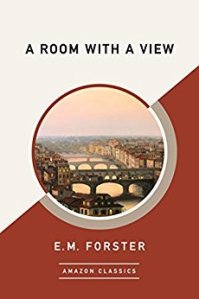
R is for A Room with a View by E M Forster. First published in 1908, this is a novella of 161 pages, a comedy of manners, satirising the manners and social conventions of Victorian/Edwardian society. It is about a young woman, Lucy Honeychurch, and her journey to self-discovery as she breaks out of the restrained culture of Edwardian England. It’s also a romance.

It begins in Florence where Lucy is staying at the Pensione Bertolini, with her older cousin and chaperone Charlotte Bartlett. They meet two other guests, a Mr Emerson and his son George who are not bound by the conventions of the day and Charlotte considers they are ill-bred. But Lucy is attracted by the Emersons’ free thinking ideas. They spend time in Florence visiting various locations including the Santa Croce church, the Piazza Della Signoria and the San Miniato church, with its beautiful facade, and take a trip into the hills.

The second half of the book takes place in England at Lucy’s home at Windy Corner where we meet the rest of her family and Lucy has to decide between the insufferable Cecil and the unconventional George. 

Top Ten Tuesday: Books with the Word HOUSE in the Title

Top Ten Tuesday is a weekly meme created by The Broke and the Bookish and now hosted by Jana at That Artsy Reader Girl. For the rules see her blog.

The topic this week is Books with the Word “[Insert Word Here]” in the Title. I decided to choose books with the word HOUSE in the title. These ten books are all books I’ve read.

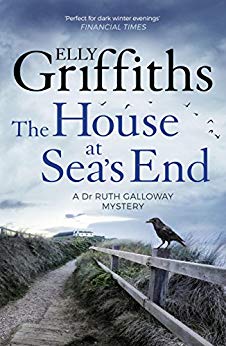
The House at Sea’s End by Elly Griffiths – a Ruth Galloway mystery.

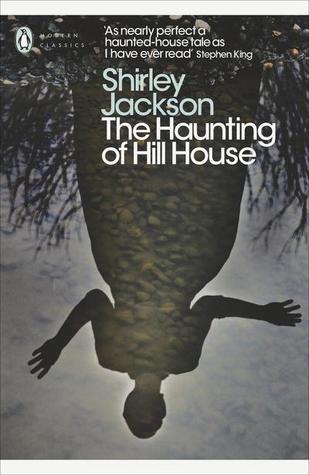
The Haunting of Hill House by Shirley Jackson – more of a psychological study than a horror story.

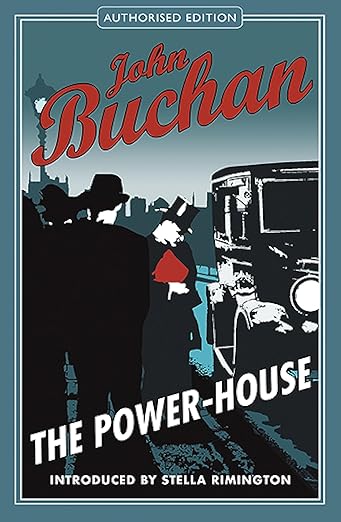
The Power-House by John Buchan – a thriller, the first of five featuring the barrister and Tory MP Edward Leithen.

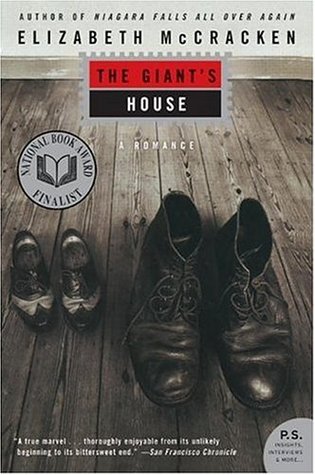
The Giant’s House by Elizabeth McCracken – a love story.

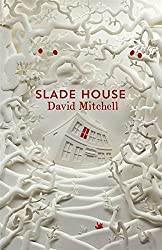
Slade House by David Mitchell – a mixture of a ghost story, science fiction and horror.

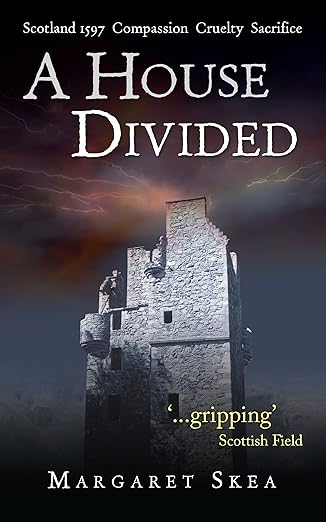
A House Divided by Margaret Skea – historical fiction set in 15th century Scotland.

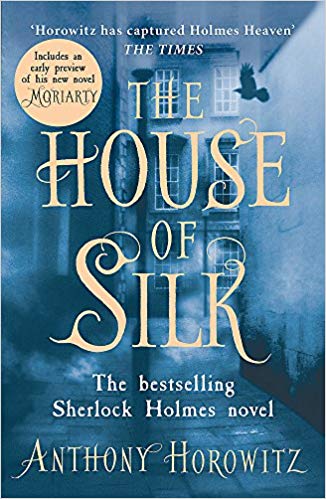
The House of Silk by Anthony Horowitz – a Sherlock Holmes novel.

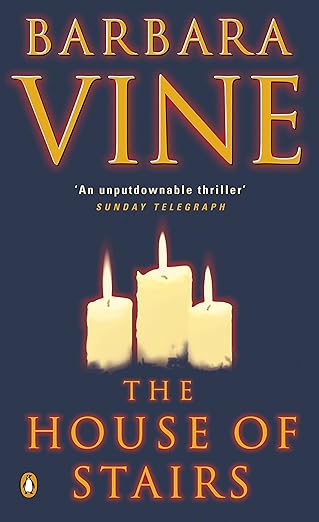
The House of Stairs by Barbara Vine – a psychological thriller.

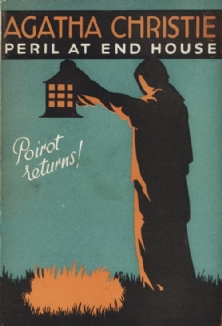
Peril at End House by Agatha Christie – a Poirot mystery.

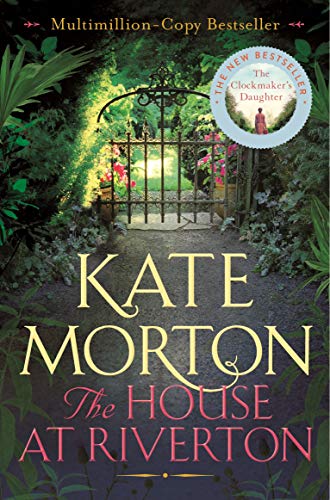
The House at Riverton by Kate Morton – historical fiction.

Have you read any of them?

The Power-House by John Buchan

As usual I am behind with writing book reviews, but whilst it is still relatively fresh in my mind I’m going to begin catching up with the latest book I read. It’s only short – 108 pages – and I enjoyed it far more than I thought I would.

Rating: 5 out of 5.

John Buchan’s The Power-House, was written in 1913 when it was serialised in Blackwood’s Magazine and then published in book form in 1916. In her Introduction to the Polygon Books edition Stella Rimington described it as:

Pure essence of Buchan – a demonstration of his magical power to weave a tale out of no materials but the threads and colours of his imagination. It does, however, possess a theme – John Bunyan’s idea, in Pilgrim’s Progress, of men of goodwill and courage struggling with an intelligent, evil power at the root of all the world’s troubles and confessions. (page vii)

The narrator is Edward Leithen, a barrister and MP. His friend and fellow MP Tommy Deloraine tells him is off to Moscow to track down one of their Oxford contemporaries, Charles Pitt-Heron, who had disappeared without letting his wife where he was going. He told her he’d be home for luncheon, but never came back. Whilst Tommy goes off in pursuit of Pitt-Heron, Leithen stays in London, but soon his curiosity draws him into the mystery, because, as he tells himself, ‘every man at the bottom of his heart believes that he is a born detective.’ And so, having collected a few items of information merely by accident and coincidence, he finds the connecting link between them in the person of Andrew Lumley, a wealthy Englishman. Lumley, an elderly man, with menacing, pale eyes, hidden behind his tinted glasses is the key to the whole mystery.

Just as Hannay in Buchan’s later novel, The Thirty-nine Steps, meets the villain Von Schwabing in the library of his country house, so Leithen meets Lumley in his gentleman’s country house, High Ashes, in his library. The two men dine together and then settle themselves in armchairs to smoke cigars and proceed to talk about many things. Leithen is perplexed by him and his speculations on the nature of civilisation, and of power.

I was struck by these thoughts: Lumley states that civilisation is a conspiracy to which Leithen responds that it is in the interests ‘of all the best brains in the world to keep up the conspiracy.‘ To which Lumley replies:

Do we really get the all the best brains working on the side of the compact? Take the business of Government. When all is said, we are ruled by amateurs and the second-rate. The methods of our departments would bring any private firm to bankruptcy. The methods of Parliament – pardon me – would disgrace any board of directors. Our rulers pretend to buy expert knowledge, but they never pay the price of it that a business man would pay, and if they get it they have not the courage to use it. (pages 33 -34)

Lumley continues in this vein and concludes that what is needed is some sort of Power-House to start the ‘age of miracles‘. Leithen is unsettled, to say the least, by his talk and his ‘eerie persuasiveness’.

From an somewhat slow start and a middle consisting mainly of conversation, the novel then picks up pace dramatically. Just as in The Thirty-nine Steps when Hannay goes on the run, fearing for his life, over the moors, so Leithen, in danger of his life, flees his pursuers through the streets of London, as he is lured in deserted buildings, taxis and a decidedly dodgy restaurant. He realises how thin the protection of civilisation is and how there were dozens of ways of spiriting him out of ‘this gay, bustling world‘, alone in a crowd with no one to help him, only his own wits.

Buchan tells a good story, even if I had little idea what the Power-House really was. It’s an international anarchist network, but who they were, what they were actually after, or how they hoped to achieve their ends was never clear to me. But I really enjoyed this book. As Stella Rimington says it has an ‘intoxicating blend of madness with scents of home and countryside.’ And

… the thinness of the crust of civilisation, whatever that may be these days, is as relevant in our time as it was when Buchan was writing in the early war-torn years of the twentieth century. (page xi)

Greenmantle by John Buchan

Greenmantle by John Buchan was my Classics Club Spin book to read by 31 January. I read the free Kindle edition (525 pages).

Greenmantle (Richard Hannay Book 2)

3*

Greenmantle is the second of five novels by John Buchan featuring the character of Richard Hannay, first published in 1916, the first being The Thirty-Nine Steps. It was written as the First World War was being fought, before the Battle of the Somme. Many of Buchan’s friends and his younger brother were killed in the war and his adventure stories are a form of escapism. It continues Hannay’s story, taking him from convalescence in  a big country house in Hampshire following the Battle of Loos in 1915, back to London for a vital meeting at the Foreign Office, and then to a top-secret and perilous mission across war-torn German-occupied Europe.

Narrated by Hannay, this is basically an adventure and spy story with a highly improbable plot. It’s pure escapism, as Hannay and his comrades, Sandy Arbuthnot, Peter Pienaar, a South African Boer, who Hannay met in South Africa when he was working as a mining engineer before the First World War, and an American, a dyspeptic businessman, John S Blenkiron embark on a quest, travelling incognito across Germany to Constantinople, reaching a climax at the battle of Erzurum in eastern Anatolia (Asian Turkey) in 1916.

Sandy, a master of disguise, is I think the hero of the book, although Hannay is the man in charge of their investigation. Ludovick Gustavus Arbuthnot, known as Sandy, was in the same battalion as Hannay during the Battle of Loos. The book begins as Hannay received a telegram from Sir Walter Bullivant summoning him to the Foreign Office where he offers him a ‘crazy and impossible mission’ to investigate the rumours of an uprising in the Muslim world. Bullivant tells him:

There is a dry wind blowing through the East, and the parched grasses wait the spark. And the wind is blowing towards the Indian border. Whence comes the wind, think you. (page 9)

The only clues they have to guide them are the words ‘Kasredin’, ‘cancer’ and ‘v.I’.

I was fascinated by the first half of the book as Hannay and the others set out on their mission, following the events of 1916, after the Gallipoli disaster as the Germans were supplying munitions to their allies, the Young Turks. Hannay describes his brief meeting with the Kaiser, Wilhelm II, who he felt had ‘loosed Hell, and the furies of Held had got hold of him.’

I didn’t think Buchan’s villains were particularly convincing as characters, the most evil being the mysterious Hilda von Einem. She fascinated Hannay whilst at the same time he instinctively hated her as he realised she was trying to cast a spell over him. The German Colonel von Stumm is a big man, a brute and a bully, whose ‘head was exactly the shape of a pear with the sharp end topmost’. Hannay thought he was

the German of caricature, the real German, the fellow we were up against.  He was as hideous as a hippopotamus, but effective. Every bristle on his odd head was effective. (page 84)

I liked the contrast between the ordinary and the exotic. The ordinary, such as the domestic scenes as in the opening scene of the book with Hannay just finishing breakfast and Sandy hunting for the marmalade. When Hannay returns from the Foreign Office with his mission in hand Sandy is eating teacakes and muffins. Blenkiron’s diet is mentioned several times as he only eats boiled fish and dry toast whilst drinking hot milk. On the other hand the exotic is found in the Garden-House of Suliman the Red, in the garden of a tumble-down coffee house, transformed from a common saloon into a place of mystery where the Companions of the Rosy Hours perform their potent magic of dance, making the world appear at one point ‘all young and fresh and beautiful’ then changing into something savage and passionate, ‘monstrous, inhuman, devilish’, until the spell is broken.

In the second half or the book the pace increases when they reach Constantinople and Buchan describes the action of the battle at Erzerum. But I found that it didn’t hold my attention as much as the earlier sections of the book, but then again I’m not keen on descriptions of battles and fighting. Overall, then I enjoyed it, which is why I’ve given it 3* on Goodreads.

This is my third book for the Mount TBR Challenge, a book I’ve owned for nearly 5 years, and as well as being on my Classics Club list it is also a book that fits into the When Are You Reading Challenge, being set in 1916, and as it it a spy/espionage story it also qualifies for the Calendar of Crime Challenge.


The Classics Club Spin Result

Classics Club

The spin number in The Classics Club Spin was announced today. It’s number …

1

which for me is Greenmantle by John Buchan. The rules of the Spin are that this is the book for me to read by January 31, 2019.

Greenmantle

Greenmantle is the second of five novels by John Buchan featuring the character of Richard Hannay, first published in 1916. I’ve read the first, The Thirty-Nine Steps.

Here’s the blurb from Amazon:

Richard Hannay is tasked to investigate rumours of an uprising in the Muslim world and takes off on a hair-raising journey through German-occupied Europe to meet up with his old friend Sandy Arbuthnot in Constantinople, where they must thwart the Germans’ plans to use religion to help them win the war. Set during World War I, Greenmantle is a contraversial meditation on the power of political Islam (it was pulled from Radio 4’s schedule at the time of the 7 July bombings).

I’m really pleased this book came up in the Spin for me as it will fit in with my reading about World War I.

Did you take part in the Classics Spin? What will you be reading?

A – Z of TBRs: P, Q and R

I’m now up to P, Q and R in my A – Z of TBRs, a series of posts in which I take a fresh look at some of my TBRs to inspire me to read more of them, or maybe to decide not to bother reading them after all. This time I’ve included one e-book.

– is for The Power House by John Buchana book I’ve had since 2014. I bought this book because I’d read and enjoyed John Buchan’s The Thirty-Nine Steps.

The Power House

It’s a short book of just 108 pages and my copy has an introduction by Stella Rimington. She writes:

The Power House is one of the least known of Buchan’s mature works, a tale without a plot, and so full of holes that it calls to mind Samuel Johnson’s definition of a ‘network’ – ‘anything reticulated and desuccated at equal distances, with interstices between the intersections’. It is pure essence of Buchan – a demonstration of his magical power to weave a tale out of no materials but the threads and colours of his imagination.

When his friend Charles Pitt-Heron vanishes mysteriously, Sir Edward Leithen, MP, is at first only mildly concerned. But a series of strange events that follow Pitt-Heron’s disappearance convinces Leithen that he is dealing with a sinister secret society. Their code name is ‘The Power-House’.

I cast my mind back to gather recollections of Pitt-Heron, but all I could find was an impression of a brilliant, uncomfortable being, who had been too fond of the byways of life for my sober tastes. There was nothing crooked in him in the wrong sense, but there might be a good deal that was perverse. I remember consoling myself with the thought that, though he might shatter his wife’s nerves by his vagaries, he would scarcely break her heart.

To be watchful, I decided, was my business. And I could not get rid of the feeling that I might soon have cause for my vigilance. (page 9)

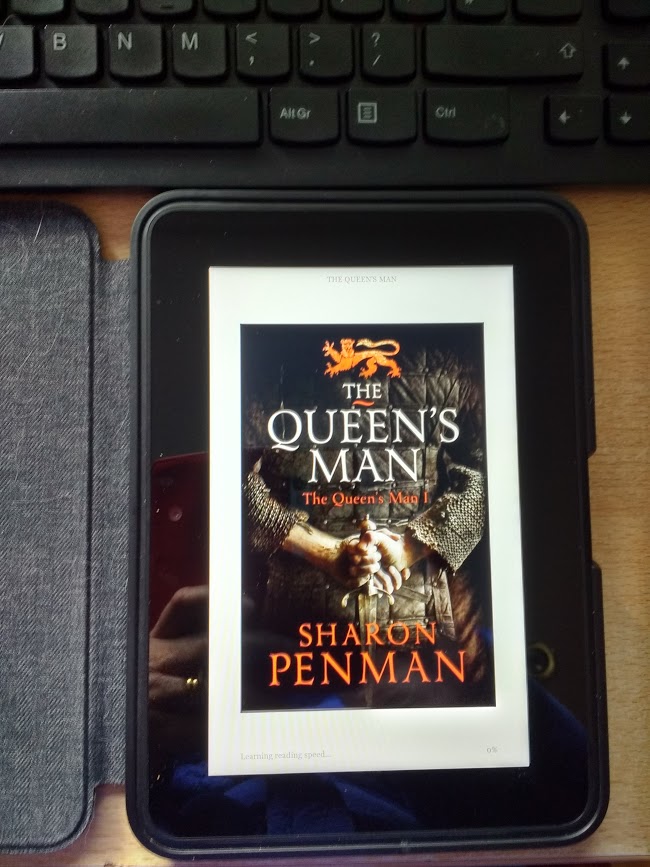
Q – is for The Queen’s Man by Sharon Penman (on my Kindle for two years). I bought this after reading her Sunne in Splendour, which I absolutely loved.

The Queen's Man

It’s set in AD 1183, when Richard the Lionheart is missing, thought to be dead and his brother Prince John is scheming to take the Crown. Justin de Quincy has just discovered his father is the Bishop of Chester. A dying man, a goldsmith, gives him a letter to deliver to Queen Eleanor, (Richard’s and John’s mother) which brings him into great danger as it reveals whether Richard is alive or dead.

Captured by Henry’s soldiers, she [Eleanor] was held prisoner for sixteen years, freed only by Henry’s death. Such a lengthy confinement would have broken most people. It had not broken Eleanor. The passionate young queen and the embittered, betrayed wife were ghosts long since laid to rest. Now in her seventy-first year, she was acclaimed and admired for her sagacity and shrewd counsel, reigning over England in her son’s absence, fiercely protective of his interests, proud matriarch of a great dynasty. A living legend. And this was the woman expecting a letter from a murdered goldsmith? Justin thought it highly unlikely. (location 323)

R– is for Resistance by Owen Sheers a book I’ve had for nearly ten years. One of the reasons I haven’t read this before now is that I couldn’t find it for a while until I discovered it out of order behind other books that I’d double-shelved. I can’t remember now what had prompted me to buy this book. Owen Sheers is an author, poet and playwright.

Resistance

Resistance gives an alternative outcome to World War Two, one in which the D-Day landings had failed in 1944 and the Nazis had invaded the UK. Sarah Lewis wakes to discover her husband and all the men in the Welsh border valley of Olchon have gone. It’s the story of a community under siege.

The meeting with Atkins had happened too quickly for George to think on the consequences yet. His head was light, open, and he swung his scythe with a renewed energy. He felt exposed, as if a layer of skin had been shaved from him, bringing him into closer contact with the world. The blade’s edge against the young stalks of bracken, the calligraphy of the swallows above him. Everything seemed clearer, brought into sharper focus. Just an hour ago the war was a different country, the contours of which he’d traced through the newspapers, in radio reports. But now he was involved, connected. He had the strange sensation of his life simultaneously diminishing and expanding under the impression of Atkins’s words and for the second time that week he felt older than his seventeen years. (page 25)

What do you think? Do you fancy any of them? Would you ditch any of them?