My Friday Post: I Am, I Am, I Am

Book Beginnings Button

Every Friday Book Beginnings on Friday is hosted by Gillion at Rose City Reader where you can share the first sentence (or so) of the book you are reading, along with your initial thoughts about the sentence, impressions of the book, or anything else the opener inspires.

This week I’m featuring I Am, I Am, I Am: Seventeen Brushes with Death by Maggie O’Farrell, one of the books I’m currently reading.

I Am, I Am, I Am: Seventeen Brushes With Death

I chose this book because I love Maggie O’Farrell’s books and as soon as I read the description I knew I had to read it:

About the Book

I AM, I AM, I AM is Maggie O’Farrell’s electric and shocking memoir of the near-death experiences that have punctuated her life. The childhood illness she was not expected to survive. A teenage yearning to escape that nearly ended in disaster. A terrifying encounter on a remote path. A mismanaged labour in an understaffed hospital.

This is a memoir with a difference: seventeen encounters with Maggie at different ages, in different locations, reveal to us a whole life in a series of tense, visceral snapshots. Spare, elegant and utterly candid, it is a book to make you question yourself. What would you do if your life was in danger? How would you react? And what would you stand to lose?

It begins:

Neck 1990

On the path ahead, stepping out from behind a boulder, a man appears.

This opening sentence drew me in immediately, knowing from the title and book description that this was not going to be a happy encounter – this is the ‘terrifying encounter on a remote path.’

~~~

Also every Friday there is The Friday 56, hosted by Freda at Freda’s Voice.

30879-friday2b56These are the rules:

  1. Grab a book, any book.
  2. Turn to page 56, or 56% on your eReader. If you have to improvise, that is okay.
  3. Find any sentence (or a few, just don’t spoil it) that grabs you.
  4. Post it.
  5. Add the URL to your post in the link on Freda’s most recent Friday 56 post.

Pages 55-56:

Suddenly the plane is falling, dropping, plummeting, like a rock fallen from a cliff. The downward velocity is astonishing, the drag, the speed of it. It feels like the world’s most unpleasant fairground ride, like a dive into nothing, like being pulled by the ankles into the endless maw of the underworld. My ears and face bloom like petals of pain, the seatbelt cutting into my thighs as I am thrown upwards.

~~~

The title is taken from Sylvia Plath’s The Bell Jar:

I took a deep breath and listened to the old brag of my heart. I am, I am, I am.

What about you? Does it tempt you or would you stop reading? 

Nonfiction November: Week 1 – Your Year in Nonfiction

This year I’m taking part in Nonfiction November, hosted by Kim of Sophisticated Dorkiness, Rennie of What’s Nonfiction, Katie of Doing Dewey, Julz of JulzReads and Sarah of Sarah’s Bookshelves.  Each week, we’ll have a different prompt and a different host looking at different ideas about reading and loving nonfiction.

This week’s topic is: Your Year in Nonfiction

Take a look back at your year of nonfiction and reflect on the following questions:

What was your favourite nonfiction read of the year?
Do you have a particular topic you’ve been attracted to more this year?
What nonfiction book have you recommended the most?
What are you hoping to get out of participating in Nonfiction November?

I’ve not been reading much nonfiction this year – just 7 books up to now. I’ve read two biographies – Victoria: A Life by A N Wilson, a long and fascinating book that portrays her both as a woman, a wife and mother as well as a queen set against the backdrop of the political scene in Britain and Europe, and Wedlock:  How Georgian Britain’s Worst Husband Met His Match by Wendy Moore, about Mary Eleanor Bowes, who was one of the richest young heiresses in 18th century Britain. I also read Jeremy Paxman’s A Life in Questions mainly about his career with little about his personal life.

The other books I read are on reading – Bookworm: A memoir of childhood reading by Lucy Mangan, on painting – Painting as a Pastime by Winston S. Churchill, on time – Timekeepers by Simon Garfield and on sleep – Why We Sleep by Matthew Walker.

Wedlock: How Georgian Britain's Worst Husband Met His Match

They are all so different that it’s hard to choose a favourite, but the one that sticks in my mind most is Wedlock, a biography of Mary Eleanor Bowes, who was one of the richest young heiresses in 18th century Britain. She fell under the spell of a handsome Irish soldier, Andrew Robinson Stoney. Her marriage to Andrew Robinson Stoney was an absolute disaster. He was brutally cruel and treated her with such violence, humiliation, deception and kidnap, that she lived in fear for her life.

The topics I’m attracted to are mainly memoirs, biographies and history, although I do like a variety of subjects. I think Bookworm is a must read for bookworms, it’s full of the joy of books – it’s not just what Lucy Mangan read, it’s also a history of children’s books, details of their authors and a memoir of Lucy’s childhood.

By participating in Nonfiction November I’m hoping this will encourage me to read more nonfiction rather than picking up the next novel to read and I’m looking forward to seeing what others recommend.

The Darkest Place by Jo Spain

The Darkest Place (An Inspector Tom Reynolds Mystery, #4)

4*

Quercus Books|20 September 2018|352 pages|Review copy

The Darkest Place is Jo Spain’s 4th Inspector Tom Reynolds Mystery book and although I haven’t read the first three I was keen to read this book when I saw it offered on NetGalley as I’d enjoyed her standalone book The Confession. As I expected there are references to the cases Tom Reynolds and his team investigated in the earlier books and it’s probably best to read those first, but actually this didn’t affect my enjoyment of this book.

I was soon gripped by the mystery right from the opening lines of the book:

Forty years was too long to wait for somebody to come back from the dead.

But still, she liked to get  everything ready. Just in case.

The ‘somebody’ is Conrad Howe, who was one of the senior doctors at St Christina’s asylum on Oilean na Coillte,  known to locals as the island of lost souls, an island (fictional) off the south-west corner of Ireland. His wife, Miriam had never given up hope that he was alive and would return home.

The psychiatric hospital was closed down years ago, but now there are plans to build a retreat on the island, an exclusive hotel, and during the demolition work a mass grave for the patients had been uncovered. Conrad’s body was found, hidden beneath some of the body bags and it was obvious that he had been murdered.

The narrative alternates between the police investigation and extracts from the diary Miriam had found hidden in the attic, describing what was happening at the hospital and the horrific treatment some of the patients were subjected to by one of the doctors. A few of the hospital staff, including the former head of St Christina’s, Dr Lawrence Boylan and an ex-nurse, Carla Crowley, and it is soon clear that something evil is still going on at the asylum.

This really is a chilling book and in parts I found it disturbing and difficult to read. Jo Spain makes it clear in her Acknowledgements that although this is crime fiction it is based on fact – such terrible things really did happen in mental institutions, housing vulnerable people. They were patients with dementia, deformities, depression, epilepsy and homosexuals – people whose families could not deal with them and they were treated mainly as though they were suffering from a physical illness or disorder, that could be fixed. Those that couldn’t be fixed were kept locked up.

For most of the book I kept wondering what had actually happened to Conrad Howe and suspecting various people of killing him, mainly thinking it was one particular person until halfway into the book, then thinking it couldn’t be that one. I was right about that, but it was only just before the truth was revealed that I had the slightest suspicion of what had really happened, which makes it a very satisfying book indeed. I’m now on the lookout for more books by Jo Spain.

Thanks to Quercus Books and NetGalley for provided a review copy of this book.

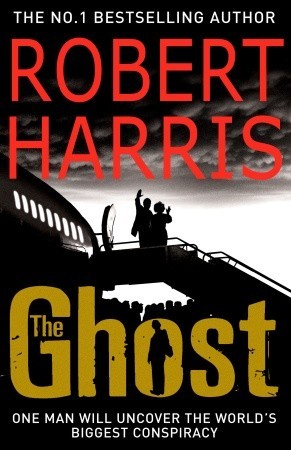
The Ghost by Robert Harris

The Ghost

4*

I have enjoyed all of Robert Harris’s books that I’ve read and The Ghost is no exceptionThe ‘ghost’ in this novel is a professional  ghostwriter employed to finish writing the memoirs of recently retired prime minister of Great Britain, Adam Peter Benet Lang. McAra, Lang’s long-term assistant, had nearly completed Lang’s memoir when he was found dead, drowned. He had gone overboard during the ferry crossing to Martha’s Vineyard, where Lang and his wife, Ruth are staying.

The setting of Martha’s Vineyard in winter reflects Lang’s mood, it is out-of-season, closed down, practically empty – as isolated as Lang himself, disconnected from the world of power he once dominated and stuck on this bleak island with his volatile wife and his aide, the beautiful Amelia Bly, who Ruth suspects is having an affair with Lang. The ghostwriter soon discovers that Lang has secrets in his past that are returning to haunt him – secrets with the power to kill. And he suspects that McAra’s death was neither an accident nor a suicide.

This is fiction, but Adam and Ruth, do have similarities to Tony and Cherie Blair. Lang is charming, personable, full of restless energy, with an engaging smile and thick wavy hair. The narrator, an unnamed writer, who Adam calls ‘man’, is a likeable character more used to ghostwriting the memoirs of footballers than politicians, who has just one month to complete Lang’s memoirs. But soon after he arrives this is reduced to two weeks when news breaks that Lang is accused of war crimes. The International Criminal Court in The Hague are investigating the allegations of Richard Rycart, the former British Foreign Secretary, that Lang had ordered the illegal handover of suspects for torture by the CIA.

I liked the details about ghostwriting from the quotes heading each chapter taken from Andrew Crofts handbook, Ghostwriting. But what I liked most about The Ghost is that it is fast- paced, full of tension and written in a straightforward linear narrative – no flashbacks or fly forwards, or multiple narrators. As in his other books  I’ve read it’s written in such a way that I feel as though I’m there with the characters taking part in the action. And his characters are distinct people, easily distinguishable from each other. In so many books I’ve read recently I’ve come across a character and have been unable to place them and have had to backtrack to find out who they are and how they fit into the plot, or the characters have similar sounding names or all begin with the same letter. Not so with The Ghost the characters have depth, the structure is clear, and there is a twist at the end that revealed the menace implied through the whole novel. Harris is a great storyteller.

My copy:

  • Paperback: 416 pages
  • Publisher: Arrow; Reprint edition (3 July 2008)
  • Language: English
  • ISBN-13: 978-009952749
  • Source: I bought the book
  • My rating: 4*


WWW Wednesday: 24 October 2018

IMG_1384-0

WWW Wednesday is run by Taking on a World of Words.

The Three Ws are:

What are you currently reading?
What did you recently finish reading?
What do you think you’ll read next?

I’m currently reading: three books, one historical fiction in hardback, one crime fiction on my Kindle and one non-fiction that I’ve borrowed from the library.

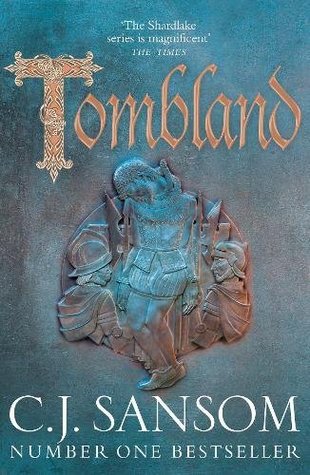
Tombland by C J Sansom, the 7th book in his Shardlake series, set in 1549 two years after the death of Henry VIII.

Tombland (Matthew Shardlake, #7)

I’m just settling into this book – Edward VI, is eleven years old and his uncle Edward Seymour, Lord Hertford, rules England as Protector. Matthew Shardlake, a lawyer in the employ of Lady Elizabeth, the old King’s younger daughter, is once more called on to investigate a murder, that of Elizabeth’s distant relative, Edith Boleyn. 1549 is the year of Kett’s Rebellion, which began when a group of rebels destroyed fences that wealthy landowners had erected to enclose their land.

I’m also reading The Darkest Place by Jo Spain, the Kindle edition was published on 20 September 2018. It’s the fourth Inspector Tom Holland mystery. I’ve read nearly 70% and am really enjoying it.

The Darkest Place (Inspector Tom Reynolds, #4)

Synopsis:

Christmas day, and DCI Tom Reynolds receives an alarming call. A mass grave has been discovered on Oileán na Caillte, the island which housed the controversial psychiatric institution St. Christina’s. The hospital has been closed for decades and onsite graves were tragically common. Reynolds thinks his adversarial boss is handing him a cold case to sideline him.

But then it transpires another body has been discovered amongst the dead – one of the doctors who went missing from the hospital in mysterious circumstances forty years ago. He appears to have been brutally murdered.

As events take a sudden turn, nothing can prepare Reynolds and his team for what they are about to discover once they arrive on the island . . .

And I’ve also started to read Jacob’s Room is Full of Books, by Susan Hill in which she writes about the books she has read, reread or returned to the shelf during one year.

Jacob's Room is Full of Books: A Year of Reading

It’s a mix of reflections on the books, on writing and of observations about a variety of topics, month by month.

I’ve recently finished:  
The Ghost

The Ghost by Robert Harris. I quoted the opening paragraph and synopsis in this post. It’s a political thriller with an anonymous narrator who is the ‘ghost’ or rather a ghostwriter employed to write the autobiography of Adam Peter Benet Lang, recently retired prime minister of Great Britain. I’m writing my review and will post it in the next few days.

My next book could be:

I am torn, as usual, wanting to read several books at once. I so want to start Daisy in Chains by Sharon Bolton – I wrote a bit about this book in this post.  It’s crime fiction about a convicted murderer, Hamish Wolfe who tries to convince, defence barrister Maggie Rose that he is innocent.

Daisy in Chains

But there are many more books also crying out to be read, so when the time comes to start another book, it could be something completely different.

Have you read any of these books?  Do any of them tempt you? 

A-Z of TBRs: E-Books: D, E and F

Earlier this year I looked through my TBRs – the ‘real’ books – and as it prompted me to read more of them, I’ve decided to take a fresh look at some of the TBRs on my Kindle. I have a bad habit of downloading books and then forgetting all about them – it’s as though they’ve gone into a black hole.

This is the second instalment of my A – Z of my e-book TBRs – with a little ‘taster’ from each. These are all fiction.

Daisy in Chains

D is for Daisy in Chains by Sharon Bolton (on my Kindle since November 2014.)  I can’t quite believe I haven’t read this book as Sharon Bolton is one of my favourite authors, but there it is – I can see I started it as I’m on page 22. It’s about a convicted murderer, Hamish Wolfe who tries to convince, defence barrister Maggie Rose that he is innocent.

The Times Online, Monday, 8 September 2014

CONTROVERSY IN COURT AS WOLFE TRIAL OPENS

Accused surgeon, Hamish Wolfe, refused to enter a plea on the first day of his trial at the Old Bailey today. In accordance with English law, he will now be tried as if he had pleaded not guilty.

Dressed in a dark grey suit, white shirt and blue tie, Wolfe appeared to be paying close attention to proceedings, but when asked to speak he remained silent, in spite of the judge, Mr Justice Peters, on three occasions, advising him that it was not in his interests to do so. (page 13)

There are letters, emails, and court transcripts as well as newspaper reports and the story is told from multiple viewpoints, told mainly as far as I can see from the little I’ve read, in the present tense, as in the following extract where Sandra, Hamish’s mother is talking to Maggie as she drives her home from the beach:

I came here today to talk to you,’ she says. I didn’t want to come to your house, I didn’t want to intrude, so I thought I’d wait for you at the beach. And then Daisy ran off just before you arrived. It all nearly went so horribly wrong.’

… ‘I drove over this morning,’ Sandra says before she’s even changed gear. ‘And yesterday morning too. I watched your car pull out of your drive. I guessed you were coming here. And that you come at high tide. (page 9)

Exposure

E is for Exposure by Helen Dunmore, on my Kindle since July 2017. It’s set in London in 1960 when the Cold War is at its height, and a spy may be a friend or neighbour, colleague or lover. At the end of a suburban garden, in the pouring rain, a woman buries a briefcase deep in the earth. She believes that she is protecting her family. What she will learn is that no one is immune from betrayal or the devastating consequences of exposure.

Another book written in the present tense, which again might be the reason I stopped reading this book at page 56:

It starts with a whistle of a train, shearing through the cold, thick dust of a November afternoon. Lily Callington hears it as she digs over her vegetable patch at the bottom of her garden in Muswell Hill. For a second she’s startled, because the whistle sounds so close, as if a rain is rushing towards her along the disused railway line at the bottom of the garden. She straightens and listens intently, frowning. the whistle goes through her, touching nerves so deep that Lily doesn’t even know where they are. The children! They aren’t here. She can’t see them, touch them, keep them safe.

Stop it you fool. They are not babies any more. Paul is ten, Sally almost nine. Even Bridget is five. They’re at school. What could be safer than a primary school in Muswell Hill?

(pages 4-5)
Flight Behaviour

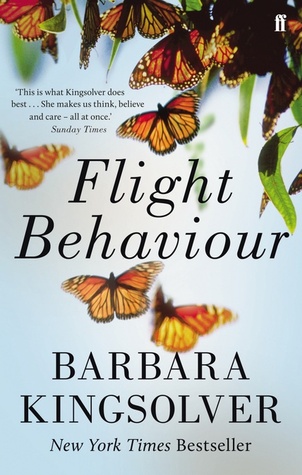
F is for Flight Behaviour by Barbara Kingsolver, on my Kindle since February 2014. On the Appalachian Mountains above her home, a young mother discovers a beautiful and terrible marvel of nature: the monarch butterflies have not migrated south for the winter this year. Is this a miraculous message from God, or a spectacular sign of climate change? Entomology expert, Ovid Byron, certainly believes it is the latter. He ropes in Dellarobia to help him decode the mystery of the monarch butterflies.

Dellarobia is a restless farm wife who gave up her own plans when she accidentally became pregnant at seventeen. Now, after a decade of domestic disharmony on a failing farm, she has settled for permanent disappointment but seeks momentary escape through an obsessive flirtation with a younger man. As she hikes up a mountain road behind her house to a secret tryst, she encounters a shocking sight: a silent, forested valley filled with what looks like a lake of fire.

The flame now appeared to lift from the individual treetops in showers of orange sparks, exploding the way a pine log does in a camp fire when it’s poked. The sparks spiralled upwards in swirls like funnel clouds. Twisters of brightness against gray sky. In broad daylight with no comprehension she watched. From the tops of the funnels the sparks lifted high and sailed out undirected above the dark forest.

A forest fire, if that’s what it was, would roar. This consternation swept the mountain in perfect silence. The air remained cold and clear. No smoke, no crackling howl. she stopped breathing for a second and closed her eyes to listen, but heard nothing. Only a faint patter like rain on leaves. (page 19)

If you’ve read any of these please let me know what you think?