Destroying Angel by S G MacLean

Destroying Angel (Damian Seeker #3)

Destroying Angel is S G MacLean’s third book in her Damian Seeker series, historical crime fiction set during the Interregnum under Oliver Cromwell, the Lord Protector. Damian Seeker, Captain of Cromwell’s Guard, works for Thurloe, Cromwell’s Chief Secretary and spy master, in charge of the security of the regime. I have read The Black Friar, the second book in the series, but I have still to read first one, The Seeker – I have reserved this at the library, so hope to read it soon.

This third book is set in 1655 when Seeker is sent north by Colonel Robert Lilburne to the village of Faithly, on the Yorkshire moors. The Rule of the Major-Generals has begun in which England and Wales were divided into ten regions, each governed by a major-general who answered to the Lord Protector. Seeker is to brief the local commissioner, Matthew Pullan, on the latest anti-Royalist laws and the new  measures  and taxes to be imposed on Royalists, to prepare the way for the rule of the major-generals. As the vicar, Septimus Jenkins complains:

This England that Cromwell is making is not the England of free men. … Local officers – village constables – to be encouraged to inform on magistrates, justices of the peace, even, that they don’t consider well enough affected to the new ways. No race meetings nor cockfights nor bear-baitings to be held, no gatherings of Royalists in men’s private houses nor in public places even, for fear that should  a handful of themselves in one place they will have nothing to do but plot to overthrow Cromwell. Answer for your movements, don’t gather with your friends. (page 50)

These are hard times and Faithly is a place full of resentment and fear, brought to crisis point when Caleb Turner, a Trier appointed by the government to enforce Puritan morality arrives in the village. In particular he has come to try the vicar for ‘ungodly acts’. Added to that people have been whipped up into a frenzy of superstition at the suspicion of witchcraft. And that is made much worse when Gwendolen, Matthew’s young ward, who some suspect was a witch, dies from eating poisoned mushrooms – the deadly destroying angel fungus.

Faithly Manor, on Faithly Moor, is the home of Sir Edward Faithly, the local JP, whose father Sir Anthony and younger brother, Thomas had fought for the Stuarts. Sir Anthony was killed during the Civil War and Thomas had fled the country, whilst Edward had stayed on to run their estate. There are rumours that Thomas has now returned to England and Seeker had been sent to discover his whereabouts.

As well as searching for Thomas, Seeker has to find out how Gwendolen died – was it an accident or had the poison been intended for someone else and if so who and why? A large part of the book is set in York and, helped by the street plan showing the key areas and buildings, I enjoyed following Seeker’s walks around the City. Seeker is my favourite character in the book; an enigmatic character, a man both respected and feared, and a man to trust. I felt I knew very little, though, about his background so was pleased that as the story progressed more details of his personal history are revealed with the appearance of people from his past.

One reason I like S G MacLean’s books (her earlier books were written under the name of Shona MacLean) is that she has based them on solid historical research (she has an M.A. and Ph.D. in History from the University of Aberdeen). Another reason is that her style of writing suits me perfectly, the characters are just right, credible well-rounded people, and the plot moves along swiftly, full of atmosphere and tension.

The Bear Pit, the fourth Seeker book is due out this July, taking him back to London to investigate illegal gambling dens. And so I hope to find out yet more about Damian Seeker.

  • Paperback: 416 pages
  • Publisher: Quercus (12 July 2018)
  • Language: English
  • ISBN: 978-1-78648-4178
  • Source: Library book
  • My Rating: 4*

Destroying Angel qualifies for the When Are You Reading? challenge, the Calendar of Crime challenge in the category of a book originally published in July, and as it is a library book it also qualifies for the The Virtual Mount TBR challenge.

Greenmantle by John Buchan

Greenmantle by John Buchan was my Classics Club Spin book to read by 31 January. I read the free Kindle edition (525 pages).

Greenmantle (Richard Hannay Book 2)

3*

Greenmantle is the second of five novels by John Buchan featuring the character of Richard Hannay, first published in 1916, the first being The Thirty-Nine Steps. It was written as the First World War was being fought, before the Battle of the Somme. Many of Buchan’s friends and his younger brother were killed in the war and his adventure stories are a form of escapism. It continues Hannay’s story, taking him from convalescence in  a big country house in Hampshire following the Battle of Loos in 1915, back to London for a vital meeting at the Foreign Office, and then to a top-secret and perilous mission across war-torn German-occupied Europe.

Narrated by Hannay, this is basically an adventure and spy story with a highly improbable plot. It’s pure escapism, as Hannay and his comrades, Sandy Arbuthnot, Peter Pienaar, a South African Boer, who Hannay met in South Africa when he was working as a mining engineer before the First World War, and an American, a dyspeptic businessman, John S Blenkiron embark on a quest, travelling incognito across Germany to Constantinople, reaching a climax at the battle of Erzurum in eastern Anatolia (Asian Turkey) in 1916.

Sandy, a master of disguise, is I think the hero of the book, although Hannay is the man in charge of their investigation. Ludovick Gustavus Arbuthnot, known as Sandy, was in the same battalion as Hannay during the Battle of Loos. The book begins as Hannay received a telegram from Sir Walter Bullivant summoning him to the Foreign Office where he offers him a ‘crazy and impossible mission’ to investigate the rumours of an uprising in the Muslim world. Bullivant tells him:

There is a dry wind blowing through the East, and the parched grasses wait the spark. And the wind is blowing towards the Indian border. Whence comes the wind, think you. (page 9)

The only clues they have to guide them are the words ‘Kasredin’, ‘cancer’ and ‘v.I’.

I was fascinated by the first half of the book as Hannay and the others set out on their mission, following the events of 1916, after the Gallipoli disaster as the Germans were supplying munitions to their allies, the Young Turks. Hannay describes his brief meeting with the Kaiser, Wilhelm II, who he felt had ‘loosed Hell, and the furies of Held had got hold of him.’

I didn’t think Buchan’s villains were particularly convincing as characters, the most evil being the mysterious Hilda von Einem. She fascinated Hannay whilst at the same time he instinctively hated her as he realised she was trying to cast a spell over him. The German Colonel von Stumm is a big man, a brute and a bully, whose ‘head was exactly the shape of a pear with the sharp end topmost’. Hannay thought he was

the German of caricature, the real German, the fellow we were up against.  He was as hideous as a hippopotamus, but effective. Every bristle on his odd head was effective. (page 84)

I liked the contrast between the ordinary and the exotic. The ordinary, such as the domestic scenes as in the opening scene of the book with Hannay just finishing breakfast and Sandy hunting for the marmalade. When Hannay returns from the Foreign Office with his mission in hand Sandy is eating teacakes and muffins. Blenkiron’s diet is mentioned several times as he only eats boiled fish and dry toast whilst drinking hot milk. On the other hand the exotic is found in the Garden-House of Suliman the Red, in the garden of a tumble-down coffee house, transformed from a common saloon into a place of mystery where the Companions of the Rosy Hours perform their potent magic of dance, making the world appear at one point ‘all young and fresh and beautiful’ then changing into something savage and passionate, ‘monstrous, inhuman, devilish’, until the spell is broken.

In the second half or the book the pace increases when they reach Constantinople and Buchan describes the action of the battle at Erzerum. But I found that it didn’t hold my attention as much as the earlier sections of the book, but then again I’m not keen on descriptions of battles and fighting. Overall, then I enjoyed it, which is why I’ve given it 3* on Goodreads.

This is my third book for the Mount TBR Challenge, a book I’ve owned for nearly 5 years, and as well as being on my Classics Club list it is also a book that fits into the When Are You Reading Challenge, being set in 1916, and as it it a spy/espionage story it also qualifies for the Calendar of Crime Challenge.


Dirty Little Secrets by Jo Spain

Quercus Books|7 February 2019 |416 pages|e-book |Review copy|4.5*

I first came across Jo Spain’s books last year when I read The Confession, a standalone novel and then The Darkest Place, her 4th Inspector Tom Reynolds Mystery book, both very good books. So I was keen to read her latest book, a psychological thriller, Dirty Little Secrets, another standalone book. I really enjoyed this very readable page-turner, keen to discover all the secrets.

It’s set in Withered Vale, a small, gated community of just seven houses, outside the small village of Marwood in Wicklow in Ireland. On the surface it is a perfect place where the wealthy live their  privileged lives and keep themselves to themselves – until a cloud of bluebottles stream out of the chimney of number 4 and Olive Collins’ dead and disintegrating body is discovered inside. She had been dead for three months and none of the neighbours had bothered to find out why she hadn’t been seen all that time. But someone must have known what had happened to her – the question being who?

When DI Frank Brazil, near to his retirement, and his partner young Emma Child arrive it’s not clear whether Olive’s death was accidental death or suicide. But they quickly establish that the boiler had been pumping out carbon monoxide and the vents and the letter box had been taped up.  It was then obvious that her death was either suicide or murder. There is plenty of DNA in the house, as it turns out that all the neighbours had visited Olive. She had tried to interfere in each of their lives and each one of them had something to hide, from past crimes, past relationships, addictions, and blackmail. They’re all suspects as each one had a motive for killing Olive.

I liked the way Jo Spain has structured her book – each character is introduced and gradually more and more facts about their lives and personalities are revealed. And Olive’s dead voice is interspersed among these people, revealing her personality, thoughts and relationships with the others, and showing just went on behind all the closed doors. I was fascinated and went from one person to the next wondering who was guilty, changing my mind as the book progressed. The characters are convincing and so it was easy to work out who was who and how they all interacted. The ending surprised me as although I had suspected what had taken place I hadn’t foreseen the whole picture.

I was hooked from the beginning to the end. Withered Vale went from being a place where the neighbours lived their lives in isolation to a much more united community as together they faced the enormity of what had happened.

My thanks to the publishers, Quercus, for my review copy via NetGalley.

Note: this book is one of my TBRs, so qualifying for Bev’s Mount TBR challenge and as it will be published in February it also qualifies for Bev’s Calendar of Crime challenge in the category of a February publication.

The Good Son by You-Jeong Jeong

Blurb When Yu-jin wakes up covered in blood, and finds the body of his mother downstairs, he decides to hide the evidence and pursue the killer himself.  Then young women start disappearing in his South Korean town. Who is he hunting? And why does the answer take him back to his brother and father who lost their lives many years ago. The Good Son by You-jeong Jeong, translated by Chi-Young Kim, is the first of her books to be translated into English. You-jeong Jeong is a South Korean writer of psychological crime and thriller fiction. She is the author of four novels including Seven Years of Darkness, which was named one of the top ten crime novels of 2015 by the German newspaper Die Zeit. My thoughts: I thought that maybe I’d made a mistake in requesting The Good Son from NetGalley when I started reading it. And at 23% I was ready to abandon it – I was tired of reading about Yu-jin trying to get rid of all the blood in the apartment and on himself after he discovered his mother lying in a pool of blood – it was so repetitive and slow going. So I did something that I very rarely do and went to the end of the book to see if it was like that all the way through – and as it looked as though it wasn’t, I carried on reading. This is a dark book, but although there is a lot of blood around at the start it isn’t actually a gory, blood and guts story. It’s a psychological did-he-do-it murder mystery. It’s tense and puzzling as Yu-jin tries to uncover what happened, at first unable to remember the events of the night before the murder. It’s written totally from Yu-jin’s perspective, so for most of the book it was as though I was reading his mind – and it’s a very strange, mixed up mind. He has difficulty with honesty and admits that he tells more lies than other people, which means that he can tell any kind of story in a believable way, and for a large part of this book I was willing to believe him, or to think the murder was all in his mind and that his mother wasn’t dead. For years he had been taking pills which his mother told him were to control his epilepsy but he didn’t like the side effects so he had stopped taking them without telling his mother. Now he’s worried about having seizures and the blank spots in his memory are confusing him.  As more of his past life is revealed in flashbacks I began to revise my opinion of him and wondered if he could have killed his mother. When he was nine his father and older brother had died in tragic circumstances that are only revealed later on in the book and even then there are different versions of what actually happened. It’s an intricate plot and just as soon as I thought I could see where it was going I realised that I’d been hoodwinked. The book is set in South Korea, mainly in Incheon, a city south of Seoul but the main focus is on this dysfunctional family and their relationships. I’m glad I didn’t give up on the book at 23% as after that point the story picked up pace and it held my interest to the end. But it is certainly a dark and unsettling character study of a psychopath. My thanks to the publishers, Little, Brown Book Group, for my review copy via NetGalley.
  • Format: Kindle Edition
  • File Size: 1126 KB
  • Print Length: 322 pages
  • Publisher: Little, Brown Book Group (3 May 2018)
  • Source: Review copy
  • My Rating: 3*

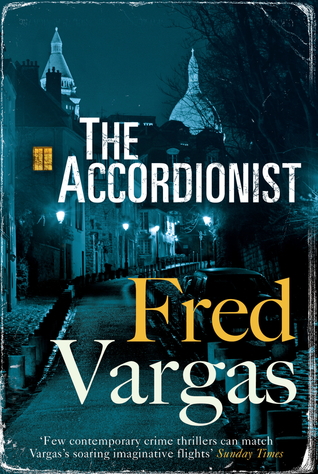
The Accordionist by Fred Vargas

The Accordionist (Three Evangelists 3)

The Accordionist by Fred Vargas and translated by SianReynolds is the third book in the Three Evangelists series and it’s probably the most puzzling of the three. They are quirky crime fiction novels, with eccentric characters and intricate plots. The three ‘Evangelists’ are thirty-something historians, Mathias, Marc and Lucien, all specialists in three different periods of history, who live in a rambling house in Paris. Together with ex-special investigator Louis Kehlweiler, retired from the Ministry of the Interior, they find themselves involved in murder mysteries, mainly because Louis just can’t resist trying to solve particularly difficult crimes.

In this third book a simple-minded young man, Clément Vauquer, who plays the accordion, is the prime suspect for the murders of two Parisian women as he was seen watching both of their apartments before their murders. Desperate to prove his innocence he appeals to Marthe, who had looked after him as a child, for help.

Louis is supposed to be translating a biography of Bismark, but the newspaper reports of the two murdered women have distracted him so when his old friend Marthe tells him that Clément, who is like a son to her, is innocent and being used as a scapegoat he agrees to investigate and find the real culprit. He in turn, enlists the help of the three evangelists and Marc’s uncle, a retired policeman and they take Clément into their house to protect him whilst they dig deeper into the mystery.

I found this book the most baffling of the trilogy and really had no idea of how they managed to unravel all the strands of this murder mystery which has its roots in the past. They worked on instincts and by deciphering Clément’s muddled thoughts and memories, and with the help of a poem by the nineteenth century poet, Gerard de Nerval, finally uncover the killer’s identity. It’s the eccentric characters and the complicated plots that make Fred Vargas’ books stand out for me.

Fred Vargas is the pseudonym of of the French historian, archaeologist and writer Frédérique Audoin-Rouzeau. She has won three International Dagger Awards from the Crime Writers Association, for three successive novels: in 2006, 2008 and 2009. I’ve also enjoyed her Commissaire Adamsberg books, probably more even than the Three Evangelists, and I still have a few of that series left to read including the tenth and latest book in the series, This Poison will Remain, due to be published in August this year.

  • Format: Paperback
  • File Size: 783 KB
  • Print Length: 370 pages
  • Page Numbers Source ISBN: 0099548364
  • Source: Library book
  • My Rating: 4*

Once Upon a River by Diane Setterfield

An intriguing and mystifying book by Diane Setterfield – Once Upon a River – without doubt one of the best books I read last year – I was entranced from the beginning to the end. It’s a mystery beginning in the Swan Inn at Radcot, an ancient inn, well-known for its storytelling, on the banks of the Thames. A badly injured stranger enters carrying the drowned corpse of a little girl. It’s mystifying as hours later the dead child, miraculously it seems, takes a breath, and returns to life. The mystery is enhanced by folklore, by science that appears to be magic, and by romance and superstition.

The story has a timeless feel to it but it is set somewhere towards the end of the nineteenth century. There are numerous strands and characters to the story and Diane Setterfield drew me slowly into the book with a leisurely description of the characters and their situations. Just as the river, a character in its own right, takes many twists and turns and has many tributaries, it becomes apparent that the little girl could belong to a number of different families all with links to the river. As the story progresses these individual families each claim the child as theirs and I was never really certain which of them – if any – were telling the truth. Much is hidden and much eventually is revealed.

It’s a multi-layered book that you need time to digest, richly atmospheric and told from multiple viewpoints. I loved all the detail – about the river itself, about photography as Henry Daunt (based on Henry Taunt, the real-life photographer of the Thames and surrounding areas) travelled along the river in a houseboat with its own darkroom, about the body’s metabolism and the treatment of injuries and diseases of the late Victorian period and about belief in the afterlife. Various people refer to Quietly, the ferryman who featured in the stories people told – he appeared when you were in trouble on the water, gliding in his punt, either guiding you to the safety of the bank, or if it is your time he takes you to another shore ‘on the other side of the river.

Once Upon a River is a beautifully and lyrically told story, and cleverly plotted so that I was not completely sure at times what it was that I was reading. It’s historical fiction with a touch of magic that completely beguiled me with its mysteries and fascinating characters. I enjoyed reading her first book, The Thirteenth Tale, years ago before I began my blog, but I loved this one so much more!

My thanks to the publishers, Transworld Digital, for my review copy via NetGalley.

  • Format: Kindle Edition
  • File Size: 2336 KB
  • Print Length: 419 pages
  • Page Numbers Source ISBN: 0857525662
  • Publisher: Transworld Digital (4 Dec. 2018)
  • Source: Review copy
  • My Rating: 5*