The Colour of Murder by Julian Symons

The Colour of Murder (British Library Crime Classics)

Poisoned Pen Press|5 February 2019 |224 pages|e-book |Review copy|4*

This edition of The Colour of Murder, published in association with the British Library, has an introduction by Martin Edwards. It was first published in 1957 by Collins. It won the prize for the best crime novel of that year awarded by the Crime Writers’ Association. I came fresh to this novel, knowing little about the plot and nothing at all about its author, Julian Symons*, so I was pleasantly surprised by how much I enjoyed it.

The Colour of Murder is a cleverly written, very readable mystery, with a focus on the psychological aspects of crime. It reflects the society and racial attitudes of its time. Written in two parts – the first is a statement to a psychiatrist, Dr Max Andreadis, written in the first person, from John Wilkins, accused of a murder on the beach at Brighton. The second part, which is written in the third person, describes John’s subsequent trial.

John is an unreliable narrator and not a very attractive character. He works in the Complaints Department in large Oxford store, a job with responsibility, but poor pay and suffers from blackouts after which he declares he can’t remember what he did. Are they brought on by his drinking, or not? He has an over-possessive mother and a dull and dutiful wife May, who doesn’t get on with his mother. When he meets Sheila in the local library he finds her beautiful and irresistible. He becomes infatuated with her, but May insists she loves him and won’t countenance a divorce. Sheila is not attracted to him but she leads him on and John believes she returns his love. So when she announces she is engaged to Bill he is devastated.  At the end of the first part of the book I was left wondering who he had killed – was it May or Sheila, or Bill? That mystery is quickly cleared up in the second part with John’s trial- but I’m not revealing it now either – that would spoil the story.

By the end of the book I still wasn’t clear about the murder. Was John the murderer, was he insane or was he responsible for his actions? Or was he innocent and if so who was the murderer? What really happened? This is a book that kept me guessing right to the very end. The characters are well drawn, although maybe veering into stereotypes in John’s mother and uncle. The account of the trial is excellent, with the introduction of additional and credible witnesses giving their accounts of John’s character and actions.

*Symons’s full name was Julian Gustave Symons, born in 1912. He was a poet, biographer  (including biographies of Charles Dickens and Thomas Carlyle) and a criminologist as well as a novelist and critic. He was a post-war President of the Detection Club from 1976 to 1985, and wrote several crime fiction and detective novels, short stories and in Bloody Murder (US title Mortal Consequences) a history of the detective story.  In 1982 he was named as Grand Master of the Mystery Writers of America – an honour accorded to only three other English writers before him: Graham Greene, Eric Ambler and Daphne Du Maurier. He died in 1994.

My thanks to the publishers, Poisoned Pen Press, for my review copy via NetGalley.

Challenges:

Cold Earth by Ann Cleeves

Cold Earth is the seventh book in Ann Cleeves’ bestselling Shetland series

Cold Earth (Shetland Island, #7)

Blurb:

In the dark days of a Shetland winter, torrential rain triggers a landslide that crosses the main Lerwick-Sumburgh road and sweeps down to the sea.

At the burial of his old friend Magnus Tait, Jimmy Perez watches the flood of mud and peaty water smash through a croft house in its path. Everyone thinks the croft is uninhabited, but in the wreckage he finds the body of a dark-haired woman wearing a red silk dress. In his mind, she shares his Mediterranean ancestry and soon he becomes obsessed with tracing her identity.

Then it emerges that she was already dead before the landslide hit the house. Perez knows he must find out who she was, and how she died.

My thoughts:

I loved the first 6 books in the Shetland series and Cold Earth is no exception. It works on all levels – a murder mystery to solve, with beautiful descriptions of the landscape, conveying a real sense of place, convincing characters with realistic dialogue, a well paced plot and above all a writing style that doesn’t intrude on the story, but leads you to keep on turning the pages from the beginning to the end. I featured this book in this My Friday post, quoting the opening sentence and a teaser from page 56.

The dead woman’s identity puzzles everyone on the island, although one person must know who she is as among the things found in the debris left in the croft is an unsigned letter addressed to Alis saying what a joy it is to welcome her back to the island.  Perez felt her exotic appearance and black hair and eyes could indicate that like him she was of Spanish descent. He and Sandy Wilson, his sergeant are joined by Chief Inspector Willow Reeves (originally from the Hebrides) from the Inverness team to head up the investigation. Perez is both troubled and distracted by her, but realises just how much he wants her to be in Shetland with him running the investigation.

As usual Perez works very much on his own, but Sandy is gaining more confidence in his detecting skills and helped by Perez he makes a valuable contribution, as they eventually discover the identity of the dead woman, why she was on the island and why she was killed.

If you haven’t read any of the Shetland books, but have seen the TV series, you’ll notice that there are some significant changes – notably in the characters of Cassie, Fran’s daughter who is still a child in the books but has grown up in the TV stories, and the relationship between her father, Duncan Hunter and Perez. And Douglas Henshall, who plays the part of Perez, is not physically like Jimmy Perez – Perez has long dark hair with Spanish ancestry in his blood, whereas Douglas Henshall is a redheaded Scot.

  • Format: Kindle Edition
  • File Size: 2376 KB
  • Print Length: 401 pages
  • Page Numbers Source ISBN: 1447278216
  • Publisher: Macmillan; Main Market edition (6 Oct. 2016)
  • Source: I bought it
  • My Rating: 4*

The Shetland Series – the books read well as stand-alones, but I think it’s better to read them in order as you can then follow the development of the main characters.:

Challenges:

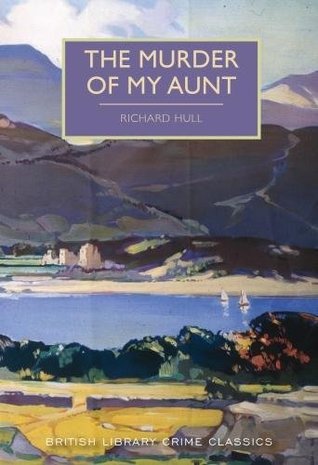
The Murder of My Aunt by Richard Hull

The Murder of My Aunt Poisoned Pen Press|4 September 2018 |227 pages|e-book |Review copy|5* This edition, published in association with the British Library, has an introduction by Martin Edwards. It was first published in 1934 by Hamish Hamilton. It was Richard Hull’s first novel. His real name was Richard Henry Sampson (1896 – 1973) and up until 1934 he had worked as a chartered accountant. With the success of The Murder of My Aunt he devoted himself to writing. The Murder of My Aunt is one of the best of the classic crime fiction novels from the Golden Age that I’ve read. On the face of it has a straightforward plot as Edward Powell, the narrator for most of the book, plots to murder his Aunt Mildred. They live in a house called Brynmawr on the outskirts of the Welsh town of Llwll. Mildred is his guardian, his parents having died in mysterious circumstances when Edward was very young. He detests living in Lwll and he also detests his aunt. It’s a contest of wills as Mildred finds Edward a great trial, she sees all his faults – he is selfish, self-centred, vain and lazy and foppishly effeminate – and she constantly nags him to change his ways, or she will ‘have to take action’. Edward, though decides that he will take action, thinking his life would be so much better without Mildred and he sets out to find a way to arrange her death so that no suspicion will fall on him. He makes copious notes of various methods and the steps he plans to take and that’s more difficult than he expected as his attempts keep failing. But it’s the writing that lifts this book from the ordinary to an original and funny murder mystery and, whilst not laugh-out-loud funny, I thought it was brilliant. It’s witty and ironic from the start as Edward pontificates on the pronunciation of the word ‘Lwll’.  Neither Edward nor Mildred come across as caricatures, but as real people, both of them with their own faults. Edward is just so insufferably awful that I felt on Mildred’s side in their battle of wits, even though she shows him up in front of the whole village – and after all she had brought him up. Once I started to read The Murder of My Aunt I was captivated and I had to read it quickly, anxious to find out if Edward did manage to kill his aunt. It makes very entertaining reading and I loved the ending, which took me by surprise and I thought was so clever – definitely a 5* read for me! Now I’m looking forward to reading more of  Richard Hull’s books and have Excellent Intentions lined up to read soon. My thanks to the publishers, Poisoned Pen Press, for my review copy via NetGalley. This is qualifies for the Mount TBR Challenge and for the Calendar of Crime Challenge for March in the category of a book in which money/fortune/inheritance has a major role.

The Glass Woman by Caroline Lea

The Glass Woman

Penguin UK Michael Joseph|7 February 2019 |400 pages|e-book |Review copy|3*

Destroying Angel by S G MacLean

Destroying Angel (Damian Seeker #3)

Destroying Angel is S G MacLean’s third book in her Damian Seeker series, historical crime fiction set during the Interregnum under Oliver Cromwell, the Lord Protector. Damian Seeker, Captain of Cromwell’s Guard, works for Thurloe, Cromwell’s Chief Secretary and spy master, in charge of the security of the regime. I have read The Black Friar, the second book in the series, but I have still to read first one, The Seeker – I have reserved this at the library, so hope to read it soon.

This third book is set in 1655 when Seeker is sent north by Colonel Robert Lilburne to the village of Faithly, on the Yorkshire moors. The Rule of the Major-Generals has begun in which England and Wales were divided into ten regions, each governed by a major-general who answered to the Lord Protector. Seeker is to brief the local commissioner, Matthew Pullan, on the latest anti-Royalist laws and the new  measures  and taxes to be imposed on Royalists, to prepare the way for the rule of the major-generals. As the vicar, Septimus Jenkins complains:

This England that Cromwell is making is not the England of free men. … Local officers – village constables – to be encouraged to inform on magistrates, justices of the peace, even, that they don’t consider well enough affected to the new ways. No race meetings nor cockfights nor bear-baitings to be held, no gatherings of Royalists in men’s private houses nor in public places even, for fear that should  a handful of themselves in one place they will have nothing to do but plot to overthrow Cromwell. Answer for your movements, don’t gather with your friends. (page 50)

These are hard times and Faithly is a place full of resentment and fear, brought to crisis point when Caleb Turner, a Trier appointed by the government to enforce Puritan morality arrives in the village. In particular he has come to try the vicar for ‘ungodly acts’. Added to that people have been whipped up into a frenzy of superstition at the suspicion of witchcraft. And that is made much worse when Gwendolen, Matthew’s young ward, who some suspect was a witch, dies from eating poisoned mushrooms – the deadly destroying angel fungus.

Faithly Manor, on Faithly Moor, is the home of Sir Edward Faithly, the local JP, whose father Sir Anthony and younger brother, Thomas had fought for the Stuarts. Sir Anthony was killed during the Civil War and Thomas had fled the country, whilst Edward had stayed on to run their estate. There are rumours that Thomas has now returned to England and Seeker had been sent to discover his whereabouts.

As well as searching for Thomas, Seeker has to find out how Gwendolen died – was it an accident or had the poison been intended for someone else and if so who and why? A large part of the book is set in York and, helped by the street plan showing the key areas and buildings, I enjoyed following Seeker’s walks around the City. Seeker is my favourite character in the book; an enigmatic character, a man both respected and feared, and a man to trust. I felt I knew very little, though, about his background so was pleased that as the story progressed more details of his personal history are revealed with the appearance of people from his past.

One reason I like S G MacLean’s books (her earlier books were written under the name of Shona MacLean) is that she has based them on solid historical research (she has an M.A. and Ph.D. in History from the University of Aberdeen). Another reason is that her style of writing suits me perfectly, the characters are just right, credible well-rounded people, and the plot moves along swiftly, full of atmosphere and tension.

The Bear Pit, the fourth Seeker book is due out this July, taking him back to London to investigate illegal gambling dens. And so I hope to find out yet more about Damian Seeker.

  • Paperback: 416 pages
  • Publisher: Quercus (12 July 2018)
  • Language: English
  • ISBN: 978-1-78648-4178
  • Source: Library book
  • My Rating: 4*

Destroying Angel qualifies for the When Are You Reading? challenge, the Calendar of Crime challenge in the category of a book originally published in July, and as it is a library book it also qualifies for the The Virtual Mount TBR challenge.

Greenmantle by John Buchan

Greenmantle by John Buchan was my Classics Club Spin book to read by 31 January. I read the free Kindle edition (525 pages).

Greenmantle (Richard Hannay Book 2)

3*

Greenmantle is the second of five novels by John Buchan featuring the character of Richard Hannay, first published in 1916, the first being The Thirty-Nine Steps. It was written as the First World War was being fought, before the Battle of the Somme. Many of Buchan’s friends and his younger brother were killed in the war and his adventure stories are a form of escapism. It continues Hannay’s story, taking him from convalescence in  a big country house in Hampshire following the Battle of Loos in 1915, back to London for a vital meeting at the Foreign Office, and then to a top-secret and perilous mission across war-torn German-occupied Europe.

Narrated by Hannay, this is basically an adventure and spy story with a highly improbable plot. It’s pure escapism, as Hannay and his comrades, Sandy Arbuthnot, Peter Pienaar, a South African Boer, who Hannay met in South Africa when he was working as a mining engineer before the First World War, and an American, a dyspeptic businessman, John S Blenkiron embark on a quest, travelling incognito across Germany to Constantinople, reaching a climax at the battle of Erzurum in eastern Anatolia (Asian Turkey) in 1916.

Sandy, a master of disguise, is I think the hero of the book, although Hannay is the man in charge of their investigation. Ludovick Gustavus Arbuthnot, known as Sandy, was in the same battalion as Hannay during the Battle of Loos. The book begins as Hannay received a telegram from Sir Walter Bullivant summoning him to the Foreign Office where he offers him a ‘crazy and impossible mission’ to investigate the rumours of an uprising in the Muslim world. Bullivant tells him:

There is a dry wind blowing through the East, and the parched grasses wait the spark. And the wind is blowing towards the Indian border. Whence comes the wind, think you. (page 9)

The only clues they have to guide them are the words ‘Kasredin’, ‘cancer’ and ‘v.I’.

I was fascinated by the first half of the book as Hannay and the others set out on their mission, following the events of 1916, after the Gallipoli disaster as the Germans were supplying munitions to their allies, the Young Turks. Hannay describes his brief meeting with the Kaiser, Wilhelm II, who he felt had ‘loosed Hell, and the furies of Held had got hold of him.’

I didn’t think Buchan’s villains were particularly convincing as characters, the most evil being the mysterious Hilda von Einem. She fascinated Hannay whilst at the same time he instinctively hated her as he realised she was trying to cast a spell over him. The German Colonel von Stumm is a big man, a brute and a bully, whose ‘head was exactly the shape of a pear with the sharp end topmost’. Hannay thought he was

the German of caricature, the real German, the fellow we were up against.  He was as hideous as a hippopotamus, but effective. Every bristle on his odd head was effective. (page 84)

I liked the contrast between the ordinary and the exotic. The ordinary, such as the domestic scenes as in the opening scene of the book with Hannay just finishing breakfast and Sandy hunting for the marmalade. When Hannay returns from the Foreign Office with his mission in hand Sandy is eating teacakes and muffins. Blenkiron’s diet is mentioned several times as he only eats boiled fish and dry toast whilst drinking hot milk. On the other hand the exotic is found in the Garden-House of Suliman the Red, in the garden of a tumble-down coffee house, transformed from a common saloon into a place of mystery where the Companions of the Rosy Hours perform their potent magic of dance, making the world appear at one point ‘all young and fresh and beautiful’ then changing into something savage and passionate, ‘monstrous, inhuman, devilish’, until the spell is broken.

In the second half or the book the pace increases when they reach Constantinople and Buchan describes the action of the battle at Erzerum. But I found that it didn’t hold my attention as much as the earlier sections of the book, but then again I’m not keen on descriptions of battles and fighting. Overall, then I enjoyed it, which is why I’ve given it 3* on Goodreads.

This is my third book for the Mount TBR Challenge, a book I’ve owned for nearly 5 years, and as well as being on my Classics Club list it is also a book that fits into the When Are You Reading Challenge, being set in 1916, and as it it a spy/espionage story it also qualifies for the Calendar of Crime Challenge.