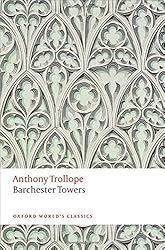
Barchester Towers by Anthony Trollope

First published in 1857 Barchester Towers, is the second book in Anthony Trollope’s Chronicles of  Barchester series, following on from The Warden.

As I began reading this book I was thinking it’s really slow, very much set in its period detailing the religious and ecclesiastical controversies of its time, but then the story of who was going to succeed the old dean, who was going to be the warden, Mr Harding or Mr Quiverful (with his 14 children) and above all who was going to marry Eleanor, Mr Harding’s widowed daughter took hold of me. Not to mention the odious Mr Slope, chaplain to the new Bishop, the ambitious, but hen-pecked Dr. Proudie and his overbearing wife who would dearly like to be the Bishop herself; the Archdeacon Dr Grantly and his wife, Susan Mr Harding’s elder daughter; the Stanhope family including the entrancing cripple, Madeline, ‘a basilisk from whom an ardent lover of beauty could make no escape‘; and the Thornes of Ullathorne.

Barchester Towers provides a view of the class structure of society, in Victorian Britain. Miss Thorne and her brother, the local squire  hold a party, a gala day, inviting all the main characters and the local labourers, their wives and children. The guests are divided according to their place in society – the upper classes and the non-quality were to eat in separate marquees. The question arose as to who should go where amongst the lower class of yokels, with the Lookalofts and the Greenacres. The Lookalofts won’t sit among the bumpkins, nor will Mrs Lookaloft think Mrs Greenacres should sit next to her and talk about cream and ducklings. But neither is she a fit companion to the Thornes and Grantlys – what a dilemma for Miss Thorne! It’s scenes like these that make Barchester Towers such an entertaining novel.

This is a novel strong on character, less strong on plot, with strong female characters, power-hungry men, humour and pathos as the various battles for supremacy are played out. And throughout the book the narrator frequently expresses his opinion on the characters and on the novel itself. Here he describes Obadiah Slope:

I never could endure to shake hands with Mr Slope. A cold, clammy perspiration always exudes from him, the small drops are ever to be seen standing on his brow and his friendly grasp is unpleasant. (page 31)

The characters, however, are not portrayed as wholly good or wholly bad. Here Trollope indicates Mr Slope’s better (if you can call it that) side:

And here the author must beg it to be remembered that Mr Slope was not in all things a bad man. His motives, like those of most men were mixed, and though his conduct was generally different from that which we would wish to praise, it was actuated perhaps as often as that of the majority of the world by a desire to do his duty. (page 146)

He also comments on how he has made his characters withhold the truth from each other, causing such misunderstandings between them:

Everything would have been explained … had she but heard the whole truth … But then where would have been my novel? (page 337)

In his Autobiography Anthony Trollope wrote that he had taken great delight in writing Barchester Towers, the characters of the Bishop and Mrs Proudie were very real to him, as were the troubles of Dr Grantly, the archdeacon and the loves of Mr Slope. As they are to me too.

I thought this statement of his was very interesting:

It [Barchester Towers] achieved no great reputation, but it was one of those novels which novel readers were called upon to read. Perhaps I may be assuming more to myself than I have a right to do in saying now that Barchester Towers has become one of those novels which do not die quite at once, which live and are read for perhaps a quarter of a century; but if that be so, its life has been so far prolonged by the vitality of some of its younger brothers. Barchester Towers would hardly be so well known as it is had there been no Framley Parsonage and no Last Chronicle of Barset. (page 104)

and here we are over 150 years later still reading Barchester Towers.

The next book in the series is Doctor Thorne, which Trollope thought had a good plot and was, he believed, the most popular book he had written. I’m looking forward to reading it.

New-To-Me Books

I took a bagful of books back to Barter Books yesterday and came home with these books:

Christie encyclopedia 01 P1010423From top to bottom

  • Sad Cypress by Agatha Christie – this is one of the few of her books that I have yet to read. I’ve been looking out for this one, first published in 1940. It’s a Poirot mystery in which there are two victims murdered by poison.

As I hope to finish reading Agatha Christie’s books this year I’ve decided to attempt reading as many of Ruth Rendell’s books and those she has written as Barbara Vine:

  • End in Tears by Ruth Rendell – an Inspector Wexford murder mystery in which the victim’s father discovers her body near the family house.
  • The Chimney Sweeper’s Boy by Barbara Vine – in this case a daughter discovers that her perfect father was not all he appeared to be.

Then I browsed the shelves and found the next two books:

  • The Winter Garden by Jane Thynne is set in Berlin in 1937, where Clara Vine, an actress is an undercover agent for British Intelligence.  I thought the author’s name was familiar but couldn’t remember reading any of her books – until I got home and found that I already have Black Roses, the first Clara Vine book (set in 1933),  unread on the black hole that is my Kindle. I’d better read Black Roses first.

and finally:

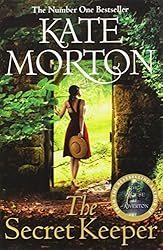
First Chapter: The Secret Keeper

First chapterEvery Tuesday Diane at Bibliophile by the Sea hosts First Chapter First Paragraph Tuesday Intros, where you can share the first paragraph, or a few, of a book you are reading or thinking about reading soon.

My choice this week is: The Secret Keeper by Kate Morton, a book from my TBR Pile Challenge 2015.

It begins:

Rural England, a farmhouse in the middle of nowhere, a summer’s day at the start of the nineteen sixties. The house is unassuming: half-timbered with white paint peeling gently on the western side and clematis scrambling up the plaster. The chimney pots are steaming and you know, just by looking, that there’s something on the stove top beneath. It’s something the way the vegetable patch has been laid out, just so, at the back of the house; the proud gleam of the leadlight windows; the careful patching of the roofing tiles.

A rustic fence hems the house and a wooden gate sparates the tame garden from the meadows on either side, the copse beyond. Through the knotted trees a stream trickles lightly over stones, flitting between sunlight and shadow as it has done for centuries; but it can’t be heard from here. It’s too far away. The house is quite alone, sitting at the end of a long dusty driveway, invisible from the country lane whose name it shares.

I’m immediately attracted to this book from these two opening paragraphs, setting the scene. I can easily paint a picture of it in my mind – I can see it! You know that in such an idyllic setting something is about to happen to upset everything; at least that is what I am anticipating  and I know from the title that there is at least one secret someone is keeping .

I also know from the description on the back cover that this is a book that switches from the 1930s, to the 1960s and the present day, which often works well for me, and that there are not only mysteries and secrets but also murder and enduring love.

Will I like it? LibraryThing thinks I probably will like The Secret Keeper (prediction confidence: very high) – we’ll see.

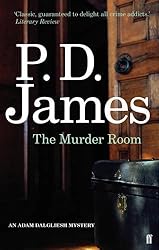
The Murder Room by P D James

The Murder Room by P D James is one of the last of the Adam Dalgleish books, first published in 2003 . Although I’ve not read many of the books I’ve watched most (if not all) of the TV adaptations, but I don’t remember watching this one.

The Murder Room itself is in the Dupayne Museum, displaying the most notorious murder cases of the 1920s and 30s, with contemporary newspaper reports of the crimes and trials, photographs and actual exhibits from the scenes of the murders. These were actual crimes and not fictional cases made up by P D James.

The novel  begins, as Commander Adam Dalgleish visits the Dupayne in the company of his friend Conrad Ackroyd who is writing a series of articles on murder as a symbol of its age. A week later the first body is discovered at the Museum and Adam and his colleagues in Scotland Yard’s Special Investigation Squad are called in to investigate the killing, which appears to be a copycat murder of one of the 1930s’ crimes.

The Murder Room is not a quick read. It begins slowly with a detailed description of the main characters and it is only after 150 or so pages that the first murder occurs, so by that time I had a good idea of who might be killed but not of the culprit as many of the characters could all have had the motive and opportunity. There are two more killings before Dalgleish reveals the culprit.

More used to fast paced murder mysteries initially I was impatient with this slow start but soon settled into P D James’ approach and appreciated the depth of the intricate plot. The setting is fascinating and the characters are convincing, so much so that I was hoping the second victim wouldn’t be one of my favourite characters.

The lease on the Museum is up for renewal and not everyone wants it to continue – as one of the characters says:

It’s the past … it’s about dead people and dead years … we’re too obsessed with our past, with hoarding and collecting for the sake of it.

There is the Dupayne family – Marcus and Caroline both actively involved in running the Museum, and their brother Nigel, who is a psychiatrist, and his daughter Sarah; the Museum staff – Muriel Godby in charge of the Museum’s day to day running, Tally Clutton the housekeeper, James Calder-Hale, the curator who used to work for MI5; Marie Strickland, a volunteer calligraphist; and Ryan Archer, the handyman and gardener.

I liked the interaction between Dalgleish and D I Kate Miskin, and between Dalgleish and Emma Lavenham who is finding their relationship increasingly frustrating. I enjoyed the book and found it absorbing and testing of both my powers of deduction and vocabulary.

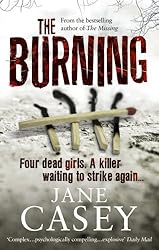
The Burning by Jane Casey

The Burning by Jane Casey is one of the books I selected for the TBR Pile Challenge 2015. It’s a book that I read about on other book blogs and thought I would like.  I was right – I really enjoyed it.

It’s the first the DC Maeve Kerrigan series. Maeve is on the murder task force investigating the case of the serial killer the media call The Burning Man. Four young women have been brutally murdered, beaten to death and their bodies burnt in secluded areas of London’s parks. When a fifth body is discovered that of Rebecca Haworth, it appears to be the work of The Burning Man – but is it, there are slight differences? The more that Maeve and her colleague Rob Langton check out the facts it appears it could be a copy-cat killing.

The pace of the book is quite slow at first as the characters are introduced and the story unfolds mainly through Maeve’s eyes  with some  chapters narrated by Rebecca’s friend Louise, and briefly by Rob. Because the pace is slow to begin with the main characters are fully rounded – Maeve in particular is a likeable character, intelligent and empathetic, working to impress her male colleagues and determined to catch the murderer. She’s new to the job, which both her boyfriend and her family criticises. Rebecca’s character is revealed through Louise’s eyes,  fleshed out as other friends give their versions of her past to Maeve and Rob. As the pace picks up, a complex  plot develops providing several suspects which kept me turning the pages right to the end.

I have the third Maeve Kerrigan book, The Last Girl, but I think I’ll postpone reading it until I’ve read the second book, The Reckoning. There are now six books in the series and Maeve has her own website!

As well as the TBR Pile Challenge The Burning completes one of the categories in the What’s In a Name challenge, that of a book title containg a word ending in ‘ing’, the My Kind of Mystery challenge and also the Mount TBR Reading Challenge (a book I’ve owned prior to 1 January 2015).

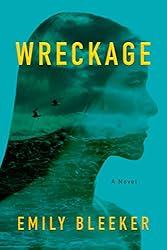
Wreckage by Emily Bleeker

When I downloaded Wreckage by Emily Bleeker I made the fatal mistake of just seeing how it began and before I knew it I was hooked, and had abandoned (just for the time being) the two novels I was already happily reading. I didn’t want to put it down – I really enjoyed it.

It’s the story of Lillian Linden and Dave Hall, who were being interviewed following their rescue from a deserted island in the South Pacific where they had spent two years after their plane crashed into the sea. The thing is their interviews are full of lies – they are desperate to keep what really happened a secret from their families.

Genevieve Randall, the TV interviewer is convinced that they are lying and tries to get them to tell the real story – how they had survived and what had happened to the other people who were on the plane, Kent, the pilot, Theresa, the flight attendant and Margaret, Lillian’s mother-in-law.

The narrative is told from Lillian’s and Dave’s point of view and moves between the present and the past. The two time periods are clearly set out and each character has a distinct voice. It worked very well, the fact that I guessed one of the big secrets early on only increased my curiosity and anticipation of what was to come next, and I was taken by surprise by the twist at the end.

It would spoil the story to say any more about this book, except to say it’s well written, full of suspense, tension and drama as well as love, loss and longing.

Wreckage is Emily Bleeker’s first novel. She is working on her second book, Beyond and I will most certainly be looking out for it. For more information see her website.

  • Format: Kindle Edition
  • File Size: 1301 KB
  • Print Length: 305 pages
  • Publisher: Lake Union Publishing (1 Mar. 2015)
  • Sold by: Amazon Media EU S.à r.l.
  • Language: English
  • ASIN: B00NAJZDIM
  • Source: My choice for February’s Kindle First Pick