Sunday Selection

I’m currently reading The Brief History of the Dead by Kevin Brockmeier and Almost Invincible: a biographical novel of Mary Shelley.  But I like to think about the books I’ve got waiting to be read. They are:

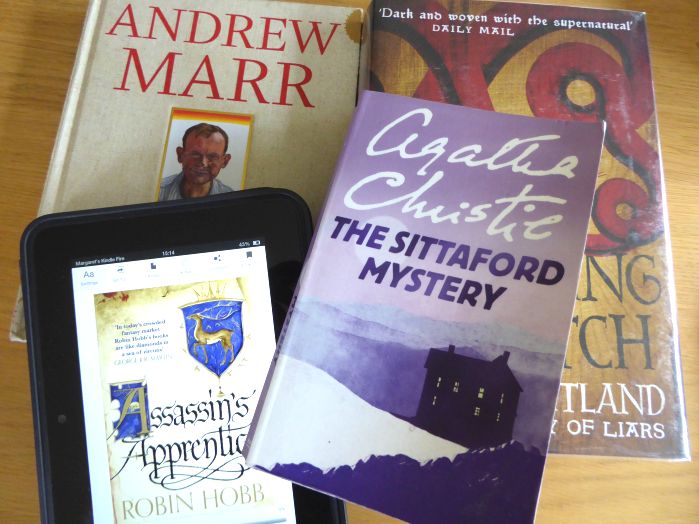
  • The Sittaford Mystery by Agatha Christie – set in a remote house in the middle of Dartmoor, a group of six people gather round a table for a séance. The spirits spell out a chilling message of murder. This is an early Agatha Christie book, first published in 1931 and is one I’ve been looking for, for ages.
  • A Short Book about Drawing by Andrew Marr. This is a library book and I have already flipped through it and read little bits. It has colour photos of his paintings along with his ideas about the differences between fine art and drawing, the mechanics of drawing and how drawing and painting can help us to think and see the world differently and so on. It looks fascinating and I’ll read this very soon I think.
  • Assassin’s Apprentice by Robin Hobb – this is free on Kindle at the moment. I know that other book bloggers like Robin Hobbs’ books and I’ve been thinking of trying one myself. This one is the first in the Farseer Trilogy. I’m not sure what to expectIf you’ve read it what do you think?
  • The Vanishing Witch by Karen Maitland. Another library book I’ve borrowed – this one from the mobile library. I loved Company of Liars and The Owl Killers, so I’m expecting great things from this book – I hope I won’t be disappointed. It’s set in the reign of Richard II, the time of the Peasants Revolt, a time of murder and mayhem and when suspicions of witchcraft were high as people started to die unnatural deaths.

The thing is that I want to read them all right now!

Catching Up

Half of September has gone! I’ve read 5 books and haven’t written about any of them (except for one and that’s for the Shiny New Books blog – more about that book later). The other four books are:

  1. The Goldfinch by Donna Tartt (on Kindle)
  2. Wycliffe and the House of Fear by W J Burley
  3. Testament of a Witch by Douglas Watt (on Kindle)
  4. The Moving Finger by Agatha Christie

It’s much easier to write about a book straight after I’ve read it, so today’s post is about the last book I’ve finished, which is The Moving Finger by Agatha Christie. I’ll try to nudge my brain into writing about the other books as soon as I can.

The Moving Finger is a book I’ve had for a few years now, so it’s one off my to-be-read shelves. It is described as a Miss Marple mystery, but as she doesn’t appear in the book until three-quarters of the way through and after there have been two deaths, she doesn’t have a big part, although she is instrumental in unveiling the murderer.

The story is narrated by Jerry Burton, who has recently moved into the market town of Lymstock with his sister, Joanna. His doctor had instructed him to move to the country where he can take things slowly and easily whilst he recovers from a flying accident. Lymstock seems to be a ‘peaceful backwater where nothing happens‘, but soon after the Burtons have moved in Joanna receives a very nasty anonymous poison-pen letter. They discover that other people have also received them, and soon afterwards Mrs Symmington apparently commits suicide followed by the death of her maid, Agnes, which is without doubt murder.

I liked The Moving Finger. As usual with Agatha Christie’s novels there are plenty of suspects, including Mrs Cleat, well-known as the ‘local witch’, and there are plenty of clues, with a good deal of misdirection throwing me into confusion about who could possibly be the culprit. She captures the nastiness of the anonymous letters well with their accusations of illicit sexual activities. I always think Agatha Christie excels with her dialogue. It’s all so natural and I have no difficulty following who is speaking. I was also convinced about the characters, especially Megan Hunter, Mrs Symmington’s twenty-year old daughter and her relationship with her step-father. Lymstock, itself is a place about fifty years behind the times, but by no means the ‘peaceful backwater where nothing happens‘ that Jerry Burton was seeking.

The police are eventually called in, in the person of Superintendent Nash who then requests help from an expert from London on anonymous letters – Inspector Graves. But the vicar’s wife, Mrs Dane Calthrop isn’t satisfied and brings in an expert of her own, an expert who ‘knows people‘, ‘someone who knows a great deal about wickedness‘ and that person is of course, Miss Marple.

The Moving Finger was first published in 1942 in New York and then in the United Kingdom in the spring of 1943. Along with the puzzle, Agatha Christie, speaking through her characters. makes several comments that interested me – on work/idleness for example. The local doctor’s sister, Miss Griffith, who is a Girl Guide leader, states that idleness is an unforgivable sin, and in response Jerry Burton says:

Sir Edward Grey … afterwards our foreign minister was sent down from Oxford for incorrigible idleness. The Duke of Wellington, I’ve heard, was both dull and inattentive to his books. And has it ever occurred to you, Miss Griffith, that you would probably not be able to take a good express train to London if little Georgie Stephenson had been out with his youth movement instead of lolling about, bored, in his mother’s kitchen until the curious behaviour of the kettle lid attracted the attention of his idle mind?

Another example – considering whether Providence/the Almighty/God would permit dreadful things to happen ‘to awaken us to a sense of our own shortcomings‘, Jerry Burton responds:

There’s too much tendency to attribute to God the evils that man does of his own free will. I might concede you the Devil. God doesn’t really need to punish us, Miss Barton. We’re so very busy punishing ourselves.

Re-reading at her detective novels, Agatha Christie wrote in her Autobiography:

I find that one I am really pleased with is The Moving Finger. It is a great test to re-read what one has written some seventeen or eighteen years later. One’s views change. Some do not stand the test of time, others do.

Agatha Christie Reading Challenge – Update

In September 2008 Kerrie at Mysteries in Paradise launched the Agatha Christie Reading Challenge to read her way through Agatha Christie’s novels, in the order in which they were written.  I joined in but decided to read the books as I come across them rather than in order of publication. There are 66 mystery and detective novels and numerous collections of short stories.

Up to now I’ve read 54 books and 4 short story collections. The list of the books I’ve read is on my Agatha Christie Reading Challenge page. Just 11 or 12 books left for me to read (plus the short stories!):

  1. 1925 – The Secret of Chimneys – I think I’ve read this one! But I can’t find a record of it or the book, so maybe I haven’t!
  2. 1930 – The Murder at the Vicarage
  3. 1931 – The Sittaford Mystery
  4. 1935 – Three Act Tragedy*
  5. 1938 – Appointment with Death
  6. 1940 – Sad Cypress
  7. 1942 – The Moving Finger*
  8. 1944 – Towards Zero*
  9. 1944 – Death Comes as an End
  10. 1945 – Sparkling Cyanide
  11. 1945 – Destination Unknown
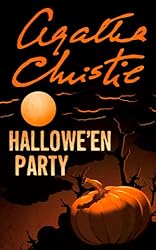
  12. 1969 – Hallowe’en Party*

* books I own

I also have The Mouse Trap to read and some of the short story collections  – Wikipedia lists these and there are a lot! Then there are the books Agatha Christie wrote under the pseudonym of Mary Westmacott. I’ve read her Autobiography, but there is also an earlier book, Come, Tell Me How You Live under the name of Agatha Christie Mallowan.

Nemesis by Agatha Christie

Nemesis first published in 1971, is one of Agatha Christie’s later books written in her eighties. It is the last book she wrote about Miss Marple. There are two more books that were published later, but those were written earlier. It’s not among the best of her books, it’s slow moving, lots of dialogue, lots of recapping of events and clues, lots of moralising and social commentary. It follows on, although it is not a sequel to, A Caribbean Mystery in which Miss Marple met Mr Rafiel.

It’s slow moving because for quite a while Miss Marple doesn’t know what the crime is that she has been asked to investigate. Mr Rafiel, who she met in the West Indies, has left her £20,000 in his will on condition she investigates a certain crime, but doesn’t give her any details. He wrote that she had a natural flair for justice leading to a natural flair for crime and reminded her that the code word is Nemesis. Then she is invited to join a tour of Famous Houses and Gardens of Great Britain at Mr Rafiel’s expense. And off she goes.

As Miss Marple remarks:

Murders as reported in the press have never claimed my attention. I have never read books on criminology as a subject or really been interested in such a thing. No, it has just happened that I have found myself in the vicinity of murder rather more often than would seem normal. (page 90)

What an understatement!

Miss Marple has to first of all work out who she can trust.Very gradually through meeting people and talking to them in her usual rather scatty old-lady manner Miss Marple begins to uncover a crime committed years earlier, working largely on intuition. During this process Miss Marple ponders on a number of subjects from wondering how the three witches in Macbeth should be portrayed, during the visit Mr Rafiel had arranged for her with the three sisters at the Old Manor House, to her disapproval of the clothes young women wore. I suspect this was Agatha Christie using Miss Marple as a mouthpiece for her own views – just as this view of rape expressed by  another character, Professor Wanstead, a friend of Mr Rafiel may be her own thoughts too:

Girls you must remember, are far more ready to be raped nowadays than they used to be. Their mothers insist, very often, that they should call it rape. (page 182)

But I wondered about the whole premise of the book – would someone really ask a person to investigate a crime and not give them any details?  It seems highly improbable to me even if Mr Rafiel had wanted Miss Marple to approach the crime with an open mind. And surely if Mr Rafiel really wanted to discover the true facts about the crime he could easily have done so before he died.

I think Nemesis lacks tension and suspense. The characters are rather hard to differentiate, mainly because there are too many, and too many who have no part in the mystery. There are few red herrings to deflect the reader, just unexplained facts that Miss Marple clears up in the last chapters. But I think it is an unusual book and I quite enjoyed it.

Adding to the TBR Shelves

A few days ago I rearranged my bookshelves – and now I’ve got to make space for a few more books, because I went to Barter Books in Alnwick on Tuesday and came home with more books to add to the TBR shelves.

Dead Scared pile I really enjoy going to Barter Books, wandering around the shelves and browsing. But I also take with me lists of books I want to look at including a list of the Agatha Christie books I haven’t read and don’t already own. There is always a good selection of books, the stock regularly changes, so there are always ‘new’ books to look at. (Barter Books is, as its name indicates, a sort of exchange of used books; you take some in and choose others in exchange. You can, of course, just buy the books if you haven’t any credit.)

I’m very pleased with this little pile of books because I’ve been on the look out for some of them for quite a while, although one of them is a book (Talking to the Dead) that I only read about on Tuesday morning on Alex’s blog Thinking in Fragments. They are (from top to bottom):

  • The Floating Admiral – this wasn’t on my list of books to look for, but it was filed with the Agatha Christie books (I always look there first) and I thought it looks good. It’s a collaboration by Agatha Christie, Dorothy L Sayers and ten other crime writers from the Detection Club, with a prologue by G K Chesterton. It was originally published in 1931 and this new edition published in 1911 has an introduction by Simon Brett.
  • The Mysterious Mr Quin by Agatha Christie, featuring Mr Satterthwaite and Mr Quin, the man ‘who appears from nowhere‘ and ‘unravels mysteries that seem incapable of solution’. It is one of the early Christie books, first published in 1930. This edition is one of the Penguin Crime fiction books in green and white reprinted in 1961 for 2/6. This fills a gap in my reading of her earliest books.
  • The Mousetrap and Selected Plays by Agatha Christie. There are three other plays in this collection – And Then There Were None, Appointment with Death and The Hollow, adapted by Agatha Christie from her novels, which, with the exception of Appointment with Death, I have read, so it’ll be interesting to see how they differ from the originals.
  • The Queen of the Tambourine by Jane Gardam. This is the only non crime fiction book in the pile, by the author of Old Filth, which I loved. It’s described on the front cover as ‘Brilliant, wickedly comic … masterly and hugely enjoyable‘. It’s about a do-gooder and promises to be a refreshing change from the crime fiction.
  • Talking to the Dead by Harry Bingham – the book recommended by Alex. It’s the first in the Fiona Griffiths series, a crime thriller in which police woman Fiona Griffiths investigates the death of a woman and her six-year old daughter. It is described on the back cover as ‘a stunner with precision plotting, an unusual setting, and a deeply complex protagonist … breathtaking.’
  • Dead Scared by S J Bolton. I like S J Bolton’s books and I’ve been looking out for this one, the second in her Lacey Flint series ever since I read the first book, Now You See Me. This is another crime thriller featuring a police woman, this one investigating a spate of suicides – all female university students.

The Big Four by Agatha Christie

I’ve read a lot of Agatha Christie’s books, most of which I’ve really enjoyed, but I’m not too keen on her books that involve spies and gangs of international criminals who are seeking world domination. And The Big Four, first published in 1927, is one of those books.

Basically it’s a collection of short stories (derived from a series of stories that first appeared in The Sketch, a weekly magazine) in which Hercule Poirot and Captain Hastings lock forces with a vast organisation of crime led by four individuals, in the course of which they uncover the identity of the ‘Big Four’. The aim of the Four is ‘to destroy the existing social order, and to replace it with an anarchy in which they would reign as dictators.’  They are a Chinese man, Li Chang Yen, an American multi-millionaire, a French woman and ‘the Destroyer’, an Englishman. Poirot is convinced that they are behind everything:

The world-wide unrest, the labour troubles that beset every nation, and the revolutions that break out in some. There are people, not scaremongers, who know what they are talking about, and they say that there is a force behind the scenes which aims at nothing less than the destruction of civilisation. (page 25)

In the course of their investigations Poirot and Hastings find themselves in many dangerous  situations, all melodramatic and a little far-fetched, from which they miraculously escape certain death. The Big Four is action packed, with Poirot uncharacteristically chasing off after the criminals, still using his ‘little grey cells’ of course, whilst Hastings is knocked out and kidnapped, and Li Chang Yen threatens to abduct and torture Hasting’s wife, whom he had left behind in their ranch in the Argentine.

This is not one of my favourite Agatha Christie books. But perhaps it is not so surprising that The Big Four is far from her best. It was in  December 1926 that Agatha Christie disappeared after her husband, Archie Christie had told her he wanted a divorce and in 1927 she was still recovering from this. It was her brother-in-law’s suggestion that the last Poirot short stories she had published could be re-written to ‘have the appearance of a book‘ as a ‘stop-gap‘ – and the result was The Big Four, which, I think, suffers from being a loosely connected collection of episodes. Agatha explained in her Autobiography that Campbell Christie had helped her with linking the short stories as she was ‘unable to tackle anything of the kind.‘ (Autobiography page 365)