Agatha Christie: Short Stories

Agatha ChristieSo far in reading Agatha Christie’s books I’ve concentrated on reading her full length novels and have only read some of her short stories. As I’ve nearly read all of her novels, although none of those she wrote as Mary Westmacott, I’ll be reading more of her short stories from now on.

So far I’ve read the following short story collections:

  • The Thirteen Problems – Miss Marple stories. It was first published in the UK in 1933, collecting together 13 short stories previously published in various magazines. The first story The Tuesday Night Club introduces the character of Miss Marple.
  • The Hound of Death – 12 stories of unexplained phenomena, in most cases tales of the supernatural rather than detective stories. Of the twelve stories I think The Witness for the Prosecution is the best. Agatha Christie later wrote a play based on this story which has subsequently been adapted for film and television.
  • The Labours of Hercules – 12 short stories featuring Hercule Poirot, first published in 1947. Poirot is thinking of retiring, but before he does he wants to solve 12 more cases and not just any cases. These have to correspond to the Twelve Labours of Hercules, specially selected problems that personally appeal to him.
  • Murder in the Mews – four stories about crimes solved by Hercule Poirot, first published in 1937.
  • The Adventure of the Christmas Pudding and a Selection of Entrées – 6 short stories

I also have the following collections to read:

  • Poirot Investigates – 11 Poirot stories
  • The Golden Ball and Other Stories – 14 stories
  • The Mysterious Mr Quin – 12 stories
  • The Complete Parker Pyne: Private Eye – 14 stories
  • Miss Marple and Mystery – 55 stories

By my reckoning Agatha Christie wrote 157 short stories, published in a number of collections. Wikipedia records that she wrote 153 short stories, published in 14 collections in the UK and in the US. Some stories were published under different names in the US Collections. And some stories appear in more than one collection, which is rather confusing.

So, I’ve compiled a list arranged in a-z order of titles from the list of books on the Official Agatha Christie Site. My list is on my Agatha Christie Short Story Progress Page.

Sad Cypress by Agatha Christie

Sad Cypress, first published in 1940, is a most satisfying mystery, in which Hercule Poirot discovers that almost everyone he talks to is lying. Only the doctor, Peter Lord, believes that Elinor Carlisle did not kill Mary Gerrard, her rival in love, despite the fact that it seems that only Elinor had the motive, the opportunity and the means to poison Mary with morphine hydrochloride. Peter, who is in love with Elinor, appeals to Poirot to prove that she is innocent.

Sad Cypress has a clever and most complicated plot, as is usual in an Agatha Christie book, and it kept me guessing right to the end. Her portrayal of Elinor is excellent – on the surface a calm, almost detached character underneath she is in turmoil, full of repressed passion and unrequited love as it becomes obvious to her that Roddy, her fiancé does not in fact love her and this leads her into actions that seem to point to her guilt.

Then there are the social and cultural themes that always interest me in Agatha Christie’s books. There is the clear distinction between the classes, knowing one’s place in society shown in the relationships between Elinor and Mary, and the almost comic depiction of the two nurses, Nurse O’Brien and Nurse Hopkins, with their gossip over cups of tea. Other themes are the nature of love, and the basis for a happy marriage, the damage caused by family secrets, the ethics of euthanasia, and the difference between thinking about murder and actually committing murder.

This book, if not the best of Agatha Christie’s books, is easily one of my favourites.  I quoted the opening paragraph of Sad Cypress in My Friday Post earlier this month.

The cover photo shown above is my own copy. Details of the latest edition are:

  • Paperback: 288 pages
  • Publisher: HarperCollins (21 May 2015)
  • Language: English
  • ISBN-10: 0008129576
  • ISBN-13: 978-0008129576

This is the first of my books for the 10 Books of Summer 2015 Challenge.

First Chapter First Paragraph: Appointment with Death

First chapterEvery Tuesday Diane at Bibliophile by the Sea hosts First Chapter First Paragraph Tuesday Intros, where you can share the first paragraph, or a few, of a book you are reading or thinking about reading soon.

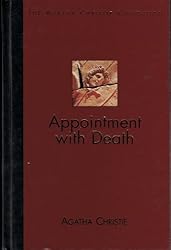
My choice this week is Appointment with Death by Agatha Christie, one of the few novels of hers that I haven’t read. It’s one of the earlier Poirot books, first published in 1938. It begins:

‘You do see, don’t you, that she’s got to be killed?’

The question floated out into the still night air, seemed to hang there a moment and then drift away down into  the darkness towards the Dead Sea.

Hercule Poirot paused a minute with his hand on the window catch. Frowning, he shut it decisively, thereby excluding any injurious night air! Hercule Poirot had been brought up to believe that all outside air was best left outside, and that night air was especially dangerous to the health.

Of course, this has me wondering who ‘she’ is, why she has to be killed and who is talking.

I don’t remember reading before about Poirot’s upbringing – intriguing to think of him as a child!


My Friday Post

Book Beginnings ButtonEvery Friday Book Beginnings on Friday is hosted by Gillion at Rose City Reader where you can share the first sentence (or so) of the book you are reading, along with your initial thoughts about the sentence, impressions of the book, or anything else the opener inspires.

Today I began reading Sad Cypress by Agatha Christie. It’s a Poirot mystery first published in 1940.

Sad cypress

It begins:

Prologue

Elinor Katharine Carlisle. You have been charged upon this indictment with the murder of Mary Gerrard upon the 27th of July last. Are you guilty or not guilty?

Elinor Carlisle stood very straight, her head raised. It was a graceful head, the modelling of the bones sharp and well defined. The eyes were a deep vivid blue, the hair black. The brows had been plucked to a faint thin line.

There was a silence – quite a noticeable silence.

Friday 56Also every Friday there is The Friday 56, hosted by Freda at Freda’s Voice.

These are the rules:

  1. Grab a book, any book.
  2. Turn to page 56, or 56% on your eReader.
  3. Find any sentence (or a few, just don’t spoil it) that grabs you.
  4. Post it.
  5. Add the URL to your post in the link on Freda’s most recent Friday 56 post.

Page 56:

Mrs Wellman may have thought she wanted to die; but side by side with that feeling there ran the hope that she would recover absolutely. And because of that hope, I think she felt that to make a will would be unlucky.

I’ve read up to page 75 and so far Poirot hasn’t appeared, except in the Prologue during Elinor’s trial: Hercule Poirot, his head a little on one side, his eyes thoughtful, was watching her.

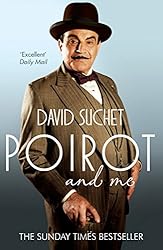
Poirot and Me by David Suchet and Geoffrey Wansell

Prologue

It is a damp, chill Friday morning in November and I am feeling old, very old; so old, indeed, that I am on the brink of death. I have lost two stone in weight, my face is the colour of aged parchment, and my hands are gnarled  like human claws.

I must have watched nearly all, if not all, of David Suchet’s performances as Agatha Christie’s Hercule Poirot. For me he was the perfect Poirot, so it was a given that I would read his autobiography, Poirot and Me, written with the help of his friend Geoffrey Wansell. And it really lives up to its title, as the main subject is David Suchet’s role as Poirot. His first performance as Poirot was in 1988. Over the intervening twenty five years he played the part in every one of the seventy Poirot stories that Agatha Christie wrote, with the exception of a tiny short story called The Lemesurier Inheritance (a story in Poirot’s Early Cases and in The Under Dog).

When I started watching the TV dramas it had been years since I’d read any of Agatha Christie’s books and I wasn’t aware that the early shows were based on her short stories – actually I didn’t even know then that she had written any short stories at all. I’ve read nearly all of her full length novels, but only a few of her short stories so far.

I think Poirot and Me may not appeal to people who are not readers of Agatha Christie’s books as it consists largely of Suchet’s summaries of the stories and how he went about analysing Poirot’s character and how he played the part. He began by compiling a list of Poirot’s characteristics, then considering his voice and his appearance. He made 92 ‘character points’ and his original list is reproduced in the book, along with photos of locations, the cast and crew.

He was most concerned that his portrayal of Poirot should be faithful to the character that Agatha Christie had created. He immersed himself so completely in the character that at times he didn’t know where Poirot ended and he began! Even so, some of the dramatisations are not strictly faithful to the original stories, for various reasons; additional characters are included and some of the plots are expanded versions, especially where the original short stories were slight. Or, for example, as in the case of the collection of short stories that make up The Twelve Labours of Hercules, the stories are so diverse that the screenwriter created an almost entirely new story, though using some of the characters.

At the end of each of the Poirot series, David Suchet didn’t know if any more were in the pipeline and he continued to play other parts in film,  on TV and on the stage. I found this just as interesting as the sections on his role as Poirot and it emphasises his qualities as an actor –  he is a ‘character’ actor, a Shakespearean actor and with the exception of Poirot his roles have been pretty dark and menacing parts. I particularly remember him in Blott on the Landscape, in which he played the malevolent gardener and in The Way We Live Now as the sinister financier Melmotte.

He thinks the charm of the Poirot stories is that

… they reveal a world where manners and morals are quite different from today. There are no overt or unnecessary sex scenes, no alcoholic, haunted detectives in Poirot’s world. He lives in a simpler, some would say more human, era; a lost England, seen through the admiring eyes of this foreigner, this little Belgian detective. For me, that makes the stories all the more appealing, for although the days he lives in seem far away, they are all the more enchanting because of it. (page 64 in the hardback edition)

I think so too – and I think the same charm and appeal can be found in the Miss Marple stories.

David Suchet wrote that when Hercule Poirot died on that late November afternoon in 2012 (as he filmed Curtain) a part of him died, but for me and doubtless for many others, Poirot lives on not just in Agatha Christie’s stories but also in David Suchet’s wonderful performances as his ‘cher ami‘, Hercule Poirot.

  • Hardcover: 320 pages (also available in paperback and on Kindle)
  • Publisher: Headline; 1st edition (7 Nov. 2013)
  • Language: English
  • ISBN-10: 0755364198
  • ISBN-13: 978-0755364190
  • Source: my local library

Three Act Tragedy by Agatha Christie

Three Act Tragedy 001

I’ve been working my way through Agatha Christie’s books over the past few years and I have just a few left to read. Three Act Tragedy is one of them. It was first published in 1935 (as Murder in Three Acts in America).

As the title indicates the book is divided into three acts, or rather parts, First Act – Suspicion, Second Act – Certainty and Third Act – Discovery. It begins as though it were a theatre programme:

Directed by

SIR CHARLES CARTWRIGHT

Assistant Directors
MR SATTERTHWAITE
MISS HERMIONE LYTTON GORE

Clothes by
AMBROSINE LTD

Illumination by
HERCULE POIROT

Summary from the back cover:

Sir Charles Cartwright, the distinguished actor, was giving a party. Around him his guests stood talking and drinking. The Reverend Stephen Babbington sipped his cocktail and pulled a wry face. the chatter continued all around. Suddenly Mr Babbington clutched at his throat and swayed …

The beginning of the drama …

Sir Charles suspects that Mr Babbington was murdered but Hercule Poirot, one of the guests, disagrees and there is nothing to show that his death was by any other than natural causes and besides who could possible have cause to kill him! However, later when Sir Bartholomew Strange, a distinguished Harley Street doctor who was also a guest at Sir Charles’ party, drops dead after sipping a glass of port at another party with some of the original guests, it becomes clear that this is murder by poisoning.

This is one of those cases where Poirot plays a secondary role, preferring to think rather than act and it is Mr Satterthwaite and Sir Charles who investigate the deaths. Mr Satterthwaite is an interesting character – ‘ a  dried-up little pipkin of a man’, ‘ a patron of art and drama, a determined but pleasant snob’ and ‘a man of considerable intelligence and a very shrewd observer of people and things.’ An ideal partner in investigation for Poirot.

(This is Mr Satterthwaite’s first appearance outside a Harley Quin story – I have yet to read the Harley Quin stories.)

As for the other characters, some fade into the background, whilst others like Sir Charles and Hermione Lytton Gore, known affectionately as Egg are in the spotlight. This is one of Agatha Christie’s earlier books and is full of baffling clues, conjuring tricks, clues concealed in conversations, with larger than life personalities, and above all with puzzles to be solved. I really enjoyed it.

In this book Hercule Poirot reveals a little of his history, coming from a large and poor family he had worked hard in the Belgian police force, made a name for himself and an international reputation. He was injured in the First World War and came to England as a refugee, eventually becoming a private inquiry agent. He displays his usual vanity and egotism when talking to Mr Satterthwaite, who had realised that he might have accidentally have drunk the poisoned cocktail, by saying:

‘There is an even more terrible possibility that you have not considered. … It might have been ME.