Choosing a Classic

It’s time I began reading another classic for the Classics Challenge. I thought I’d look at the openings of some to see which takes my fancy.

Wives and Daughters by Elizabeth Gaskell:

To begin with the old rigmarole of childhood. In a country there was a shire, and in that shire there was a town, and in that town there was a house, and in that house there was a room, and in that room there was a bed, and in that bed there lay a little girl; wide awake and longing to get up, but not daring to do so for fear of the unseen power in the next room – a certain Betty, whose slumbers must not be disturbed until six o’clock struck, when she awakened herself ‘as sure as clockwork’, and left the household very little peace afterwards.

It reminds me of the children’s song Old MacDonald had a Farm with its repetitions. The little girl is Molly Gibson and Betty with the unseen powers is the family’s servant. It promises a story of a family and Molly’s place within it and this opening interests me. I don’t know anything about the book and have not seen any of the TV adaptations, so I’m coming to it with a completely open mind – no other interpretations to influence my reading of Elizabeth Gaskell’s words.

Silas Marner by George Eliot:

In the days when the spinning-wheels hummed busily in the farmhouses – and even great ladies, clothed in silk and thread-lace, had their toy spinning-wheels of polished oak – there might be seen, in districts far away from the lanes, or deep in the bosom of the hills, certain pallid undersized men, who, by the side of brawny country-folk, looked like the remnants of a disinherited race.

This one looks good too about village/rural life at the beginning of the 19th century. The only book by George Eliot that I’ve read is Middlemarch, which I loved. You have to have time and patience to read her books. Silas Marner, however, is a much shorter book with less characters than Middlemarch.

Three Men in a Boat by Jerome K Jerome:

There were four of us – George and William Samuel Harris, and myself, and Montmorency. We were sitting in my room, smoking, and talking about how bad we were – bad from a medical point of view I mean, of course.

We were all feeling seedy, and we were getting quite nervous about it.

Yet another author I know nothing about and as for the book I only know it’s reckoned to be a comedy. Again I have very few preconceptions about this book and have no ideas about the characters or what happens. I think Montmorency may be a dog as the book’s full title is Three Men in a Boat (to say nothing of the dog).

Now I just have to decide which one to read.

Wondrous Words Wednesday

Wondrous Words Wednesday is a weekly meme where we share new (to us) words that we’ve encountered in our reading. It is hosted by Kathy, over at BermudaOnion’s Weblog.

My words this week come from After the Armistice Ball by Catriona McPherson, set in 1922.

  • jounced – ‘Alec increased the speed again as we passed the sign for Reivers Rest and we jounced over the close-cropped turf faster and faster until the car rounded the last of the gorse into the open and skidded to a slithering halt.

I could tell from the context what ‘jounced’ means, but it’s a word I’ve not come across before. Looking it up I found it does mean just what it sounds like – ‘to jounce is to move or cause to move with bumps and jolts’ (from The Free Dictionary).

I like the Wikipedia definition of jounce – ‘in physics, jounce or snap is the fourth derivative of the position vector with respect to time, with the first, second, and third derivatives being velocity, acceleration, and jerk, respectively; in other words, the jounce is the rate of change of the jerk with respect to time.’ As I said, just what I thought it was!

  • Thawpit – ‘I should begin calmly but ready to dissolve into tears if the occasion arose and a corner of my handkerchief was soaked in Thawpit to help with the dissolving.’

I had no idea what Thawpit was – and amazingly discovered that it was a a stain remover, a solvent that containing carbon tetrachloride. It’s no longer available, presumably because of the danger of sniffing it etc. No wonder Dandy Gilver (the amateur sleuth in the book) ‘succumbed to a fit of weeping’ when she ‘dabbed her eyes’ with the Thawpit soaked hankie.

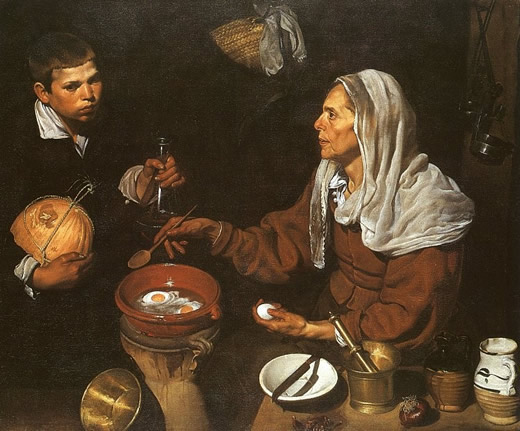
  • chafing-dish – ‘I trigger no obvious trip-wire en route from my bedroom to the ground floor, but every morning Pallister appears with a chafing-dish just as I’m sitting.’ He then cooked Dandy’s eggs.
An old woman poaching eggs in a glazed earthenware chafing dish over charcoal

A chafing-dish is a new term to me. Wikipedia explains that it is ‘a kind of portable grate raised on a tripod, originally heated with charcoal in a brazier, and used for foods that require gentle cooking, away from the fierce heat of direct flames.’


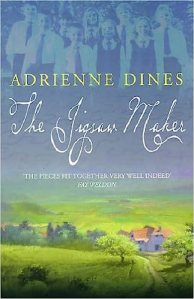
The Jigsaw Maker by Adrienne Dines

It was back in July 2007 that I bought The Jigsaw Maker and it’s been sitting on the to-be-read bookshelves ever since. It was worth waiting for as I thoroughly enjoyed it.

Lizzie Flynn has a shop in a village near Kilkenny, a sort of knick-knack shop selling a variety of goods, cards, flower arrangements, home-made sweets, that needs brightening up and bringing up to date. Much like Lizzie herself, a single lady nearing 50. Her settled life is turned upside down with the arrival of the Jigsaw Maker – Jim Nealon, a stranger who walks into her shop one morning and asks her to sell his beautiful jigsaws.

But these are no ordinary jigsaws. Jim makes wooden jigsaws, tiny intricately shaped pieces ‘finely cut so that they were more like buttons than jigsaw pieces’  And each one is individual showing a photograph of a real place accompanied by a personalised history of the scene:

It’s not just history,’ Jim said. ‘It’s real life. You don’t just know what it looks like now; you get a feel for what it was like in its heyday. It’s a personal memory. (page 8.)

He proposes to take photos of places, not the tourist attractions, but the places their ancestors might have lived and worked. He asks Lizzie to help him by writing about the scenes. To begin with he shows her a photo of the local school and asks her to picture herself back there in 1969 and write what she remembers – what it was like to be a pupil there.

It just so happens that 1969 had been quite an eventful year. This opens up the floodgates of memory for Lizzie as painful and puzzling events from that year almost over power her. Looking back at the child she was she realises that not everything was as it had appeared to her then.

It is just like a jigsaw – all the pieces are there and both the reader and Lizzie have to put them together correctly to get the correct picture. This is a beautifully written book, one with pace and tension in just the right places. I could visualise the scenes and the characters and I became anxious for Lizzie as she realised the truth not only about the events she had seen, but also about her place in those events. There are plenty of repressed secrets that come to the surface and an added mystery too – who is Jim? Why has he come to the village and why did he ask Lizzie in particular to help him?

I hope I’m not going to wait another 5 years to read more books by Adrienne Dines. There are two more: Toppling Miss April and Soft Voices Whispering.

  • My rating: 4.5/5
  • Paperback: 307 pages
  • Publisher: Transita (10 Feb 2006)
  • Language English
  • ISBN-10: 190517523X
  • ISBN-13: 978-1905175239
  • Source: I bought it
  • Author’s website and blog

Saturday Snapshot

Our back garden isn’t the usual type of garden as it’s mainly grass, a stream and woodland. At the end of January we had a tidying-up session in the woodland and a small fire burning small branches that the wind had blown down.

Further down the wood the snowdrops are still in flower.

See more Saturday Snapshots on Alyce’s blog, At Home With Books.

A Classics Challenge – February Prompt: Character

This month’s focus from Katherine of November’s Autumn for the Classics Challenge is on character. Write about a character you find interesting, it doesn’t have to be your favorite. Perhaps your least favorite or a minor one: choose any.

I’m answering a combination of her Level 1 and 2 questions. What phrases has the author used to introduce this character? Find a portrait or photograph that closely embodies how you imagine them.  Has your opinion of them altered? Do you find them believable? Would you want to meet them?

I read The Woman in White in January and wrote some thoughts about previously. The book has some very interesting characters and I’ve chosen to describe the villain – Count Fosco, a friend of Sir Percy Glyde.

We see him first through Marian Halcombe’s eyes (see my earlier post for her description). She is Laura’s half- sister and I think she is the real heroine of this book. She describes Fosco:

He looks like a man who could tame anything. If he had married a tigress, instead of a woman, he would have tamed the tigress.

The man has interested me, has attracted me, has forced me to like him.

he is immensely fat. Before this time I have always disliked corpulent humanity.

here, nevertheless, is Count Fosco, as fat as Henry the Eighth himself, established in my favour, at one day’s notice, without let or hindrance from his own odious corpulence. Marvellous indeed!

She is impressed most by his unfathomable grey eyes, which have a cold, beautiful, irresistible glitter and hold an extraordinary power, one which forces her to look at him and causes her sensations she would rather not feel. Although an Italian, he speaks excellent English. He is old (sixty!), but his movements are light and easy. He is very sensitive to noise and winced when Sir Percy Beat one of the spaniels – he cares for animals more than he cares for humans.

And his most curious peculiarity is his fondness for pet animals – a cockatoo, two canaries and a whole family of white mice, all of which are familiar with him. The birds sit on his fat fingers and the mice crawl all over him, popping in and out of his waistcoat. He kisses them and twitters to his birds.

Below is an illustration from the 1865 edition of the book, which doesn’t really portray him as I see him.

But this is more like it – Michael Crawford’s portrayal in the West End musical in 2004.

As for his character, Marian may be attracted to him, but he is is a true villain, completely domineering, sinister, clever and untrustworthy. He is powerful, a sensualist whose wife is completely besotted by him. Whilst it might seem from my description that Fosco is a caricature, he does come across as a believable character and certainly one I would not wish to meet.