Resistance by Owen Sheers

I decided to read Resistance by Owen Sheers for the Reading Wales Month 2025 hosted by Karen at BookerTalk. It’s another one of my TBRs, a paperback that I bought in 2008. It was first published in 2007 by Faber and Faber (349 pages). Resistance was his first novel.

Owen Sheers was brought up in Abergavenny. The winner of an Eric Gregory Award and the 1999 Vogue Young Writer’s Award, his first collection of poetry, The Blue Book, was shortlisted for the Welsh Book of the Year.

From Owen Sheer’s website:

1944. After the fall of Russia and the failed D-Day landings, a German counter-attack lands on British soil. Within a month, half of Britain is occupied.

Sarah Lewis, a 26-year-old farmer’s wife, wakes to find her husband Tom has disappeared. She is not alone. All the other women in the isolated Welsh border valley of Olchon also wake to find their husbands gone. With this sudden and unexplained absence the women regroup as an isolated, all-female community and wait, hoping for news.

A German patrol arrives in the valley, the purpose of their mission a mystery. When a severe winter forces the two groups into co-operation, a fragile mutual dependency develops. Sarah begins a faltering acquaintance with the patrol’s commanding officer, Albrecht Wolfram. But as the pressure of the war beyond presses in on them, the valley’s delicate state of harmony is increasingly threatened, before being broken completely, with devastating consequences.

Imbued with immense imaginative breadth and confidence, Owen Sheers’ debut novel unfolds with the pace and intensity of a thriller. A hymn to the glorious landscape of the border territories and a gripping portrait of a community under siege, Resistance is a first novel of considerable grace and power.

My thoughts:

I love historical fiction, but this is different – it is alternate history. Sheers speculates upon how the course of history might have been altered if Germany had won the Second World War and invaded and occupied Great Britain, an alarming prospect. The plot centres on the inhabitants of the isolated Olchon valley in the Black Mountains of south-east Wales close to Hereford and the border between Wales and England.  It’s set in 1944–45, shortly after the failure of Operation Overlord and a successful German counter-invasion of Great Britain.  

I enjoyed it mainly for Sheers’ beautiful descriptions of the Welsh countryside, so vivid that I can easily imagine I was there, and the daily tasks of farming life, but this does make it slow reading. The main characters are Sarah, and the other women, Maggie, Mary, Menna and Bethan, living in the valley whose husbands had left, Albrecht, an English speaker and ex-Oxford scholar, who leads a German patrol ordered to establish an observation post in the valley, and George, a teenager, recruited by ‘Tommy Atkins’, a British Intelligence officer, to join the British Resistance movement observing the enemy troop movements.

This is a very visual book, and character driven with very little action until the second half of the book. After reading so much crime fiction and fast action novels I had to adapt my reading speed to appreciate this book and to fully enjoy it. It’s a book to read slowly absorbing the language and descriptions. I particularly liked the details about the Welsh poet, who told Sarah of the tales of King Arthur, Lancelot and Percival (knights of the Round Table) and about Welsh princes, Irish princesses and English armies. One of the stories was about a Welsh king and his army, beaten in the hills by Edward I. Beaten but not killed and not captured and never seen again.

Thousands of men swallowed within the muscles of the earth that formed Wales’ natural defences against her invaders. And they were still there. At this point the poet paused in his painting, placed his brush into a cloudy jar of water and leant closer to Sarah’s listening face. His voice dropped, so quiet she could barely hear him over the running of the streams. Yes, he’d whispered, still there in the hills, deep inside them, buried under the peat, heather, gorse, rowan, bog-cotton, stone and soil. Asleep. Not dead, asleep. An entire army and their king, ready to wake and defend the country in its hour of need. (pages 176 and 177)

Sarah wonders if that’s where their husbands have gone deep underground. She wanted to believe that it was so, that their husbands would be coming back to defend their country. This is a story I’ve come across before, but in England, a legend of a cavern beneath Alderley Edge in Cheshire, full of knights in armour awaiting a call to decide the fate of a great battle for England. There is no king named, but there is a wizard involved, who is referred to as Merlin in later versions of the legend.

Another part that struck a chord with me is when Albrecht took Sarah up into the hills, luring her through a crack in the rock in the cliff wall to a large cavity, where the Mappa Mundi was kept hidden from the SS. It’s a medieval map of the world – I’ve seen it in Hereford Cathedral. Scholars believe it was made around the year 1300 and shows the history, geography and destiny of humanity as it was understood in Christian Europe in the late thirteenth and early fourteenth centuries. In his Afterword Owen Sheers states that the Mapp Mundi was removed from Hereford Cathedral and eventually kept in a coal mine in Bradford-upon-Avon.

There is much more in this book that I’ve not described – the relationship between the women and the Germans, particularly that between Sarah and Albrecht, who eventually realised what they had in common, a love of music and literature. I haven’t described how the wider community reacted to the invasion, and the suspicion and fear that they all experienced. And, having said that there is very little action in this book there is plenty of detail and thoughts about war, occupation, death and above all about Wales. The ending is particularly poignant.

Owen Sheers’ Afterwood explains where he got the idea to write an alternative history. He had first heard of the plans for a British resistance organisation when he was working for a builder in the Llanthony valley and the builder told him how during the war some farmers in the area were given caches of arms which they’d hidden in underground bunkers in the hills. Should the orders come they were to leave their homes and wives and take to the Black Mountains to resist the German army. Later on, in 2001 he heard a radio interview on the Today programme with George Vater, who had, as a young man, been recruited into the Auxiliary Units Special Duties Section comprising local people trained to spy on an occupying German force. Sheers knew George Vater and visiting him, George had shown him cuttings, maps and photographs and told how he had been approached by a man calling himself ‘Tommy Atkins’ who invited to join his Special Duties Section. So, whilst this is a work of fiction it is based on fact, woven into Sheers’ story and he writes that only the valley is real.

I enjoyed it far more than I expected and I’d love to read more of Owen Sheers’ work.

The Likeness by Tana French

It’s nearly the end of March when the Reading Ireland Month 2025 hosted by Cathy at 746 Books ends. I had a list of books to choose from and I read one of my TBRs, The Likeness by Tana French, a book I’ve had for eight years. It’s the second book in the Dublin Murder Squad Mysteries. I read the first book, In the Woods, in 2014.

Hodder and Stoughton| 2008| 574 pages| 4*

Description:

Still traumatised by her brush with a psychopath, Detective Cassie Maddox transfers out of the Murder squad and starts a relationship with fellow detective Sam O’Neill. When he calls her to the scene of his new case, she is shocked to find that the murdered girl is her double. What’s more, her ID shows she is Lexie Madison – the identity Cassie used, years ago, as an undercover detective. With no leads, no suspects and no clues to Lexie’s real identity, Cassie’s old boss spots the opportunity of a lifetime: send Cassie undercover in her place, to tempt the killer out of hiding to finish the job.

I loved this book. I couldn’t remember very much about In the Woods, but I had no difficulty in following The Likeness, so I think it’s a good standalone mystery. It’s a gripping fast paced book, set in Ireland, with well drawn characters, including a group of five friends living in a large house in the countryside. French portrays each of these friends in detail, and as the story progresses their backgrounds and relationships are revealed. The book begins as one of the friends, Lexie Madison is murdered.

Astonished by the fact that Lexie is her double, Detective Cassie Maddox, who played a small role in In the Woods, is persuaded to go undercover at the house, and assume the dead women’s identity, the police having told her friends she wasn’t killed, but was merely wounded. Far-fetched, yes, but it didn’t take me long before I found myself accepting this was feasible. If you find that impossible then this book is not for you, which would be a shame as it is well written, outstanding in its depiction of the Irish countryside and the interaction of the characters. It explores their feelings and emotions, their motivations and desires to such an extent that I was totally engrossed in the book, hoping, irrationally, that Lexie was not dead but had survived and all would be well. Of course, that was not possible and the ending was inevitable.

Now I am just as eager to read the next book in the series, Faithful Place, which features one of the other characters in the Murder Squad, Undercover cop Frank Mackay.

Top Ten Tuesday: Books I Did Not Finish

Top Ten Tuesday is a weekly meme created by The Broke and the Bookish and now hosted by Jana at That Artsy Reader Girl. For the rules see her blog.

The topic this week is Books I Did Not Finish. I rarely give up on books I’ve bought but I borrow lots of library books and often take them back before I’ve finished them. Sometimes it’s because they’re books that are due back before I’ve finished them, or because I’ve borrowed them to see if I’d like them and decide not to read them.

These are books on the library’s list of books I’ve borrowed over the last couple of years that I had to return before I’d read them:

Pianos and flowers : brief encounters of the romantic kind by Alexander McCall Smith, a short story collection

A possible life by Sebastian Faulks

Sugar money : a novel by Jane Harris

The Shrouded Path by Sarah Ward

Cuddy by Benjamin Myers

Daphne Du Maurier and her sisters : the hidden lives of Piffy, Bird and Bing by Jane Dunn

Maltese Falcon by Dashiel Hammett

Hag-seed : the Tempest retold by Margaret Atwood

The beginner’s goodbye by Anne Tyler

Your beautiful lies by Louise Douglas

Have you read any of them?

Top Five Tuesday:Top 5 books with an emotion in the title

Top 5 Tuesday was created by Shanah at Bionic Book Worm, and it is now being hosted by Meeghan at Meeghan Reads. For details of all of the latest prompts for January to March, see Meeghan’s post here.

Today the topic is Top 5 books with an emotion in the title. Whether it’s happy or sad, anger or excitement, any emotion is fine!

These are all books I’ve read with links to my reviews.

All Passion Spent by Vita Sackville-West. Lady Slane is an ageing British aristocrat. Her husband has recently died at the age of 94, leaving his family with the problem of ‘What was to be done about Mother?’ The family are four sons and two daughters. Lady Slane at 88 is still a beautiful woman and quickly but quietly asserts her independence. She ignores her children and decides to live, with her maid Genoux, in a house in Hampstead that she had first seen thirty years previously. This is a novel of contrasts, beautifully written, and expressing so many emotions in a quiet unassuming manner.

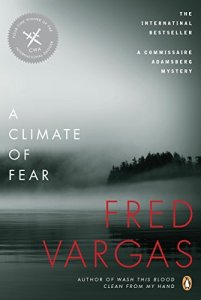
A Climate of Fear by Fred Vargas, a Commissaire Adamsberg murder mystery. I like Adamsberg; he’s original, a thinker, who doesn’t like to express his feelings, but mulls things over. He’s an expert at untangling mysteries, an invaluable skill in this, one of the most complicated and intricate mysteries I’ve read. He’d compared the investigation right from the start to a huge tangled knot of seaweed. A woman is found bleeding to death in her bath, having apparently committed suicide, there’s a secretive society studying and re-enacting scenes from the French Revolution, and two deaths ten years earlier on an isolated island off the coast of Iceland, where the afturganga, the demon who owns the island summons people to their death.

The Grapes of Wrath by John Steinbeck. Steinbeck’s writing conjures up such vivid pictures and together with his use of dialect I really felt I was there in America in the 1930s travelling with the Joad family on their epic journey from Oklahoma to California. What a long, hard journey with such high hopes of a better life and what a tragedy when they arrived to find their dreams were shattered, their illusions destroyed and their hopes denied. Throughout the book, Steinbeck shows the inhumanity of man to man and also the dignity and compassion, the essential goodness and perseverance of individuals against such appalling conditions and inhumane treatment. 

Stone Cold Heart by Caz Frear, a police procedural written in the first person present tense narrated by DC Cat Kinsella who is part of the Murder Investigation Team 4. Naomi Lockhart, a young Australian woman was murdered and at first it looked as though her flatmate had killed her. It’s a most convoluted and tangled tale, filled with secrets and lies, most of which are complete red herrings.  Alongside the murder mystery, the book follows the story of DC Cat Kinsella’s family and the mystery surrounding Maryanne Doyle that was told in Sweet Little Lies – you really do need to read that book first to understand what is going on in her family life in this book. Cat is a conflicted character to say the least and although other readers have found her a warm and likeable character I found her one of the most irritating fictional detectives in crime fiction.

Cruel Acts by Jane Casey. A year ago, Leo Stone was convicted of murdering two women and sentenced to life in prison. Now he’s been freed on a technicality, and he’s protesting his innocence. DS Maeve Kerrigan and DI Josh Derwent are determined to put Stone back behind bars where he belongs, but the more Maeve digs, the less convinced she is that he did it. Then another woman disappears in similar circumstances. Is there a copycat killer, or have they been wrong about Stone from the start?

Murder at Gull’s Nest by Jess Kidd

Faber & Faber| 11 Mar. 2025| 335 pages| review copy| e-book| 4*

Summary from the publishers’ website:

The first in a sparkling new 1950s seaside mystery series, featuring sharp-eyed former nun Nora Breen.

After thirty years in a convent, Nora Breen has thrown off her habit and set her sights on the seaside town of Gore-on-Sea. Why there? Why now? Instinct tells her it’s better not to reveal her reasons straight away. She takes a room at Gulls Nest guest house and settles in to watch and listen.

Somewhere in the north, a religious community meets for Vespers. Here on the southeast coast, Nora Breen prepares for braised liver and a dining room full of strangers.

Over disappointing – and sometimes downright inedible – dinners, Nora realises that she was right to keep quiet: her fellow lodgers are hiding something. At long last, she has found an outlet for her powers of observation and, well, nosiness: there is a mystery to solve, and she is the only person for the job.

My thoughts:

This is the first one of Jess Kidd’s books that I’ve read and I didn’t know what to expect. I enjoyed it. It’s quirky with some odd characters. At times it feels like a cosy crime mystery, but it’s also rather dark and foreboding, whereas at other times there’s some humour and also a hint of a romance. The setting is good in a fictional 1950s British seaside town.

It’s the mystery and the characters (there a lot) that stand out the most in my mind. Nora, the main character, is a no-nonsense person, who has just left a convent after 30 years, where she worked as a nurse. She went to the same guest house at Gore-on-Sea to find her friend, Frieda, a novice who had previously left the same convent due to ill health. Frieda had been writing to her weekly, but Nora hadn’t heard from her for some time and knew something was very wrong.

There are some very strange people. Among these people the ones who stood out for me are Nora, who is adjusting to life outside the outside world, whilst trying not to draw attention to herself. Dinah, who is eight years old, is the daughter of Helena, the owner of Gulls Nest, and is a very strange child. Nora first met Dinah hanging upside down from a curtain rail. Sometimes she hides in a small cupboard and doesn’t speak to anyone, living in a world of her own. Then there is old Professor Poppy, a Punch and Judy man with his puppets, and the mysterious Karel Jezek, who follows the young married couple Stella and Teddy. Teddy is suspicious of Karel, suspecting that something is going on between him and Stella.

Frieda had told Nora that she believed all the people at Gulls Nest were concealing some kind of secret. And indeed they were as Nora finds out. Life at Gulls Nest is tense, as all the residents’ secrets and past lives bubble away under the surface. Matters come to the boil as some of them die, or are they murdered? Nora helps Detective Inspector Rideout of the local police as he investigates the deaths as well as Frieda’s disappearance.

Overall I loved this book, crime fiction that is really in a category all of its own, that kept me wondering what was going on all the way to the end.

Jess Kidd was brought up in London as part of a large family from county Mayo and has been praised for her unique fictional voice. Her debut, Himself, was shortlisted for the Irish Book Awards in 2016, the Authors’ Club Best First Novel Award 2017 and longlisted for the John Creasey (New Blood) Dagger 2017. Jess won the 2016 Costa Short Story Award. Her second novel, The Hoarder, also titled Mr. Flood’s Last Resort (U.S.), was shortlisted for the Kerry Group Irish Novel of the Year 2019 and longlisted for the 2020 International Dublin Literary Award. Both books were BBC Radio 2 Book Club Picks. Her third book, the Victorian detective tale Things in Jars, has been released to critical acclaim. Jess’s work has been described as ‘Gabriel García Márquez meets The Pogues.’

Jess’s first book for children, Everyday Magic, was published in April 2021. Jess’s fourth novel for adults, The Night Ship, was released in August 2022. Murder at Gulls Nest, the first in the Nora Breen Investigates series will publish in Spring 2025. Jess is currently developing her own original TV projects with leading UK and international TV producers. (Copied from the C & W, a London-based literary agency’s website)

Many thanks to the publishers for a review copy via NetGalley.

Bleak House by Charles Dickens: Book Beginnings on Friday & The Friday 56

Every Friday Book Beginnings on Friday is hosted by Gillion at Rose City Reader where you can share the first sentence (or so) of the book you are reading. You can also share from a book you want to highlight just because it caught your fancy.

I’m featuring Bleak House, one of the books I’m currently reading.

Chapter 1 In Chancery

London. Michaelmas term lately over, and the Lord Chancellor sitting in Lincoln’s Inn Hall. Implacable November weather. As much mud in the streets as if the waters had but newly retired from the face of the earth, and it would not be wonderful to meet a Megalosaurus, forty feet long or so, waddling like an elephantine lizard up Holborn Hill.

Also every Friday there is The Friday 56, hosted by Freda at Freda’s Voice, but she is taking a break and Anne at My Head is Full of Books has taken on hosting duties in her absence. You grab a book and turn to page 56 (or 56% of an eBook), find one or more interesting sentences (no spoilers), and post them.

I found it a quite delightful place – in front, the pretty avenue and drive by which we had approached (and where, by the by, we had cut up the gravel so terribly with our wheels that I asked the gardener to roll it) at the back, the flower garden, with my darling at her window up there, throwing it open to smile at me, as if she would have kissed me from that distance.

The narrator in this passage is Esther Summerson. She and the two wards in the Jarndyce and Jarndyce case, had arrived at Bleak House and she is describing the scene that she saw from her bedroom window on their first morning at Bleak House.

Description:

Bleak House is the ninth novel by Charles Dickens, published in twenty monthly installments between March 1852 and September 1853. It is held to be one of Dickens’s finest novels, containing one of the most vast, complex and engaging arrays of minor characters and sub-plots in his entire canon. The story is told partly by the novel’s heroine, Esther Summerson, and partly by an omniscient narrator. Memorable characters include the menacing lawyer Tulkinghorn, the friendly but depressive John Jarndyce and the childish Harold Skimpole, as well as the likeable but imprudent Richard Carstone.

At the novel’s core is long-running litigation in England’s Court of Chancery, Jarndyce and Jarndyce, which has far-reaching consequences for all involved. This case revolves around a testator who apparently made several wills, all of them seeking to bequeath money and land surrounding the Manor of Marr in South Yorkshire. The litigation, which already has consumed years and sixty to seventy thousand pounds sterling in court costs, is emblematic of the failure of Chancery. Dickens’s assault on the flaws of the British judiciary system is based in part on his own experiences as a law clerk, and in part on his experiences as a Chancery litigant seeking to enforce his copyright on his earlier books. His harsh characterisation of the slow, arcane Chancery law process gave memorable form to pre-existing widespread frustration with the system. Though Chancery lawyers and judges criticized Dickens’s portrait of Chancery as exaggerated and unmerited, his novel helped to spur an ongoing movement that culminated in enactment of the legal reform in the 1870s. In fact, Dickens was writing just as Chancery was reforming itself, with the Six Clerks and Masters mentioned in Chapter One abolished in 1842 and 1852 the need for further reform was being widely debated.

I first read this book many years ago before I began my blog.