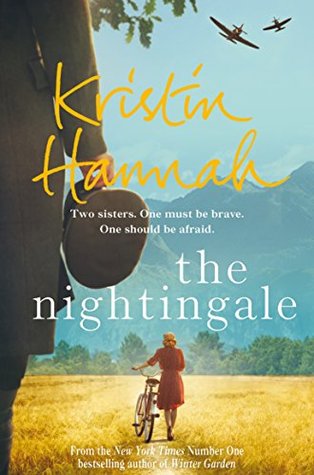
The Nightingale by Kristin Hannah

the Nightingale

Pan |29 January 2015| 5*

The Nightingale, in 2015 was voted a best book of the year by Amazon, Buzzfeed, iTunes, Library JournalPasteThe Wall Street Journal and The Week.  Additionally, the novel won the coveted Goodreads and People’s Choice Awards. The audiobook of The Nightingale won the Audiobook of the Year Award in the fiction category. And I can see why.

Blurb:

Despite their differences, sisters Vianne and Isabelle have always been close. Younger, bolder Isabelle lives in Paris while Vianne is content with life in the French countryside with her husband Antoine and their daughter. But when the Second World War strikes, Antoine is sent off to fight and Vianne finds herself isolated so Isabelle is sent by their father to help her.

As the war progresses, the sisters’ relationship and strength is tested. With life changing in unbelievably horrific ways, Vianne and Isabelle will find themselves facing frightening situations and responding in ways they never thought possible as bravery and resistance take different forms in each of their actions.

My thoughts:

The Nightingale is one of the most moving books I’ve read and I was emotionally drained by the end of the story. It tells of two French sisters and their experiences during the occupation of France in the Second World War. The younger sister, Isabelle is beautiful, impetuous and a rebel. She joins the Resistance Movement, whereas Vianne, married,  stays at home looking after her daughter whilst her husband goes off to war.

This is a story of courage, of love and of the determination to survive under dreadful and appalling conditions – the horrors and dilemmas of living in an occupied country under Nazi rule, with rationing, curfews, and the dangers of being caught helping or of being a Resistance fighter. Vianne was faced with the dilemmas of whether to collude with the Nazi officers billeted in her house and whether to help her Jewish friend to escape before she could be taken off to the concentration camps. Isabelle takes desperate risks as she helps British and American airmen to freedom over the Alps to Spain. Hannah spares no details and I struggled to read the details of what people can do to those they consider their enemies.

Interspersed at intervals the narrative moves to 1995 as one of the sisters is invited and goes to a reunion. For a long time I couldn’t decide which one it was and by the time it was revealed I was in tears at the sadness and pathos of it all.

This book is one of my TBRs – a book I’ve owned prior to 1 January 2018.

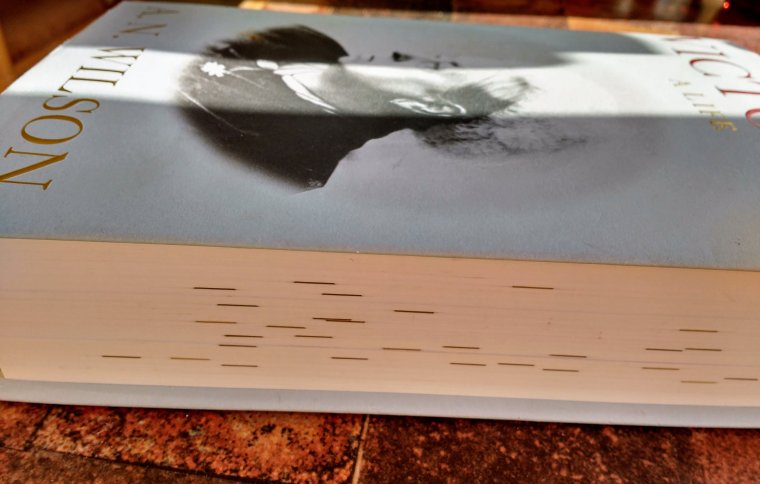
Victoria: A Life by A. N. Wilson

I finished reading Victoria: A Life at the end of January with a sense of sadness that it was over – I’d been reading it for three months and I have learned so much and enjoyed it immensely. Victoria was 81 when she died and had been Queen for nearly 64 years, from 1837 to 1901. She’d had 9 children and was grandmother of 42.

A. N. Wilson’s biography of Victoria is masterful, detailed and like all good biographies is well researched and illustrated, with copious notes, an extensive bibliography and an index. He had access to the Royal Archives and permission from Her Majesty Queen Elizabeth II to quote from materials in royal copyright. He portrays her both as a woman, a wife and mother as well as a queen set against the backdrop of the political scene in Britain and Europe.

Whilst I was reading I wrote three posts about different aspects of the book that interested me at the time – one on my thoughts soon after I started reading the biography, one on Christmas at Windsor in 1860 and one on Victoria and John Brown.

And now I’ve finished it I’m not sure what to write about it. It has fascinated me and surprised me. It surprised me because it is so extensive, with so much about her involvement in the politics of the time. It has made me want to know more about so many of the people – such as Lord Melbourne, Gladstone, who she disliked so much that when he stayed at Balmoral she wouldn’t speak to him, Disraeli who she liked very much and of course her beloved Albert.

I think A.N.Wilson himself sums it up best in this quotation:

‘Writing about Queen Victoria has been one of the most joyous experiences of my life. I have read thousands (literally) of letters never before published, and grown used to her as to a friend. Maddening? Egomaniac? Hysterical? A bad mother? Some have said so. What emerged for me was a brave, original woman who was at the very epicentre of Britain’s changing place in the world: a solitary woman in an all-male world who understood politics and foreign policy much better than some of her ministers; a person possessed by demons, but demons which she was brave enough to conquer. Above all, I became aware, when considering her eccentric friendships and deep passions, of what a lovable person she was.’ A. N. Wilson

and in the last paragraph of the book he wrote of Victoria’s greatness and the awe awe she inspired:

The awe is for Queen Victoria the woman. Step over the carpet to that plump little figure that sits at her table, state papers or a Hindustani grammar open in front of her, the Munshi or Princess Beatrice at her side. You are approaching someone of great kindliness, someone of a far sharper intelligence than you would have guessed, and someone who – contrary to the most tedious of all the clichés about her – was easily amused. but you are also, if you have your wits about you, more than a little afraid. You are in the presence of greatness. (page 575)

This was going to be my last post about the book, but I have placed so many markers in places of interest to me as I read that I think I may do at least one more just of passages that I’d like to remember.

IMG_20180215_101313191_HDR.jpg

My Tuesday Post: The Nightingale by Kristin Hannah

Every Tuesday First Chapter, First Paragraph/Intros is hosted by Vicky of I’d Rather Be at the Beach sharing the first paragraph or two of a book she’s reading or plans to read soon.

Teaser Tuesdays is hosted by The Purple Booker. Post two sentences from somewhere in a book you’re reading. No spoilers, please! List the author and book title too.

My first paragraph this week is from The Nightingale by Kristin Hannah, which I’m currently reading. It’s one of my TBRs.

The Nightingale: Bravery, Courage, Fear and Love in a Time of War

It begins:

April 9, 1995 – The Oregon Coast

If I have learned anything in this long life of mine, it is this: In love we find out who we want to be; in war we find out who we are. Today’s young people want to know everything about everyone. They think that talking about a problem will solve it. I come from a quieter generation. We understand the value of forgetting, the lure of reinvention.

Beginning in 1995 this novel moves back in time to the start of the Second World War to France.

Here is a teaser from page 88:

Vianne’s anger dissolved; without it, she felt inexpressibly tired. This essential difference had always been between them. Vianne the rule follower and Isabelle the rebel. Even in girlhood, in grief, they had expressed their emotions differently.

Blurb:

Despite their differences, sisters Vianne and Isabelle have always been close. Younger, bolder Isabelle lives in Paris while Vianne is content with life in the French countryside with her husband Antoine and their daughter. But when the Second World War strikes, Antoine is sent off to fight and Vianne finds herself isolated so Isabelle is sent by their father to help her.

As the war progresses, the sisters’ relationship and strength is tested. With life changing in unbelievably horrific ways, Vianne and Isabelle will find themselves facing frightening situations and responding in ways they never thought possible as bravery and resistance take different forms in each of their actions.

I’ve read nearly half the book so far and am really enjoying it, but I’m not sure yet about the identity of the narrator in the opening chapter – which sister is it? I keep changing my mind about it. Please don’t tell me if you know – that would be a such a spoiler …

My Friday Post: The Lake House by Kate Morton

Book Beginnings Button

Every Friday Book Beginnings on Friday is hosted by Gillion at Rose City Reader where you can share the first sentence (or so) of the book you are reading, along with your initial thoughts about the sentence, impressions of the book, or anything else the opener inspires.

This week I’m featuring The Lake House by Kate Morton. This is one of my TBRs.

It begins in Cornwall in August 1933:

The rain was heavy now and the hem of her dress was splattered with mud. She’d have to hide it afterwards; no one could know that she’d been out.

Also every Friday there is The Friday 56, hosted by Freda at Freda’s Voice. These are the rules:

  1. Grab a book, any book.
  2. Turn to page 56, or 56% on your eReader.
  3. Find any sentence (or a few, just don’t spoil it) that grabs you.
  4. Post it.
  5. Add the URL to your post in the link on Freda’s most recent Friday 56 post.

Page 56

Sadie pictured the muddy lake and its eerie avian population. ‘Yes, that’s it. What happened there?’

‘A terrible business,’ Louise said, with a sad shake of her head. ‘Back in the thirties, before I was born. My mother used to talk about it, though – usually when she wanted to stop us kids from wandering too far. A child went missing on the night of a grand party. It was a big story at the time; the family was wealthy and the national press paid a lot of attention. There was a huge police investigation, and they even brought down the top brass from London. Not that any of it helped.

What a coincidence! I think these two extracts sum up what this book is about – an unsolved mystery of a child who disappeared without a trace.

I’ll be reading this book soon. What do you think? does it tempt you too?

A – Z of TBRs: P, Q and R

I’m now up to P, Q and R in my A – Z of TBRs, a series of posts in which I take a fresh look at some of my TBRs to inspire me to read more of them, or maybe to decide not to bother reading them after all. This time I’ve included one e-book.

– is for The Power House by John Buchana book I’ve had since 2014. I bought this book because I’d read and enjoyed John Buchan’s The Thirty-Nine Steps.

The Power House

It’s a short book of just 108 pages and my copy has an introduction by Stella Rimington. She writes:

The Power House is one of the least known of Buchan’s mature works, a tale without a plot, and so full of holes that it calls to mind Samuel Johnson’s definition of a ‘network’ – ‘anything reticulated and desuccated at equal distances, with interstices between the intersections’. It is pure essence of Buchan – a demonstration of his magical power to weave a tale out of no materials but the threads and colours of his imagination.

When his friend Charles Pitt-Heron vanishes mysteriously, Sir Edward Leithen, MP, is at first only mildly concerned. But a series of strange events that follow Pitt-Heron’s disappearance convinces Leithen that he is dealing with a sinister secret society. Their code name is ‘The Power-House’.

I cast my mind back to gather recollections of Pitt-Heron, but all I could find was an impression of a brilliant, uncomfortable being, who had been too fond of the byways of life for my sober tastes. There was nothing crooked in him in the wrong sense, but there might be a good deal that was perverse. I remember consoling myself with the thought that, though he might shatter his wife’s nerves by his vagaries, he would scarcely break her heart.

To be watchful, I decided, was my business. And I could not get rid of the feeling that I might soon have cause for my vigilance. (page 9)

Q – is for The Queen’s Man by Sharon Penman (on my Kindle for two years). I bought this after reading her Sunne in Splendour, which I absolutely loved.

The Queen's Man

It’s set in AD 1183, when Richard the Lionheart is missing, thought to be dead and his brother Prince John is scheming to take the Crown. Justin de Quincy has just discovered his father is the Bishop of Chester. A dying man, a goldsmith, gives him a letter to deliver to Queen Eleanor, (Richard’s and John’s mother) which brings him into great danger as it reveals whether Richard is alive or dead.

Captured by Henry’s soldiers, she [Eleanor] was held prisoner for sixteen years, freed only by Henry’s death. Such a lengthy confinement would have broken most people. It had not broken Eleanor. The passionate young queen and the embittered, betrayed wife were ghosts long since laid to rest. Now in her seventy-first year, she was acclaimed and admired for her sagacity and shrewd counsel, reigning over England in her son’s absence, fiercely protective of his interests, proud matriarch of a great dynasty. A living legend. And this was the woman expecting a letter from a murdered goldsmith? Justin thought it highly unlikely. (location 323)

R– is for Resistance by Owen Sheers a book I’ve had for nearly ten years. One of the reasons I haven’t read this before now is that I couldn’t find it for a while until I discovered it out of order behind other books that I’d double-shelved. I can’t remember now what had prompted me to buy this book. Owen Sheers is an author, poet and playwright.

Resistance

Resistance gives an alternative outcome to World War Two, one in which the D-Day landings had failed in 1944 and the Nazis had invaded the UK. Sarah Lewis wakes to discover her husband and all the men in the Welsh border valley of Olchon have gone. It’s the story of a community under siege.

The meeting with Atkins had happened too quickly for George to think on the consequences yet. His head was light, open, and he swung his scythe with a renewed energy. He felt exposed, as if a layer of skin had been shaved from him, bringing him into closer contact with the world. The blade’s edge against the young stalks of bracken, the calligraphy of the swallows above him. Everything seemed clearer, brought into sharper focus. Just an hour ago the war was a different country, the contours of which he’d traced through the newspapers, in radio reports. But now he was involved, connected. He had the strange sensation of his life simultaneously diminishing and expanding under the impression of Atkins’s words and for the second time that week he felt older than his seventeen years. (page 25)

What do you think? Do you fancy any of them? Would you ditch any of them?

A – Z of TBRs: M, N and O

I’m now up to M, N, and O in my A – Z of TBRs, a series of posts in which I take a fresh look at some of my TBRs to inspire me to read more of them by the end of the year, or maybe to decide not to bother reading them after all. These TBRs are all physical books – I’ve not included e-books. Looking at my books like this is encouraging me to read more of my own books as I’ve read two of the books I’ve featured in the earlier posts.

I’m enjoying searching my shelves – finding books I’d forgotten were there (the disadvantage of shelving books behind others).

MNO bks P1020320

– is for Mercy by Jodie Picoulta book I’ve had since 2008. LibraryThing predicts that I probably won’t like this book. Two cousins are driven to extremes by the power of love, as one helps his terminally ill wife commit suicide and the other becomes involved in a passionate affair with his wife’s new assistant.

I bought this book because I’ve read and enjoyed three other books by Jodie Picoult.

According to the sworn voluntary statement of James MacDonald, his wife had been suffering from the advanced stages of cancer and had asked him to kill her. Which did not account for the raw scratches on his face, or the fact that he had traveled to a town he had never set foot in to commit the murder. Maggie had not videotaped her wishes, or even written them down and had them notarized to prove she was of sane mind – Jamie said that she hadn’t wanted it to be a production, but a simple gift.

What it boiled down to, really, was Jamie’s word. Cam’s only witness was dead. He was supposed to believe the confession of James MacDonald solely because he was a MacDonald, a member of his clan. (page 39)

N – is for Notes from an Exhibition by Patrick Gale (on my TBR shelves since 2011). LibraryThing predicts that I probably will like this book. When troubled artist Rachel Kelly dies painting obsessively in her attic studio in Penzance, her saintly husband and adult children have more than the usual mess to clear up. She leaves behind an extraordinary and acclaimed body of work – but she also leaves a legacy of secrets and emotional damage that will take months to unravel.

I haven’t read any of Patrick Gale’s books, but I was attracted to it by the blurb.

‘We are here to say goodbye to our dear Rachel, who was a regular attender since Anthony first brought her to Penzance a little over forty years ago. For those of you who have never been to a Friends’ Meeting before, this may not be the kind of funeral you’re used to. The proceedings take the form of a Quaker Meeting for Worship. This is based on silent contemplation. There are two aims in our worship: to give thanks for the life that has been lived and to help those who mourn to feel a deep and comforting sense of divine presence within us. The silence may be broken by anyone, Quaker or not, who feels moved to speak, to pray or offer up a memory of Rachel.’ (page 62)

O – is for An Officer and a Spy by Robert Harris a book I’ve only had for nearly two years. LibraryThing predicts that I probably will like this book. A recreation of a scandal that became the most famous miscarriage of justice in history, this is the story of the infamous Dreyfus affair told as a chillingly dark, hard-edged novel of conspiracy and espionage. Paris in 1895. Alfred Dreyfus, a young Jewish officer, has just been convicted of treason, sentenced to life imprisonment at Devil’s Island, and stripped of his rank in front of a baying crowd of twenty-thousand.

I bought this on the strength of the other books by Robert Harris that I’ve enjoyed. I’ve heard of the Dreyfus affair but know very little about it.

Beneath the letters is a thin manilla envelope containing a large photograph, twenty five centimetres by twenty. I recognise it immediately from Dreyfus’s court martial – a copy of the covering note, the famous bordereau, that accompanied the documents he passed to the Germans. It was the central evidence against him produced in court. Until this morning I had no idea how the Statistical Section had got its hands on it. And no wonder. I have to admire Lauth’s handiwork. Nobody looking at it could tell it had once been ripped into pieces: all the tear marks have been carefully touched out, so that it seems a whole document. (pages 40 -41)

What do you think? Do you fancy any of them? Would you ditch any of them?