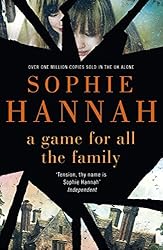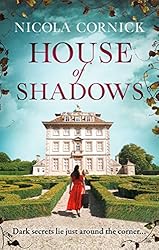
A Game For All the Family by Sophie Hannah

I’ve recently finished reading A Game For All the Family by Sophie Hannah, a standalone book, described as ‘ a literary puzzle to unlock the dark side of the mind.’

Publishers’ blurb:

Justine thought she knew who she was, until an anonymous caller seemed to know better…

After escaping London and a career that nearly destroyed her, Justine plans to spend her days doing as little as possible in her beautiful home in Devon.

But soon after the move, her daughter Ellen starts to withdraw when her new best friend, George, is unfairly expelled from school. Justine begs the head teacher to reconsider, only to be told that nobody’s been expelled – there is, and was, no George.

Then the anonymous calls start: a stranger, making threats that suggest she and Justine share a traumatic past and a guilty secret – yet Justine doesn’t recognise her voice. When the caller starts to talk about three graves – two big and one small, to fit a child – Justine fears for her family’s safety.

If the police can’t help, she’ll have to eliminate the danger herself, but first she must work out who she’s supposed to be…

Practically from the start I had my doubts about Justine. Was she an unreliable narrator? Could I believe her story, told in the third person but revealing what was going through her mind? Or was her daughter Ellen right when she told her mother that she was a ‘nutter‘? That sense of distrust pervaded my reading. Obviously something had happened to make Justine give up her job in TV drama production and want to ‘do Nothing’, something traumatic and life-changing – had it affected her mental stability or had it happened because she was mentally unstable? I couldn’t decide.

What I can say is that it’s a book about the truth – just who is telling the truth, just who is who they purport to be, and most of all about identity. Who is real, who is making it all up (well Sophie Hannah, obviously).

It is described as a ‘chilling ‘ novel, but I didn’t find it spine tingling, or scary, because it came over to me as artificial, and contrived. It’s also long-winded and mostly completely unbelievable, which made it lose any sense of tension or suspense. But it is a cleverly complicated plot, with stories within stories, – it’s just not chilling.

As well as the anonymous threatening phone calls, and the head teacher’s denial that George had not been expelled and indeed her insistence that he had never even been at the school, Justine is also puzzled by the story that Ellen is writing for her creative writing homework – a story set in their house about a strange family who had lived there in the past and a murder that had taken place there. Where did Ellen get this story, is it based on fact? Ellen simply won’t tell her. Are the phone calls connected to this story and to George?

Maybe it’s too complicated, because at times I just wished the endless questions that went through Justine’s mind would come to an end. They did of course and by the time I did get to the end I still couldn’t decide whether Ellen was right – is Justine a nutter and as I suspect an unreliable narrator, or not?

I didn’t love this book, but it certainly filled my mind and made me think both whilst I was reading it and for days afterwards – and I like that about a book. If Justine is a reliable narrator and was telling the truth all along then she is still a nutter, because if what she described actually happened at the end of the story it was terrible and she was mentally ill and in that case, definitely a chilling ending. I just can’t decide! It is an extraordinary and weird book.

My thanks to Lovereading for sending me an uncorrected proof copy of this book that has had me puzzling for days. A Game For All the Family is due to be published on 13 August 2015 by Hodder & Stoughton.

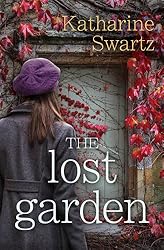
The Lost Garden by Katharine Swartz

The Lost Garden is  an emotionally intense novel of love, loss and grief, set in both the past and the present day, in a small village on the Cumbrian coast.

In 1919 Eleanor, the daughter of the vicar of Goswell, is struggling to adjust to the loss of her brother, Walter who died just before the Armistice was declared and in the present day half-sisters Marin and Rebecca are coming to terms with the death of their father and his wife.

The link between the two stories centres around the walled garden at the back of the Bower House, a small house next to the church. It was said to have been the herb garden for the monastery before the Reformation.

In 1919 the garden is covered in brambles and Eleanor decides she wants to make it into a garden of remembrance, a place to just be, to remember or to forget as much as you need. And she begins to restore it with the help of the church gardener, Jack. As they do so the garden begins to blossom as winter moves into spring and summer, but the mood of both the family and the country remains sombre as they come to terms with the aftermath of the First World War.

In the present day, Marin has bought the Bower House, not knowing its history. Rebecca discovers the walled garden once more overgrown with brambles and weeds and it captures her imagination. And when Marin she sees a photo of a young woman in the garden, thought to have been taken around 1920 she is determined to find out more – just who was the young woman and what is underneath the brambles. With the help of the local gardener, Joss, she begins to restore the garden and in doing so they discover secrets about both the past and the present.

The Lost Garden is a gentle story, well told and an enjoyable read, switching between the past and the present. The differences in attitudes and social conventions of the times provide a distinct contrast and highlights the parallels between the two stories. I liked the story-lines for both Marin and Eleanor, both have difficult relationships with their sisters and both are coming to terms with their grief, but on the whole I was more interested in Eleanor’s story, set against the backdrop of the post First World War.

My thanks to Lovereading for providing an advance proof of this novel, due to be published 15 May 2015. The Lost Garden is the second book in Katharine Swartz’s Tales from Goswell series – the first is The Vicar’s Wife.

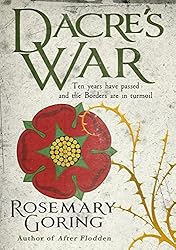
Dacre’s War by Rosemary Goring

Dacre’s War is compelling reading, a  thoroughly absorbing and beautifully written novel set in the Scottish and English Borders and London between 1523 – 1525 some ten years after the events described in Rosemary Goring’s earlier book, After Flodden. I wondered as I began reading whether it could equal After Flodden, a book I loved when I read it two years ago – it did. I think it even surpasses it.

I loved Dacre’s War and keen as I was to read to the end I didn’t want to leave the characters. Once again I was swept away by the story, re-living the scenes through Rosemary Goring’s vivid descriptions and the drama of the characters’ lives, people who came to life in the pages of this book.

Dacre’s War describes how Adam Crozier, the head of his clan, plots to take revenge on Lord Thomas Dacre, the Warden General of the English Marches and the Keeper of Carlisle, who had brought about the death of Adam’s father. Ten years after the Battle of Flodden, Dacre is the most powerful man in the north of England, but the Marches are a constant battlefield, dangerously out of control, and a hotbed of thieves and killers in thrall to the Warden. Without him Henry VIII believes the situation would be much worse.

It is against this background that Crozier forms an alliance with Dacre’s enemies, both English and Scots to inform Henry of Dacre’s crimes and bring about his downfall.

There are some remarkable scenes in this book, and amongst them are the scenes in the Star Chamber where Dacre is brought to answer the charges against him in front of Cardinal Wolsey and his imprisonment in the Fleet Prison. I felt as though I was there, watching, breathing the same air – not a pleasant experience. Similarly with Crozier, I could visualise his home, Crozier’s Keep, sense the tension and fear as his wife, Louise, is left at home, pregnant and in danger of losing the baby.

There is so much packed in this book, political intrigue, personal conflict and vengeance, and spies, manipulators and double crossers abound. It is impossible to write more without revealing the plot and the eventual ending. It’s a brilliant book.

Dacre’s War is due to be published in June 2015. My copy is a pre-publication review copy courtesy of www.lovereading.co.uk.

  • Hardcover: 352 pages
  • Publisher: Polygon (16 June 2015)
  • Language: English
  • ISBN-10: 1846973112
  • ISBN-13: 978-1846973116

Rosemary Goring was born in Dunbar and studied social and economic history at the University of St Andrews; and, after graduation, worked at W&R Chambers as a reference editor. Rosemary was the literary editor of Scotland on Sunday, followed by a brief spell as editor of Life & Work, the Church of Scotland’s magazine, before returning to newspapers as literary editor of the Herald, and later also of the Sunday Herald. In 2007 she published Scotland: The Autobiography: 2000 Years of Scottish History By Those Who Saw it Happen, which has since been published in America and Russia.

Reading Challenges: Read Scotland, Historical Fiction Challenge.

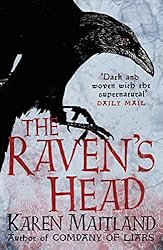
The Raven’s Head by Karen Maitland

I loved Karen Maitland’s medieval mysteries, Company of Liars: a novel of the plague and The Owl Killers and although I didn’t think The Vanishing Witch had quite the same magic spark I still enjoyed it. So when Lovereading offered me a proof copy of The Raven’s Head for review I was keen to read it.
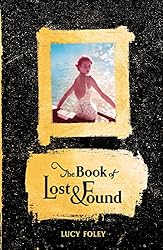
Publisher: Headline Review
Publication date: March 12, 2015
ISBN: 9781472215055

Summary from Karen Maitland’s website:

Vincent is an apprentice librarian who stumbles upon a secret powerful enough to destroy his master. With the foolish arrogance of youth, he attempts blackmail but the attempt fails and Vincent finds himself on the run and in possession of an intricately carved silver raven’s head.

Any attempt to sell the head fails ‘¦ until Vincent tries to palm it off on the intimidating Lord Sylvain ‘“ unbeknown to Vincent, a powerful Alchemist with an all-consuming quest. Once more Vincent’s life is in danger because Sylvain and his neighbours, the menacing White Canons, consider him a predestined sacrifice in their shocking experiment.

Chilling and with compelling hints of the supernatural.

My thoughts:

Set in 1224 in France and England this is a dark book. I found parts of it very uncomfortable and disturbing to read and yet also very compelling. Life in the medieval world was cruel and brutal and The Raven’s Head describes that world in minute detail, evoking the superstitious fear of the period.

The story is told from the three main characters point of view -Vincent, Wilky, a young boy taken from his family to live in a monastery in Norfolk where unspeakable terrors await him and the other young boys, and Gisa also living in Norfolk, working in her uncle’s apothecary’s shop. Their lives are connected through Lord Sylvain who is trying to find a way to bring the dead back to life and the abbot, trying to find the elixir of life – both experimenting with alchemy.

Karen Maitland provides a cast of characters and sets out the historical background and provides notes and a glossary on the practice of  alchemy during the Middle Ages, all of which I found indispensable. Each chapter is headed by a quotation taken from the writings of early Christian and Islamic alchemists – most of which I found incomprehensible.

She explains that alchemy was a dangerous practice, many chemical experiments could go horribly wrong – as in this book. Alchemists worked in secret. It was mystical, as they searched for the means to transform the base soul of man into pure incorruptible spirit, as well as physical, searching for the stone, elixir or tincture to turn base metals into precious metals.

Although long this is a fast-paced book and I read it quite quickly.  I enjoyed the historical setting and even though it took me right to the edge of my comfort zone as far as reading horrific detail the rest of the book made up for that in terms of a well constructed storyline and believable characters. Once I began I had to finish the book.

The Book of Lost and Found by Lucy Foley

It’s so good to start 2015 reading a book I really enjoyed. It’s The Book of Lost and Found by Lucy Foley – due to be published later this month. I received my copy courtesy of Lovereading for review.

Summary from inside the front cover:

In many ways, my life has been rather like a record of the lost and found. Perhaps all lives are like that.

It’s when life started in earnest
HERTFORDSHIRE, 1928

The paths of Tom and Alice collide against a haze of youthful, carefree exuberance. And so begins a love story that finds its feet by a lake one silvery moonlit evening . . .

It’s when there were no happy endings
PARIS, 1939

Alice is living in the City of Light, but the pain of the last decade has already left its mark. There’s a shadow creeping across Europe when she and Thomas Stafford ‘“ now a world famous artist ‘“ find each other once more . . .

It’s when the story begins
LONDON, 1986
Bequeathed an old portrait from her grandmother, Kate Darling uncovers a legacy that takes her to Corsica, Paris and beyond. And as the secrets of time fall away, a love story as epic as it is life-changing slowly reveals itself . . .

Once I started reading it I didn’t want to stop; Lucy Foley is a great storyteller – it’s hard to believe that this is her first novel! It’s the story of Tom and Alice beginning in 1928 in Hertfordshire and moving backwards and forwards in time and place to 1986, from Paris, to London, Corsica and New York. It all revolves around Kate, whose mother, June, had recently died in a plane crash. When Kate is given an old line drawing in pen and ink, dated 1929, of a young woman, she initially thinks it is of June, but realises that it can’t be – the date is too early and the clothes and hair are all wrong. Thus the search for the woman in the drawing and the artist begins.

There is so much I loved in this book – the characters, the settings and the time periods, against the backdrop of years before, during and after the Second World War. It’s a love story, of course, as well as a story of loss, discovery and grief as the decisions we make impact not just on our own lives but on those of others too.

It is a beautiful book and one that I’d like to re-read one day – I’m sure that I would find things in it I missed this time in my eagerness to find out what happened next.

Lucy Foley studied English Literature at Durham and UCL universities. She now writes full-time, having worked for several years as a fiction editor in the publishing industry. She is now working on her next novel – I hope it’s not too long coming!

Sausage Hall by Christina James

When the publishers of Sausage Hall emailed me offering a review copy of the book I thought it sounded interesting, although I wasn’t keen on the title – I thought it sounded a bit gimmicky and it nearly putting me off reading it.  But I’m glad it didn’t because I would have missed out on a good story, a crime mystery with a sinister undercurrent exploring the murky world of illegal immigrants, and a well researched historical element. I enjoyed it.

Sausage Hall is the third book in the DI Yates series and although I haven’t read the first two that wasn’t a problem – it stands well on its own, but I’d like to read the two earlier books. This is set in the South Lincolnshire Fens and is an intricately plotted crime mystery, uncovering a crime from the past whilst investigating a modern day murder.

Synopsis from the back cover:

Sausage Hall: home to millionaire Kevan de Vries, grandson of a Dutch immigrant farmer. De Vries has built up a huge farming and food packing empire which extends, via the banana trade, to the West Indies. But Sleazy MD, Tony Sentance, persuades de Vries to branch out into the luxury holiday trade. De Vries and wife, Joanna, take the first cruise out to explore the potentially lucrative possibilities. However, back at home, a break-in at Sausage Hall uncovers a truly gruesome historical discovery. And when a young employee of de Vries is found dead in the woods, D.I. Yates is immediately called in … 

The narrative switches between the first person present tense (Kevan) and the third person past tense, which took me a bit to get used to. Actually I thought this worked very well; even though the use of the first person present tense usually irritates me, it didn’t in this book and it gives a good insight into Kevan’s character as well as providing essential information about his background and relationships.

I particularly liked DC Juliet Armstrong, DI Tim Yates’ colleague – the two make a good combination, even though Juliet spends a good part of the book isolated in hospital with Weil’s disease, having been bitten by a rat. In fact of the two characters I thought Juliet was the most clearly defined. Maybe a second reading would help clarify Yates’ character for me, or maybe this is where not reading the two earlier books is a drawback. This is not a book you can read quickly as there are plenty of characters and several plot threads that need to be kept in my mind as you read the book.

I liked the historical elements of the plot and the way Christina James has connected the modern and historical crimes, interwoven with the history of Kevan’s home, Laurieston House, known to the locals as ‘Sausage Hall’ and the secrets of its cellar – just what is the link between Cecil Rhodes, the Victorian financier, statesman, and empire builder of British South Africa, and the Jacobs family who were the previous owners of Sausage Hall?

Added to this is the mystery of the death of a young woman found dead in the woods near the De Vries food-packing plant in Norfolk. It seems she was employed at the plant although the supervisors there deny any knowledge of her. DI York suspects she is an Eastern European illegal immigrant. And as for Tony Sentance, just what is his hold over Kevan and his wife and their son, Archie? It was only just before the end that I suspected the truth. 

Publishers’ Biographical Note: ‘C.A. James was born in Spalding and sets her novels in the evocative Fenland countryside of South Lincolnshire. She works as a bookseller, researcher and teacher. She has a lifelong fascination with crime fiction and its history. She is also a well-established non-fiction writer, under a separate name.’

There is more information about Christina James and her books on her blog The earlier DI Yates books are In the Family and Almost Love.

  • Paperback: 256 pages
  • Publisher: Salt Publishing (17 Nov 2014)
  • Language: English
  • ISBN-10: 1907773827
  • ISBN-13: 978-1907773822
  • Source: review copy from the publishers