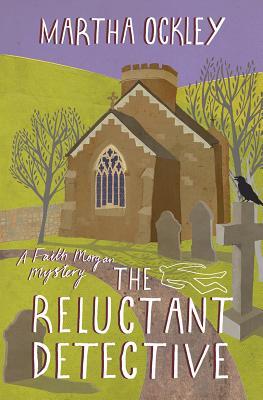
The Reluctant Detective by Martha Ockley

17742272I had little idea what to expect from Martha Ockley’s first Faith Morgan mysteryThe Reluctant Detective as I hadn’t come across the author before and all I had to go on was the description on LibraryThing’s Early Reviewers page last month:

‘Former cop Faith Morgan may have quit the world of crime, but crime has not let her go. Now a priest in the Church of England, she is assigned to the improbably named village of Little Worthy, and within an hour of her arrival she witnesses the sudden, shocking death of a fellow priest. To her distress, the detective assigned to the case is Ben, her former partner and former boyfriend.

As she meets her parishioners she learns some surprising details about her apparently well-loved predecessor, and starts to suspect a motive for his death. The cop may have donned a clerical collar, but the questions keep coming. How will she reconcile her present calling with her past instincts? Is she in danger herself? What should she do about Ben?’

I thought a detective who  was a priest and who used to be a policewoman sounded interesting. So, I am very pleased that The Reluctant Detective turned out to be a good read. Faith Morgan is a well-rounded character; she’s very likeable, observant, compassionate and the sort of person that people feel comfortable talking to – a bit like a young Miss Marple. Indeed, the book has an Agatha Christie feel to it – set in an apparently idyllic country village, with interesting and somewhat quirky characters and although there is one rather gruesome death, it’s not a gory thriller. In short it’s the type of murder mystery that I like, with plenty of complications that kept me guessing about the identity of the murderer for most of the book.

The church and village location are convincing. The parish church of St John is an old building dating from Saxon times, with a tower and church bells, set in the English countryside:

Faith avoided the main approach and followed a gravel path around the back of the church. A creamy cloud of ivory clematis cascaded over a grey stone wall. Beyond a solitary pony raised its chestnut head to gaze mournfully at her from a field of weeds. Some way off squatted a group of ramshackle farm buildings. (page 9)

Faith’s ex – Detective Inspector Ben Shorter, reluctantly allows Faith to contribute to the search for the murderer and the chemistry between the two of them is clearly evident even though he can’t understand why she left the police force for the church. Indeed, Faith herself wonders if she has done the right thing, cutting herself off from her old life and her old self as she realises that she likes investigating, and analyzing people, their expressions and body language and working out what makes them tick. But these are assets for a priest as well as for a police officer. And as for death:

It struck Faith how death is always startling, facing us with the greatest mystery: how the particular and the individual can vanish from this world so completely in a moment. (page 17)

The back cover reveals that Martha Ockley lives in the North East of England and has close links with the church, having grown up as the daughter of a minister. She is a full-time writer of both fiction and non-fiction. I was curious about Martha Ockley and wondered why she had given ‘special thanks to Rebecca Jenkins’ on the title page, so I searched online and discovered that ‘Martha Ockley’ is actually a pseudonym of Rebecca Jenkins, the daughter of the Rev David Jenkins, formerly the Bishop of Durham.

Thanks to LibraryThing and Lion Fiction/Kregel Publications for providing a copy for review. Based on my reading of The Reluctant Detective I shall certainly seek out more books by Martha Ockley/Rebecca Jenkins. There are two more Faith Morgan books:

  • The Advent of Murder
  • A Saintly Killing (to be published in October 2014)

And writing as Rebecca Jenkins:

The R F Jarrett books (the Regency Detective)

  • The Duke’s Agent (1997)
  • Death of a Radical (2010)

also Non Fiction:

  • Free to Believe (David Jenkins and Rebecca Jenkins (1991)
  • Fanny Kemble: a reluctant celebrity (2005)
  • The First London Olympics 1908 (2008)

The Dance of Love by Angela Young

Angela Young‘s new novel The Dance of Love is historical fiction set at the turn of the twentieth century between 1899 and 1919. It is outstanding and I loved it so much. At times as I read it I could hardly see the pages through my tears – and there have not been many books that have that effect on me.  It’s a brilliant book, both a heart-rending love story and a dramatic story too, as the sinking of the Titanic in 1912 and the devastating and tragic effects of the First World War impact on the characters’ lives.

It’s the story of Natalie, the daughter of Sir Thomas Edwardes, a wealthy business man, a self-made man who is socially unsure of himself, but who wants his daughter to be accepted into society. It begins in 1899, a period when young ladies were presented at Court for the London Season, an opportunity to meet their future husbands. Natalie’s friends, the daughters of Lady Bridewell, are looking forward to the London Season. But Natalie has little desire to be presented at Court, relishing the idea that she would be free to live without such restraints and marry for love, someone who will care for her for herself, not because of her family connections. However, she falls in with her father’s wishes and when she meets a handsome artist-soldier, Lieutenant Haffie, it seems her wish for a happy marriage will come true.

What I really liked about this book is the way historical background is seamlessly interwoven with the narrative and how it captures the changes in society as the years went by. Natalie grows from a young, impulsive teenager with passion for romance and dancing into a responsible young woman whose hopes for a happy marriage are in the balance.  The portrait of the Edwardian upper classes, with their lavish life style, glittering balls and all their extravagances is fascinating, contrasting with the enormous changes in society as the War takes its effect.

I liked all the details about paintings as Haffie shows his work to Natalie – Angela Young’s beautiful descriptions draw such vivid full colour images that I could easily visualise the paintings, which Natalie says are ‘mysteries made of light.’  And her portrayal of the settings, whether in London, Devon or the Scottish Highlands are just as vivid, making this a richly descriptive book.

But it is the effect of the War and the effect on the families of those people travelling across the Atlantic on the Titanic that really brought home to me the whole human tragedy that people lived through, much more than any historical account has done. I think it’s seeing these events through the eyes of the people left at home that has the most impact.

I had enjoyed Angela Young’s first novel, Speaking of Love and so was pleased to accept her offer of an uncorrected proof copy of The Dance of Love. I’m so glad I did as it’s a beautifully written, brilliant book that moved me deeply, and one I shall most definitely re-read (always proof of a good book for me).

The Dance of Love will be published on 31 July 2014.

Shadows on Our Skin by Jennifer Johnston

Shadows on Our Skin by Jennifer Johnston has recently been re-issued as an e-book. It was first published in 1977 when it was shortlisted for the Booker Prize. I was pleased to be offered a copy for review as I have enjoyed a few of her books, such as The Illusionist and Two Moons.

This is the story of Joe, living in Derry (Londonderry), Northern Ireland before the Troubles and the Bloody Sunday attack in 1972. Joe is a schoolboy, living with his mother and his alcoholic father, a former war hero who reminisces and feeds on his memories. It’s a violent situation at home, as the father dominates his wife and son, with an even more violent conflict in the streets. To a certain extent Joe lives within his own head, writing poetry, and his mother is keen to keep him indoors once school has finished because she fears he will be shot as the British soldiers patrol the streets. However, he has made friends with Kathleen, a young English teacher and they meet after school. She encourages his writing, enhancing his escape from reality. But when his brother, Brendan returns home his involvement in the IRA brings Joe back to earth with a sharp shock, as the conflict comes closer to home.

Shadows on Our Skin is an engrossing book, the writing is taut and spare and yet poetical, the scenes standing out vividly in my mind. The characters’ interaction is full of emotion, and of tension; their feelings of despair and bitterness are all very evident. The book is certainly an enlightening read for me.

  • Format: Kindle Edition
  • File Size: 515 KB
  • Print Length: 177 pages
  • Publisher: Open Road Media (24 Jun 2014)
  • Sold by: Amazon Media EU S.à r.l.
  • Language: English
  • ASIN: B00KQ6PJZE
  • Source: Review copy

A Place for Us by Harriet Evans

Blurb:

The day Martha Winter decided to tear apart her family began like any other day.

When Martha, a wife and mother of three, sits down one late summer’s morning to write out the invitations to her eightieth birthday celebration, she knows that what she is planning to reveal at the party could ruin the idyllic life she and her husband David have spent over fifty years building…

But she has to let her family know what she and David have sacrificed. She can’t live a lie any more.

The invitation goes out far and wide, calling her three children and their families back home to Winterfold, their rambling house in the heart of the English countryside. They are Bill, the doctor; Florence, the eccentric academic; and Daisy, the child who never fit in. As the story unfolds, each character reveals the secrets, joys, and tragedies they are wrestling with through the confines of the family. What will happen when Martha finally tells the truth? 

My thoughts:

I haven’t read any of Harriet Evans’ books before I read A Place for Us, so I didn’t know what to expect. The Winters appear to be the perfect family, but no family can be that perfect and one by one their secrets begin to surface. Martha Winter is approaching 80 and invites all her family to a party stating that she has an important announcement to make. The book has a slow start as the Winter family is large and it took me a while to get them all clear in my mind – I drew a family tree for myself which helped. It turns out that they are by no means the perfect family – rather dysfunctional in fact.


I thought some characters were more fully developed than others, which makes the book rather disjointed and I was more interested in some at the expense of others, Florence, the younger daughter who is an art historian living in Italy is perhaps the most interesting.


However, after the slow start I soon guessed what the big secret was and I thought it all became too predictable. An entertaining, if undemanding book, which I think could have benefited from being shorter.

My thanks to Lovereading who sent me a copy of this book for review.

Casting the Net by Pam Rhodes

Blurb:

Heart-warming English comedy of manners, featuring the trials and tribulations of newly ordained minister, Neil FisherIn part two of the Dunbridge Chronicles, Neil Fisher returns from ordination inspired by his sense of ministry, but determined to distance himself from the two ladies in his life. This is not altogether well received, and a wide segment of the congregation of St Stephen’s, Dunbridge–including the music group–points Neil to the error of his ways.

Meanwhile Neil’s close friend Colin and his wife Jeannie are delighted by the birth of a daughter, but is all well with the baby? Neil’s mother Iris continues to meddle, to his irritation. Churchwarden Peter has said a relieved farewell to his flighty wife Glenda–or has he? Dunbridge is not as peaceful as it seems. 

My thoughts:

I liked this light easy-to-read book that deals with serious issues from the Christian perspective. Life in Dunbridge is far from peaceful and the Neil, the curate has many crises to face, not the least being his vicar’s loss of faith. It’s full of interesting characters, painting a picture of life in a small town.

  • Publisher ‏ : ‎ Lion Fiction; 1st New edition (21 Feb. 2014)
  • Language ‏ : ‎ English
  • Paperback ‏ : ‎ 256 pages
  • ISBN-10 ‏ : ‎ 1782640622
  • ISBN-13 ‏ : ‎ 978-1782640622
  • My Rating: 3*

He Wants by Alison Moore

I received a proof copy of He Wants by Alison Moore from Lovereading for review. It will be published in August this year. I began reading with high expectations because I thought I’d like it from the publishers’ synopsis:

Lewis Sullivan, an RE teacher at a secondary school, is approaching retirement when he wonders for the first time whether he ought to have chosen a more dramatic career. He lives in a village in the Midlands, less than a mile from the house in which he grew up. He always imagined living by the sea. His grown-up daughter visits every day, bringing soup. He does not want soup. He frequents his second-favourite pub, where he can get half a shandy, a speciality sausage and a bit of company. When an old friend appears on the scene, Lewis finds his routine and comfortable life shaken up.

However, this synopsis is a bit misleading. Lewis is not approaching retirement – he has already retired. He is looking back over his life and thinking about all the things he had wanted/wants/ does not want.  It’s a book about ageing and unfulfilled expectations. It jumps around mirroring Lewis thought processes as he remembers his childhood, his parents, his wife, his daughter and his friend Sydney.

He Wants is a short book (180 pages in the proof copy). Written in the present tense, it’s a bleak tale of a man whose life did not turn out as he expected or wanted. I don’t have to like the characters to enjoy reading a book, but despite the quality of writing, which is taut and effective in creating an atmosphere of unease and emptiness, I couldn’t take to this book. Lewis’s dissatisfaction with his life compared to how had imagined it would be was just too drab and unrelenting.

Lewis had wanted all sorts of fantastic things. The chapter headings indicate the things he wanted but never got, or the things he did not want and did get: he did not want soup or the sausages, he did not want the boy to be spoiled, he wanted to go to the moon, to live in Australia, to be seen, a time machine and a cup of tea and so on.

Sadly, it was not my cup of tea.

Alison Moore was shortlisted for the Man Book Prize in 2012 with her debut novel The Lighthouse, a book I haven’t read and may check just to see if it’s in the same vein as He Wants.