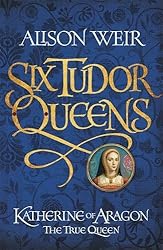
Six Tudor Queens: Katherine of Aragon, the True Queen by Alison Weir

I received a proof copy of Six Tudor Queens: Katherine of Aragon, the True Queen as a member of the reader review panel for Lovereading.co.uk. It’s the first book in a series of novels about Henry VIII’s Queens and is due to be published in May 2016.

This is fictional biography at its most straight forward, written in an uncomplicated style. Told from Katherine’s point of view it follows her life from the time she arrived in England at the age of sixteen to marry Prince Arthur, the elder of Henry VII’s two sons, to her death in 1536.

I knew the brief facts about Katherine, the daughter of Isabella and Ferdinand of Spain, married first to Prince Arthur and then to his brother Henry after a papal dispensation allowing the marriage after Arthur’s death; her subsequent failure to produce a living male heir, suffering a series of miscarriages; the only baby to survive was a daughter, Mary; and her divorce in 1533 from Henry VIII, who was by then besotted with Anne Boleyn.

This novel fills in the facts in great detail including the question of whether her first marriage was consummated. Katherine maintained it wasn’t and based on research Weir takes her word as the truth. In her Author’s Note she refers to recent research by Giles Tremlett and Patrick Williams that shows ‘we can be fairly certain that Katherine’s marriage to Prince Arthur was not consummated and that he died of tuberculosis.’  She cites the basis of her account of Arthur’s illnesss on Dr. Alcaraz’s testimony, given on 1531 at Zaragoza. She portrays Katherine as a determined woman who never ceased loving Henry and above all who did everything she could to protect the legitimacy of her daughter.

Katherine is portrayed as a woman of her time – obedient to her parents and her husband, conscientious about doing her duty  and active in maintaining an alliance between England and Spain. But even so, she resisted Henry in his demands for an annulment of their marriage. She was heart-broken both at her failure to produce a living male heir and to keep Henry’s love – because they were in love at the beginning – and maintained that she was the true queen right up to her death. I tend to forget the length of their marriage, glibly remembering the mnemonic ‘Divorced, beheaded, died, divorced, beheaded, survived‘. Katherine and Henry were married for over 20 years. I did get tired of the account of their endless wrangling, going over and over the same arguments, never getting anywhere – but then I suppose that was how it was for them both.

Overall I enjoyed this book. It’s a long and comprehensive study, which has increased my knowledge and understanding of Katherine of Aragon and the early 1500s. It is obviously based on extensive research and written with great attention to historical accuracy, but in places this made it tedious and too drawn out.

  • Hardcover: 624 pages – also available as a Kindle edition
  • Publisher: Headline Review (5 May 2016)
  • Language: English
  • ISBN-10: 1472227476
  • ISBN-13: 978-1472227478
  • Product Dimensions: 15.3 x 5.6 x 23.4 cm
  • Source: Review copy

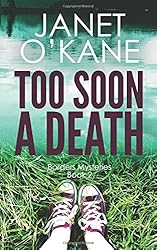
Too Soon a Death by Janet O’Kane

Janet O’Kane’s second book Too Soon a Death follows on from No Stranger to Death, set in a fictional village in the Scottish Borders and continues the story of Doctor Zoe Moreland, a widow and one of the doctors at the local health centre. A boy’s body is discovered on the banks of the River Tweed, near the Chain Bridge, linking Scotland and England and Zoe is asked to help identify the body because he had a note in his clothing giving the health centre’s address and phone number – but he was not one of their patients.

Zoe is not without her own problems. I think this book reads well as a stand alone book, but it certainly helps to have read the previous book, which explains her current condition. At the beginning of Too Soon a Death she is still recovering from a vicious attack (details in No Stranger to Death) and is heavily pregnant.

As the events unfold, she receives anonymous phone calls and is followed by someone in a blue car, who at one point almost runs her down. Added to that her best friend Kate Mackenzie, a deaf genealogist, is having problems both with her ex-husband and a client, with disastrous results. Can Zoe trust a new acquaintance, the vet Patrick Dunin – she wonders who it is that keeps phoning him claiming his attention? A large, vicious looking dog attacks Zoe’s own dog and is savaging sheep. Where has he come from? And that is not all – Zoe has secrets in her own past that are finally revealed in this book.

In some respects Too Soon a Murder has a Midsomer Murders atmosphere, and a general ‘cosy’ feel, but it is not without violence. Its main focus, however, is on Zoe, how she is coping with her pregnancy, her plans for Keeper’s Cottage, which she has bought from Kate’s brother and her hopes to become a partner in the health centre. The crimes are investigated by DCI Erskine Mathers and Sergeant Trent, with Zoe’s assistance, although there are things she can’t tell the police because of patient confidentiality. It has a great sense of location (this may be helped because I know the area a little bit, living a few miles away on the English side of the Border), and the characters are well grounded and believable people, even the minor characters such as Margaret Howie, the practice receptionist, comes across as a character in her own right.

My thanks to Janet O’Kane for providing me with a copy to read and review. I’m looking forward to reading her third book, which she is currently writing.

Reading challenges: My first book for the Read Scotland Challenge –  a book set in Scotland.

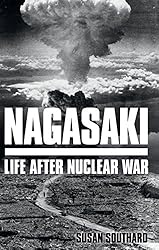
Nagasaki: Life After Nuclear War by Susan Southard

Nagasaki: Life after Nuclear War by Susan Southard is an amazing, heart-wrenching book.

The facts are horrendous – on August 9th 1945, two days after the atomic bombing of Hiroshima, a five-ton plutonium bomb was dropped on the small coastal town of Nagasaki. The effects were cataclysmic.

This must be one of the most devastatingly sad and depressing books I’ve read and yet also one of the most uplifting, detailing the dropping of the bomb, which killed 74,000 people and injured another 75,000. As the subtitle indicates this book is not just about the events of 9 August 1945 but it follows the lives of five of the survivors from then to the present day. And it is their accounts which make this such an emotive and uplifting book, as it shows their bravery, how they survived, and how they were eventually able to tell others about their experiences. Along with all the facts about the after effects of the bombing, the destruction, and radiation, it exposes the true horror of atomic warfare, making it an impressive and most compelling account of pain, fear, bravery and compassion.

Throughout the book the black and white photos illustrate the true horror of the effects of the bomb – photos of Nagasaki both before and after the bomb was dropped, of five survivors – Wada Kohi (aged 18 in August 1945), a street car operator; Nagano Etsuko (aged 16), who worked on a production line in a Mitsubishi airplane parts factory;  Taniguchi Sumiteru (aged 16), who worked at Minchino-o Post Office; Yoshida Katsuji (aged 13), a student at Nagasaki Prefecture Technical School on a ship building course; and Do-oh Mineko (aged 15), formerly a student at Keiho Girls High School, working at the Mitsubishi Arms Factory Onashi Plant. There are also maps showing Japan today and of Nagasaki 1945 showing the Scope of Atomic Bomb Damage.

Susan Southard’s ten years of research has resulted in this impressive book as she reveals what happened in particular to these five survivors, their immediate injuries, the radiation-related cancers and illnesses they have suffered, and their difficulties of daily living still in pain both physical and emotional.

In addition to all that Nagasaki ‘reveals the censorship that kept the suffering endured by the hibakusha [atomic bomb-affected people] hidden around the world. For years after the bombings news reports and scientific research were censored by U.S. occupation forces and the U.S. government led an efficient campaign to justify the necessity and morality of dropping the bombs’ (from the jacket sleeve).

I knew a bit about Hiroshima and Nagasaki before I read this book but it has opened my eyes to the true horror of nuclear war and the need to prevent anything like this happening again.

Many thanks to Souvenir Press Ltd for sending me a complimentary copy for review.

  • Hardcover: 416 pages
  • Publisher: Souvenir Press Ltd (2 Nov. 2015)
  • Language: English
  • ISBN-10: 0285643274
  • ISBN-13: 978-0285643277

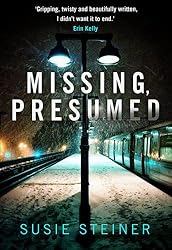
Missing, Presumed by Susie Steiner

I was a bit doubtful that I would like Missing, Presumed by Susie Steiner as it’s written in the present tense, which I usually find irritating. But I needn’t have been concerned because it wasn’t long before I’d completely forgotten the tense and I was totally immersed in the story. And I loved it.

Missing, Presumed is crime fiction, investigating the disappearance of Edith Hind, a beautiful Cambridge post-grad.  Her boyfriend, Will Carter had returned to their flat to find the front door open, coats in disarray and a spatter of blood on the kitchen floor. It’s told from different characters’ viewpoint, each one individually distinct, beginning with DS Manon Bradshaw on the Major Incident Team (her name means ‘bitter’ in Hebrew, but I thought it was Welsh), a lonely disillusioned single woman approaching forty, who overcomes her insomnia by listening to the low murmurings of police reports on her radio.

Edith’s mother, Miriam, Lady Hind, is distraught, wondering if somehow this is fault, her daughter the centre of a drama. Sir Ian Hind, a successful doctor, physician to the Royal Family and a friend of the Home Secretary adds to the pressure the police are under to find Edith. Edith’s friend, Helena comes under suspicion and known offenders are interviewed, but after the first 72 hours she is still missing. The team’s urgency is cooling  as the possibility that Edith is still alive diminishes. Then a dog walker finds a body in the Ouse, near Ely; is it Edith? The search for the killer is intensified.

This has all the ingredients of a successful crime novel for me. My only criticism of the book is that I didn’t think the final section, ‘One Year Later‘ in which the ends are tied up , was necessary. But apart from that I found it gripping and intense. I was intrigued by the multi-layered plot, and thought the characters were fully rounded, believable people, explored with psychological depth – in particular Manon Bradshaw stands out. And, best of all, it is beautifully written.

The Author

Susie Steiner is a novelist and freelance journalist. She began her writing career as a news reporter first on local papers, then on the Evening Standard, the Daily Telegraph and The Times. In 2001 she joined The Guardian, where she worked as a commissioning editor for 11 years. For more information see her website, susiesteiner.co.uk

My thanks to Lovereading for providing an advance proof of this novel, due to be published in February 2016. Missing, Presumed is Susie Steiner’s second book ‘“ the first is Homecoming, which I really must read.

And I do hope she will write more about DS Manon Bradshaw.

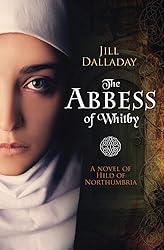
The Abbess of Whitby by Jill Dalladay

The Abbess of Whitby is subtitled A Novel of Hild of Northumbria. As Jill Dalloway explains in her Author’s Note at the end of the book what we know about Hild (St Hilda) comes from the Jarrow monk Bede’s  A History of the English Church and People written 40 years after her death. He gave no information about her between the ages of 13 and 33, so Jill Dalloway has based her fictional account of her life up to the age of 33 on the works of various modern scholars, assuming that like other royal girls of the time she was married for dynastic or political purposes. The major characters are historical, with a few exceptions and Hild’s husband and son are fictional. Hild was born in 614 and died in 680.

Knowing very little about the historical background to the story I found this a fascinating book, but could not have followed it very easily without the list of characters, the family tree of the royal families of Northumbria and the maps showing the Peoples of 7th Century Britain and of Hild’s Northumbria. I was surprised by how much people travelled in the 7th century. It spurred me on to find out more and I am now reading The King in the North: the Life and Times of Oswald of Northumbria by Max Adams. I would also like to read Edwin: High King of Britain and Oswald: Return of the King both by Edoardo Albert.

About two thirds of the book covers Hild’s early life, from the time she was chosen to lead the handmaidens of the fertility goddess  Eostre. It’s a time of transition as people are gradually being converted to Christianity, although at first it appears to be a matter of politics rather than of faith. Her marriage to Cerdic of the Goddodin tribe took her to Din Edin (Edinburgh). When home and family are lost in Oswy’s sack of Edinburgh, she finds herself in enemy hands, but meets the charismatic Aidan (St Aidan of Lindisfarne). The final part of the book covers her life as she helped establish various chapels and finally settled in Whitby as the Abbess there, involved in resolving the Easter dispute at the Synod of Whitby in 664. This settled that the calculations to establish the date of Easter would be according to the customs of Rome, rather than the Celtic customs practised by Irish monks at Iona and also to observe the monastic tonsure.

For me the first two thirds  of the book, showing the disputes between the separate kingdoms in Britain in the 7th century, the  transition from pagan to Christian beliefs and the harsh conditions and plague people had to endure, came to life more successfully than the later chapters.

I received this book for review from the publishers via LibraryThing’s Early Reviewers Program.

  • Paperback: 352 pages
  • Publisher: Lion Fiction; 1st New edition (21 Aug. 2015)
  • Language: English
  • ISBN-10: 1782641548
  • ISBN-13: 978-1782641544

Jill Dalloway is a classicist, historian and former head teacher who pioneered the Cambridge Latin Course. She lives in Whitby.

The Monocled Mutineer by John Fairley & William Allison

When I was asked if I would read and review a revised edition of The Monocled Mutineer by John Fairley and William Allison, the book on which the 1986 BBC TV series was based I was immediately interested as I had watched the TV series.

Description from the Press Release:

In 1917 British, New Zealand and Australian troops stationed at the Étaples Training Camp in northern France protested against the inhuman conditions and the protest erupted into mutiny. Private Percy Toplis was named by the authorities as a leader of this mutiny. While several of the mutineers were executed in its aftermath, Toplis escaped and remained at large for three years. The Army immediately covered up the mutiny, thousands of the participants died shortly afterwards in the Passchendaele offensive while the survivors remained silent for over fifty years. After three years as Britain’s most wanted man Percy Toplis was killed in 1920 by a policeman.

My thoughts:

This is the 2nd and updated edition of The Monocled Mutineer, which  includes a new introduction and epilogue that expand on newly discovered information about the events of the mutiny and the government’s response to it. It is primarily based on interviews and correspondence with survivors of the First World War nearly sixty years after the events they describe. In 1976 the authors advertised in newspapers asking whether any veterans from the First World War had recollections of the events in Étaples in September 1917. They received many replies containing:

  … sharp, bitter accounts of events long ago, but far from forgotten. Inevitably they were careful handwritten stories in old men’s script, teased out without any other prompting than the brief enquiry in their local paper. (page 2)

In addition to the anecdotal evidence the authors have used other sources including the published personal reminiscences of Edwin Woodhall,  Detective and Service Days and Lady Angela Forbes. Memories and Base Details; journalists’ accounts in various periodicals; and have drawn background material from records about the First World War in the  Imperial War Museum, The Public Record Office and the British Newspaper Library.

Not many contemporary records have survived that relate to the mutiny. One of the surviving records is the war diary of the Commandant at the Étaples Camp,  Brigadier-General Andrew Graham Thomson. Thompson describes what happened as a ‘disturbance’ and as ‘riots’ and ‘breakouts’:

Disturbance in Reinforcement Camp between military police and troops, Corporal Wood, 4th Gordons being accidentally shot … a crowd of about 1,000 gathered at Ã‰taples town, and about 7.30 pm tried to break into the Sevigne cafe where two policemen were hiding. (page 1)

But in 1978, after the publication of the 1st edition and the BBC dramatisation, the British government admitted that the events that took place at Ã‰taples had been a mutiny and also that  it was probable that the records relating to the board of inquiry into the events had been destroyed many years ago. The files on the mutiny and Percy Toplis’ military records are closed until 2017.

Historical accuracy is never easy to obtain, especially where records have been lost and where there is a limited number of sources to compare one against the other. In this case the main sources of information are the personal accounts from the veterans as they remembered them many years later.

And the picture they paint is a most remarkable and shocking one of the brutal and inhuman conditions which were in operation at the camp. As for Toplis’ part in the mutiny, the letters from the veterans occasionally mentioned him and whilst some thought he was the main ringleader, few thought he was the only one, but that there were a number of soldiers involved. One remembered Toplis’ name on a wanted poster and wrote:

If he was a villain then he was not the only one around Étaples. Maybe he too was tired of being humiliated, deprived, brutalized and treated like a dog. We had all got tired of being treated with less consideration than that given to horses. (page 91)

Another reported that Toplis, heading a mob of about 1,000 deserters confronted Thompson, surrounding his car. Toplis climbed on the running board and dictated the terms for ending the mutiny (page 93). After the mutiny ended, whilst some of the ringleaders were executed, Toplis escaped. Others were killed in the battle for Passchendale which began on 20th September.

Maybe more information will be available in 2017 when the files are opened and a fuller picture of what happened will emerge.

The Monocled Mutineer also goes into detail about Percy Toplis’ life before and after the war. Coming from a working-class background, by the age of eleven he was already a con artist and a thief. He must have been a charismatic character, able to both charm and deceive people, successfully impersonating officers, able to melt into the background deserting and then rejoining the army seemingly at will, not sentenced to execution by the firing squad (the penalty for desertion). But after the war ended in 1920 his luck ran out as he was accused of murdering a taxi-driver. The inquest held that he was guilty in his absence. Toplis fled, evading capture for six weeks and he was eventually shot down in a police ambush near Plumpton in Cumberland.

  • Paperback: 208 pages
  • Publisher: Souvenir Press Ltd; 2nd Revised edition edition (7 Sept. 2015)
  • Language: English
  • ISBN-10: 028564310X
  • ISBN-13: 978-0285643109
  • Source: review copy from the publisher