The Raven’s Head by Karen Maitland

I loved Karen Maitland’s medieval mysteries, Company of Liars: a novel of the plague and The Owl Killers and although I didn’t think The Vanishing Witch had quite the same magic spark I still enjoyed it. So when Lovereading offered me a proof copy of The Raven’s Head for review I was keen to read it.

Publisher: Headline Review
Publication date: March 12, 2015
ISBN: 9781472215055

Summary from Karen Maitland’s website:

Vincent is an apprentice librarian who stumbles upon a secret powerful enough to destroy his master. With the foolish arrogance of youth, he attempts blackmail but the attempt fails and Vincent finds himself on the run and in possession of an intricately carved silver raven’s head.

Any attempt to sell the head fails ‘¦ until Vincent tries to palm it off on the intimidating Lord Sylvain ‘“ unbeknown to Vincent, a powerful Alchemist with an all-consuming quest. Once more Vincent’s life is in danger because Sylvain and his neighbours, the menacing White Canons, consider him a predestined sacrifice in their shocking experiment.

Chilling and with compelling hints of the supernatural.

My thoughts:

Set in 1224 in France and England this is a dark book. I found parts of it very uncomfortable and disturbing to read and yet also very compelling. Life in the medieval world was cruel and brutal and The Raven’s Head describes that world in minute detail, evoking the superstitious fear of the period.

The story is told from the three main characters point of view -Vincent, Wilky, a young boy taken from his family to live in a monastery in Norfolk where unspeakable terrors await him and the other young boys, and Gisa also living in Norfolk, working in her uncle’s apothecary’s shop. Their lives are connected through Lord Sylvain who is trying to find a way to bring the dead back to life and the abbot, trying to find the elixir of life – both experimenting with alchemy.

Karen Maitland provides a cast of characters and sets out the historical background and provides notes and a glossary on the practice of  alchemy during the Middle Ages, all of which I found indispensable. Each chapter is headed by a quotation taken from the writings of early Christian and Islamic alchemists – most of which I found incomprehensible.

She explains that alchemy was a dangerous practice, many chemical experiments could go horribly wrong – as in this book. Alchemists worked in secret. It was mystical, as they searched for the means to transform the base soul of man into pure incorruptible spirit, as well as physical, searching for the stone, elixir or tincture to turn base metals into precious metals.

Although long this is a fast-paced book and I read it quite quickly.  I enjoyed the historical setting and even though it took me right to the edge of my comfort zone as far as reading horrific detail the rest of the book made up for that in terms of a well constructed storyline and believable characters. Once I began I had to finish the book.
The Book of Lost and Found by Lucy Foley

It’s so good to start 2015 reading a book I really enjoyed. It’s The Book of Lost and Found by Lucy Foley – due to be published later this month. I received my copy courtesy of Lovereading for review.
Summary from inside the front cover:

In many ways, my life has been rather like a record of the lost and found. Perhaps all lives are like that.

It’s when life started in earnest
HERTFORDSHIRE, 1928

The paths of Tom and Alice collide against a haze of youthful, carefree exuberance. And so begins a love story that finds its feet by a lake one silvery moonlit evening . . .

It’s when there were no happy endings
PARIS, 1939

Alice is living in the City of Light, but the pain of the last decade has already left its mark. There’s a shadow creeping across Europe when she and Thomas Stafford ‘“ now a world famous artist ‘“ find each other once more . . .

It’s when the story begins
LONDON, 1986
Bequeathed an old portrait from her grandmother, Kate Darling uncovers a legacy that takes her to Corsica, Paris and beyond. And as the secrets of time fall away, a love story as epic as it is life-changing slowly reveals itself . . .

Once I started reading it I didn’t want to stop; Lucy Foley is a great storyteller – it’s hard to believe that this is her first novel! It’s the story of Tom and Alice beginning in 1928 in Hertfordshire and moving backwards and forwards in time and place to 1986, from Paris, to London, Corsica and New York. It all revolves around Kate, whose mother, June, had recently died in a plane crash. When Kate is given an old line drawing in pen and ink, dated 1929, of a young woman, she initially thinks it is of June, but realises that it can’t be – the date is too early and the clothes and hair are all wrong. Thus the search for the woman in the drawing and the artist begins.

There is so much I loved in this book – the characters, the settings and the time periods, against the backdrop of years before, during and after the Second World War. It’s a love story, of course, as well as a story of loss, discovery and grief as the decisions we make impact not just on our own lives but on those of others too.

It is a beautiful book and one that I’d like to re-read one day – I’m sure that I would find things in it I missed this time in my eagerness to find out what happened next.

Lucy Foley studied English Literature at Durham and UCL universities. She now writes full-time, having worked for several years as a fiction editor in the publishing industry. She is now working on her next novel – I hope it’s not too long coming!

Sausage Hall by Christina James

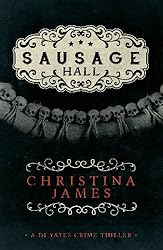
When the publishers of Sausage Hall emailed me offering a review copy of the book I thought it sounded interesting, although I wasn’t keen on the title – I thought it sounded a bit gimmicky and it nearly putting me off reading it.  But I’m glad it didn’t because I would have missed out on a good story, a crime mystery with a sinister undercurrent exploring the murky world of illegal immigrants, and a well researched historical element. I enjoyed it.

Sausage Hall is the third book in the DI Yates series and although I haven’t read the first two that wasn’t a problem – it stands well on its own, but I’d like to read the two earlier books. This is set in the South Lincolnshire Fens and is an intricately plotted crime mystery, uncovering a crime from the past whilst investigating a modern day murder.

Synopsis from the back cover:

Sausage Hall: home to millionaire Kevan de Vries, grandson of a Dutch immigrant farmer. De Vries has built up a huge farming and food packing empire which extends, via the banana trade, to the West Indies. But Sleazy MD, Tony Sentance, persuades de Vries to branch out into the luxury holiday trade. De Vries and wife, Joanna, take the first cruise out to explore the potentially lucrative possibilities. However, back at home, a break-in at Sausage Hall uncovers a truly gruesome historical discovery. And when a young employee of de Vries is found dead in the woods, D.I. Yates is immediately called in … 

The narrative switches between the first person present tense (Kevan) and the third person past tense, which took me a bit to get used to. Actually I thought this worked very well; even though the use of the first person present tense usually irritates me, it didn’t in this book and it gives a good insight into Kevan’s character as well as providing essential information about his background and relationships.

I particularly liked DC Juliet Armstrong, DI Tim Yates’ colleague – the two make a good combination, even though Juliet spends a good part of the book isolated in hospital with Weil’s disease, having been bitten by a rat. In fact of the two characters I thought Juliet was the most clearly defined. Maybe a second reading would help clarify Yates’ character for me, or maybe this is where not reading the two earlier books is a drawback. This is not a book you can read quickly as there are plenty of characters and several plot threads that need to be kept in my mind as you read the book.

I liked the historical elements of the plot and the way Christina James has connected the modern and historical crimes, interwoven with the history of Kevan’s home, Laurieston House, known to the locals as ‘Sausage Hall’ and the secrets of its cellar – just what is the link between Cecil Rhodes, the Victorian financier, statesman, and empire builder of British South Africa, and the Jacobs family who were the previous owners of Sausage Hall?

Added to this is the mystery of the death of a young woman found dead in the woods near the De Vries food-packing plant in Norfolk. It seems she was employed at the plant although the supervisors there deny any knowledge of her. DI York suspects she is an Eastern European illegal immigrant. And as for Tony Sentance, just what is his hold over Kevan and his wife and their son, Archie? It was only just before the end that I suspected the truth. 

Publishers’ Biographical Note: ‘C.A. James was born in Spalding and sets her novels in the evocative Fenland countryside of South Lincolnshire. She works as a bookseller, researcher and teacher. She has a lifelong fascination with crime fiction and its history. She is also a well-established non-fiction writer, under a separate name.’

There is more information about Christina James and her books on her blog The earlier DI Yates books are In the Family and Almost Love.

  • Paperback: 256 pages
  • Publisher: Salt Publishing (17 Nov 2014)
  • Language: English
  • ISBN-10: 1907773827
  • ISBN-13: 978-1907773822
  • Source: review copy from the publishers

Almost Invincible by Suzanne Burdon

Almost InvincibleMary Shelley’s life and relationship with the poet Percy Bysshe Shelley was truly remarkable, a story of scandal, love and loss. And Suzanne Burdon using letters and diaries has written a remarkable novel, Almost Invincible, about her.

Mary ‘s parents were two radical writers, William Godwin and Mary Wollstonecraft, the advocate of women’s rights. At the age of sixteen she met Shelley, who was already married. They fell in love, abandoned their families and eloped, but significantly they took Mary’s step-sister, Claire with them. It was disastrous because Claire was in love with Shelley too and almost constantly in conflict with Mary.

The novel begins in Geneva in 1816 as Mary reads the opening pages of her novel, Frankenstein to Shelley, Lord Byron and their friends:

It was barely five on a summer afternoon but already eerily dark. The candles were lit and shivered in response to the wind and rain pounding against the panelled windows. Mary took up her scribbled pages and found her voice.

From then on the novel goes back to Mary’s meeting with Shelley in St Pancras churchyard in London two years earlier and follows their tempestuous lives until Shelley’s death in Italy in 1823. Mary went through so much; social outcasts they spent their time moving houses from France, England, Switzerland and Italy. She had two miscarriages and suffered the deaths of two of her children. Her father’s description of her shows her spirit:

She is singularly bold, somewhat imperious, and active of mind. Her desire of knowledge is great, and her perseverance in everything she undertakes, almost invincible.

But above all, it was her love for Shelley that sustained her. I found this a very moving book as it weaves its way through the tangled and often turbulent relationships of Mary, Shelley, Claire and their friends and acquaintances. At times Claire’s behaviour was so manipulative and destructive that Mary could not bear to be with her. Yet through all the sadness, grief, illnesses, and financial difficulties she found solace in her writing.

Suzanne Burdon has written a most impressive story. She has done extensive research, using original letters and stories in the Abinger Collection in the Bodleian Library in Oxford and the Carl Phorzheimer Collection of Shelley and His Circle in the New York Public Library. Almost Invincible is her first novel, based on fact but conveying the emotions, thoughts and feelings of her characters so convincingly. I was entranced.

  • Paperback: 340 pages
  • Publisher: Criteria Publishing
  • Language: English
  • ISBN-10: 0992354005
  • ISBN-13: 978-0992354008
  • Source: review copy from the publishers

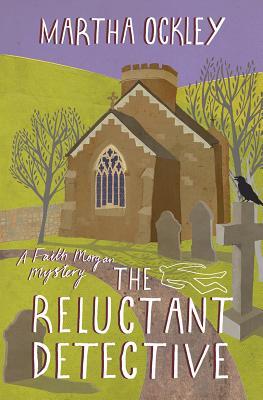
The Reluctant Detective by Martha Ockley

17742272I had little idea what to expect from Martha Ockley’s first Faith Morgan mysteryThe Reluctant Detective as I hadn’t come across the author before and all I had to go on was the description on LibraryThing’s Early Reviewers page last month:

‘Former cop Faith Morgan may have quit the world of crime, but crime has not let her go. Now a priest in the Church of England, she is assigned to the improbably named village of Little Worthy, and within an hour of her arrival she witnesses the sudden, shocking death of a fellow priest. To her distress, the detective assigned to the case is Ben, her former partner and former boyfriend.

As she meets her parishioners she learns some surprising details about her apparently well-loved predecessor, and starts to suspect a motive for his death. The cop may have donned a clerical collar, but the questions keep coming. How will she reconcile her present calling with her past instincts? Is she in danger herself? What should she do about Ben?’

I thought a detective who  was a priest and who used to be a policewoman sounded interesting. So, I am very pleased that The Reluctant Detective turned out to be a good read. Faith Morgan is a well-rounded character; she’s very likeable, observant, compassionate and the sort of person that people feel comfortable talking to – a bit like a young Miss Marple. Indeed, the book has an Agatha Christie feel to it – set in an apparently idyllic country village, with interesting and somewhat quirky characters and although there is one rather gruesome death, it’s not a gory thriller. In short it’s the type of murder mystery that I like, with plenty of complications that kept me guessing about the identity of the murderer for most of the book.

The church and village location are convincing. The parish church of St John is an old building dating from Saxon times, with a tower and church bells, set in the English countryside:

Faith avoided the main approach and followed a gravel path around the back of the church. A creamy cloud of ivory clematis cascaded over a grey stone wall. Beyond a solitary pony raised its chestnut head to gaze mournfully at her from a field of weeds. Some way off squatted a group of ramshackle farm buildings. (page 9)

Faith’s ex – Detective Inspector Ben Shorter, reluctantly allows Faith to contribute to the search for the murderer and the chemistry between the two of them is clearly evident even though he can’t understand why she left the police force for the church. Indeed, Faith herself wonders if she has done the right thing, cutting herself off from her old life and her old self as she realises that she likes investigating, and analyzing people, their expressions and body language and working out what makes them tick. But these are assets for a priest as well as for a police officer. And as for death:

It struck Faith how death is always startling, facing us with the greatest mystery: how the particular and the individual can vanish from this world so completely in a moment. (page 17)

The back cover reveals that Martha Ockley lives in the North East of England and has close links with the church, having grown up as the daughter of a minister. She is a full-time writer of both fiction and non-fiction. I was curious about Martha Ockley and wondered why she had given ‘special thanks to Rebecca Jenkins’ on the title page, so I searched online and discovered that ‘Martha Ockley’ is actually a pseudonym of Rebecca Jenkins, the daughter of the Rev David Jenkins, formerly the Bishop of Durham.

Thanks to LibraryThing and Lion Fiction/Kregel Publications for providing a copy for review. Based on my reading of The Reluctant Detective I shall certainly seek out more books by Martha Ockley/Rebecca Jenkins. There are two more Faith Morgan books:

  • The Advent of Murder
  • A Saintly Killing (to be published in October 2014)

And writing as Rebecca Jenkins:

The R F Jarrett books (the Regency Detective)

  • The Duke’s Agent (1997)
  • Death of a Radical (2010)

also Non Fiction:

  • Free to Believe (David Jenkins and Rebecca Jenkins (1991)
  • Fanny Kemble: a reluctant celebrity (2005)
  • The First London Olympics 1908 (2008)

The Dance of Love by Angela Young

Angela Young‘s new novel The Dance of Love is historical fiction set at the turn of the twentieth century between 1899 and 1919. It is outstanding and I loved it so much. At times as I read it I could hardly see the pages through my tears – and there have not been many books that have that effect on me.  It’s a brilliant book, both a heart-rending love story and a dramatic story too, as the sinking of the Titanic in 1912 and the devastating and tragic effects of the First World War impact on the characters’ lives.

It’s the story of Natalie, the daughter of Sir Thomas Edwardes, a wealthy business man, a self-made man who is socially unsure of himself, but who wants his daughter to be accepted into society. It begins in 1899, a period when young ladies were presented at Court for the London Season, an opportunity to meet their future husbands. Natalie’s friends, the daughters of Lady Bridewell, are looking forward to the London Season. But Natalie has little desire to be presented at Court, relishing the idea that she would be free to live without such restraints and marry for love, someone who will care for her for herself, not because of her family connections. However, she falls in with her father’s wishes and when she meets a handsome artist-soldier, Lieutenant Haffie, it seems her wish for a happy marriage will come true.

What I really liked about this book is the way historical background is seamlessly interwoven with the narrative and how it captures the changes in society as the years went by. Natalie grows from a young, impulsive teenager with passion for romance and dancing into a responsible young woman whose hopes for a happy marriage are in the balance.  The portrait of the Edwardian upper classes, with their lavish life style, glittering balls and all their extravagances is fascinating, contrasting with the enormous changes in society as the War takes its effect.

I liked all the details about paintings as Haffie shows his work to Natalie – Angela Young’s beautiful descriptions draw such vivid full colour images that I could easily visualise the paintings, which Natalie says are ‘mysteries made of light.’  And her portrayal of the settings, whether in London, Devon or the Scottish Highlands are just as vivid, making this a richly descriptive book.

But it is the effect of the War and the effect on the families of those people travelling across the Atlantic on the Titanic that really brought home to me the whole human tragedy that people lived through, much more than any historical account has done. I think it’s seeing these events through the eyes of the people left at home that has the most impact.

I had enjoyed Angela Young’s first novel, Speaking of Love and so was pleased to accept her offer of an uncorrected proof copy of The Dance of Love. I’m so glad I did as it’s a beautifully written, brilliant book that moved me deeply, and one I shall most definitely re-read (always proof of a good book for me).

The Dance of Love will be published on 31 July 2014.