The Family Secret by Tracy Buchanan

The Family Secret

Avon Books UK|10 January 2019|Print length 400 pages|e-book Review copy|3*

The Family Secret by Tracy Buchanan is the first of her books that I’ve read. Although I liked it, I didn’t love it, but maybe that’s because it is romantic fiction, a genre that I don’t read very often.

It’s an emotional family drama set in two timelines. The narrative switches between the two periods – one in 2009 written in the third person present tense and the other in 1989 – 1996 in the first person past tense, so the timelines are easily distinguishable. The two storylines eventually merge. However, it begins with a prologue in which an unnamed woman drowns in a frozen lake, watched by an unnamed man. As I read on I was wondering who they were and what had led up to that scene and how it fitted into the main part of the book.

There are plenty of secrets and several twists in the story. In 2009, Amber Caulfield comes across a young girl, stumbling along the beach at Winterton Chine on the south coast of England, not wearing a coat or shoes and unable to remember who she is, or how she got there. Amber who has her own problems decides to help her remember who she is and to reunite her with her family.

The second storyline, beginning in 1989 is full of secrets too. Gwyneth is a wildlife documentary filmmaker who gets lost as she’s driving in the Scottish Highlands. She comes across a lodge overlooking a loch. It’s Christmas Eve, freezing cold and snowing, so she decides to ask for help, but seeing a ptarmigan gets out her camera to film the bird and steps onto the frozen loch, the ice cracks and she falls into the water. Fortunately she is rescued by Dylan McClusky and taken in by his family. She is made welcome but it soon becomes apparent that this is a dysfunctional family with a number of problems and secrets. Gwyneth too has a troubled background and a big secret that she keeps well hidden.

 It’s a novel about love, loss and guilt, but it’s a bit too predictable for my liking, with rather too many coincidences that weren’t very convincing. But it’s an easy and enjoyable book to read and it kept my interest to the endI liked the vivid descriptions of the landscape and wildlife both in the Scottish Highlands and in Iceland in the depths of winter, bringing the settings to life.

My thanks to the publishers, Avon Books UK for my review copy via NetGalley.
My Friday Post: A Foreign Field by Ben Macintyre

Book Beginnings Button

Every Friday Book Beginnings on Friday is hosted by Gillion at Rose City Reader where you can share the first sentence (or so) of the book you are reading, along with your initial thoughts about the sentence, impressions of the book, or anything else the opener inspires.

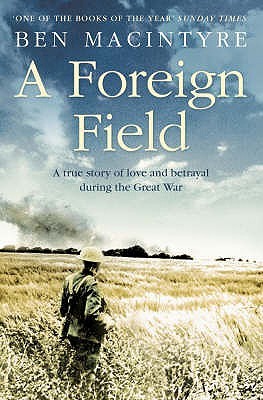
This week I’m featuring one of my TBRs, A Foreign Field by Ben Macintyre. It’s non-fiction about four young British soldiers who were trapped behind enemy lines at the height of the fighting on the Western Front in August 1914. 

A Foreign Field

It begins with a Prologue:

Prologue

The glutinous mud of Picardy caked at my shoe-soles like mortar, and damp seeped into my socks as the rain spilled from an ashen sky. Ina patch of cow-trodden pasture beside the little town of Le Catelet we stared out from beneath a canopy of umbrellas at a pitted chalk rampart, the ivy-strangled remnant of a vast medieval castle, to which a small plaque had been nailed: ‘Ici ont été fusillés quatre soldats Britannique.’ Four British soldiers were executed by firing squad on this spot.

Followed by Chapter One – The Angels of Mons:

On a balmy evening at the end of August in the year 1914, four young soldiers of the British army – two English and two Irish  – crouched in terror under a hedgerow near the Somme river in northern France, painfully adjusting to the realisation that they were profoundly lost, adrift in a briefly tranquil no-man’s land somewhere between their retreating comrades and the rapidly advancing German army, the largest concentration of armed men the world had ever seen.

Also every Friday there is The Friday 56, hosted by Freda at Freda’s Voice.

30879-friday2b56These are the rules:

  1. Grab a book, any book.
  2. Turn to page 56, or 56% on your eReader. If you have to improvise, that is okay.
  3. Find any sentence (or a few, just don’t spoil it) that grabs you.
  4. Post it.
  5. Add the URL to your post in the link on Freda’s most recent Friday 56 post.

Page 56:

Local gossips thought that Jeanne was a’racy’ type; she smoked cigarettes, drove an automobile without gloves on, and treated everybody with exactly the same direct, penetrating and faintly lofty manner, usually from the saddle.

~~~

I enjoyed reading Ben Macintyre’s Operation Mincemeat about the Allies’ deception plan code-named Operation Mincemeat in 1943, which underpinned the invasion of Sicily, so I’m hoping I’ll like this one too.

What do you think? Would you keep reading?

Wakenhyrst by Michelle Paver

A tale of mystery and imagination laced with terror. 

Wakenhyrst

Head of Zeus|4 April 2019|e-book 5683 KB|Review copy|4*

Wakenhyrst by Michelle Paver is a dark and sinister tale, full of menace and suspense. It’s a slow-burner, told through different points of view, that builds to a climax with a sad twist in the story right at the end – one I hadn’t seen coming. It’s set in a remote hamlet in the Suffolk Fens, an eerie waterlogged landscape where Edmund Stearn, a historian, and his family live in a large manor house, Wake’s End, on the edge of the Fens, said to be the oldest and most rotten of fens. It was a place of dread, haunted by spirits and the home of eels and other foul creatures.

The novel begins with a magazine report in 1966 on the events that took place at Wake’s End in 1913 when sixteen-year old Maud Stearne watched her father, Edmund, leave the house, armed with an ice-pick and a geological hammer and murder the first person he came across in the orchard. Maud was the only witness. She is now a recluse and in 1913 she had only spoken briefly at his trial. But now she needs money to repair the ancient manor house that is her home and has invited the journalist to Wake’s End. He believes Edmund was innocent and hopes to discover the truth – was Edmund mad and what did he write in his notebook that Maud has never confirmed even existed? Maud’s evidence was full of holes – did she commit the murder and frame her father, who took the blame?

 Edmund never explained why he did it, or how he ended up in the well, screaming with terror as he fought off a mass of eels. He spent the rest of his life in an asylum, where he created three paintings that astonished the world – grotesque paintings full of colour and tiny malevolent faces leering out of the canvas, the stuff of nightmares. 

What follows is a story of disintegrating madness, revealed in Edmund Stearne’s notebook as the reporter persuades Maud to tell her story, going back to her childhood, when her mother was still alive. Her mother got the same illness every year, or so Maud believed – an illness where her middle swelled, resulting in a period of ‘groaning’, as her middle would burst and ending with either ‘a bloody chamberpot’, or a dead baby. When she died Maud blamed her father and believed he was insane when he became obsessed with the medieval painting  of the Last Judgement, known as the Doom, that he found in the churchyard. He connects the Doom with the writings of Alice Pyett, a medieval mystic whose book he was transcribing.

There is a sense of impending disaster as the tale unfolds. Whilst the fens are a source of dread and fear for Edmund, they are a place of solace and beauty for Maud. The book is full of the folklore and customs of the local people and their belief in the spirits that haunt the fen – ferishes, Jack-o’-Lanterns and Black Shuck – Michelle Paver notes in her Author’s Note that she has not invented these. Maud’s childhood, her fear of her father and his violence towards her and her mother, are scenes that are based on the misogynist attitudes of the period.

Maud’s life was run by her father’s rules. She had no friends or companions apart from the servants, whose lives were ruled by superstitions, until she met Jubal Rede, the wild man who lived in the fen. He was kind to her and taught her the ways of the fen. But there is also Chatterpie, the magpie she rescued from the well and grew to love, and then Clem, the young under-gardener who she also grew to love.

It’s a compelling story, steeped in atmosphere, with characters typical of an earlier age whose lives were oppressed and isolated from the wider world. I loved the setting, the mysterious fenland, the horrific gothic and dark nature of the story, the mystery of the murder and most of all I loved Maud and her independent spirit that brought her through the nightmare.

My thanks to the publishers, Head of Zeus for my review copy via NetGalley.

Greenmantle by John Buchan

Greenmantle by John Buchan was my Classics Club Spin book to read by 31 January. I read the free Kindle edition (525 pages).

Greenmantle (Richard Hannay Book 2)

3*

Greenmantle is the second of five novels by John Buchan featuring the character of Richard Hannay, first published in 1916, the first being The Thirty-Nine Steps. It was written as the First World War was being fought, before the Battle of the Somme. Many of Buchan’s friends and his younger brother were killed in the war and his adventure stories are a form of escapism. It continues Hannay’s story, taking him from convalescence in  a big country house in Hampshire following the Battle of Loos in 1915, back to London for a vital meeting at the Foreign Office, and then to a top-secret and perilous mission across war-torn German-occupied Europe.

Narrated by Hannay, this is basically an adventure and spy story with a highly improbable plot. It’s pure escapism, as Hannay and his comrades, Sandy Arbuthnot, Peter Pienaar, a South African Boer, who Hannay met in South Africa when he was working as a mining engineer before the First World War, and an American, a dyspeptic businessman, John S Blenkiron embark on a quest, travelling incognito across Germany to Constantinople, reaching a climax at the battle of Erzurum in eastern Anatolia (Asian Turkey) in 1916.

Sandy, a master of disguise, is I think the hero of the book, although Hannay is the man in charge of their investigation. Ludovick Gustavus Arbuthnot, known as Sandy, was in the same battalion as Hannay during the Battle of Loos. The book begins as Hannay received a telegram from Sir Walter Bullivant summoning him to the Foreign Office where he offers him a ‘crazy and impossible mission’ to investigate the rumours of an uprising in the Muslim world. Bullivant tells him:

There is a dry wind blowing through the East, and the parched grasses wait the spark. And the wind is blowing towards the Indian border. Whence comes the wind, think you. (page 9)

The only clues they have to guide them are the words ‘Kasredin’, ‘cancer’ and ‘v.I’.

I was fascinated by the first half of the book as Hannay and the others set out on their mission, following the events of 1916, after the Gallipoli disaster as the Germans were supplying munitions to their allies, the Young Turks. Hannay describes his brief meeting with the Kaiser, Wilhelm II, who he felt had ‘loosed Hell, and the furies of Held had got hold of him.’

I didn’t think Buchan’s villains were particularly convincing as characters, the most evil being the mysterious Hilda von Einem. She fascinated Hannay whilst at the same time he instinctively hated her as he realised she was trying to cast a spell over him. The German Colonel von Stumm is a big man, a brute and a bully, whose ‘head was exactly the shape of a pear with the sharp end topmost’. Hannay thought he was

the German of caricature, the real German, the fellow we were up against.  He was as hideous as a hippopotamus, but effective. Every bristle on his odd head was effective. (page 84)

I liked the contrast between the ordinary and the exotic. The ordinary, such as the domestic scenes as in the opening scene of the book with Hannay just finishing breakfast and Sandy hunting for the marmalade. When Hannay returns from the Foreign Office with his mission in hand Sandy is eating teacakes and muffins. Blenkiron’s diet is mentioned several times as he only eats boiled fish and dry toast whilst drinking hot milk. On the other hand the exotic is found in the Garden-House of Suliman the Red, in the garden of a tumble-down coffee house, transformed from a common saloon into a place of mystery where the Companions of the Rosy Hours perform their potent magic of dance, making the world appear at one point ‘all young and fresh and beautiful’ then changing into something savage and passionate, ‘monstrous, inhuman, devilish’, until the spell is broken.

In the second half or the book the pace increases when they reach Constantinople and Buchan describes the action of the battle at Erzerum. But I found that it didn’t hold my attention as much as the earlier sections of the book, but then again I’m not keen on descriptions of battles and fighting. Overall, then I enjoyed it, which is why I’ve given it 3* on Goodreads.

This is my third book for the Mount TBR Challenge, a book I’ve owned for nearly 5 years, and as well as being on my Classics Club list it is also a book that fits into the When Are You Reading Challenge, being set in 1916, and as it it a spy/espionage story it also qualifies for the Calendar of Crime Challenge.


Dirty Little Secrets by Jo Spain

Quercus Books|7 February 2019 |416 pages|e-book |Review copy|4.5*

I first came across Jo Spain’s books last year when I read The Confession, a standalone novel and then The Darkest Place, her 4th Inspector Tom Reynolds Mystery book, both very good books. So I was keen to read her latest book, a psychological thriller, Dirty Little Secrets, another standalone book. I really enjoyed this very readable page-turner, keen to discover all the secrets.

It’s set in Withered Vale, a small, gated community of just seven houses, outside the small village of Marwood in Wicklow in Ireland. On the surface it is a perfect place where the wealthy live their  privileged lives and keep themselves to themselves – until a cloud of bluebottles stream out of the chimney of number 4 and Olive Collins’ dead and disintegrating body is discovered inside. She had been dead for three months and none of the neighbours had bothered to find out why she hadn’t been seen all that time. But someone must have known what had happened to her – the question being who?

When DI Frank Brazil, near to his retirement, and his partner young Emma Child arrive it’s not clear whether Olive’s death was accidental death or suicide. But they quickly establish that the boiler had been pumping out carbon monoxide and the vents and the letter box had been taped up.  It was then obvious that her death was either suicide or murder. There is plenty of DNA in the house, as it turns out that all the neighbours had visited Olive. She had tried to interfere in each of their lives and each one of them had something to hide, from past crimes, past relationships, addictions, and blackmail. They’re all suspects as each one had a motive for killing Olive.

I liked the way Jo Spain has structured her book – each character is introduced and gradually more and more facts about their lives and personalities are revealed. And Olive’s dead voice is interspersed among these people, revealing her personality, thoughts and relationships with the others, and showing just went on behind all the closed doors. I was fascinated and went from one person to the next wondering who was guilty, changing my mind as the book progressed. The characters are convincing and so it was easy to work out who was who and how they all interacted. The ending surprised me as although I had suspected what had taken place I hadn’t foreseen the whole picture.

I was hooked from the beginning to the end. Withered Vale went from being a place where the neighbours lived their lives in isolation to a much more united community as together they faced the enormity of what had happened.

My thanks to the publishers, Quercus, for my review copy via NetGalley.

Note: this book is one of my TBRs, so qualifying for Bev’s Mount TBR challenge and as it will be published in February it also qualifies for Bev’s Calendar of Crime challenge in the category of a February publication.

The Good Son by You-Jeong Jeong

Blurb When Yu-jin wakes up covered in blood, and finds the body of his mother downstairs, he decides to hide the evidence and pursue the killer himself.  Then young women start disappearing in his South Korean town. Who is he hunting? And why does the answer take him back to his brother and father who lost their lives many years ago. The Good Son by You-jeong Jeong, translated by Chi-Young Kim, is the first of her books to be translated into English. You-jeong Jeong is a South Korean writer of psychological crime and thriller fiction. She is the author of four novels including Seven Years of Darkness, which was named one of the top ten crime novels of 2015 by the German newspaper Die Zeit. My thoughts: I thought that maybe I’d made a mistake in requesting The Good Son from NetGalley when I started reading it. And at 23% I was ready to abandon it – I was tired of reading about Yu-jin trying to get rid of all the blood in the apartment and on himself after he discovered his mother lying in a pool of blood – it was so repetitive and slow going. So I did something that I very rarely do and went to the end of the book to see if it was like that all the way through – and as it looked as though it wasn’t, I carried on reading. This is a dark book, but although there is a lot of blood around at the start it isn’t actually a gory, blood and guts story. It’s a psychological did-he-do-it murder mystery. It’s tense and puzzling as Yu-jin tries to uncover what happened, at first unable to remember the events of the night before the murder. It’s written totally from Yu-jin’s perspective, so for most of the book it was as though I was reading his mind – and it’s a very strange, mixed up mind. He has difficulty with honesty and admits that he tells more lies than other people, which means that he can tell any kind of story in a believable way, and for a large part of this book I was willing to believe him, or to think the murder was all in his mind and that his mother wasn’t dead. For years he had been taking pills which his mother told him were to control his epilepsy but he didn’t like the side effects so he had stopped taking them without telling his mother. Now he’s worried about having seizures and the blank spots in his memory are confusing him.  As more of his past life is revealed in flashbacks I began to revise my opinion of him and wondered if he could have killed his mother. When he was nine his father and older brother had died in tragic circumstances that are only revealed later on in the book and even then there are different versions of what actually happened. It’s an intricate plot and just as soon as I thought I could see where it was going I realised that I’d been hoodwinked. The book is set in South Korea, mainly in Incheon, a city south of Seoul but the main focus is on this dysfunctional family and their relationships. I’m glad I didn’t give up on the book at 23% as after that point the story picked up pace and it held my interest to the end. But it is certainly a dark and unsettling character study of a psychopath. My thanks to the publishers, Little, Brown Book Group, for my review copy via NetGalley.
  • Format: Kindle Edition
  • File Size: 1126 KB
  • Print Length: 322 pages
  • Publisher: Little, Brown Book Group (3 May 2018)
  • Source: Review copy
  • My Rating: 3*