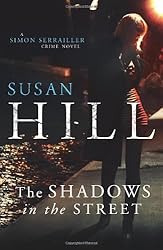
The Shadows in the Street by Susan Hill

The Shadows in the Streets is Susan Hill’s fifth Simon Serrailler crime novel. I’ve read the earlier books which I enjoyed, although I found the fourth book, The Vows of Silence rather a gloomy book not just because of the murders but also because of the unhappy state of Simon and his family. So, I decided to wait a while before moving on to the fifth book. And I am now way behind in reading the series, which will reach book 8 in October!

Susan Hill’s Serrailler novels, whilst being crime fiction, concern moral and social issues. They also follow the lives of the Serrailler family, the main characters being Simon and his sister, Dr Cat Deerbon, which is why I think it’s best to read them in order. I noticed that in this book there are references to events and characters in the earlier books and I had to look back to refresh my memory. Without knowing what happened before those incidents would not have made much sense. The books are character-driven, concentrating on the people involved in the crime rather than the police investigations, although that of course is also part of the story.

There are two major themes in this book. One concerns the murders of local prostitutes, found strangled and Susan Hill draws a sympathetic, but never a condescending or judgemental view of these women’s lives, resulting in a moving storyline of a young woman, Abi who is a single mother. Alongside this is the problem of mental illness, with Ruth Webber, who suffers from manic depression. She is the wife of the new Dean of the Cathedral and arrives full of plans to change things, which causes problems. When she too goes missing there are fears she may become one of the murder victims.

I think of these novels more as psychological studies than crime fiction – the characters and their lives predominate, whilst the police make slow progress in finding the murderer (much like real life, maybe). Anyway it’s the characters and their problems that interested me more in this book than the police procedures.

The Shadows in the Street is a complex book, but it is immensely readable and once the mystery really got under way it’s tense and full of suspense. I really enjoyed it.

Read Scotland 2014 Challenge: two books

I’ve got a bit behind with writing reviews, so here are some notes on two books I’ve recently read, both of which fit into the Read Scotland 2014 Challenge.

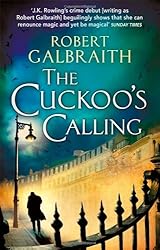
It’s common knowledge now that Robert Galbraith is J K Rowling’s pseudonym. I wish I’d read The Cuckoo’s Calling without knowing that, as although I have no problem with authors writing under pseudonyms, I found myself thinking how like the Harry Potter books it is in some ways and I doubt I’d have thought that if I’d read it ‘blind’.

Anyway, I liked The Cuckoo’s Calling. It is crime fiction, set in the world of Cormoran Strike (a Harry Potterish name, I thought), an ex-army private detective, who is struggling to get clients and pay his bills, sleeping on a camp bed in his office. Along comes Robin Ellacott, from the Temporary Solutions Agency to help out (think, Hermione Granger). She’s intelligent, efficient, remarkably resourceful, and she soon has Strike organised, which is essential as he is asked by John Bristow, a lawyer and the brother of a childhood friend to investigate the death of his sister, Lula Landry. The police are satisfied that Lula, a model, had committed suicide, but Bristow is certain that she didn’t.
What follows is at times a leisurely narrative and the plot is quite complex, but not too difficult to work out. The characters are convincing, Robin in particular soon became my favourite. She has an enquiring mind, ‘fascinated by the interior workings of other people’s minds‘ and despite her fiancé’s opposition to her job, she carries on, motivated by her fascination with investigating, and her secret ambition to be a private detective. In fact without Robin, Strike would have really struggled to get to the truth.

I’ve counted this book towards the Read Scotland 2014 Challenge because J K Rowling, although she was born in England has lived in Scotland for twenty-one years and plans to spend the rest of her life in Scotland. Whereas the author of the next book, Muriel Spark is an author who was born and grew up in Edinburgh, but who later lived in London. To qualify for this challenge books have to be by Scottish authors, either by birth or immigration, or about or set in Scotland – quite a wide brief!

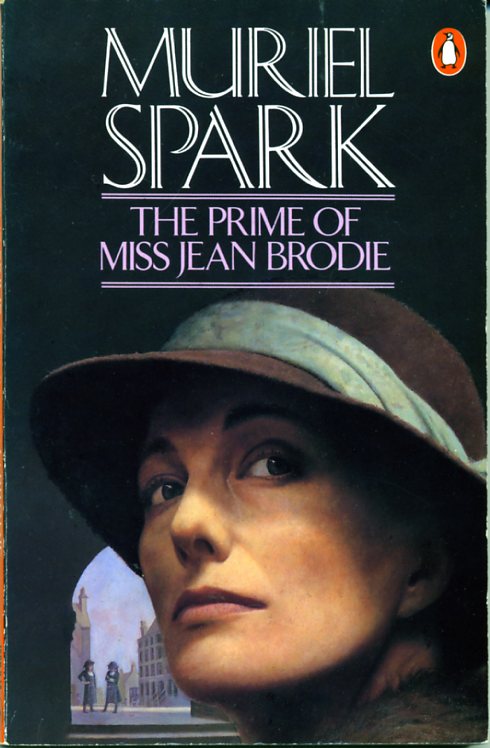
brodie001The Prime of Miss Jean Brodie is perhaps Muriel Spark’s most famous novel. I’ve read it before and seen the film, with Maggie Smith in the title role. Each time I’ve read it I’ve really enjoyed it – it’s one of those books that isn’t spoilt by knowing what happens, because part of the pleasure of reading it is the fact that I do know who betrayed Miss Brodie. Despite her declaration: ‘Give me a girl at an impressionable age and she will be mine for life‘, it is one of the ‘Brodie set’ who causes her downfall, that and her pride and self-absorption.

But what really impresses me about this book is the writing, so compact, so perceptive and so in control of the shifts in time backwards and forwards. It’s a joy to read. I’ve written more about it in this post.

It's Spin Time!

The Classics Club Spin, that is. I don’t mind which book comes up in the Spin as they are all books I’d like to read. I quite fancy reading one of Dickens’ books this summer and can’t decide which one! And that is why I’ve included five of his books in the list.

Here are the rules:

* List any twenty books you have left to read from your Classics Club list.The Classics Club
* Number them from 1 to 20.
* Next Monday (August 11th) the Classics Club will announce a number.
* This is the book you need to read by October 6th.

Here’s my list:

  1. Lady Susan/The Watsons/Sanditon by Jane Austen – her first full-length novel
  2. Lorna Doone: A Romance of Exmoor by R D Blackmore
  3. Out of Africa by Karen Blixen – I’ve been meaning to read this ever since I saw the film, which is only loosely based on the book.
  4. No Name by Wilkie Collins – because I liked The Moonstone and The Woman in White
  5. Little Dorrit by Charles Dickens
  6. Martin Chuzzlewit by Charles Dickens
  7. Nicholas Nickleby by Charles Dickens
  8. Oliver Twist by Charles Dickens
  9. Pickwick Papers by Charles Dickens
  10. Parade’s End by Ford Maddox Ford – I liked the TV series with Benedict Cumberbatch so much, I hope I like the book!
  11. Where Angels Fear to Tread by E M Forster
  12. The Man Who Would Be King by Rudyard Kipling
  13. The Call of the Wild by Jack London
  14. One Hundred Years of Solitude by Gabriel Garcia Marquez
  15. Of Human Bondage by W. Somerset Maugham
  16. Travels with a Donkey in the Cevennes by Robert Louis Stevenson
  17. Gulliver’s Travels by Jonathan Swift
  18. Barchester Towers (Barsetshire Chronicles, #2) by Anthony Trollope
  19. The Age of Innocence by Edith Wharton
  20. The Voyage Out by Virginia Woolf – her first novel

July's Books

In July I read lots – 11 books. I’ve written about 6 of them (the links underlined go to my posts on the books). For the books without reviews I’ve added a few thoughts in this post, although I do intend to write more fully about some of them later on.

Three of them are TBRs (books I’ve had since before January 2014), which is good, but as I’ve acquired more than three this month the total number of TBRs is rising, not falling! I read three non-fiction and the rest are fiction of various genres.

  1. Midnight in St Petersburg by Vanora Bennett – a review copy, historical fiction. I thought this portrayal of the Russian Revolution and the effect it had on ordinary people was well done and I did enjoy it.
  2. Casting the Net by Pam Rhodes – a review copy from LibraryThing. A light easy-to-read book that deals with serious issues from the Christian perspective. Life in Dunbridge is far from peaceful and the Neil, the curate has many crises to face, not the least being his vicar’s loss of faith. It’s full of interesting characters, painting a picture of life in a small town.
  3. A Place for Us by Harriet Evans – I received this from Lovereading as a mystery book – no author or title and no publication date. It’s a family saga about the Winters, who at first appear to be the perfect family, but no family can be that perfect and one by one their secrets begin to surface. The book has a slow start as the Winter family is large and it took me a while to get them all clear in my mind. I thought some characters were more fully developed than others, which makes the book rather disjointed. However, after the slow start I soon guessed what the big secret was and I thought it all became too predictable. An entertaining, if undemanding book, which I think could have benefited from being shorter. The book is to be published in 4 parts – Parts 1 and 2 are available now.
  4. Shadows on Our Skin by Jennifer Johnston – another review copy, this is the story of Joe, living in Derry (Londonderry), Northern Ireland before the Troubles and the Bloody Sunday attack in 1972.  An engrossing book, the writing is taut and spare and yet poetical, and the scenes standing out vividly in my mind.
  5. Shakespeare: The Biography by Peter Ackroyd  – a fascinating book which enhanced my understanding of the world in which Shakespeare lived and wrote. A book I’ve been meaning to read for ages.
  6. The Last Runaway by Tracy Chevalier – historical fiction. I really liked this book about the life of Honor Bright after she emigrated from Dorset to America in 1850 where she joined a Quaker community in Ohio. It intertwines her story with that of the €˜Underground Railroad’, helping the runaway slaves from the southern states to escape to Canada.
  7. Wycliffe and the Four Jacks by W J Burley – crime fiction, set in Cornwall. This is a quick read, with plenty of red herrings, but not too difficult to unravel. I enjoyed it.
  8. The Cuckoo’s Calling by Robert Galbraith (J K Rowling) – crime fiction. I’ll be writing what I think about this book in a separate post.
  9. I Murdered My Library by Linda Grant – an essay of just 28 pages in which Linda Grant tells about moving house and downsizing her considerable book collection to fit into a small flat. I really liked this little e-book.
  10. Charles Dickens: a Life by Claire Tomalin – I intend to write a separate post for this one too. One of my TBRs it’s a long and detailed biography that taught me a lot about Dickens.
  11. The Prime of Miss Jean Brodie by Muriel Spark -I’ve read this book for the third time now and I still think it is an excellent book. I last read it in July 2008. I may write more in a separate post.

It’s always hard deciding which book I enjoyed this most and this month it’s even more difficult as I enjoyed most of them very much. But, for the second month on the run, it’s non-fiction, and mainly because it is so well researched and detailed – and even more so because it made me want to read more of Charles Dickens’ books it has to be Charles Dickens: a Life by Claire Tomalin.

Catching Up With My Reading

Once more I’ve been reading books and moving on without writing about them. Here are just two of the books I’ve read recently:

The Last Runaway by Tracy Chevalier – I really liked this book, historical fiction about the life of Honor Bright after she emigrated from Dorset to America in 1850 where she joined a Quaker community in Ohio. It intertwines her story with that of the ‘Underground Railroad’, helping the runaway slaves from the southern states to escape to Canada.

Honor is a quilter, but finds that American quilts are not the same as English ones, just as America is very different from England, both in landscape, temperature and culture. She struggles to fit in, finding it hard to adjust. I thought this was well handled and the sense of period and place is impressive, with a wealth of detail about the land and the struggles of the settlers. She can’t face the journey back across the Atlantic and marries Jack Haymaker, a young farmer whose mother and sister disapprove of her.

The slavery question caused Honor a real dilemma, as she became involved in the Underground Railroad, a network of safe houses and people willing to provide food and shelter for the runaways. Should she abide by the law, or follow her Quaker beliefs about equality, thus putting the rest of her family at risk as well as herself? This is compounded by her relationship with Belle Mills and her disreputable brother Donovan who has taken a liking to Honor, but is also a slave-catcher, ruthless in his pursuit.

I think it’s a very entertaining book, full of colourful characters, although some, like Jack are not as well developed as others. I liked the detail about quilting, even though I have never done any! But it was the account of life on the frontier and the Underground Railroad that made the book for me. Here are Honor’s thoughts about slavery:

She had begun with a clear principle born of a lifetime of sitting in silent expectation: that all people are equal in God’s eyes, and so should not be enslaved to one another. Any system of slavery must be abolished. It had seemed simple in England; yet in Ohio that principle was chipped away at, by economic arguments, by personal circumstances, by deep-seated prejudice that Honor sensed even in Quakers. …

When an abstract principle became entangled in in daily life, it lost its clarity and became compromised and weakened. (page 259)

I borrowed this book from the library.

In complete contrast I moved on from The Last Runaway to Wycliffe and the Four Jacks by W J Burley, crime fiction set in Cornwall, featuring Chief Superintendent Wycliffe, who is on holiday but still gets drawn into a murder investigation.

Author David Cleeve, who writes under the pseudonym Peter Stride asks for Wycliffe’s advice about a series of sinister warnings he has received in the form of a playing card – the Jack of Diamonds. Then, a young woman is found dead, an apparently motiveless crime, but, as Wycliffe discovers, it follows a series of crimes, the clues all seeming to centre on an archaeological dig on Cleeve’s land. A further murder helps to pinpoint the culprit.

This is a quick read, with plenty of red herrings, but not too difficult to unravel. I liked it and I liked the personal touches that make Wycliffe a real person, a somewhat irritable man who likes his food, and gets on well with his wife. He is a thoughtful detective:

He was in a strange mood, suddenly everything had become unreal: the bare schoolroom with its peeling green walls, the battered tables, the scratched filing cabinets, his colleagues bending over their reports … He had known such experiences since childhood when, suddenly, everything seemed remarkable, nothing was ordinary any more. His mother would say: ‘Why aren’t you playing with your toys, Charles?’ Later, at school, it was ‘Day-dreaming again, Wycliffe!’ Now DS Lane was watching him and probably thinking, ‘Why dies he just sit there?’ (page 165)

It’s periods like this, however, that help Wycliffe focus his thoughts.

Wycliffe and the Four Jacks was first published in 1985. It’s the 12th in Burley’s series of 22 Wycliffe books.

Book Beginnings: The Crow Road by Iain Banks

It was the day that my grandmother exploded. I sat in the crematorium, listening to my Uncle Hamish quietly snoring in harmony to Bach’s Mass in B Minor, and I reflected that it always seemed to be death that drew me back to Gallanach.

A dramatic opening that caught my attention when I began reading Iain Bank’s novel The Crow Road. I’ve read on further and so far I’m intrigued and amused by this family saga of the McHoans, that switches about between the generations.

Every Friday Book Beginnings on Friday is hosted by Gillion at Rose City Reader where you can share the first sentence (or so) of the book you are reading, along with your initial thoughts about the sentence, impressions of the book, or anything else the opener inspires.