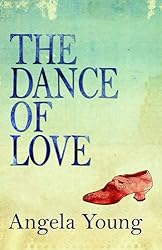
The Dance of Love by Angela Young

Angela Young‘s new novel The Dance of Love is historical fiction set at the turn of the twentieth century between 1899 and 1919. It is outstanding and I loved it so much. At times as I read it I could hardly see the pages through my tears – and there have not been many books that have that effect on me.  It’s a brilliant book, both a heart-rending love story and a dramatic story too, as the sinking of the Titanic in 1912 and the devastating and tragic effects of the First World War impact on the characters’ lives.

It’s the story of Natalie, the daughter of Sir Thomas Edwardes, a wealthy business man, a self-made man who is socially unsure of himself, but who wants his daughter to be accepted into society. It begins in 1899, a period when young ladies were presented at Court for the London Season, an opportunity to meet their future husbands. Natalie’s friends, the daughters of Lady Bridewell, are looking forward to the London Season. But Natalie has little desire to be presented at Court, relishing the idea that she would be free to live without such restraints and marry for love, someone who will care for her for herself, not because of her family connections. However, she falls in with her father’s wishes and when she meets a handsome artist-soldier, Lieutenant Haffie, it seems her wish for a happy marriage will come true.

What I really liked about this book is the way historical background is seamlessly interwoven with the narrative and how it captures the changes in society as the years went by. Natalie grows from a young, impulsive teenager with passion for romance and dancing into a responsible young woman whose hopes for a happy marriage are in the balance.  The portrait of the Edwardian upper classes, with their lavish life style, glittering balls and all their extravagances is fascinating, contrasting with the enormous changes in society as the War takes its effect.

I liked all the details about paintings as Haffie shows his work to Natalie – Angela Young’s beautiful descriptions draw such vivid full colour images that I could easily visualise the paintings, which Natalie says are ‘mysteries made of light.’  And her portrayal of the settings, whether in London, Devon or the Scottish Highlands are just as vivid, making this a richly descriptive book.

But it is the effect of the War and the effect on the families of those people travelling across the Atlantic on the Titanic that really brought home to me the whole human tragedy that people lived through, much more than any historical account has done. I think it’s seeing these events through the eyes of the people left at home that has the most impact.

I had enjoyed Angela Young’s first novel, Speaking of Love and so was pleased to accept her offer of an uncorrected proof copy of The Dance of Love. I’m so glad I did as it’s a beautifully written, brilliant book that moved me deeply, and one I shall most definitely re-read (always proof of a good book for me).

The Dance of Love will be published on 31 July 2014.

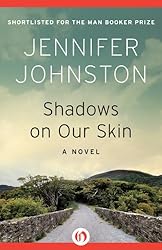
Shadows on Our Skin by Jennifer Johnston

Shadows on Our Skin by Jennifer Johnston has recently been re-issued as an e-book. It was first published in 1977 when it was shortlisted for the Booker Prize. I was pleased to be offered a copy for review as I have enjoyed a few of her books, such as The Illusionist and Two Moons.

This is the story of Joe, living in Derry (Londonderry), Northern Ireland before the Troubles and the Bloody Sunday attack in 1972. Joe is a schoolboy, living with his mother and his alcoholic father, a former war hero who reminisces and feeds on his memories. It’s a violent situation at home, as the father dominates his wife and son, with an even more violent conflict in the streets. To a certain extent Joe lives within his own head, writing poetry, and his mother is keen to keep him indoors once school has finished because she fears he will be shot as the British soldiers patrol the streets. However, he has made friends with Kathleen, a young English teacher and they meet after school. She encourages his writing, enhancing his escape from reality. But when his brother, Brendan returns home his involvement in the IRA brings Joe back to earth with a sharp shock, as the conflict comes closer to home.

Shadows on Our Skin is an engrossing book, the writing is taut and spare and yet poetical, the scenes standing out vividly in my mind. The characters’ interaction is full of emotion, and of tension; their feelings of despair and bitterness are all very evident. The book is certainly an enlightening read for me.

  • Format: Kindle Edition
  • File Size: 515 KB
  • Print Length: 177 pages
  • Publisher: Open Road Media (24 Jun 2014)
  • Sold by: Amazon Media EU S.à r.l.
  • Language: English
  • ASIN: B00KQ6PJZE
  • Source: Review copy

A Place for Us by Harriet Evans

Blurb:

The day Martha Winter decided to tear apart her family began like any other day.

When Martha, a wife and mother of three, sits down one late summer’s morning to write out the invitations to her eightieth birthday celebration, she knows that what she is planning to reveal at the party could ruin the idyllic life she and her husband David have spent over fifty years building…

But she has to let her family know what she and David have sacrificed. She can’t live a lie any more.

The invitation goes out far and wide, calling her three children and their families back home to Winterfold, their rambling house in the heart of the English countryside. They are Bill, the doctor; Florence, the eccentric academic; and Daisy, the child who never fit in. As the story unfolds, each character reveals the secrets, joys, and tragedies they are wrestling with through the confines of the family. What will happen when Martha finally tells the truth? 

My thoughts:

I haven’t read any of Harriet Evans’ books before I read A Place for Us, so I didn’t know what to expect. The Winters appear to be the perfect family, but no family can be that perfect and one by one their secrets begin to surface. Martha Winter is approaching 80 and invites all her family to a party stating that she has an important announcement to make. The book has a slow start as the Winter family is large and it took me a while to get them all clear in my mind – I drew a family tree for myself which helped. It turns out that they are by no means the perfect family – rather dysfunctional in fact.


I thought some characters were more fully developed than others, which makes the book rather disjointed and I was more interested in some at the expense of others, Florence, the younger daughter who is an art historian living in Italy is perhaps the most interesting.


However, after the slow start I soon guessed what the big secret was and I thought it all became too predictable. An entertaining, if undemanding book, which I think could have benefited from being shorter.

My thanks to Lovereading who sent me a copy of this book for review.

The Discourtesy of Death by William Brodrick

William Brodrick’s Father Anselm books never fail to meet my expectations. They are thought provoking and philosophical concerning moral dilemmas and on top of all that they’re crime fiction – an ideal combination for me. The Discourtesy of Death is the fifth Father Anselm novel and there is nothing simple or easy to solve in this book, be it the ethics or the crime, or whether Jennifer’s death was actually a crime at all.

Jennifer Henderson, a young woman, an acclaimed ballet dancer, was paralysed after a fall and later diagnosed with terminal cancer. She died and for two years her death was accepted as a peaceful death, a result of the cancer. But then an anonymous letter casts doubt on the matter – was her death assisted suicide, or murder?

Father Anselm, the lawyer-turned-monk, is asked by his Prior, who had received the letter, to investigate, even though there is no evidence of murder and on the face of it no suspects. So, this is by no means an ordinary investigation and Anselm has to work hard to get to the truth. Jennifer’s family and friends are the focus of his search and as he reviews the details of Jennifer’s last day he realises that any of them could have done something to her; but who, what and why?

The book explores the philosophical, moral and theological issues of the right-to-die, the questions about the nature of life and the choices available, whether mercy killing to stop another person’s suffering can ever be justified. Because of this the pace is slow, almost leisurely, even with the added drama of Jennifer’s father’s actions as part of the SAS in Northern Ireland, which continues to haunt him.

I was drawn into some of the red herrings, but in the end it was the question of what Anselm would decide to do with what he had discovered that exercised me. It left me wondering about the issues raised, which are thoroughly explored throughout the book with the implications of the various outcomes clearly stated.

One final thought about life and death comes from Anselm as he watched the fleeting appearances of the fish in the river, their flashes of bright silver disappearing so quickly before his eyes:

And, elevating his mind above carp and trout, Anselm thought that the glory of life – even brief and trimmed down to the point of seeming insignificance – remained utterly breathtaking. That death, with all its power, would always be the one who came afterwards, the latecomer who’d missed the party.

Whilst I don’t think The Discourtesy of Death is quite as good as the third Father Anselm book, A Whispered Name, which I thought was brilliant, it is still an excellent book, that I thoroughly enjoyed.

There are five Father Anselm novels, and I’ve read them out of order, so I’ve still got the fourth book, The Day of the Lie left to read.

  1. The Sixth Lamentation (2003)
  2. The Gardens of the Dead (2006)
  3. A Whispered Name (2008)
  4. The Day of the Lie (2012)
  5. The Discourtesy of Death (2013)
The Sixth LamentationThe Gardens of the DeadA Whispered NameThe Day of the Lie
The Discourtesy of Death
I

Midnight in St Petersburg by Vanora Bennett

Sometimes I get requests from authors/publishers to review books and occasionally a book just turns up in the post unannounced. Over a year ago now I unexpectedly received a copy of Midnight in St Petersburg by Vanora Bennett and although it appealed to me I put it to one side whilst I finished other books. It has taken me until now to get round to actually reading it.

And I’m glad I did as it is an interesting book – historical fiction beginning in 1911 in pre-revolutionary Russia with Inna Feldman travelling by train to St Petersburg to escape the pogroms in Kiev hoping to stay with her distant cousin, Yasha Kagan. She is welcomed into the Leman family where she and Yasha are apprentices in their violin-making workshop. Inna is a talented, albeit shy, violinist and she falls in love with Yasha through their shared love of music.

The book is split into three sections – September – December 1911, 1916-17 and 1918-19 as Russia enters the First World War and is plunged into Revolution and life becomes increasingly dangerous for them all. Inna is torn between her love for Yasha, wildly rebellious and an activist in the revolution, and the older and more secure Englishman, Horace Wallick who works for the jeweller, Faberge, painting miniatures. It’s a story of survival under extreme conditions.

I liked the way Vanora Bennett intermingled Inna’s personal story with the historical characters of the time, including Father Grigory, Prince Youssoupoff and Lenin. I particularly liked the Father Grigory sections. Inna first met him on the train to St Petersburg when he helped her and I had my suspicions about who he really was, although it was a while before Inna discovered his identity. I also thought the details of violin-making were fascinating and I really liked the sections about Horace and his work for Faberge. What is perhaps even more fascinating is that Horace Wallick was a real person, Vanora Bennett’s great-great-uncle who really did work for Faberge from 1910 to 1919, which makes the story all the more authentic.

However, I thought the pace of the novel wasn’t very well structured as after an attention grabbing opening I thought it dragged a bit in the middle and that it was drawn to a too hasty conclusion. Overall, though I thought this portrayal of the Russian Revolution and the effect it had on ordinary people was well done and I did enjoy it.

This is the second of Vanora Bennett’s books I’ve read – the first was Portrait of an Ordinary Woman the story of Sir Thomas More’s fall from Henry VIII’s favour and that of his adopted daughter Meg Giggs. I shall look out for more of her books.

Casting the Net by Pam Rhodes

Blurb:

Heart-warming English comedy of manners, featuring the trials and tribulations of newly ordained minister, Neil FisherIn part two of the Dunbridge Chronicles, Neil Fisher returns from ordination inspired by his sense of ministry, but determined to distance himself from the two ladies in his life. This is not altogether well received, and a wide segment of the congregation of St Stephen’s, Dunbridge–including the music group–points Neil to the error of his ways.

Meanwhile Neil’s close friend Colin and his wife Jeannie are delighted by the birth of a daughter, but is all well with the baby? Neil’s mother Iris continues to meddle, to his irritation. Churchwarden Peter has said a relieved farewell to his flighty wife Glenda–or has he? Dunbridge is not as peaceful as it seems. 

My thoughts:

I liked this light easy-to-read book that deals with serious issues from the Christian perspective. Life in Dunbridge is far from peaceful and the Neil, the curate has many crises to face, not the least being his vicar’s loss of faith. It’s full of interesting characters, painting a picture of life in a small town.

  • Publisher ‏ : ‎ Lion Fiction; 1st New edition (21 Feb. 2014)
  • Language ‏ : ‎ English
  • Paperback ‏ : ‎ 256 pages
  • ISBN-10 ‏ : ‎ 1782640622
  • ISBN-13 ‏ : ‎ 978-1782640622
  • My Rating: 3*