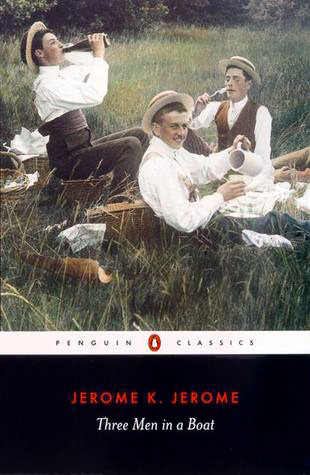
Three Men in a Boat by Jerome K Jerome

Three Men in a Boat

4*

I’ve wondered about reading Three Men in a Boat (to say nothing of the dog) by Jerome K Jerome for many years  – I first heard about it when I was at school when one of my friends read it and said she thought it was very good. And since I’ve been blogging I’ve seen that people love this book and think it’s very funny. So, I decided that it was about time that I read it.

three men map

When Jerome began writing this book he intended it to be a serious travel book about the Thames, its scenery and history, but, as he wrote it turned into a funny book.  The Thames remains at the centre of the book but it is also full of anecdotes about the events that happened to him and his friends whilst out on the river, interspersed with passages about the scenery and history. The main characters were real people, Jerome’s friends – ‘George‘ is George Wingrave who was the best man at his wedding, and ‘Harris‘ is Carl Hentschel, a photographer. Only the dog ‘Montmorency‘ is fictional.

This book was first published in 1889, which means that the descriptions of the places they passed through or stayed the night, are like a snapshot in time of what life was like in the Thames Valley, showing the how use of the river had changed with the coming of the railways for transporting goods. Cheap excursion tickets to stations along the river also meant that people could reach places like Henley, Hampton Court and Windsor as the river became the place for picnics, and regattas and hiring skiffs and punts. As time went on the river became more and more popular for fishing, boating and photography as well as a fashionable venue for young ladies to parade their elegant dresses.

It’s a story of a journey, comparing their trip to Stanley’s expedition to Africa searching for Dr Livingstone. It’s satirical, ironic and farcical.The book is composed of amusing mishaps and situations as the three friends decide what to take with them and what not to take, come across the problems of packing and unpacking the boat, where to stop the night, what food to take, and showing how they entertained themselves, for example singing comic songs, accompanied by George’s banjo, and ending in sentiment as they break down in tears singing ‘Two Lovely Black Eyes’. George’s tale of getting lost in the Hampton Court Maze made me chuckle as time after time whichever route he took he couldn’t find the way out.

I liked the way Jerome breaks up his account of their journey with recording historical events, such as his imaginative description of the signing of Magna Carta when they reach Runnymede and his account of Henry VIII’s wooing of Anne Boleyn at the priory in the grounds of Ankerwyke House, describing him as ‘that foolish boy‘ and imagining that people would have come upon them ‘when they were mooning round Windsor and Wraysbury, and have exclaimed, “Oh! you here!” and Henry would have blushed’, and Anne would have said ‘isn’t it funny? I’ve just met Mr Henry VIII in the lane, and he’s going the same way I am.’

It’s  a gentle witty book that kept me entertained all the way through – and I can’t say that for every book I read. It’s been on my Classics Club list from the first time I complied my list in 2013 and it’s also a book I’ve owned for over 11 years.

Italian Shoes by Henning Mankell

Italian Shoes

I decided to read Italian Shoes by Henning Mankell, translated by Laurie Thompson, after reading After the Fire his second book about Frederick Welin.  The events in Italian Shoes take place eight years earlier and explains in more detail Welin’s background and why he lives in self-imposed exile on an island in the Swedish archipelago. The two books can be read as standalones, but I think it would be better to read them in order to make a complete whole. These books are not Kurt Wallender mysteries but are character studies of a man living on his own, trying to come to terms with his past and reflecting on ageing and death. He cuts a hole in the ice every morning and lowers himself into the freezing water to remind himself that he is alive.

If this description makes Welin sound cold that is because he is a loner and finds it difficult to open himself up to others. He is sixty six, lives alone, apart from his cat and his dog, both of them old and dying, and he has no real friends. There is Jansson, a hypochondriac, the  postman who visits daily, but Welin doesn’t like him. He has come to a point in his life when he can’t decide what to do but suspects that his life would continue in the same way and nothing would change.

How wrong he was! That January after a snowstorm he saw a figure standing out on the ice motionless leaning on a Zimmer frame three nautical miles from the mainland. It was Harriet, the woman he had loved and abandoned nearly 40 years earlier, leaving her without any explanation. From that point onwards his life changes dramatically, for Harriet is terminally ill and wants him to take her to a small lake in northern Sweden, hidden deep in the forest; a place Welin’s father took him to once as a boy. But there are more revelations and he is forced to face the mistakes he made in the past.

The book is written in four parts, or Movements – Ice, the winter in which Welin is frozen both in his emotions and feelings, The Forest, the spring as his life and feelings begin to emerge, The Sea as his life begins to change and finally, Winter Solstice as the days start to lengthen and Welin’s new life actually begins.

I was puzzled at first by two things – the title, Italian Shoes, which seemed to be at odds with the book’s description about a man living on his own in the Swedish archipelago. the first clue comes with the quotation at the beginning of the book from Chuang Chou:

When the shoe fits, you don’t think about the feet.

Feet and shoes are mention several times throughout the book – Welin wears cut-off wellington boots most of the time – Harriet used to work in a shoe shop – and an Italian shoemaker who lives in the forest promises to make him a pair of shoes.

The second thing that made me wonder is the presence of a gigantic anthill in Welin’s living room. I do not like ants at all and the thought of an anthill next to a table in the middle of the room, almost as high as the table, swallowing up the cloth hanging down over the edge is horrific. It has been there for eleven years, containing maybe a million or more ants and Welin does not want to part with it – until the end of the book. I decided it symbolised his  inertia during the time it had been growing and he watched the ants at work. Its removal signified the change that takes place in his life.

Although this is a dark and melancholy book, as it progresses Welin begins to come to life again and to interact with others, taking responsibility for his past actions. It’s a beautifully written book, with vivid descriptions of the settings and the weather and I found it absolutely fascinating.

This book slots into the only reading challenge I’m doing this year – What’s in a Name 2018. It fits into the category of a book with a nationality in the title. It’s also one of my TBRs.

  • Format: Kindle Edition
  • File Size: 783 KB
  • Print Length: 370 pages
  • Page Numbers Source ISBN: 0099548364
  • Publisher: Vintage Digital (2 April 2009)
  • Source: I bought it
  • My Rating: 4*

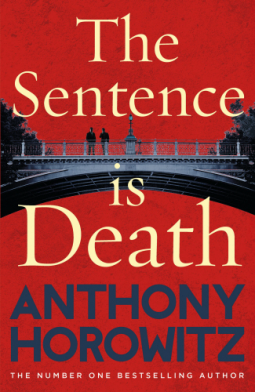
The Sentence is Death by Anthony Horowitz

5*

Random House UK Cornerstone|1 November 2018|384 pages|Review copy Last year when I read The Word is Murder I thought it was a very clever and different type of murder mystery. It features Daniel Hawthorne, an ex-policeman, now a private investigator, who the police call in to help when they have a case they call a ‘sticker’. What I found particularly interesting was the way that Anthony Horowitz inserted himself into the fiction, recruited by Hawthorne to write a book about him and the cases he investigates. In The Sentence is Death, Anthony appears again as a character, reluctantly, as he had agreed to a three-book contract with Hawthorne. At the start of the book Anthony, who wrote the script for the TV series of Foyles War, is on the set as the opening scenes in the seventh series were being shot. The rehearsal was disastrous, but it came to an abrupt end when Hawthorne interrupted the scenes by driving straight into the middle of the set to tell Anthony there had been another murder and that the police had asked for his help. Divorce lawyer Richard Pryce was found dead in his home, having been hit on the head by a wine bottle, a 1982 Chateau Lafite worth £3,000, and then stabbed to death with the broken bottle. There are several clues – there’s the number 182 written in green paint on the wall, the incredibly expensive bottle of wine when Pryce was a teetotaller, a public threat from a well known feminist writer, an unknown visitor the evening he was killed and plenty of other enemies as suspects.  There’s no doubt that Daniel is a brilliant detective, but Anthony finds him trying as he’s uncommunicative, keeping Anthony in the dark most of the time, he swears and he calls him ‘Tony’. I found it all most entertaining and perplexing, completely foxed by all the red herrings and twists and turns in the plot. But, mainly because I’d read the first book, I loved the interaction between Anthony and Daniel and had no difficulty with the mix of fact and fiction, enjoying the details about Anthony’s life as a scriptwriter as much as the mystery about the murder. I don’t think, however that you need to read The Word is Murder first because as a murder mystery The Sentence is Death works well as a standalone. But to  see how their relationship began and develops it would help to read the books in order. I loved this book as much or maybe even more than the first one and am delighted that I received a copy of this book from the publisher, via NetGalley, for review.

Books Read in November 2018

This month I read seven books, made up of one review copy that came to me via  NetGalley, two library books and four of my own books (two of these on Kindle). Two of the seven books are non-fiction and the rest are fiction. My ratings range from 5 to 2.5 stars and are based solely on my reactions to the books.

I’ve written about three of these books (click on the links to read my reviews):

Jacob's Room is Full of Books: A Year of ReadingAbsolute ProofIn a Dark, Dark Wood

  1. Jacob’s Room is Full of Books by Susan Hill 5*  – in which Susan Hill describes a year of her reading.
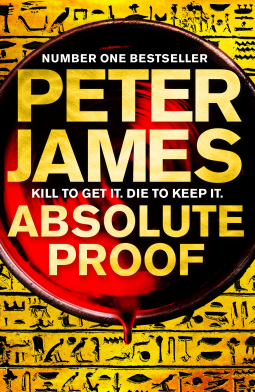
  2. Absolute Proof by Peter James 3.5* –  a standalone thriller that is very different from his Roy Grace books. It has similarities to Dan Brown’s The Da Vinci Code, as the search is on for proof of  God’s existence.
  3. In a Dark, Dark Wood by Ruth Ware 2.5* – I was disappointed as this book promised to be a psychological thriller but it neither thrilled nor scared me, although it is a page-tuner. Leonora and Clare haven’t seen  or even spoken to each other since they were 16, ten years ago. So why has Clare invited Leonora to her hen party held in a glass house in the middle of a wood?

Here are some brief notes about the remaining four books:

I Am, I Am, I Am: Seventeen Brushes With DeathThe ReckoningThe New Mrs CliftonTombland (Matthew Shardlake, #7)

I Am, I Am, I Am by Maggie O’Farrell 5* – I wrote this Friday post about this book, with two quotations and a summary of the book. It’s a memoir with a difference: seventeen encounters of near-death experiences, with Maggie at different ages, in different locations, revealing a whole life in a series of tense, visceral snapshots. It’s a beautifully written book that I loved.

The Reckoning by John Grisham 5*, about Pete Banning, Clanton’s favourite son, a returning war hero, the patriarch of a prominent family, a farmer, father, neighbour, and a faithful member of the Methodist Church. Why did he shoot and kill the Reverend Dexter Bell? And then refuse to say why he killed him? I was intrigued and fascinated by the whole book that went back into Pete’s wartime experiences during world War Two during the Bataan Death March in the Philippines.

The New Mrs Clifton by Elizabeth Buchan 4* this begins in 1974 with the discovery of a skeleton, the remains of a woman, between twenty-five and thirty, buried beneath a tree in the garden of house in Clapham, facing the Common. Her identity and why and how she was killed is not revealed until very nearly the end of the book.

It then moves back in time to 1945 when Intelligence Officer Gus Clifton returns to London with Krista, the German wife he married secretly in Berlin. For his sisters, Julia and Tilly, this broken woman is nothing more than the enemy. For Nella, Gus’s loyal fiancée, it is a terrible betrayal. Elizabeth Buchan paints a convincing and moving picture of life in both London and Berlin post-war, highlighting the devastation of the bombing and showing how people have to come to terms with the changes in their lives. All the way through the book I wondered who the killer was and which woman had been murdered.

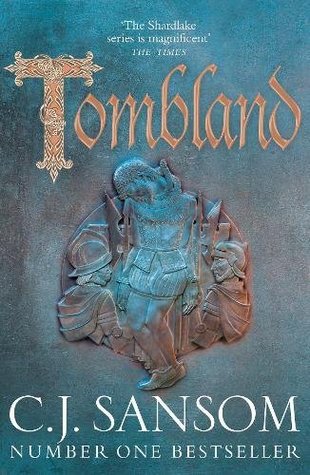
Tombland by C J Sansom 5* – I wrote this Friday post this book, giving two quotations and a summary of the book. Set in 1549 this is a remarkable and detailed book about the situation as Edward VI is on the throne following the death of his father Henry VIII and his uncle Edward Seymour, Duke of Somerset, rules as Protector.

Matthew Shardlake has been working as a lawyer in the service of Edward’s sister, the Lady Elizabeth. He is employed to investigate the gruesome murder of Edith Boleyn, the wife of John Boleyn – a distant Norfolk relation of Elizabeth’s mother. But the main part of the book is about Kett’s Rebellion – as thousands of peasants, in protest about the enclosures of common land, gather together on Mousehold Heath outside Norwich and battle ensues.

It’s an enormous book and I’m planning to write a longer post about it.


Absolute Proof by Peter James

3.5*

Pan Macmillan|4 October 2018|570 pages|Review copy Investigative reporter Ross Hunter nearly didn’t answer the phone call that would change his life – and possibly the world – for ever. ‘I’d just like to assure you I’m not a nutcase, Mr Hunter. My name is Dr Harry F. Cook. I know this is going to sound strange, but I’ve recently been given absolute proof of God’s existence – and I’ve been advised there is a writer, a respected journalist called Ross Hunter, who could help me to get taken seriously.’ What would it take to prove the existence of God? And what would be the consequences? This question and its answer lie at the heart of Absolute Proof, an international thriller from bestselling author Peter James. The false faith of a billionaire evangelist, the life’s work of a famous atheist, and the credibility of each of the world’s major religions are all under threat. If Ross Hunter can survive long enough to present the evidence . . . Absolute Proof is a long book and at times I struggled to carry on reading as, although for the most part it is fast-paced, it is slow going in parts. And it certainly tested my ability to suspend my disbelief several times. I’ve only read two of Peter James’ books previously, both crime fiction set in Brighton featuring Detective Superintendent Roy Grace. Absolute Proof is a standalone thriller and is very different from the Roy Grace books. It has similarities to Dan Brown’s The Da Vinci Code, as the search is on for proof of  God’s existence. Ross Hunter is married to Imogen and they are expecting their first child – however he has serious doubts about his marriage and suspects Imogen of cheating on him. The story of their marriage unfolds, underlying the main plotline.  Dr Harry  F Cook, a former RAF officer and  retired history of art professor, contacts Ross and drip feeds him information that Cook claims proves that God exists. The grid references Cook gives Hunter takes him to various places including Glastonbury, where he visits the Chalice Well in search of the Holy Grail, and Egypt in search of Queen Hatshepsut’s Temple. All the time he is in danger of death as he is pursued by those who do not want Cook’s claims to be made public. It’s a dramatic and hair-raising story that made me want to know what happened next at the same time as it made me question its credibility. It is certainly thought provoking and entertaining. One of the things that intrigued me was that in his Acknowledgements Peter James explains that the book began with a phone call he received in 1989 from someone who did indeed claim that he had been given absolute proof of God’s existence and that he had been given Peter James’s name as an author who would help him to get taken seriously. This started James’s ‘journey of exploration into what might be considered absolute proof – and just what the consequences might be.’ During the intervening years he has talked to many people from different faiths and had discussions with scientists, academics, theologians and clerics. He has certainly done his research and gives a long list of the people who have helped him, plus a list of his sources of reference, giving me yet more details of books I’d like to read. Thanks to Pan Macmillan and NetGalley for provided a review copy of this book.

My Friday Post: I Am, I Am, I Am

Book Beginnings Button

Every Friday Book Beginnings on Friday is hosted by Gillion at Rose City Reader where you can share the first sentence (or so) of the book you are reading, along with your initial thoughts about the sentence, impressions of the book, or anything else the opener inspires.

This week I’m featuring I Am, I Am, I Am: Seventeen Brushes with Death by Maggie O’Farrell, one of the books I’m currently reading.

I Am, I Am, I Am: Seventeen Brushes With Death

I chose this book because I love Maggie O’Farrell’s books and as soon as I read the description I knew I had to read it:

About the Book

I AM, I AM, I AM is Maggie O’Farrell’s electric and shocking memoir of the near-death experiences that have punctuated her life. The childhood illness she was not expected to survive. A teenage yearning to escape that nearly ended in disaster. A terrifying encounter on a remote path. A mismanaged labour in an understaffed hospital.

This is a memoir with a difference: seventeen encounters with Maggie at different ages, in different locations, reveal to us a whole life in a series of tense, visceral snapshots. Spare, elegant and utterly candid, it is a book to make you question yourself. What would you do if your life was in danger? How would you react? And what would you stand to lose?

It begins:

Neck 1990

On the path ahead, stepping out from behind a boulder, a man appears.

This opening sentence drew me in immediately, knowing from the title and book description that this was not going to be a happy encounter – this is the ‘terrifying encounter on a remote path.’

~~~

Also every Friday there is The Friday 56, hosted by Freda at Freda’s Voice.

30879-friday2b56These are the rules:

  1. Grab a book, any book.
  2. Turn to page 56, or 56% on your eReader. If you have to improvise, that is okay.
  3. Find any sentence (or a few, just don’t spoil it) that grabs you.
  4. Post it.
  5. Add the URL to your post in the link on Freda’s most recent Friday 56 post.

Pages 55-56:

Suddenly the plane is falling, dropping, plummeting, like a rock fallen from a cliff. The downward velocity is astonishing, the drag, the speed of it. It feels like the world’s most unpleasant fairground ride, like a dive into nothing, like being pulled by the ankles into the endless maw of the underworld. My ears and face bloom like petals of pain, the seatbelt cutting into my thighs as I am thrown upwards.

~~~

The title is taken from Sylvia Plath’s The Bell Jar:

I took a deep breath and listened to the old brag of my heart. I am, I am, I am.

What about you? Does it tempt you or would you stop reading?