Hitler’s Secret by Rory Clements

Hitler's secret

Bonnier Zaffre| 23 January 2020| 339 pages| e-book| review copy via NetGalley| 4 stars

Description from the author’s website:

In late autumn 1941, Nazi Germany has conquered most of western Europe and is now laying waste to the Soviet Union with a relentless drive towards the East. But a secret from Hitler’s past life threatens to destabilise the Nazi regime – and there are men who will stop at nothing to prevent it coming out. 

My thoughts

I enjoyed Rory Clements’ first book in his Tom Wilde series, Corpus so much that I decided to look out for more of his books. But somehow I missed the next two books as Hitler’s Secret is the fourth book in the series. Luckily for me, it reads perfectly as a standalone, although at some point I would like to read the books I missed.

This is a complicated novel and I am not going to attempt to describe all the details.  Just before the USA’s entry into the Second World War, Cambridge professor Tom Wilde, an American, is smuggled into Nazi Germany at the instigation of an American intelligence officer to collect a mysterious package from Berlin. He isn’t told what is in the package, but I thought it was obvious from quite early in the book what it was.  I think that increased the tension and suspense throughout the book and at several points in the story, I just couldn’t imagine how Tom would succeed in his mission as he is pursued by numerous people including the powerful Nazi, Martin Borman and his agents. Hermann Goering and his wife Emmy also play an important role in the story as does the internal struggle for power under Hitler, whereas Hitler himself does not appear.

I enjoyed all of it – the somewhat predictable plot, the amazing coincidences, the chase across Germany and the Baltic, the doubtful characters, as well as all the twists and turns and seemingly impossible situations that they encounter. It’s fast paced, full of action, danger, violence and double-cross – a most satisfying and compelling thriller. The ending in England is also intriguing, full of heart stopping moments in scenes that had my head whirling. Needless to say really, but I was gripped by this book and I just had to find out what happened. I think the last final twist about Hitler’s secret was very well done.

Short Stories on Sunday

Over several years I’ve been reading my way through Agatha Christie’s books and short stories. I’ve read all her detective/mystery novels and some of her short story collections. In an attempt to read more of the short stories I’ve decided to read some each Sunday, beginning with the stories collected in Miss Marple and Mystery.

IMG_20180513_095855842.jpgThis collection contains 55 stories, 20 of them featuring Miss Marple. There is an Short Story Chronology in the Appendix with a table aiming to present all Agatha Christie’s short stories published between 1923 and 1971, listed in order of traced first publication date. Counting how many there are in total is a difficult task – some stories that first appeared in weekly or monthly magazines were later  re-worked and became chapters in a larger work, some in Partners in Crime were sub-divided into smaller chapters, 13 were re-worked into the episodic novel, The Big Four, and some were rewritten so substantially that they appear separately in different books!
I’ve read some of these in other short story collections but there are still many I haven’t read.

The Girl in the Train is one I haven’t read before. It was first published in Grand Magazine in February 1924 and was adapted as one of the Agatha Christie Hour drama series for by Thames Television in 1982 as part of their ten-part programme. It’s a very short story that also appears in The Listerdale Mystery collection of short stories.

George Rowland is the heir to his Uncle William’s wealth but is left without a job or a home when William throws him out on his heel. On a whim George Rowland decides to catch a train down to Rowland’s Castle, a village which happens to bear his name. A beautiful girl bursts into his compartment, frantically begging to be hidden.  She gives him a package saying it is the key to everything and he is to guard it with his life. Jumping out of the train at the first stop she tells him to follow the little man with a small dark beard getting on the train. His life changes dramatically as he follows her instructions.

It’s a bit of nonsense really, in the same vein as Christie’s Tommy and Tuppence stories. A quick easy read, but entertaining nevertheless and possibly the first of books entitled The Girl … 

My Friday Post: A Killing Kindness by Reginald Hill

Book Beginnings Button

Every Friday Book Beginnings on Friday is hosted by Gillion at Rose City Reader where you can share the first sentence (or so) of the book you are reading, along with your initial thoughts about the sentence, impressions of the book, or anything else the opener inspires.

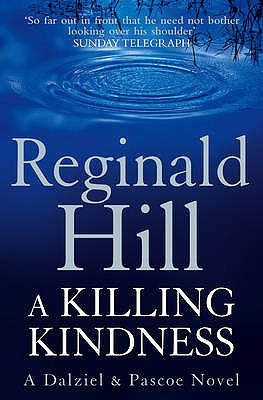
A Killing Kindness by Reginald Hill is one of the books I’m thinking I’ll read next. It’s the 6th Dalziel and Pascoe novel

A killing kindness


… it was green, all green, all over me, choking, the water, then boiling at first, and roaring, and seething, till all settled down, cooling, clearing, and my sight up drifting with the last few bubbles, till through the glassy water I see the sky clearly, and the sun bright as a lemon, and birds with wings wide as a windmill’s sails slowly drifting round it, and over the bank’s rim small dark faces peering, timid as beasts at their watering, nostrils sniffing danger and shy eyes bright and wary, till a current turns me over, and I drift, and am still drifting …

What the hell’s going on here! Stop it! This is sick …

I wasn’t sure what was going on either …

Also every Friday there is The Friday 56, hosted by Freda at Freda’s Voice.

30879-friday2b56These are the rules:

  1. Grab a book, any book.
  2. Turn to page 56, or 56% on your eReader. If you have to improvise, that is okay.
  3. Find any sentence (or a few, just don’t spoil it) that grabs you.
  4. Post it.
  5. Add the URL to your post in the link on Freda’s most recent Friday 56 post.

Page 56: it’s becoming clearer now what was going on –

… all over me, choking, the water all boiling at first, and roaring, and seething …. Pascoe shook the medium’s taped words out of his mind and went on with his reading.

There was a degree of lividity down the left side which was unusual for a corpse taken from the water, but could be explained by the fact that the body seemed to have been wedged in the debris by the canal bank rather than rolling free in the current.

Blurb:

When Mary Dinwoodie is found choked in a ditch following a night out with her boyfriend, a mysterious caller phones the local paper with a quotation from Hamlet. The career of the Yorkshire Choker is underway.

If Superintendent Dalziel is unimpressed by the literary phone calls, he is downright angry when Sergeant Wield calls in a clairvoyant.

Linguists, psychiatrists, mediums – it’s all a load of nonsense as far as he is concerned, designed to make a fool of him.

And meanwhile the Choker strikes again – and again…

~~~

Have you read this book? What did you think?

WWW Wednesday: 15 January 2020

IMG_1384-0

WWW Wednesday is run by Taking on a World of Words.

The Three Ws are:

What are you currently reading?
What did you recently finish reading?
What do you think you’ll read next?

Currently I’m reading three books:

Charles Dickens oliver twist etcOliver Twist by Charles Dickens, my Classics Club Spin book. It’s one of those books that I think I know the story from watching TV adaptations, but I have never read it. I’ve discovered that I only ‘know’ the beginning of the book up to the part where Oliver is rescued by Mr Brownlow from Fagin’s clutches, only to be snatched back by Nancy. After that the story is totally new to me.

John Lennon LettersI’m also reading The John Lennon Letters edited by Hunter Davies. It includes a brief biography and using almost three hundred of Lennon’s letters and postcards, to relations, friends, fans, strangers, and lovers follows his life more or less chronologically. It’s a large, heavy hardback book, illustrated with photos and reproductions of the letters etc. This is going to be a long-term read for me.

The Windsor StoryThe third book is one I’ve only just started – I’ve been struck by some of the parallels between Edward VIII’s abdication in 1936 in order to marry Wallis Simpson and the current situation of Prince Harry and Meghan in wanting to step back as senior royals, and I remembered I have The Windsor Story by J Bryan III and Charles V Murphy. It looks remarkably comprehensive and is another book that I think will take me a long time to read.

Lady of the ravensThe last book I finished reading is  The Lady of the Ravens by Joanna Hickson, historical fiction about about the early years of Henry’s reign as seen through the eyes of Joan Vaux, a lady in waiting to Elizabeth of York, whose marriage in 1486 to Henry united the Houses of Lancaster and York after the end of the Wars of the Roses.  I found this a fascinating book and posted my review a few days ago.

Tinker tailorI have several books lined up to read next including Tinker, Tailor, Soldier, Spy by John Le Carré because over the Christmas period I watched the film starring Gary Oldman as George Smiley, along with Colin FirthTom HardyJohn Hurt and others. I began reading the book years ago and have a bookmark at page 88, but I’ll have to go back to the beginning now.
A killing kindnessBut I’d also like to start A Killing Kindness, the next Dalziel and Pascoe novel, the 6th one in Reginald Hill’s series. It looks good – about Mary Dinwoodie whose body is found choked in a ditch following a night out with her boyfriend, and a mysterious caller phones the local paper with a quotation from Hamlet.

But knowing how long it could be until I start the next book, it could be something completely different!

Have you read any of these books?  Do any of them tempt you? 

A Pinch of Snuff by Reginald Hill

A Pinch of Snuff

HarperCollins|2003|362 pages|Paperback|my own copy|4* 

A Pinch of Snuff is Reginald Hill’s fifth Dalziel and Pascoe novel, first published in 1978. It was televised in 1994 by Yorkshire Television, two years before the BBC series began. The characters of Dalziel and Pascoe were played by comedians Gareth Hale and Norman Pace, with Christopher Fairbank as Sergeant Edgar Wield. It was not a success and Reginald Hill was said to have been unhappy with the series. Subsequently the Dalziel and Pascoe books were adapted for BBC television from 1996 to 2007 with the actors Warren Clarke and Colin Buchanan in the lead roles.

I finished reading A Pinch of Snuff just before Christmas and didn’t have time to review it then, so these are just a few notes of what I thought about it. It is better than the earlier books, almost as good as the later books and I enjoyed it very much. It begins as Jack Shorter, Pascoe’s dentist, tells him that he thinks that in one of the blue movies shown at the Calliope Club, an actress wasn’t acting but that she really was beaten up and that her teeth were actually broken. However, when Pascoe begins to investigate his dentist’s allegations it seems that the dentist’s fears were unfounded as the actress in question assures Pascoe that she was acting and certainly wasn’t hurt. But then the cinema is wrecked and its owner killed. Shorter, meanwhile, is accused of molesting an underage patient and is allegedly responsible for getting her pregnant.

All in all, this is a complicated book involving child abuse, pornography, violence towards women and snuff films. It starts slowly, but as the various twists and turns crop up the pace quickens. The events are shown through Pascoe’s eyes and we see his relationships with Dalziel and Sergeant Wield develop.  Elly, Pascoe’s wife, still doesn’t get on with Dalziel, and her feminism comes to the fore in her antagonism against him. 

The 6th book in the series is A Killing Kindness and I shall be reading that very soon.

These are the Dalziel and Pascoe books I’ve read so far:

1. A Clubbable Woman (1970) 
2. An Advancement of Learning (1971)
3. Ruling Passion (1973)
4. An April Shroud (1975) 
8. Exit Lines (1984)
11. Bones and Silence (1990) 
14. Pictures of Perfection (1993) – read, no post
17.On Beulah Height (1998) 
20. Death’s Jest Book (2002) 
21. The Death of Dalziel (2007)

Six Degrees of Separation: from Daisy Jones and The Six to Thirteen

I love doing Six Degrees of Separation, a monthly link-up hosted by Kate at Books Are My Favourite and Best. Each month a book is chosen as a starting point and linked to six other books to form a chain. A book doesn’t need to be connected to all the other books on the list, only to the one next to it in the chain.

Daisy Jones

This month the chain begins with Daisy Jones and The Six by Taylor Jenkins Reid,  a novel about the rise and fall of a fictional 70s rock band inspired by Fleetwood Mac.

There are always several ways to go when compiling these Six Degree chains and at first my mind went blank  but looking at the books we got for Christmas I decided that Face It: a Memoir by Debbie Harry was just the right book for my first link, a book about a real rock band. Debbie Harry is the best known face of Blondie; she and the band forged a new sound that brought together the worlds of rock, punk, disco, reggae and hip-hop to create some of the most beloved pop songs of all time.

The Ballad of Jethro Tull: The official illustrated oral history is another book we got for Christmas. It’s Jethro Tull’s story told by Ian Anderson, band members past and present and the people who helped Tull become one of the most successful bands in rock history.

And then I thought my chain needed a change of genre, but sticking with the word ‘ballad’ I thought of Dreamwalker: The Ballad of Sir Benfro: Book 1 by James Oswald, a magical tale of the young dragon, Benfro, inspired by the language and folklore of Wales. It follows the adventures of a young dragon, Sir Benfro, in a land where his kind have been hunted near to extinction by men.

For the next link I turned to crime fiction and to one of James Oswald’s Inspector McLean novels, set in Edinburgh – The Hangman’s Song. It’s a dark, tense novel with elements of the supernatural  and parapsychology thrown in. It’s not a book for the faint-hearted or the squeamish as there are details of some gruesome deaths, murders and beatings that the characters go through. 

James Oswald is a Scottish author and so my last link is to another Scottish author – Chris Brookmyre, who has written The Way of all Flesh, under the pseudonym of Ambrose Parry with his wife, Dr Marisa Haetzman a consultant anaesthetist. It is set in Edinburgh in 1847 as Dr James Young Simpson, a professor of midwifery, discovered the anaesthetic properties of chloroform. It combines fact and fiction most successfully, the social scene, historical and medical facts slotting perfectly into the plot. It was on the Longlist for the 2019 Theakston Old Peculier Crime Novel of the Year.

But the winner was Thirteen by Steve Cavannagh, an Irish author. It’s the fifth book in the Eddie Flynn series of crime thrillers, ‘serving up a delicious twist to the traditional courtroom thriller, where in this instance the real killer is not the one on trial, but a member of the jury!’ I have a copy but haven’t read it yet. And quite by chance I see that it also links back to Daisy Jones and the Six as it has a number in the title.

From a fictional rock band to two real rock bands my chain also links up books of ballads and three crime fiction novels.

Next month (1 February 2020), we’ll begin with Fleishman is in Trouble by Taffy Brodesser-Akner.