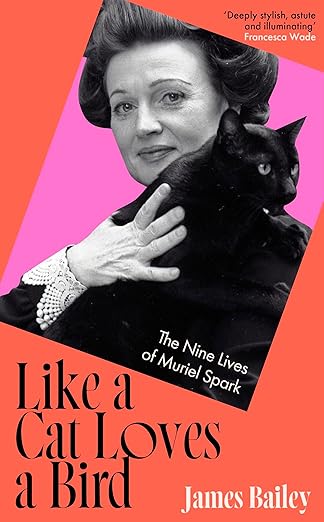
Hodder & Stoughton| 9 April 2026| 309 pages e-book| Review copy 4*
Description:
Muriel Spark (1918–2006) was one of literature’s great shapeshifters. That mercurial quality is found in her strange, brilliant, cruel novels—with their plots featuring a cast of elderly characters receiving telephone calls from Death, the devil going clubbing in Peckham, and a fascist schoolmistress leading her coterie of girls astray—but it is also true of her as a person. As sly, nimble, and elegant as Spark’s own work, Like a Cat Loves a Bird offers a thrilling new perspective on a remarkable life and career that spanned much of the twentieth century.
From Spark’s childhood in Edinburgh to her final years in Tuscany—via South Africa, London, New York, and Rome—James Bailey traces a light-footed journey around the world and through the novelist’s strange and magnificent books. The result is an irresistible story of transformation, wit, and fierce determination—and a passionate case for this vital modern artist.
Like a Cat Loves a Bird: The Nine Lives of Muriel Spark by James Bailey appealed to me partly because I’ve read a couple of books by Muriel Spark and last year I read Appointment in Arezzo: A Friendship with Muriel Spark by Alan Taylor, a warm, personal and affectionate account. Taylor first met Muriel Spark in 1990, when he interviewed her for a newspaper article on the publication of her novel, Symposium. They became friends and met frequently during the last fifteen years of her life. It’s a fascinating insight into her life, and what she thought about writing, as well as reflecting on her books. So, I thought this book would help me learn more about her life and work.
It seems a comprehensive account of Spark’s life and works, drawing on a wide range of sources, including interviews with and essays by her, profiles in newspapers and magazines,radio and television programmes, literary criticism, reviews as well as letters, manuscripts, receipts and research folders contained in her own archive. He also used Michael Stannards’s Muriel Spark: the Biography. At the end of the book there are notes on each chapter, giving where he found the information and also an extensive bibliography.
Bailey describes Spark thus:
Dame Muriel Sarah Spark (née Camberg) is perhaps modern literature’s finest shapeshifter, who over the course of her eighty-eight years and in the twenty years since her death, remains elusive, contradictory and endlessly fascinating. … She was, if you believe what you read in the papers: a genius, a survivor, a bad mother, a fickle friend, a closeted lesbian, a tyrant, a loner, an eccentric, a recluse, a control freak, and a terrible gossip. She would politely encourage you not to believe what you read in the papers.
What came over to me is an impression that Muriel Spark, like most of us I suppose, changed over the years. She was a complex person who took brave choices in her life, but writing was her main motivation, or even her obsession. Bailey’s book is balanced between giving insights into her personal life, and into her work, showing how the two were intricately intertwined. He writes about her childhood and family life, her relationships with parents, her husband, Sidney and her son, Robin who became estranged from her after his parents divorced. He paints an objective picture of Muriel Spark which doesn’t flatter her. It seems she was rather formidable and a difficult person to get to know.
He also writes about her books, giving a synopsis of each book, stating that they resist easy definition and that her novels and short stories are different in style and genre. Some are social satire, whilst others are detective fiction, ghost stories, political parody, gothic melodrama and the roman clef. As I’ve only read two of her novels I’m now keen to read more and I’ll also seek out her short stories.
Spark’s friend Penny Jardine first met Muriel Spark in 1968 in Rome at a hairdresser’s salon. She was looking for secretarial work and handed Spark her a card bearing her credentials. Six months later she was employed to sort Spark’s library. Some years later, having become friends Jardine moved in with Spark, living in Oliveto, near Arezzo in Tuscany, where she also took care of the household as well as acting as her secretary, liaising with agents and translators, responding to requests for interviews and public appearances, and replying to fan mail on Spark’s behalf. The arrangement got people talking but Spark said that they were not lesbians although they were very fond of each other.
I wondered where the title, Like a Cat Loves a Bird came from. Bailey states that ‘cats wandered in and out of Spark’s life’. Spark was like her feline companions – ‘she came and went as she pleased. Forever on the prowl for her own kind of ‘mousing prospects’, she searched intently for freedom, intellectual stimulation, and the perfect conditions under which her writing could flourish’. The title comes from an interview in which she replied to a question about ‘the cruelty and violence she inflicted on her characters and did she hate them?’ She said ‘Oh no I love them most intensely like a cat loves a bird. You know cats do love birds; they love to fondle them’.
If you enjoy Muriel Spark’s books, I hope you’ll enjoy this book too. It’s not just a biography, but also a literary biography.
Many thanks to the author and Penguin for a review copy via NetGalley.


It sounds like a fascinating set of insights into such an interesting person, Margaret. Spark’s work isn’t everyone’s cuppa, but it’s so influential, and learning about the person behind that work sounds very interesting.
LikeLiked by 1 person
As you say, Margot this is a fascinating set of insights into Muriel Spark and her work. I first read The Prime of Miss Jean Brodie many years ago and more recently read Loitering with Intent, which is not as good, in my opinion. So I’ve been wondering what her other books are like and Bailey’s book has got me interested to read more of them.
LikeLike
Oh I love a literary biography. Enjoyed your detailed review. Love that cover, too.
LikeLiked by 1 person
Thanks Nicola. I love the cover too – that and the title caught my eye making me curious about the book.
LikeLike