Throwback Thursday: Curtain by Agatha Christie

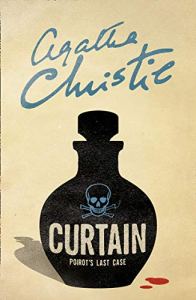
Today I’m looking back at my post on Curtain: Poirot’s Last Case by Agatha Christie, one of my favourite Agatha Christie books. I first reviewed it on December 2, 2010.

My review begins:

Curtain was first published in 1975, but it was written in the 1940s during the Second World War. Agatha Christie had written it with the intention that it be published after her death, but in 1975 her publishers persuaded her to release it so that it could appear in time for the Christmas season – a ‘Christie for Christmas’.

In this book Poirot and Hastings have come full circle, returning to Styles, the scene of their first case. Poirot is now an old man (just how old is not revealed  – I think if you go by the chronology of the novels he must have been about 120, but there is no need to be too precise), and close to death.  Hastings is the narrator of this mystery. He is saddened by the devastation age has had on Poirot

Click here to read my full review

The next Throwback Thursday post is scheduled for February 3, 2022.

Book Beginnings & The Friday 56: Servant of Death by Sarah Hawkswood

Every Friday Book Beginnings on Friday is hosted by Gillion at Rose City Reader where you can share the first sentence (or so) of the book you are reading. You can also share from a book you want to highlight just because it caught your fancy.

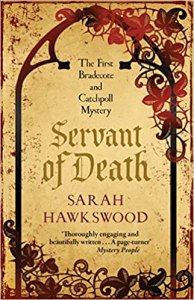
Servant of Death is one of the books I’ve recently borrowed from the library. It’s historical crime fiction set in 1143 in Pershore Abbey, the first in the series of Bradecote and Catchpoll Mysteries set in the twelfth century, in Worcestershire.  

The Book Begins:

Elias of St Edmondsbury, master mason, stood with the heat of the midsummer sun on broad back and thinning pate, rivulets of sweat trickling down between his shoulder blades. The wooden scaffolding clasped the north transept of the abbey church, close as ivy.

Also every Friday there is The Friday 56, hosted by Freda at Freda’s Voice. *Grab a book, any book. *Turn to Page 56 or 56% on your  ereader . If you have to improvise, that is okay. *Find a snippet, short and sweet, but no spoilers!

These are the rules:

  1. Grab a book, any book.
  2. Turn to page 56, or 56% on your eReader. If you have to improvise, that is okay.
  3. Find any sentence (or a few, just don’t spoil it) that grabs you.
  4. Post it.
  5. Add the URL to your post in the link on Freda’s most recent Friday 56 post.

Page 56:

‘He dropped to his knees, careful to avoid the dark, sticky stain, and slid his hand beneath the corpse. Feeling around tentatively, he was relieved to find the cords of the monk’s scrip, and followed them to the leather bag, which was still full. Whoever had killed him had not had time or inclination to investigate it.

Summary:

The much-feared and hated Eudo – the Lord Bishop of Winchester’s clerk – is bludgeoned to death in Pershore Abbey and laid before the altar in the attitude of a penitent. Everyone who had contact with him had reason to dislike him, but who had reason to kill him? The Sheriff of Worcestershire’s thief taker, wily Serjeant Catchpoll, and his new and unwanted superior, Undersheriff Hugh Bradecote, have to find the answer. And as the claustrophobic walls of the Abbey close in on the suspects, the killer strikes again.

This is the first book by Sarah Hawkswood that I’ve come across.

About Sarah Hawkswood, a pen name.

Sarah Hawkswood read Modern History at Oxford University and specialised in Military History and Theory of War. She turned from writing military history to mediaeval murder mysteries set in the turmoil of The Anarchy in the mid 12thC, all located in Worcestershire, where she now lives. The Bradecote & Catchpoll series began with Servant of Death (previously published as The Lord Bishop’s Clerk) and the ninth, Wolf at the Door, was published in August 2021 with the tenth, A Taste for Killing, due out in 2022.

~~~

What have you been reading lately?

Book Beginnings & The Friday 56: The Dogs of Riga by Henning Mankell

Every Friday Book Beginnings on Friday is hosted by Gillion at Rose City Reader where you can share the first sentence (or so) of the book you are reading. You can also share from a book you want to highlight just because it caught your fancy.

i’m still reading Hilary Mantel’s The Mirror and the Light and am stuck in the middle of the book where the narrative is so slow as Cromwell reminisces about his childhood and early adult years. I’m also reading The Count of Monte Cristo, such a long book, but it is moving along swiftly and although it’s a bit confusing with all the aliases that Dantès uses I think I’ve now got them straight in my head, and I’m really enjoying it.

But it’s time I started something new – so I picked a book at random off my bookshelves and began reading The Dogs of Riga by Henning Mankell, the second book in his Kurt Wallander series.

The Book Begins:

It started snowing shortly after 10am.

The man in the wheelhouse of the fishing boat cursed. He’d heard the forecast, but hoped they might make the Swedish coast before the storm hit.

Also every Friday there is The Friday 56, hosted by Freda at Freda’s Voice. *Grab a book, any book. *Turn to Page 56 or 56% on your  ereader . If you have to improvise, that is okay. *Find a snippet, short and sweet, but no spoilers!

These are the rules:

  1. Grab a book, any book.
  2. Turn to page 56, or 56% on your eReader. If you have to improvise, that is okay.
  3. Find any sentence (or a few, just don’t spoil it) that grabs you.
  4. Post it.
  5. Add the URL to your post in the link on Freda’s most recent Friday 56 post.

Page 56:

‘Bjork grabbed hold of the newspaper again and read aloud, “‘Soviet death patrols. The new Europe has exposed Sweden to crime with a political slant.’ What do they mean by that? Can anyone explain? Wallander?’

Summary:

Sweden, winter, 1991. Inspector Kurt Wallander and his team receive an anonymous tip-off. A few days later a life raft is washed up on a beach. In it are two men, dressed in expensive suits, shot dead.

The dead men were criminals, victims of what seems to have been a gangland hit. But what appears to be an open-and-shut case soon takes on a far more sinister aspect. Wallander travels across the Baltic Sea, to Riga in Latvia, where he is plunged into a frozen, alien world of police surveillance, scarcely veiled threats, and lies.

Doomed always to be one step behind the shadowy figures he pursues, only Wallander’s obstinate desire to see that justice is done brings the truth to light.

I read the first Wallander book, Faceless Killers several years ago and have been wanting to read more, so this book was a lucky random pick from my bookshelves this morning.

What have you been reading lately?

Novellas in November: Translation Week: Pietr the Latvian by Georges Simenon, Translated by David Bellos

This week’s  Novellas in November is Translation Week and I’ve chosen Georges Simenon’s Pietr the Latvian, translated by David Bellos (165 pages). It is officially the first Maigret book, although it was originally published in instalments in the magazine Ric et Rac between July and October 1930.

Rating: 3 out of 5.

Jules Maigret is a Detective Chief Inspector of the Flying Squad in Paris and we get a really detailed description of him – he was a broad heavy man, aged forty-five:

His clothes were well cut and made of fairly light worsted. He shaved every day and looked after his hands.

But his frame was proletarian. He was a big bony man. Iron muscles shaped his jacket sleeves and quickly wore through new trousers.

He had a way of imposing himself just by standing there. His assertive presence had often irked many of his own colleagues.

It was something more than self-confidence but less than pride. He would turn up and stand like a rock with his feet wide apart. On that rock all would shatter, whether Maigret moved forward or stayed exactly where he was.

His pipe was nailed to his jawbone. (page 21)

He has received messages that Pietr the Latvian, an international criminal, is en route by train from the Netherlands to Paris. He has a description of Pietr and went immediately to the Gare du Nord to intercept him. But on spotting him he had to let him go because a man had been murdered on the train – and that man also matched Pietr’s description. From that point on. I became increasingly confused. Who is Pietr the Latvian? Was he the man who got off the train or the man who was murdered?

There are many characters and for quite a lot of the book I struggled to work out who was who. Maigret spends his time going from place to place and interviewing many people and I really had little idea of what was going on. The question of identity plays a major part. Pietr was thought to be the head of a major international ring mainly involved in fraud, counterfeit money and forged documents and his known associates seem to be mainly British and American. The setting in the 1930s is a mix of glamorous hotels and bars in Paris, seedy back streets, and the seaside town of Fécamp in Normandy. The book does feel dated now along with the anti-antisemitism some of the characters voiced.

If you haven’t read any of the Maigret books I suggest you start with one of the later books, which are much better. What I liked about it is that it establishes Maigret’s character and appearance right from the beginning. He feels like a real person with solidity and presence. He’s also tough, carrying on chasing around after Pietr even after he’s been shot. I think it’s an interesting story, in which a lot happens and even if I was mystified at first it did become clearer as I read on and I was pleased to find that I had worked out Pietr’s identity before it was revealed.

Pietr the Latvian is included in the Inspector Maigret Omnibus 1. The four titles are Pietr the Latvian, The Hanged Man of Saint-Pholien, The Carter of ‘La Providence’, The Grand Banks Café.

Previously I’ve read:

and

Recent Loans from the Library

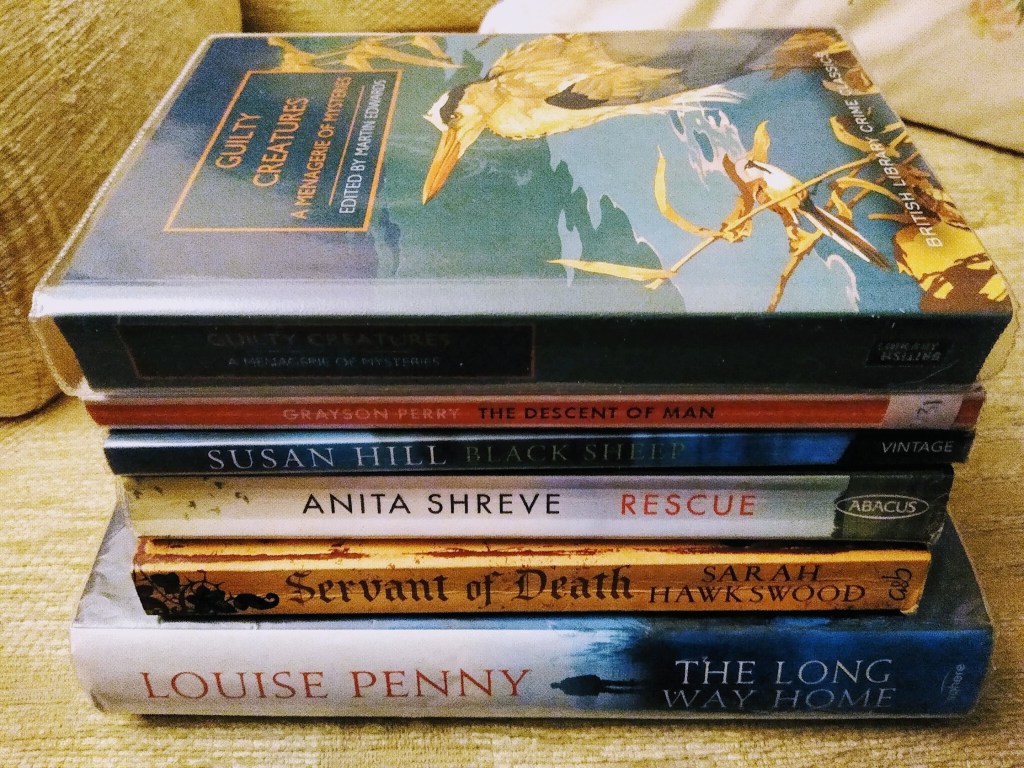
Guilty Creatures: A Menagerie of Mysteries edited and introduce by Martin Edwards. I like these anthologies as much, if not more, for Martin Edwards’ introductions than for the actual stories. I often find that they’re too short for my liking, but I’m hoping there will be some that will prove me wrong. This collection includes stories by Arthur Conan Doyle, G K Chesterton, Edgar Wallace, Josephine Bell and Christianna Brand, among others.

The Descent of Man by Grayson Perry. During the fist lockdown I loved watching Grayson’s Art Club, Channel 4’s documentary series hosted by him and his wife, psychotherapist Philippa Perry. In this book he is looking at masculinity, particularly examining how men dominate much of our world, how men dress and act, how men resort to crime and violence, and how men feel.

Black Sheep by Susan Hill, a novella about a brother an sister who grew up in a coal mining village and yearn to escape. Neither can break free and their decisions result in brutal consequences. It sounds a bit grim!

Rescue by Anita Shreve. The last few books by Anita Shreve I’ve read haven’t been as good as her earlier ones, so I’m hoping this one won’t be disappointing. It’s about a paramedic who rescues a troubled young woman from a car crash. They start a love affair and have a daughter. Eighteen years later he is raising the girl on his own,

Servant of Death by Sarah Hawkswood, historical murder mystery set in the 12th century, the first in the Bradcote and Catchpole mystery series. The Lord Bishop of Winchester’s clerk – is bludgeoned to death in Pershore Abbey and laid before the altar in the attitude of a penitent. Who hated him enough to murder him?

The Long Way Home by Louise Perry. I thought it looked familiar and when I got home and checked my blog I realised I’d borrowed this book before – in 2018! But I took it back unread, thinking I’d try to get the first one. It’s the 10th Chief Inspector Gamache novel – and I still haven’t read any of the previous books, so maybe I’ll read this one this time.

The Man Who Died Twice by Richard Osman

Penguin| 16 September 2021| 422 pages| Review copy| 1*

I don’t want to say much about this book. If you’re expecting crime fiction that exercises your ‘little grey cells’ this is not the book for you. Granted it is complicated and there’s lots going on, plenty of murders, drug dealers, spies and mobsters etc, etc. But essentially it is light easy reading,with the sort of humour that makes you groan in despair, and a great deal of waffle and tedious wittering on.about various mundane matters. As you can see I’m not the target market for this book and with nearly 8,000 ratings on Amazon, 96% of which are 5 and 4 stars, I am definitely in the minority. I was hoping I’d enjoy it more than his first book, The Thursday Murder Club, but sadly I think it’s worse.

Here’s the synopsis:

It’s the following Thursday.

Elizabeth has received a letter from an old colleague, a man with whom she has a long history. He’s made a big mistake, and he needs her help. His story involves stolen diamonds, a violent mobster, and a very real threat to his life.

As bodies start piling up, Elizabeth enlists Joyce, Ibrahim and Ron in the hunt for a ruthless murderer. And if they find the diamonds too? Well, wouldn’t that be a bonus?

But this time they are up against an enemy who wouldn’t bat an eyelid at knocking off four septuagenarians. Can The Thursday Murder Club find the killer (and the diamonds) before the killer finds them? 

My thoughts:

It follows on from Richard Osman’s first book about four residents of Coopers Chase retirement village, Elizabeth, Joyce, Ron, and Ibrahim, four septuagenarians, who call themselves The Thursday Murder Club. Elizabeth is a former MI5 agent and this book reveals a lot about her life as a spy. Needless to say she is clever, with the answers to all the problems that are thrown at her when her ex-husband appears on the scene, having stolen 20 million pounds of jewellery from the Mafia.

As in The Thursday Murder Club, the text is written in the past tense interspersed with extracts from Joyce’s diary written in the present tense. Joyce is an irritating character, and her diary is where most of the waffling and wittering on is found. She also explains what has been happening as though having read it already the reader is too dim to understand it. Then we are treated to DCI Chris Hudson’s cringey romance with Patrice, PC Donna de Freitas.

Overall the characters are rather stereotypical, and the plot is over complicated and unconvincing. Richard Osman’s type of humour does not match mine, so I doubt very much that I’ll be reading any more of his books – I see he has another one in the pipeline!