Friday Book Snippets combining Book Beginnings on Friday and the Friday 56, is co-hosted by Anne@HeadFullofBooks and Olivia at Bemused and Bookish.
Directions: Share two snippets (a sentence or short paragraph) from a) the book’s opening and b) page 56 (or another page) from the book you are currently reading. No spoilers, please.
This week I’m featuring Maigret and the Old People by Georges Simenon, book 56 of 75 Inspector Maigret.
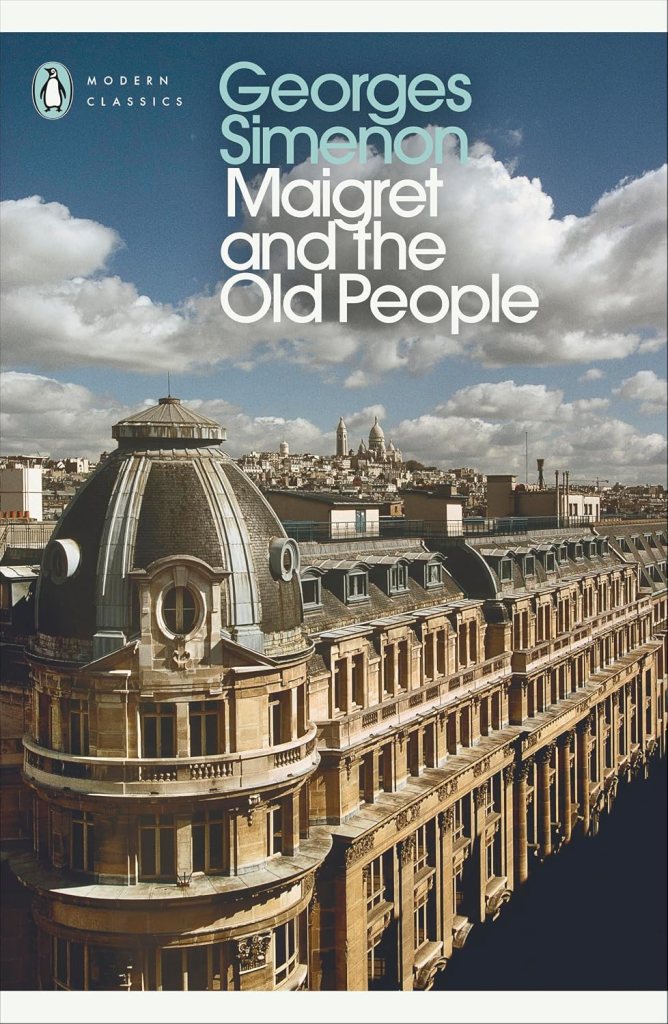
1st snippet, Chapter 1 :
It was one of those exceptional months of May, the kind you only encounter two or three times in your life, and which have the luminosity, the smell of childhood, memories. Maigret called it a ‘May of hymns’, because it reminded him both of his first communion and his first spring in Paris, when everything was still new and wonderful to him.
2nd snippet, page 113:
Here everything was too perfect. Everything had a logical explanation, everything except the old man’s death.
Description from Goodreads:
When a wealthy aristocrat is found murdered in his home, Inspector Maigret must navigate a high-stakes case in the moneyed world of Paris’s upper crust.
Maigret is called to the home of Armand de Saint-Hilaire, a highly respected diplomat who has been found by his housekeeper, shot dead in his study. Maigret is urged to be discrete in his investigation, but after interviewing everyone concerned, the inspector is at a loss to the identity of the perpetrator—until he comes across a series of letters spanning decades between the victim and a widowed woman. As Maigret uncovers the details behind the pair’s relationship, he gets closer to discovering the tragic truth behind the official’s demise.
With the pressure mounting, the inspector must navigate class divides and his own position in society to uncover the killer. Maigret and the Old People is an absorbing mystery and a thoughtful examination of the different worlds money creates.
My thoughts:
Georges Simenon wrote 75 novels and 28 short stories featuring Inspector Jules Maigret, published chronologically in French from 1931 to 1973. I’ve been reading the Maigret books completely out of order for years now and I think they read well as standalones. Maigret and the Old People (aka Maigret in Society) is the 56th book, first published in 1960, so one of the later books in the series. My copy is an e-book, translated by Shaun Whiteside and published by Penguin. It’s a novella of 159 pages.
I really enjoy these books, following Maigret’s life and career as he ages. As the title indicates old age is one of the themes in this book. Maigret himself is aging, nearing retirement and, apart from him, all the characters are aged between 65 and 85. It begins as Maigret is remembering his childhood, thinking of his communion and his first spring in Paris. He is feeling both light and melancholy, reflecting about his awe when he first entered the Police Judiciaire building, and realising that the Seine hadn’t changed and neither had the anglers who were still in the same spot, as if they hadn’t moved from it. This is one of the things I enjoy about Simenon’s writing, the way he describes the setting, as in the opening sentences so that we know that is spring in Paris, followed by the insight into Maigret’s thoughts and his nostalgic mood.
The novel is full of Maigret’s memories of his childhood, spent in the shadow of the chateau owned by the Count and Countess of Saint-Fiacre where his father was the estate manager. It is in this frame of mind that he investigates the death of the former ambassador, the Count of Saint-Hilaire, who had been found shot in his study, by his housekeeper of 42 years, Jaquette Larrieu. Maigret is asked to be discreet, but with no obvious motive or suspects, he is hampered. He proceeds with caution, not wanting to make hasty judgements. But, he had lost his confidence
… unprepared in the face of people whose existence he hadn’t even suspected. All their attitudes, their ideas, their reactions were alien to him, and he tried in vain to classify them under any particular category. (page 146)
He finds a bundle of letters from Princess Isabelle of V, who had been a lifelong friend of Saint-Hilaire’s. The two of them had fallen in love, but she had married Prince Hubert of V, of one of the great French families. So for fifty years they had written to each other every day, but they had never met.
After interviewing everyone concerned, Maigret is still puzzled. And so was I. I thoroughly enjoyed it. I particularly enjoy Maigret’s methods of investigating, his intuition and the way he spends time pondering the psychology of the characters. I also liked the glimpses into his past, explaining his awkwardness with the aristocracy, as well as the insights into his life with his wife, Louise, usually referred to as Madame Maigret.
I have no expectations that I’ll read all 75 of the Maigret novels, but I’d like to read as many as I can.


 book, first published in 1959.