Novellas in November: Translation Week: Pietr the Latvian by Georges Simenon, Translated by David Bellos

This week’s  Novellas in November is Translation Week and I’ve chosen Georges Simenon’s Pietr the Latvian, translated by David Bellos (165 pages). It is officially the first Maigret book, although it was originally published in instalments in the magazine Ric et Rac between July and October 1930.

Rating: 3 out of 5.

Jules Maigret is a Detective Chief Inspector of the Flying Squad in Paris and we get a really detailed description of him – he was a broad heavy man, aged forty-five:

His clothes were well cut and made of fairly light worsted. He shaved every day and looked after his hands.

But his frame was proletarian. He was a big bony man. Iron muscles shaped his jacket sleeves and quickly wore through new trousers.

He had a way of imposing himself just by standing there. His assertive presence had often irked many of his own colleagues.

It was something more than self-confidence but less than pride. He would turn up and stand like a rock with his feet wide apart. On that rock all would shatter, whether Maigret moved forward or stayed exactly where he was.

His pipe was nailed to his jawbone. (page 21)

He has received messages that Pietr the Latvian, an international criminal, is en route by train from the Netherlands to Paris. He has a description of Pietr and went immediately to the Gare du Nord to intercept him. But on spotting him he had to let him go because a man had been murdered on the train – and that man also matched Pietr’s description. From that point on. I became increasingly confused. Who is Pietr the Latvian? Was he the man who got off the train or the man who was murdered?

There are many characters and for quite a lot of the book I struggled to work out who was who. Maigret spends his time going from place to place and interviewing many people and I really had little idea of what was going on. The question of identity plays a major part. Pietr was thought to be the head of a major international ring mainly involved in fraud, counterfeit money and forged documents and his known associates seem to be mainly British and American. The setting in the 1930s is a mix of glamorous hotels and bars in Paris, seedy back streets, and the seaside town of Fécamp in Normandy. The book does feel dated now along with the anti-antisemitism some of the characters voiced.

If you haven’t read any of the Maigret books I suggest you start with one of the later books, which are much better. What I liked about it is that it establishes Maigret’s character and appearance right from the beginning. He feels like a real person with solidity and presence. He’s also tough, carrying on chasing around after Pietr even after he’s been shot. I think it’s an interesting story, in which a lot happens and even if I was mystified at first it did become clearer as I read on and I was pleased to find that I had worked out Pietr’s identity before it was revealed.

Pietr the Latvian is included in the Inspector Maigret Omnibus 1. The four titles are Pietr the Latvian, The Hanged Man of Saint-Pholien, The Carter of ‘La Providence’, The Grand Banks Café.

Previously I’ve read:

and

Recent Loans from the Library

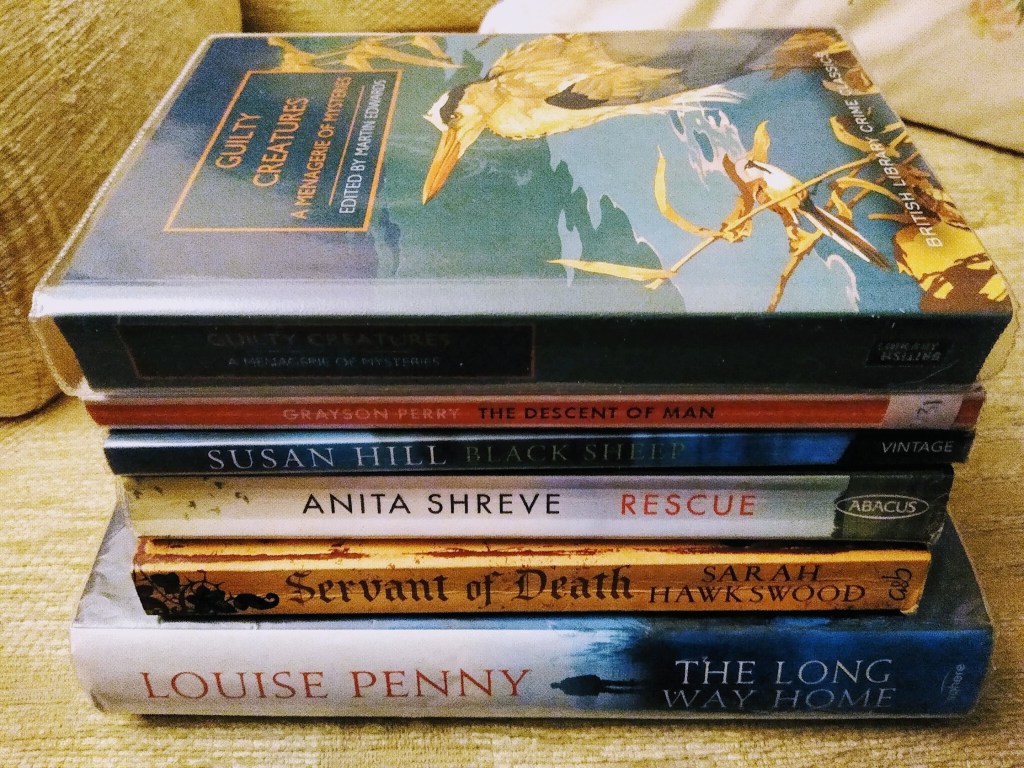
Guilty Creatures: A Menagerie of Mysteries edited and introduce by Martin Edwards. I like these anthologies as much, if not more, for Martin Edwards’ introductions than for the actual stories. I often find that they’re too short for my liking, but I’m hoping there will be some that will prove me wrong. This collection includes stories by Arthur Conan Doyle, G K Chesterton, Edgar Wallace, Josephine Bell and Christianna Brand, among others.

The Descent of Man by Grayson Perry. During the fist lockdown I loved watching Grayson’s Art Club, Channel 4’s documentary series hosted by him and his wife, psychotherapist Philippa Perry. In this book he is looking at masculinity, particularly examining how men dominate much of our world, how men dress and act, how men resort to crime and violence, and how men feel.

Black Sheep by Susan Hill, a novella about a brother an sister who grew up in a coal mining village and yearn to escape. Neither can break free and their decisions result in brutal consequences. It sounds a bit grim!

Rescue by Anita Shreve. The last few books by Anita Shreve I’ve read haven’t been as good as her earlier ones, so I’m hoping this one won’t be disappointing. It’s about a paramedic who rescues a troubled young woman from a car crash. They start a love affair and have a daughter. Eighteen years later he is raising the girl on his own,

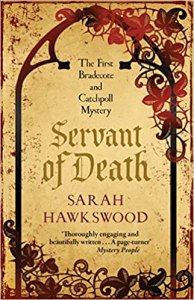
Servant of Death by Sarah Hawkswood, historical murder mystery set in the 12th century, the first in the Bradcote and Catchpole mystery series. The Lord Bishop of Winchester’s clerk – is bludgeoned to death in Pershore Abbey and laid before the altar in the attitude of a penitent. Who hated him enough to murder him?

The Long Way Home by Louise Perry. I thought it looked familiar and when I got home and checked my blog I realised I’d borrowed this book before – in 2018! But I took it back unread, thinking I’d try to get the first one. It’s the 10th Chief Inspector Gamache novel – and I still haven’t read any of the previous books, so maybe I’ll read this one this time.

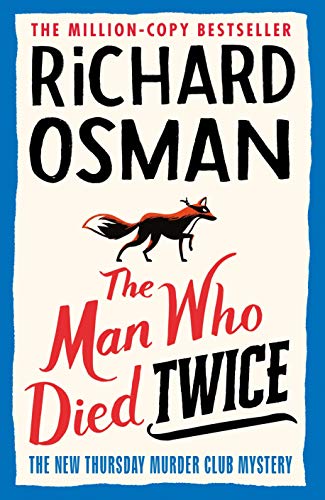
The Man Who Died Twice by Richard Osman

Penguin| 16 September 2021| 422 pages| Review copy| 1*

I don’t want to say much about this book. If you’re expecting crime fiction that exercises your ‘little grey cells’ this is not the book for you. Granted it is complicated and there’s lots going on, plenty of murders, drug dealers, spies and mobsters etc, etc. But essentially it is light easy reading,with the sort of humour that makes you groan in despair, and a great deal of waffle and tedious wittering on.about various mundane matters. As you can see I’m not the target market for this book and with nearly 8,000 ratings on Amazon, 96% of which are 5 and 4 stars, I am definitely in the minority. I was hoping I’d enjoy it more than his first book, The Thursday Murder Club, but sadly I think it’s worse.

Here’s the synopsis:

It’s the following Thursday.

Elizabeth has received a letter from an old colleague, a man with whom she has a long history. He’s made a big mistake, and he needs her help. His story involves stolen diamonds, a violent mobster, and a very real threat to his life.

As bodies start piling up, Elizabeth enlists Joyce, Ibrahim and Ron in the hunt for a ruthless murderer. And if they find the diamonds too? Well, wouldn’t that be a bonus?

But this time they are up against an enemy who wouldn’t bat an eyelid at knocking off four septuagenarians. Can The Thursday Murder Club find the killer (and the diamonds) before the killer finds them? 

My thoughts:

It follows on from Richard Osman’s first book about four residents of Coopers Chase retirement village, Elizabeth, Joyce, Ron, and Ibrahim, four septuagenarians, who call themselves The Thursday Murder Club. Elizabeth is a former MI5 agent and this book reveals a lot about her life as a spy. Needless to say she is clever, with the answers to all the problems that are thrown at her when her ex-husband appears on the scene, having stolen 20 million pounds of jewellery from the Mafia.

As in The Thursday Murder Club, the text is written in the past tense interspersed with extracts from Joyce’s diary written in the present tense. Joyce is an irritating character, and her diary is where most of the waffling and wittering on is found. She also explains what has been happening as though having read it already the reader is too dim to understand it. Then we are treated to DCI Chris Hudson’s cringey romance with Patrice, PC Donna de Freitas.

Overall the characters are rather stereotypical, and the plot is over complicated and unconvincing. Richard Osman’s type of humour does not match mine, so I doubt very much that I’ll be reading any more of his books – I see he has another one in the pipeline!

A Z of TBRs: E-Books – J, K and L

It’s been a long time since I last looked at the forgotten e-books on my Kindle, so it’s time to dip into it again. I have a bad habit of downloading books and then forgetting all about them – it’s as though they’ve gone into a black hole.

Today I’m looking at books with titles beginning with the letters J, K and L, with a little ‘taster’ from each. The summaries are from Goodreads.

Jeremy Hutchinson’s Case Histories by Thomas Grant – I bought this in February 2020 after watching the BBC series,The Trial of Christine Keeler, the story of the Profumo affair in 1962 as seen from her perspective. Hutchinson was Keeler’s defence barrister.

Summary: Born in 1915 into the fringes of the Bloomsbury Group, Jeremy Hutchinson went on to become the greatest criminal barrister of the 1960s, ’70s and ’80s. The cases of that period changed society for ever and Hutchinson’s role in them was second to none. In Case Histories, Jeremy Hutchinson’s most remarkable trials are examined, each one providing a fascinating look into Britain’s post-war social, political and cultural history.

A cartoon by Cummings appeared in the Daily Express on 10 July 1963 headed ‘The adventures of James Macbond’. It showed the beleaguered figure of Harold Mavmillan fleeing from three assailants. Kim Philby and his fellow spy John Vassall are both dressed as shady hoodlums, one wielding a knife, the other a pistol both aimed at Macmillan. Christine Keeler is the third, incarnated on the page as a sort of vampiric harpy, her long-nailed hand outstretched trying to clutch the Prime Minister’s coat tails.

That year was a kind of horror show for Macmillan, and he was not to see out 1963 as Prime Minister. His resignation was accepted by the Queen in October.(page 95)

The Keeper of Lost Things by Ruth Hogan – I bought this in May 2017 and can’t remember how I first came across it.

Summary: Anthony Peardew is the keeper of lost things. Forty years ago, he carelessly lost a keepsake from his beloved fiancée, Therese. That very same day, she died unexpectedly. Brokenhearted, Anthony sought consolation in rescuing lost objects—the things others have dropped, misplaced, or accidentally left behind—and writing stories about them.

He took a sip from his drink and lovingly kissed the cold glass of the photograph before replacing it on the table next to his chair. She was not a classic beauty; a young woman with wavy hair and large dark eyes that shone, even in an old black and white photograph. But she was wonderfully striking, with a preserve that still reached out from all those years ago and captivated him. She had been dead for forty years, but she was still his life, and her death had given him his purpose. It had made Andrew Peardew the Keeper of Lost Things. (page 4)

The Lady of Sorrows by Anne Zouroudi – I bought this in April 2013! It is the fourth in Anne Zouroudi’s Mysteries of the  Greek Detective series featuring Hermes Diaktoros. Hermes is a detective with a difference. Just who he is and who he works for is never explained. I have read three of the books in the series. Each one features one of the Seven Deadly Sins.

Summary: A painter is found dead at sea off the coast of a remote Greek island. For our enigmatic detective Hermes Diaktoros, the plot can only thicken: the painter’s work, an icon of the Virgin long famed for its miraculous powers, has just been uncovered as a fake. But has the painter died of natural causes or by a wrathful hand? What secret is a dishonest gypsy keeping? And what haunts the ancient catacombs beneath the bishop’s house?

‘Allow me to introduce myself. I am Hermes Diaktoros, of Athens. Diaktoros being, as you may know, an ancient word for messenger. My father has a strange idea of humour. He’s something of a scholar of the classical world.’

Politely, the priest took the fat man’s hand, which was, in spite of the day’s heat was quite cool to touch.

‘Father Linos Egiotis,’ said the priest.

‘A pleasure,’ said the fat man. ‘Now, I know you must be anxious to close up for siesta, and I won’t keep you.’ He turned back to the icon. ‘She’s very lovely, isn’t she?’ he said. ‘I have been wanting to make her acquaintance for many years. Quite by chance we were passing within a few miles, and had time enough before my next engagement to make the detour. She has quite a reputation, I believe, for performing magic tricks. Magic tricks are a paerticular interest of mine.’

‘Magic tricks?’ queried the priest, with annoyance. ‘The Lady occasionally sees fit to grant miracles. They are acts of divine grace, not magic tricks.’ (page 31)

So, three very different books from the depths of my Kindle. I’m not sure which one to read first. If you’ve read any of these books please let me know what you think. Or if you haven’t read them do they tempt you?

Book Beginnings & The Friday 56: The Couple at No. 9 by Claire Douglas

Every Friday Book Beginnings on Friday is hosted by Gillion at Rose City Reader where you can share the first sentence (or so) of the book you are reading. You can also share from a book you want to highlight just because it caught your fancy.

This week I’m featuring The Couple at No. 9 by Claire Douglas. I’ve read three of Claire Douglas’s books before and loved each one, so I have high hopes for this one. They are dramatic, tense, and full of atmosphere and suspense.

The Book Begins:

I’m in the front garden pulling at weeds that spill out from the borders of the driveway, like gigantic spiders, when I hear yells. Deep and gutteral.

Also every Friday there is The Friday 56, hosted by Freda at Freda’s Voice. *Grab a book, any book. *Turn to Page 56 or 56% on your  ereader . If you have to improvise, that is okay. *Find a snippet, short and sweet, but no spoilers!

These are the rules:

  1. Grab a book, any book.
  2. Turn to page 56, or 56% on your eReader. If you have to improvise, that is okay.
  3. Find any sentence (or a few, just don’t spoil it) that grabs you.
  4. Post it.
  5. Add the URL to your post in the link on Freda’s most recent Friday 56 post.

Page 56:

Lorna had envisaged the day she’d become a grandmother. She knew she wouldn’t be old, because she’d been such a young mother. But she’d expected to be older than forty-sodding-one. What will Alberto think?

Summary::

When Saffron Cutler and boyfriend Tom move into 9 Skelton Place, they didn’t expect to find this.

Two bodies, buried under the patio over thirty years ago.

When the police launch a murder investigation, they ask to speak to the cottage’s former owner – Saffy’s grandmother, Rose, whose Alzheimer’s clouds her memory.

But it is clear she remembers something . . .

What happened thirty years ago?
What part did her grandmother play?
And is Saffy now in danger? . . .

~~~

What do you think – does this book appeal to you too?

Whose Body? by Dorothy L Sayers

I’ve read some of Dorothy L Sayers’s Lord Peter Wimsey Mystery series and enjoyed them immensely. But up until now have not read the first book in the series, Whose Body?, first published in 1923. It’s an amusing Golden Age mystery that kept me entertained throughout. Lord Peter is a wealthy amateur detective, a friend of Inspector Charles Parker, a Scotland Yard detective. He called ‘Lord’ as he is the younger son of a duke.

When the naked body of a man, wearing only a pair of pince-nez is found in Mr Alfred Thipp’s Battersea bathroom, Lord Peter is asked by his mother, the Dowager Duchess of Denver, to help solve the mystery of whose body had found its way into the bath. The police investigation is being led by Inspector Sugg, who doesn’t welcome what he calls Lord Peter’s ‘interference’ in the case. He thinks the dead body might be that of Sir Reuben Levy, a wealthy London financier who had vanished from his bedroom, leaving no trace. Meanwhile Charles is investigating Sir Reuben’s disappearance himself. Although the body in the bath at first appears to be Sir Reuben it soon becomes clear that it is not and that the two cases are not connected. But are they?

As I began reading I was a bit put off by the dialogue between Lord Peter and his valet Bunter, who used to be his batman in the army. The dialogue is supposed to be witty banter between the two of them but to my mind it was irritating and superficial, definitely dated, and reminded me a just a tiny bit of the Jeeves and Wooster stories. But that was just at the start – it’s not at all like Jeeves and Wooster! I enjoyed watching the mystery unfold, which put Lord Peter’s life into grave danger. There are many complications and twists and turns that did stretch my credulity. It has a serious side too as events trigger traumatic memories for Lord Peter of his time in the trenches of the First World War

My rating: 4*

There are 15 books in the series (linked to my reviews when I’ve read the book):


   1. Whose Body? (1923)
   2. Clouds of Witness (1926)
   3. Unnatural Death (1927)
   4. Lord Peter Views the Body (1928)
   5. The Unpleasantness at the Bellona Club (1928)
   6. Strong Poison (1930)
   7 Five Red Herrings (1931)
   8. Have His Carcase (1932)
   9. Hangman’s Holiday (1933)
   10. Murder Must Advertise (1933)
   11. The Nine Tailors (1934)
   12. Gaudy Night (1935)
   13. Busman’s Honeymoon (1937)
   14. In the Teeth of the Evidence (1939)
   15. Striding Folly (1972)