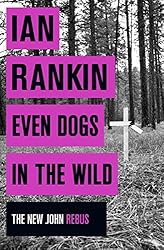
Even Dogs in the Wild by Ian Rankin

In Ian Rankin’s previous book Saints of the Shadow Bible Rebus was back on the police force, the rules on retirement age having changed. Now, two years later in Even Dogs In the Wild Rebus is on his second retirement – well almost. It seems they can’t do without him and when someone takes a potshot at retired gangster, Big Ger Cafferty DI Siobhan Clarke suggests they ask him to act in a ‘consultative capacity’ albeit not as a cop and with no warrant card or real powers and with no pay. Cafferty refuses to let the police in to talk to him – he’ll only speak to Rebus. That suits Rebus as he’s bored with being retired, each day the same as the one before.

It seems this is connected to the killing of David Menzies Lord Minton, a former Lord Advocate, who had been found beaten around the head and throttled. He had received a note: I’M GOING TO KILL YOU FOR WHAT YOU DID – as had Cafferty.

A second strand of the story concerns the warfare between two gangs, one from Glasgow, headed by Joe Stark, who have arrived in Edinburgh looking for a guy called Hamish Wright and whatever it is he has stolen from them, and the other from Edinburgh, headed up by Darrell Christie, Cafferty’s successor. DI Malcolm Fox, no longer in Professional Standards, is seconded to the team of undercover cops from Glasgow, surveilling Stark and his men.

And so a complicated scenario unfolds, with more deaths, and so many twists and turns that my mind was in a whirl as I tried to sort out all the characters. After a dramatic scene set in woods in the Fife countryside some years earlier, the story gathered pace and tension as the various elements came together. Who is the murderer, what connection does Cafferty have with Lord Minton, how does the gang warfare fit into the murders, who is the mole in the Glasgow gang, and what happened years ago in Acorn House, an assessment centre for children in care,  a sort of remand home?

It was intriguing to see Rebus and Cafferty working together, although never fully confiding in each other. They have had a complex relationship in the past, aggressive and hostile and yet at times they have worked together before.  Rankin, as usual, successfully combines all the elements of the crime mystery with the personal lives of the main characters and at the same time highlighting various current political and social issues, such as the involvement of public figures in child abuse cases and the effect this has on the individuals concerned and their families.

The title comes from The Associates song of the same name, released in 1982:

Even dogs in the wild
Could do better than this
Even dogs in the wild
Will care for
Whatever means most to them

It’s also interesting to look back over the Rebus books which I began reading eight years ago (to the month!). They cover his life as a detective beginning with Knots and Crosses, first published in 1987. Rebus, ex-army, SAS was then a Detective  Sergeant, aged 42. He was divorced and smoked and drank too much.  By the time of Even Dogs in the Wild in some respects he hasn’t changed much – still a loner, still drinking and smoking, but so much has happened that he has changed, both in his personal and professional life. I’ve read all the books, but I’ve not written about all of them and some of my posts are quite short. At one time I began summarising the books, listing the characters and crimes, but I didn’t get very far – maybe I’ll finish it one day.

I like the series as a whole and think this latest book stands well with the best of them.  The first Rebus book I read was Set in Darkness, the 11th book in the series. It was obvious that this featured characters that had been in the earlier books but I didn’t find it difficult to follow who was who and their relationships. Even so I decided I needed to start at the beginning and read them in sequence. And I think, for me at least, that works best, in order to fully understand the background and how the characters interacted and evolved.

Has Rebus had his day? He tells Fox

‘It feels like the end of a long song though – men like Cafferty and Joe Stark … and me too, come to that … we’re on our last legs. Our way of thinking seems … I don’t know.’

‘Last century?’

‘Aye, maybe.’ (p 243)

We’ll see. One nice touch throughout the book is the little dog, Brillo who seems to have adopted Rebus – but will Rebus settle for walks in the country with Brillo, and being a granddad?

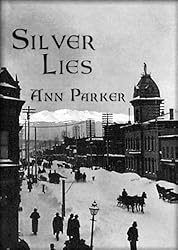
Silver Lies by Ann Parker

From out of the black hole that is my Kindle came Silver Lies by Ann Parker, a new-to-me author. Books have been known to disappear for ever in there and this one had been languishing down in the depths for three years, so I thought it was time to read it. It looked as though it would be a bit different from other books I’ve been reading this year. Apart from True Grit I don’t think I’ve read any westerns for years and actually this one is not a typical western. It’s not a Cowboys and Indians type western at all but is set in 1879/80 in the silver-mining town of Leadville, Colarado in the heart of the Rocky Mountains. It probably fits in more with the crime fiction genre than with westerns, but it was the setting  that attracted me to it.

It’s a really good story beginning when Joe Rose, a silver assayer, facing a bleak future as the last of his money has gone and the hope of making his fortune in silver has disappeared, is found dead in Tiger Alley propped up behind the Silver Queen saloon. Inez Stannert’s husband Mark had won the saloon in a poker game and eight months before the story begins he had left her and their friend and business partner, Abe Jackson to run it on their own. Inez has no idea where he is and whether he’ll ever return.

Joe’s death is just the start of the mystery – was his death an accident or was he murdered and if so why?  Inez sets out to discover the truth and although his wife Emma has asked her to settle his affairs for her what is she keeping from Inez? Where is Mark and why did he leave? There is a new Reverend in town. Inez falls for his charms but is he to be trusted? She had him pegged as a gambler rather than a man of the cloth. And she doesn’t trust the new marshall either – ‘a thin man with the look of a hungry rattlesnake’. Inez knows he is ‘just a two-bit gunslinger from Texas’ hired by the ‘silver barons to keep the peace after last month’s lynching’. So it’s no wonder that she uncovers a web of deceit, counterfeit, blackmail and murder.

With plenty of memorable characters I could easily imagine I was in the silver rush town, a town where:

People rush in – from the East, from the West – and collide at the top of the Rockies. They’re looking for riches or looking to escape. And running. Everyone’s either from their past or running toward some elusive vision of the future. (location 5896)

Leadville was a colourful place, a boom-town, bustling with life -everything is there – the Silver Queen saloon and the Crystal Belle Saloon, Leadville’s leading parlor house, a brick built opera house, whose patrons ‘swelled the after-midnight crowds’ in the Silver Queen saloon, five banks and a small white church with a steeple.

Silver Lies won the Willa Award for Historical Fiction and the Colorado Gold Award and was chosen as best mystery of the year by Publishers Weekly and The Chicago Tribune.  For more information about Ann Parker and her books see her website.

I was completely engrossed in this book with its multi-layered and intricate plot that kept me guessing all the way through.  I hope to read more of this series:
  1. Silver Lies (2003)
  2. Iron Ties (2006)
  3. Leaden Skies (2009)
  4. Mercury’s Rise (2011)

Reading challenges: Mount TBR Reading Challenge 2015Historical Fiction Reading ChallengeColor Coded Challenge

R.I.P.X – Completed

This year (the 10th anniversary) the annual R.I.P event was hosted by Andi and Heather of The Estella Society. It ran from September 1st to October 31st.

It involved reading books that fitted into one or more of the following categories:

Mystery
Suspense
Thriller
Dark Fantasy
Gothic
Horror
Supernatural

There are several levels, depending on how many books you read. I initially thought I’d aim low with just one book. But I actually read eight, more than enough for –

Peril the First – to read four books.

ripnineperilfirst

This is what I read:

  1. Dead Scared by Sharon Bolton
  2. Like This, For Ever by Sharon Bolton
  3. The Buried Giant by Kazuo Ishiguro
  4. The Ghosts of Altona by Craig Russell
  5. The Moth Catcher by Ann Cleeves
  6. A Dark and Twisted Tide by Sharon Bolton
  7. The Devil’s Promise by David Stuart Davies
  8. Little Black Lies by Sharon Bolton

Just two were from my initial list and the others just turned up, as it were! I still have these books I want to read/reread:

  • The Wasp Factory by Iain Banks
  • A Song of Stone by Iain Banks
  • Poirot Investigates by Agatha Christie
  • Northanger Abbey by Jane Austen ‘“ I read this so many years ago that it will be like reading it for the first time. It was one of the set books at school and I don’t think I appreciated it then.
  • Talking to the Dead by Harry Bingham
  • The Rottweiler by Ruth Rendell

The Case-Book of Sherlock Holmes by Sir Arthur Conan Doyle

The Case-Book of Sherlock Holmes contains twelve short stories first published between 1921 and 1927. In the Preface Conan Doyle  wrote that he hoped his Sherlock Holmes stories had provided

that distraction from the worries of life and stimulating change of thought that can only be found in the fairy kingdom of romance.

In this post I’m only writing about three of them for The 1924 Club; stories that were first published in 1924 (for more details about The I924 Club click on this link). They do indeed, provide both a distraction and a stimulating change of thought. The narrator in these three stories is Dr Watson.

The Adventure of the Sussex Vampire – this was first published in the January 1924 issues of The Strand Magazine in London and Hearst’s International Magazine in New York.

As Sherlock Holmes says when he first heard about a case concerning vampires,‘we seem to have been switched on to a Grimm’s fairy tale.‘ He tells Watson they cannot take it seriously:

Rubbish Watson, rubbish! What have we to do with walking corpses who can only be held in their grave by stakes driven through their hearts? It’s pure lunacy!

But he takes on the case for two reasons – one, he’s interested in the house in Essex belonging to Mr Ferguson where his wife is suspected of being a vampire, and two, Ferguson had known Watson when they played rugby together for Blackheath. His Peruvian wife had been seen attacking his son from a previous marriage and also leaning over her own baby and biting his neck. She refused to explain herself. Holmes solves the mystery, indeed he had reached his conclusion even before arrived in at the house, based on his conviction that the idea of a vampire was absurd. I enjoyed this tale, mainly because Holmes used logic and deduction in coming to his conclusion, overriding the supernatural.

The Adventure of the Three Garridebs – first published in October 1924 in Collier’s Weekly and then in The Strand Magazine in January 1925.

I think this is a rather strange and artificial story, Dr Watson says it may have been a comedy or a tragedy. It led to him being shot in the leg and yet there was certainly an element of comedy. It’s about a man with the unusual name of Garridebs, ostensibly looking for two other men with the same name  to inherit five  million dollars each. Of course, that is not his real reason and the man is none other than a  known murderer.  It shows, however, the depth of Holmes’ feeling for Watson, as he says:

It was worth a wound – it was worth many wounds – to know the depth of loyalty and love which lay behind that cold mask. The clear, hard eyes were dimmed for a moment, and the firm lips were shaken. For the one and only time I caught a glimpse of a great heart as well as of a great brain. All my years of service culminated in that moment of revelation.

It’s in this story too that Watson reveals that Holmes had refused a knighthood.

The Adventure of the Illustrious Client – first published in Collier’s Weekly in November 1924.

At the request of an unnamed but illustrious client, Holmes and Watson investigate the case concerning Violet de Merville, young, rich and beautiful who has fallen under the spell of the notorious Baron Gruner. Her father, General de Merville wants to prevent them from marrying.  Gruner is known as a violent murderer and Holmes is keen to meet a man who may be more dangerous even than the late Professor Moriarty. But he has to enlist the help of one of Gruner’s past mistresses to open Violet’s eyes to the true nature of the man she thought she loved.

I like the personal touches in this story, the opening scene for example shows Holmes and Watson in the drying-room of a Turkish Bath, lying in an isolated corner on two couches, side by side, smoking in a state of lassitude. Watson says that it is where he finds Holmes less reticent and more human than anywhere else. Watson knows that although he was nearer to Holmes than anyone else he was always conscious of the gap between them – Holmes leaves his closest friend guessing what his exact plans may be.

These three stories all illustrate Holmes’ deductive powers and seemingly cold nature but also reveal the depth of feeling between him and Watson. Bur I’m not sure that they reflect anything in particular about what was being published in 1924.

I shall write about the remaining stories in the Case-Book at a later date.

Little Black Lies by Sharon Bolton

You can tell from the title what to expect from this book – lies, black lies, but they’re not little lies, they are whopping great big lies. The story is narrated by three of the main characters, Catrin, Callum and Rachel, all unreliable narrators either self deceptive, delusional or manipulative. They are all damaged characters.

Three years before the story begins Catrin’s two sons died in an accident caused by her then best friend Rachel. She has never got over it; they have haunted her ever since and she has not spoken to Rachel since then, determined to take revenge as the third anniversary of their death approaches. A year after their deaths Fred Harper went missing and was never found, then another boy, Jimmy Brown disappeared. As the story begins yet another boy, Archie West is missing. The nightmare continues with the disappearance of Peter, Rachel’s third and youngest son.

Little Black Lies is set in the Falkland Islands in 1994, twelve years after the war and Sharon Bolton’s descriptions of the islands paint a vivid picture of the isolation, the close knit community and war scarred landscape.

But there are a few things about this book that mean whilst I enjoyed the descriptive writing, the sense of place and the opening section very much I didn’t really like it. I began reading it with high expectations as it has received much praise and I’ve enjoyed everything else by Sharon Bolton that I’ve read. And although I was dismayed when I found it was written in the present tense (which is not my favourite style) I thought it was very promising and read on eagerly.

But when I finished it I gave it 3 stars on Goodreads, rounded up from 2.5 (Goodreads doesn’t have half marks!). I wasn’t keen on the focus on missing/dead children which so many books seem to have had recently. And it was a combination of the present tense and the way the plot descended into more of a farce with several twists and turns, particularly as the book draws to an end, one after the other that I just didn’t think was credible. The final  twist at the end came out of the blue for me, although thinking back it shouldn’t have been such a surprise. But I felt a bit cheated. In fact I’m rather annoyed with myself as I’d totally forgotten FictionFan had reviewed this book and I’d thought then that it was one that didn’t appeal to me – at least I was right!

A Dark and Twisted Tide by Sharon Bolton: Mini Review

I finished reading A Dark and Twisted Tide, the 4th in the Lacey Flint series, at the end of September, but never got round to writing about it, so now this is just a mini review.

Synopsis from the back cover:

Police Constable Lacey Flint thins she’s safe. Living on the river, swimming in the river, she’s never been happier. It can’t last. Because Lacey has secrets. And when the first body floats, it’s only a matter of time before her fragile life falls apart. And the river is the last place she should be ..,

This is such a terrifying novel, particularly if like me, you have a fear of drowning. No longer a detective, Lacey is now a police constable with the Metropolitan Police’s Marine Unit on the River Thames, living on a houseboat (actually a vintage sailing yacht) in Deptford Creek and wanting a quieter and safer life whilst trying to recover from the terrifying events of her last cases. Unlike me, Lacey loves swimming and is perfectly at home in water, so much so that she wild-swims in the Thames as often as tide and conditions allow, loving it so much that she feels she has become part of the river. But even she experiences the terror of being drawn down into the water ‘within a frantic gasp of drowning‘.

A Dark and Twisted Tide is a multi-layered book, told from different characters’ perspectives, complex and chilling as it weaves its way through murders, people trafficking, a mysterious character called ‘the swimmer’, more details about Lacey’s background and the ongoing saga of her relationship with Mark Joesbury. It’s a grim tale with a great sense of foreboding and mystery – a book I read far too quickly, making me think at some point I’ll read it again more slowly as I’m sure there’s a lot I missed. An excellent read for RIP X!