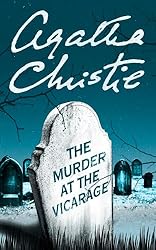
The Murder at the Vicarage by Agatha Christie

Ingenious! That’s what I thought when I’d finished reading The Murder at the Vicarage. Although Agatha Christie had written short stories featuring Miss Marple this is the first full length Miss Marple story, published in 1930.
I’ve been reading my way through Agatha Christie’s crime fiction for a few years now, totally out of order, which is why I’ve only just got round to reading The Murder at the Vicarage. I’d picked up along the way on the fact that Miss Marple uses her knowledge of people to help her solve the mysteries she investigates. And it is in this book that her use of analogy is made absolutely explicit, as she considers who could have killed Colonel Prothero, the unpopular churchwarden, found in the vicar’s study shot through the head. She comes up with seven suspects, all based on examples of human behaviour she has observed in the past.

Miss Marple is not the popular figure she appears in the later books as not everybody likes her. The vicar does, liking her sense of humour, and describing her as ‘a white-haired old lady with a gentle appealing manner’, whereas his wife describes her as ‘the worst cat in the village. And she always knows everything that happens – and draws the worst inference from it.

But it is very helpful to know what is going on in St Mary Mead, about Dr Stone, a well-known archaeologist superintending the excavation of a barrow on Colonel Protheroe’s land and about Mrs Lestrange, a mysterious woman who has recently moved to the village and also about who was coming and going to the vicarage and when.

It’s also helpful to have a a plan of St Mary Mead, showing where the main characters live, and plans of the layout of the vicarage and the vicar’s study, where the murder occurred.

After one of the suspects confesses to the murder Inspector Slack, who shows his contempt for Miss Marple, thinks the case is closed, but Miss Marple is puzzled – the facts seem to her to be wrong. The Murder at the Vicarage has an intricate plot, is full of red herrings and was impossible for me to unravel, but Miss Marple with her knowledge of ‘Human Nature’ solves the mystery.

I enjoyed this book very much, but Agatha Christie writing her Autobiography years later, wasn’t all that pleased with it. She thought it had too many characters and too many sub-plots; she is probably right. But she thought that the main plot was sound and that the village was as real to her as it could be. It’s real to me too.

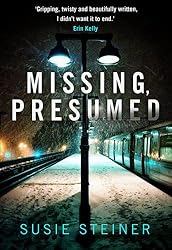
Missing, Presumed by Susie Steiner

I was a bit doubtful that I would like Missing, Presumed by Susie Steiner as it’s written in the present tense, which I usually find irritating. But I needn’t have been concerned because it wasn’t long before I’d completely forgotten the tense and I was totally immersed in the story. And I loved it.

Missing, Presumed is crime fiction, investigating the disappearance of Edith Hind, a beautiful Cambridge post-grad.  Her boyfriend, Will Carter had returned to their flat to find the front door open, coats in disarray and a spatter of blood on the kitchen floor. It’s told from different characters’ viewpoint, each one individually distinct, beginning with DS Manon Bradshaw on the Major Incident Team (her name means ‘bitter’ in Hebrew, but I thought it was Welsh), a lonely disillusioned single woman approaching forty, who overcomes her insomnia by listening to the low murmurings of police reports on her radio.

Edith’s mother, Miriam, Lady Hind, is distraught, wondering if somehow this is fault, her daughter the centre of a drama. Sir Ian Hind, a successful doctor, physician to the Royal Family and a friend of the Home Secretary adds to the pressure the police are under to find Edith. Edith’s friend, Helena comes under suspicion and known offenders are interviewed, but after the first 72 hours she is still missing. The team’s urgency is cooling  as the possibility that Edith is still alive diminishes. Then a dog walker finds a body in the Ouse, near Ely; is it Edith? The search for the killer is intensified.

This has all the ingredients of a successful crime novel for me. My only criticism of the book is that I didn’t think the final section, ‘One Year Later‘ in which the ends are tied up , was necessary. But apart from that I found it gripping and intense. I was intrigued by the multi-layered plot, and thought the characters were fully rounded, believable people, explored with psychological depth – in particular Manon Bradshaw stands out. And, best of all, it is beautifully written.

The Author

Susie Steiner is a novelist and freelance journalist. She began her writing career as a news reporter first on local papers, then on the Evening Standard, the Daily Telegraph and The Times. In 2001 she joined The Guardian, where she worked as a commissioning editor for 11 years. For more information see her website, susiesteiner.co.uk

My thanks to Lovereading for providing an advance proof of this novel, due to be published in February 2016. Missing, Presumed is Susie Steiner’s second book ‘“ the first is Homecoming, which I really must read.

And I do hope she will write more about DS Manon Bradshaw.

Five of the Best for November 2011-2015

This was originally Cleo’s idea (Cleopatra Loves Books). It’s to look back over your reviews of the past five years and pick out your favourite books for each month from 2011 ‘“ 2015. I like it so much it inspired me to do the same.

I really enjoy looking back over the books I’ve loved reading. These are some of my favourite books for each November from 2011 to 2015 (click on the titles/covers to see my original reviews). November is apparently the month where the crime fiction books I’ve read have been my favourite reads.

Three of the five books are Ian Rankin’s Rebus books – November is the month he’s published his latest books and November is the month I read them.  Ian Rankin is one of my favourite authors and his Rebus books never fail to impress me both with their ingenuity and the quality of their plots and characterisations.

2011

White Nights by Ann Cleeves – the second in her Shetland Quartet, featuring Detective Jimmy Perez, set mainly in Biddista, a fictional village of a few houses, a shop, an art gallery and restaurant called the Herring House, and an old Manse. A man’s body is found, hanging in the hut where the boat owners of the village of Biddista keep their lines and pots. Perez recognises the dead man ‘“ he’s the mystery man who had caused a scene the previous evening at the opening of Bella Sinclair’s and Fran Hunter’s art exhibition.

This book is not only full of believable characters, each one an individual in their own right, it also has a nicely complicated plot and a great sense of location. It’s the place, itself, that for me conveyed the most powerful aspects of the book. The ‘˜white nights’ are the summer nights when the sun never really goes down. They call it the ‘˜summer dim’, the dusk lasts all night, and in contrast to the bleak, black winters, fills people with ‘˜a kind of frenzy‘˜.

2012

Standing in Another Man’s Grave by Ian Rankin. This is the first book after Rebus’s retirement in which he is working for SCRU ‘“ the Serious Crime Review Unit, a Cold Case unit of retired police officers, investigating the disappearance of a young woman missing since 1999, and linking it with later cases of missing women all in the vicinity of the A9. He also clashes with Malcolm Fox of Edinburgh’s internal affairs unit – their dislike is mutual.

I  was gripped by this book and liked the way Rankin included characters from earlier books, such as Big Ger Caffety, Siobhan Clarke, now a DI, and in particular Malcolm Fox.

2013

Saints of the Shadow Bible by Ian Rankin. I think this is one of his best ‘“ a realistic and completely baffling mystery. a complex, multi-layered case, linking back to one of Rebus’s early cases on the force as a young Detective Constable. Rebus is now back on the force, the rules on retirement age having changed, but as a Detective Sergeant. Once more he is under scrutiny by Malcolm Fox. There are suspicions that Rebus and his colleagues, who called themselves ‘˜The Saints of the Shadow Bible’ were involved in covering up a crime, allowing a murderer to go free.

The interaction between Rebus and Fox is one of the joys of this book. Beneath his controlled exterior Fox is just as much a loose cannon as Rebus, he’s not a team player either and it is fascinating to see how Rebus gets under his skin and reveals Fox’s true nature.

2014

And now for a different author, but still crime fiction:

Blue Heaven by C J Box. I loved this book, the first one of C J Box’s books that I’ve read. The action takes place over four days in North Idaho one spring. It’s a story about two children, Annie and William who decide to go fishing without telling their mother, Monica, and witness a murder in the woods. One of the killers sees them and they run for their lives.

I loved the writing style – straightforward storytelling, with good descriptions of locality and characters; characters that are both likeable and downright nasty, but not caricatures. It’s a book that got right inside my mind so that I found myself thinking about when I wasn’t reading it and keen to get back to it. And the ending was what I hoped, and also dreaded it would be.

2015

Back to Rebus – although I also loved Claire Tomalin’s Mrs Jordan’s Profession.

Even Dogs in the Wild –  Now, two years later on from The Saints of the Shadow Bible Rebus is on his second retirement, working in a ‘˜consultative capacity’, albeit not as a cop and with no warrant card or real powers and with no pay. Once more this is a complicated plot, involving Malcolm Fox now seconded to the team of undercover cops from Glasgow, gang warfare, and Big Ger Cafferty. There are so many deaths and twists and turns that my mind was in a whirl as I tried to sort out all the characters.

Rankin, as usual, successfully combined all the elements of the crime mystery with the personal lives of the main characters and at the same time highlighting various current political and social issues.

Is this the last we’ll see of Rebus? Only time and Ian Rankin will tell.

The Ghost Riders of Ordebec by Fred Vargas

I really enjoyed The Ghost Riders of Ordebec. It’s full of  eccentric and quirky characters, an intriguing mystery beginning with the death of an old woman, killed with breadcrumbs, then a car is burnt out with someone inside, and a pigeon is found with its legs tied together so it can’t fly.

But the main mystery Commissaire* Adamsberg has to solve is the strange tale a woman from Ordebec, a little village in Normandy, presents to him.

Blurb:

‘People will die,’ says the panic-stricken woman outside police headquarters.

She refuses to speak to anyone besides Commissaire Adamsberg. Her daughter has seen a vision: ghostly horsemen who target the most nefarious characters in Normandy. Since the middle ages there have been stories of murderers, rapists, those with serious crimes on their conscience, meeting a grisly end following a visitation by the riders.

Soon after the young woman’s vision a notoriously vicious and cruel man disappears. Although the case is far outside his jurisdiction, Adamsberg agrees to investigate the strange happenings in a village terrorised by wild rumours and ancient feuds.

My thoughts:

This is the 8th book in Fred Vargas’ series of Commissaire Adamsberg books. I’ve previously read two, so I’ve a bit of catching up to do. But although there are obviously events that I don’t know about (the appearance of a son, aged 28, that he hadn’t known about, for one thing) this doesn’t detract from the story. I loved all the strange characters – not just the odd people living in Ordebec, but also Adamsberg’s fellow police officers whom he describes as:

 … a hypersomniac who goes to sleep without warning, a zoologist whose speciality is fish, freshwater fish in particular, a woman with bulimia who keeps disappearing in search of food, an old heron who knows a lot of myths and legends, a walking encyclopaedia who drinks white wine non-stop — and the rest to match. (page 67)

And I also loved the medieval myths and legends forming the basis of the plot: the ghostly army that gallops along the Chemin de Bonneval, led by the terrifying Lord Hellequin.

Adamsberg is a thinker ‘ but a vague thinker ‘ he works mainly on intuition, and in this book his intuition and deductive reasoning have to work overtime. I was thoroughly immersed in this book, enjoying the humour as well as the mystery, intrigued to see how the crimes came together and how the pigeon was rescued. It’s original, and maybe not altogether plausible, but most definitely a treat to read.

Fred Vargas is the pseudonym of the French historian, archaeologist and writer Frédérique Audoin-Rouzeau.

*Commissaire is roughly the equivalent of a British Superintendent. His colleagues’ ranks in descending order are commandant, lieutenant and brigadier.

Agatha Christie Reading Challenge Update

agatha_christie_rcIt’s been a while since I’ve written about where I’m up to in reading my way through Agatha Christie’s crime fiction novels and short stories.  In fact it’s been months since I last read an Agatha Christie book!

The list of the books I’ve already read is on this page. I still have many of the short stories to read but just four novels!!

I’m aiming to read these four remaining novels by the end of this year:

  1. The Murder at the Vicarage – (Miss Marple)
  2. Death Comes as the End
  3. Sparkling Cyanide (Colonel Race)
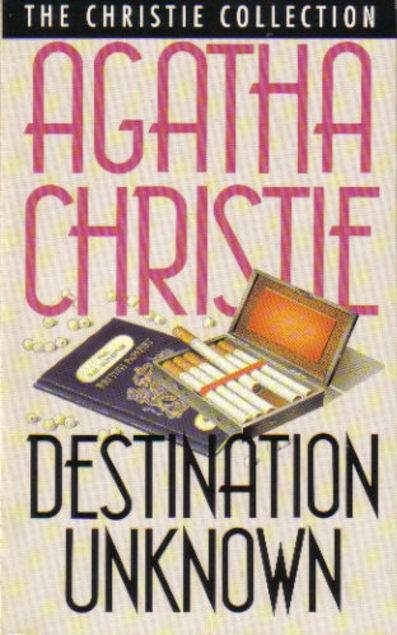
  4. Destination Unknown

A Fear of Dark Water by Craig Russell

Once more I’m trying to catch up writing about the books I’ve read recently so this is just a short post about A Fear of Dark Water by Craig Russell. It’s the sixth book in the series featuring Jan Fabel, the head of Hamburg’s Murder Commission, but it’s only the second one that I’ve read (I previously read the seventh book, The Ghosts of Altona). Craig Russell has now joined my list of favourite authors and I think Fabel now equals Rebus as one of my favourite police detectives.

In A Fear of Dark Water a massive storm hits Hamburg, flooding the city, just as a major environmental summit is about to start.  A serial rapist and murderer is still at large in the city and when the flood waters recede a headless torso is found washed up. Initially it’s thought to be another victim of the killer, who had dumped his victims’ bodies in waterways around the city.

But there’s more to it than that as Fabel’s investigations dig up a secret environmental organisation/cult called ‘Pharos’, that demands its members hand over all their wealth to it, and with an aggressive and hostile approach to criticism. Fabel is drawn into the high-tech world of cyberspace, particularly the Virtual Dimension site, where people create personalities who only exist in cybre-space and who only interact through the internet – a world unfamiliar to Fabel, who denies he is technophobic, insisting he is a traditionalist.

This is a fast paced and complex, multi-layered crime novel that I thoroughly enjoyed and that kept me guessing right to the end.

The Author

Born in Fife, Craig Russell served for several years as a police officer in Scotland, before becoming an advertising copywriter and later creative director. His Fabel novels were inspired by his long-standing interest in the language, culture and people of Germany.

In addition to his Jan Fabel books Craig Russell also writes the Lennox thrillers set in 1950s Glasgow and I hope to get round to reading those too.