The Case-Book of Sherlock Holmes by Sir Arthur Conan Doyle

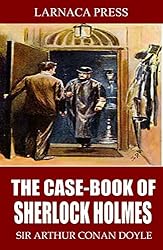
The Case-Book of Sherlock Holmes contains twelve short stories first published between 1921 and 1927. In the Preface Conan Doyle  wrote that he hoped his Sherlock Holmes stories had provided

that distraction from the worries of life and stimulating change of thought that can only be found in the fairy kingdom of romance.

In this post I’m only writing about three of them for The 1924 Club; stories that were first published in 1924 (for more details about The I924 Club click on this link). They do indeed, provide both a distraction and a stimulating change of thought. The narrator in these three stories is Dr Watson.

The Adventure of the Sussex Vampire – this was first published in the January 1924 issues of The Strand Magazine in London and Hearst’s International Magazine in New York.

As Sherlock Holmes says when he first heard about a case concerning vampires,‘we seem to have been switched on to a Grimm’s fairy tale.‘ He tells Watson they cannot take it seriously:

Rubbish Watson, rubbish! What have we to do with walking corpses who can only be held in their grave by stakes driven through their hearts? It’s pure lunacy!

But he takes on the case for two reasons – one, he’s interested in the house in Essex belonging to Mr Ferguson where his wife is suspected of being a vampire, and two, Ferguson had known Watson when they played rugby together for Blackheath. His Peruvian wife had been seen attacking his son from a previous marriage and also leaning over her own baby and biting his neck. She refused to explain herself. Holmes solves the mystery, indeed he had reached his conclusion even before arrived in at the house, based on his conviction that the idea of a vampire was absurd. I enjoyed this tale, mainly because Holmes used logic and deduction in coming to his conclusion, overriding the supernatural.

The Adventure of the Three Garridebs – first published in October 1924 in Collier’s Weekly and then in The Strand Magazine in January 1925.

I think this is a rather strange and artificial story, Dr Watson says it may have been a comedy or a tragedy. It led to him being shot in the leg and yet there was certainly an element of comedy. It’s about a man with the unusual name of Garridebs, ostensibly looking for two other men with the same name  to inherit five  million dollars each. Of course, that is not his real reason and the man is none other than a  known murderer.  It shows, however, the depth of Holmes’ feeling for Watson, as he says:

It was worth a wound – it was worth many wounds – to know the depth of loyalty and love which lay behind that cold mask. The clear, hard eyes were dimmed for a moment, and the firm lips were shaken. For the one and only time I caught a glimpse of a great heart as well as of a great brain. All my years of service culminated in that moment of revelation.

It’s in this story too that Watson reveals that Holmes had refused a knighthood.

The Adventure of the Illustrious Client – first published in Collier’s Weekly in November 1924.

At the request of an unnamed but illustrious client, Holmes and Watson investigate the case concerning Violet de Merville, young, rich and beautiful who has fallen under the spell of the notorious Baron Gruner. Her father, General de Merville wants to prevent them from marrying.  Gruner is known as a violent murderer and Holmes is keen to meet a man who may be more dangerous even than the late Professor Moriarty. But he has to enlist the help of one of Gruner’s past mistresses to open Violet’s eyes to the true nature of the man she thought she loved.

I like the personal touches in this story, the opening scene for example shows Holmes and Watson in the drying-room of a Turkish Bath, lying in an isolated corner on two couches, side by side, smoking in a state of lassitude. Watson says that it is where he finds Holmes less reticent and more human than anywhere else. Watson knows that although he was nearer to Holmes than anyone else he was always conscious of the gap between them – Holmes leaves his closest friend guessing what his exact plans may be.

These three stories all illustrate Holmes’ deductive powers and seemingly cold nature but also reveal the depth of feeling between him and Watson. Bur I’m not sure that they reflect anything in particular about what was being published in 1924.

I shall write about the remaining stories in the Case-Book at a later date.

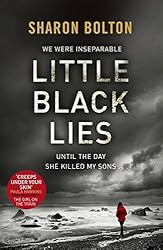
Little Black Lies by Sharon Bolton

You can tell from the title what to expect from this book – lies, black lies, but they’re not little lies, they are whopping great big lies. The story is narrated by three of the main characters, Catrin, Callum and Rachel, all unreliable narrators either self deceptive, delusional or manipulative. They are all damaged characters.

Three years before the story begins Catrin’s two sons died in an accident caused by her then best friend Rachel. She has never got over it; they have haunted her ever since and she has not spoken to Rachel since then, determined to take revenge as the third anniversary of their death approaches. A year after their deaths Fred Harper went missing and was never found, then another boy, Jimmy Brown disappeared. As the story begins yet another boy, Archie West is missing. The nightmare continues with the disappearance of Peter, Rachel’s third and youngest son.

Little Black Lies is set in the Falkland Islands in 1994, twelve years after the war and Sharon Bolton’s descriptions of the islands paint a vivid picture of the isolation, the close knit community and war scarred landscape.

But there are a few things about this book that mean whilst I enjoyed the descriptive writing, the sense of place and the opening section very much I didn’t really like it. I began reading it with high expectations as it has received much praise and I’ve enjoyed everything else by Sharon Bolton that I’ve read. And although I was dismayed when I found it was written in the present tense (which is not my favourite style) I thought it was very promising and read on eagerly.

But when I finished it I gave it 3 stars on Goodreads, rounded up from 2.5 (Goodreads doesn’t have half marks!). I wasn’t keen on the focus on missing/dead children which so many books seem to have had recently. And it was a combination of the present tense and the way the plot descended into more of a farce with several twists and turns, particularly as the book draws to an end, one after the other that I just didn’t think was credible. The final  twist at the end came out of the blue for me, although thinking back it shouldn’t have been such a surprise. But I felt a bit cheated. In fact I’m rather annoyed with myself as I’d totally forgotten FictionFan had reviewed this book and I’d thought then that it was one that didn’t appeal to me – at least I was right!

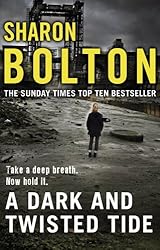
A Dark and Twisted Tide by Sharon Bolton: Mini Review

I finished reading A Dark and Twisted Tide, the 4th in the Lacey Flint series, at the end of September, but never got round to writing about it, so now this is just a mini review.

Synopsis from the back cover:

Police Constable Lacey Flint thins she’s safe. Living on the river, swimming in the river, she’s never been happier. It can’t last. Because Lacey has secrets. And when the first body floats, it’s only a matter of time before her fragile life falls apart. And the river is the last place she should be ..,

This is such a terrifying novel, particularly if like me, you have a fear of drowning. No longer a detective, Lacey is now a police constable with the Metropolitan Police’s Marine Unit on the River Thames, living on a houseboat (actually a vintage sailing yacht) in Deptford Creek and wanting a quieter and safer life whilst trying to recover from the terrifying events of her last cases. Unlike me, Lacey loves swimming and is perfectly at home in water, so much so that she wild-swims in the Thames as often as tide and conditions allow, loving it so much that she feels she has become part of the river. But even she experiences the terror of being drawn down into the water ‘within a frantic gasp of drowning‘.

A Dark and Twisted Tide is a multi-layered book, told from different characters’ perspectives, complex and chilling as it weaves its way through murders, people trafficking, a mysterious character called ‘the swimmer’, more details about Lacey’s background and the ongoing saga of her relationship with Mark Joesbury. It’s a grim tale with a great sense of foreboding and mystery – a book I read far too quickly, making me think at some point I’ll read it again more slowly as I’m sure there’s a lot I missed. An excellent read for RIP X!

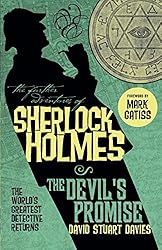
The Devil’s Promise by David Stuart Davies

The full title of this book is The Further Adventures of Sherlock Holmes: The Devil’s Promise.

From the back cover:

The discovery of a corpse on a deserted beach is just the first in a series of mysterious and terrifying events that threaten Sherlock Holmes. While investigating the death, Holmes and Watson attract unwanted attention from the strange inhabitants of the nearby village, and are viciously attacked. Watson wakes to discover that months have passed and his friend is not the man he remembers. What has transpired during those lost days? And is it connected to the notorious “Devil’s Companion” whose descendants live nearby?

A book for RIP X, and one I had high hopes of when I read the Foreword by Mark Gatiss – an English actor, comedian, screenwriter and novelist, writing for Doctor Who and the co-creator of Sherlock. He wrote:

I think that Sherlock Holmes is imperishable, a brilliant British icon – indeed a worldwide icon. He represents the best of us. He is as clever as we would all like to be. He is surprising, capricious, slightly dangerous, strangely elegant, dashing, Byronic and the best and wisest man any of us will ever know.

I believe he lasts because we all want to be Sherlock Holmes and we all want to believe there are people like Sherlock Holmes out there, instead of the universe being completely chaotic, which is actually the truth.

This fabulous character is the creation of Arthur Conan Doyle who, in my opinion, was a writer of genius. No wonder many of us wish to tread in his footsteps. Sherlock now lives in other people’s stories too, as he does in The Devil’s Promise, penned by the great Davies, whose Sherlock Holmes writings have brought me hours of pleasure.

Holmes and Watson are staying in an isolated cottage in Devon when they they find themselves caught up in a nightmare scenario of a puzzling surreal nature they cannot understand. After Holmes discovers the body on the beach weird images appear on the door of the cottage, they are attacked by villagers, and meet a brother and his strange sister who warns them to leave or they will be killed.

But I was a little disappointed; it began well but later became repetitive – the dead body disappears and reappears and Watson keeps getting into fights, being hit on the head and losing consciousness. It has elements of suspense, as Holmes is coerced to take part in a ceremony to raise the Devil. But I began to think it was all very predictable – maybe it’s the cynic in me but I found myself reading just to see how it ended and whether it was as predictable as I thought it was. And it was, apart from the very last three sentences.

Five of the Best: September 2011-2015

This was originally Cleo’s idea (Cleopatra Loves Books). It’s to look back over your reviews of the past five years and pick out your favourite books for each month from 2011 ‘“ 2015. I like it so much it inspired me to do the same.

I really enjoy looking back over the books I’ve loved reading. These are some of my favourite books for each September from 2011 to 2015 (click on the titles/covers to see my original reviews). These are all crime fiction, mostly dark scary books, because each September and October I take part in the R.I.P. Challenge, that is hosted this year by The Estella Society.

2011
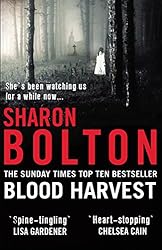
Blood Harvest by Sharon Bolton.  I can’t quite believe that it’s four years ago that I read this book as I can still remember the tension, terror and suspense within its pages.  It’s a dark, scary book, set in the fictional town of Heptonclough in Lancashire.There are two churches, the ancient ruined Abbey Church and standing next to it the ‘˜new’ church of St Barnabas. The Fletchers have just moved into a new house built on the land right next to the boundary wall of the churchyard. But this is not a safe place for children, three little girls have died over the past ten years, and when the Fletcher children start to hear voices in the graveyard more disturbing events unfold.

2012
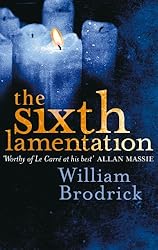
The Sixth Lamentation by William Brodrick, the first Father Anselm book. This is historical fiction and it’s also a mystery. It looks back  to the Second World War in occupied France, telling a dramatic tale of love and betrayal, full of suspense, and interwoven stories, with accurate details of life in Paris during the Occupation and the subsequent war trials. William Brodrick has also drawn on his own personal experience. He was formerly in religious life but left before his final vows.

2013
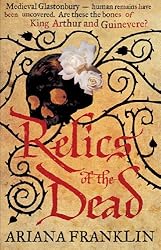
Relics of the Dead by Ariana Franklin, the third book in her Mistress of the Art of Death series. The date is 1176, the setting is Glastonbury where the monks, after a fire had destroyed their monastery, discovered two skeletons buried in their graveyard. The question is  ‘“ are these the remains of King Arthur and Queen Guinevere? Henry II needs evidence that they are not and sends Adelia Aguilar, the anatomist, to examine the bones for evidence. I’ve always liked the stories about King Arthur, about his life and death, about Excalibur (which does feature in this book), about Guinevere’s affair with Lancelot,  and the Holy Grail (which do not).

2014

The Brimstone WeddingBrimstone wedding by Barbara Vine. This is one of the best of Barbara Vine’s books that I’ve read ‘“ nearly as good as A Dark-Adapted Eye and writing under her real name, Ruth Rendell, A Judgement in Stone. it’s not horrific in the overblown graphic sense, but in a sinister, psychological way that really is ‘˜chilling’ and inexpressibly sad. The atmosphere is mysterious, a house isolated in the fens, seems to hold the key to the past. Stella, who is dying of lung cancer,  never mentions her husband or her past life, but gradually she confides in Jenny, a carer at the retirement home where Stella lives, telling her things she has never said to her son and daughter ‘“ things about her life she doesn’t want them to know.

2015

This September I’m spoilt for choice as I read several excellent books – The Ghosts of Altona by Craig Russell is just one of them. This is his 7th book featuring Jan Fabel, the head of Hamburg’s Murder Commission, a very cleverly plotted book, multi-layered and complex and I loved it.

A murder mystery combining a cold case and present day murders combined with great storytelling, rich descriptions, interwoven with details of near-death experiences, the Gothic, mental and personality disorders makes this most definitely one of the best books I’ve read this year.

I must also mention three of Sharon Bolton’s Lacey Flint books that I read this September – all excellent books.

The Ghosts of Altona by Craig Russell

Last week I quoted the opening paragraphs and the description of The Ghosts of Altona by Craig Russell, a novel, which won this year’s Bloody Scotland Crime Novel of the YearIt’s an outstanding book, one of the best I’ve read this year. I suppose it can be called a modern Gothic tale as well as being a crime thriller. Russell is a new author to me, but by no means is he a new author, The Ghosts of Altona being his 7th book featuring Jan Fabel, the head of Hamburg’s Murder Commission. However, it didn’t spoil my enjoyment that I’d jumped into the series right at the end. And in a way it didn’t matter at all as in the first chapter Jan has a near-death experience when he is shot by a suspected child killer, which has a profound effect on his life and the way he views death.

Two years later his first case as a detective is resurrected when the body of Monika Krone is found under a car park, fifteen years after she disappeared. The prime suspect at that time was Jochen Hubner, a serial rapist, christened ‘Frankenstein’ by the press because of his monstrous appearance, but there was no conclusive evidence to connect him to her disappearance. Monika, beautiful, intelligent and cruel had been the centre of a group of students obsessed with the Gothic. Then ‘Frankenstein’ escapes from prison and there are more murders which Fabel thinks are linked to the discovery of Monika’s remains, all of men who were in the same Gothic set at university.

There are many allusions to the Gothic tradition and symbolism, the killings being reminiscent of Edgar Allan Poe’s macabre tales, as well as philosophising on the nature of near-death experiences, Schrödinger’s cat, Cotard’s Delusion (in which sufferers believe themselves to be dead), and the intertwining of the hallucinogenic, the psychedelic, the spiritual and the macabre. All absolutely fascinating and incorporated seamlessly into the crime investigation so that I was turning the pages as fast as possible to get to the solution. It’s all very cleverly plotted, multi-layered and complex and I loved it.

As well as the story and the characters I loved the setting – Hamburg, a city I knew very little about before reading The Ghosts of Altona, the second largest city in Germany, a member of the medieval Hanseatic League. It’s a city of water with two lakes and the river Elbe running through it and it has more canals than Amsterdam and Venice combined. Altona, one of the city boroughs had been under Danish administration for over two centuries.

The Author

Craig Russell is an award-winning, best-selling and critically-acclaimed author, published in twenty-five languages around the world. The Devil Aspect was acquired by Jason Kaufman, Dan Brown’s editor at Doubleday. The movie rights to the Devil Aspect have been bought by Columbia Pictures. Five Jan Fabel novels have been made into movies (in one of which Craig Russell makes a cameo appearance as a detective) for ARD, the German national broadcaster, and the Lennox series has been optioned for TV development. See his website for more information.