November's Books & Crime Fiction Pick of the Month

These are the books I finished reading in November (linked to my posts on the books):

  1. Saints of the Shadow Bible by Ian Rankin
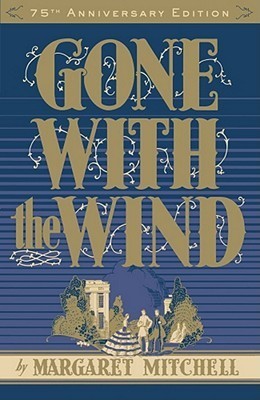
  2. Gone with the Wind by Margaret Mitchell and also this post
  3. Instructions for a Heatwave by Maggie O’Farrell
  4. Julius by Daphne Du Maurier (from my To-Be-Read books)
  5. The Midwich Cuckoos by John Wyndham (Kindle)
  6. N or M? by Agatha Christie (from my To-Be-Read books)
  7. St Mawr by D H Lawrence (from my To-Be-Read books)

The books without posts are:

Instructions for a Heatwave is a book I bought this year; it’s shortlisted for the 2013 Costa Novel Award.  The Midwich Cuckoos is an e-book I borrowed from the Kindle Users Lending Library. Three of the books are books I’ve owned for several years (the To-Be-Read books).

It was a good month for reading. Just two of the books are crime fiction – Saints of the Shadow Bible and N or M?  Both books are by writers at the top of their form, but Ian Rankin’s Saints of the Shadow Bible is my Crime Fiction Pick of the Month.

See Kerrie’s blog for more Crime Fiction Picks of the Month.


Color Coded Challenge

Well, I did say a few weeks ago that I was thinking of making this blog a mainly challenge-free zone, but I’ve changed my mind. I am determined that next year I will reduce the number of my unread books by a significant amount.

So I will be taking part in those challenges that encourage me to concentrate on reading books I’ve owned before 1 January 2014 and one of them is Bev’s Color Coded Challenge 2014.

Color Coded Challenge

Here are the rules:

*Read nine books in the following categories (in some categories I have more than one book to choose from, but have just included one for the time being).

1. A book with “Blue” or any shade of Blue (Turquoise, Aquamarine, Navy, etc) in the title – Blue Heaven by C J Box

2. A book with “Red” or any shade of Red (Scarlet, Crimson, Burgundy, etc) in the title – The Redbreast by Jo Nesbo

3. A book with “Yellow” or any shade of Yellow (Gold, Lemon, Maize, etc.)in the title – The Yellow Admiral by Patrick O’Brian

4. A book with “Green” or any shade of Green (Emerald, Lime, Jade, etc) in the title – The Olive Readers by Christine Aziz

5. A book with “Brown” or any shade of Brown (Tan, Chocolate, Beige, etc) in the title – Portrait in Sepia by Isabel Allende

6. A book with “Black” or any shade of Black (Jet, Ebony, Charcoal, etc) in the title – On the Black Hill by Bruce Chatwin

7. A book with “White” or any shade of White (Ivory, Eggshell, Cream, etc)in the title – The White Queen by Philipa Gregory

8. A book with any other color in the title (Purple, Orange, Silver, Pink, Magneta, etc.) – Purple Hibiscus by Chimamanda Ngozi  Adichie

9. A book with a word that implies color (Rainbow, Polka-dot, Plaid, Paisley, Stripe, etc.) – Dying in the Wool by Frances Brody

* Any book read from January 1 through December 31, 2014 will count.

*Crossovers with other challenges are fine.

Gone With the Wind: Historical Fiction

Gone With the Wind

In a previous post on Gone With the Wind I wrote that I had learned a lot about the American Civil War and Reconstruction, about slavery (very different from Uncle Tom’s Cabin) and a lot about Georgia and Atlanta. In the comments Jane pointed out, quite correctly, that the book ‘shouldn’t be taken as history, but as reflective of a very strong point-of-view of American history, circa 1930.’

I hadn’t meant that I was taking GWTW as historical fact, but that it had led me to wanting to know more about the period and in that respect it had opened up new areas for me. For example, I’d never heard of ‘Reconstruction’ before in the sense of what happened to the southern states following the Civil War and I knew next to nothing about the causes of the war, other than the fact that the southern states wanted to leave the Union, that they wanted to be an independent nation. I was in no doubt, however, that the book is a novel – historical fiction, not historical fact.

All written history is a selection of facts and involves to a greater or lesser extent an interpretation of those facts. Its accuracy depends on the sources used, and in turn those sources inevitably are subject to perspective and bias. Similarly, historical fiction can throw light on the past; it can flesh out the facts, bringing the past to life – and it can be subject to the bias and opinions of the author.

I was fascinated to read that Margaret Mitchell, who was born in Atlanta in 1900 grew up listening to the war stories of Confederate veterans and yet she didn’t know until she was ten years old that the South had lost the war!

Margaret Mitchell was writing from a Southerner’s perspective, but that does not mean that her book is any the less invalid. She presents the Civil War period and its aftermath as seen through southern eyes and basically it is the story as seen through the women’s eyes. There is little about the actual battles, but this is still a war novel, even though it’s set mostly in the homes of the characters – in Tara, and in Atlanta. It depicts the hardships and suffering of the civilian population as well as the wounded soldiers, their grief and desolation and the devastating effect on the land and townships. You can see Atlanta going up in flames, the devastation of the countryside as the railroads and plantations were destroyed, and feel the hunger as the people starved.

Then there is the question of slavery and the Ku Klux Klan, both essential elements in the novel. The depiction of slaves divides them into two categories – house slaves and field hands, raising racial issues and the different attitudes between the North and the South towards the slaves. The plantation owners are portrayed as viewing their slaves, in particular the house slaves, as part of their family, protecting them and caring for them, treating them as children and of lower intelligence, and the slaves responded with loyalty to their owners. Again this is one perspective on the past, one that is at variance that of the northern states – clearly indicated in the novel. There are several references in Gone With the Wind to Uncle Tom’s Cabin in which Margaret Mitchell contradicts Harriet Beecher Stowe’s scene of bloodhounds chasing runaway slaves. Similarly the view she gives of the Ku Klux Clan is not what I expected. This led me to want to know more about the history of slavery in America and I turned to the one book I own, specifically on American history – Out of Our Past: The Forces that Shaped Modern America by Carl N Degler to find out more.

This is one of the things  I like about reading historical fiction – as well as giving me a glimpse into the past, showing me areas of history I know little or nothing about, bearing in mind that there is always more than one side to a story. And I really need to do more research into these matters.

Julius by Daphne du Maurier

Daphne du Maurier’s Rebecca was one of the first adult books that I remember reading and it has remained a favourite ever since I first read it. It led me on to read more of her books and in my teens and twenties I read and re-read Jamaica Inn, Frenchman’s Creek, The Scapegoat, Mary Anne and The King’s General. They were the type of books that I loved.

Later on I discovered that she had written many more books and I’ve gradually been reading them, but, with perhaps the exception of My Cousin Rachel, they have not had the same magic quality that had kept me enthralled in the past. So I wasn’t quite sure what to expect when I began reading Julius, her third book written when she was twenty-six. It may lack that magic quality of her later books, but it is still compelling and disturbing reading, rich in detail and characterisation.
Julius (originally published in 1933 as The Progress of Julius) is the life story of a ruthless man, driven by his lust for power, and his dedication to getting ‘something for nothing’. It’s a chilling tale about a man whose love for his daughter brings about his ruin.

But that is jumping ahead in the story. It begins with his birth in Paris in 1860. Julius Levy grows up in a peasant family in a village on the banks of the Seine and caught up in the Franco-Prussian War, he escapes to Algeria, where he learns to swindle and manipulate. He moves on to London, all the time scheming and making money, getting richer, regardless of who he hurt, or indeed of whose death he caused as he built up his empire of cafés and married Rachel, the daughter of a diamond merchant.

It’s a dramatic story covering the years 1860 -1932, as the old century ended and the new one began:

Now came the close of the century and the death of the Queen followed by peace in South Africa, and these things also served as a milestone in the life of Julius Lévy. They marked the end of an era  showing him the path to greater prosperity than he had as yet achieved. It was the beginning of a new age – the age of progress and speed and efficiency that he had long foreseen and the dawn of mechanism in all things, electricity, motor-cars and soon flying-machines in the air. The spirit abroad was one he understood, the demon of restlessness unsatisfied stretching hungry fingers to the skies in a superhuman effort to conquer insatiable hunger, a spirit of rapacity and greed and excitement burning like a living flame. (page 195)

Julius is half-Jewish and the book veers on anti-Semitism, indeed in later years Daphne du Maurier considered excising those elements from the novel. But that would have meant the novel would have lacked depth as it is his Jewishness that lifts him from being a complete monster. As a mixed-up, lonely child he found in the temple that he was among his own people, and the music took hold of his heart, giving him peace. It is his tragedy that he lost that peace and struggled throughout the rest of his life trying to re-capture it.

His love for his daughter, Gabriel overwhelms him, but it is a possessive, suffocating love that leads him to extremes. His inability to love without the need to possess and control is shown early on in the book when forced to leave home and unable to take his cat he ties a stone around her neck and throws her in the Seine, rather than leave her to fend for herself or for someone else to take care of her. That made me shudder, but it is little compared to how he treated people.

I’ve read that Du Maurier based the character of Julius on that of her father, Gerald, that the possessiveness, the emotional demands and the sentiments Julius expresses were Gerald’s, and the words Gabriel speaks were her own thoughts. (Daphne du Maurier by Margaret Forster page 84)

At times melodramatic, this is a powerful novel, of a deprived, starving child who sold rats on the streets of Paris, and who dragged himself up from poverty and obscurity to become a man of  wealth and status and a cold-blooded sadist and murderer. I wrote about the beginning  of the book in an earlier post, describing how as a baby he was reaching for things beyond his grasp. The book ends as it began with Julius still reaching for the clouds:

He cried to them and they did not come. They passed away from him as though they had never been, indifferent and aloof, like wreaths of smoke they were carried away by the wind, born of nothing, dissolving into nothing, a momentary breath that vanished in the air. (page 308)

First Chapter: Shakespeare the Biography by Peter Ackroyd

First chapterEvery Tuesday Diane at Bibliophile by the Sea hosts First Chapter First Paragraph Tuesday Intros, where you can share the first paragraph or (a few) of a book you are reading or thinking about reading soon.

In my last post I mentioned Peter Ackroyd’s biography of William Shakespeare when deciding which book to read next. As soon as I began the first chapter I knew that this is the next non fiction book I’ll be reading.
The first paragraph is:

William Shakespeare is popularly supposed to have been born on 23 April 1564, or St George’s Day. The date may in fact have been 21 April or 22 April, but the coincidence of the national festival is at least appropriate.

But it is the second paragraph that caught my attention, after all Shakespeare’s birthday or supposed birthday was not a surprise to me. The second paragraph, however, gives me information I hadn’t known before:

When he emerged from the womb into the world of time, with the assistance of a midwife, an infant of the sixteenth century was washed and then ‘swaddled’ by being wrapped tightly in soft cloth. Then he was carried downstairs in order to be presented to the father. After this ritual greeting, he was taken back to the birth-chamber, still warm and dark where he was lain beside the mother. She was meant to ‘draw to her all the diseases from the child’, before her infant was put in a cradle. A small portion of butter and honey was usually placed in the baby’s mouth. It was the custom in Warwickshire to give the suckling child hare’s brains reduced to jelly. ( page 3)

Ackroyd is not of course saying that this is what happened when Shakespeare was born, merely that this was the ritual at the time and he refers to David Cressy’s book, Birth, Marriage, and Death: Ritual, Religion, and the Life Cycle in Tudor and Stuart England as the source of his information. But it is fascinating, nonetheless to think of the infant William wrapped in swaddling clothes and sucking hare’s brain jelly! Butter and honey sounds far more delectable. And how different from birth today.

Sunday Selection: Choosing the next book to read

Yesterday I finished reading both Instructions for a Heatwave by Maggie O’Farrell and Julius by Daphne Du Maurier, leaving me with no books on the go. This morning I started to read The Midwich Cuckoos by John Wyndham, but I like to read more than one book at a time of different genres so that I don’t get them mixed up in my mind, preferably with one non-fiction book.

I think I’ll read a biography or an autobiography.

There was a programme on TV last night about D H Lawrence, a Culture Show Special, which reminded me that I haven’t read his biography yet which I bought a few years ago when we visited the house in Eastwood where he was born. It’s D H Lawrence: the Life of an Outsider by John Worthen who was one of the contributors to the programme. I got the book off the shelf and immediately saw why I haven’t read it yet – it’s in such a small font, with quotations in an even smaller font – not good for my eyes. It’s a pity I don’t have it on Kindle but maybe I’ll give it a go, definitely a book to read in daylight. And as I have just one of D H Lawrence’s books that I haven’t read yet – St Mawr – I may read that. It’s a novella, so it won’t take me long.
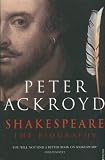
Anther book I’ve been meaning to read before now is Peter Ackroyd’s Shakespeare:the Biography. The Classics Club is running a new project next year Twelve Months of Classic Literature with different topics for each month and January’s topic is William Shakespeare.  I think Ackroyd’s book would be a good choice for this project. It’s described on the book jacket as
 … neither an academic description, nor a didactic analysis. Written with intuition and imagination unique to Peter Ackroyd, a book by a writer about a writer, brilliant and straightforward, it vividly presents the reader with the circumstances of Shakespeare’s life and art.

It sounds just right. I think I’ll begin with this book.

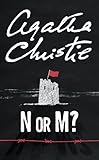
That leaves me with choosing a crime fiction book and I have quite a lot of those to choose from. I haven’t read an Agatha Christie this month so I’m going to choose one of hers or some of her short stories (I have several collections still unread). I think I’ll read the oldest I have, which is N or M? a Tommy and Tuppence war time mystery, first published in 1941. I have a feeling this will be better than the last Tommy and Tuppence book I read, Postern of Fate, which was Agatha Christie’s last novel and not one of her best.