Gone With The Wind: Some Thoughts

Gone with the wind 001

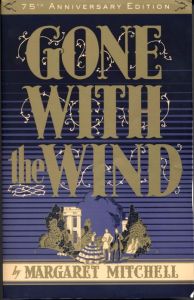
Yesterday I finished reading Margaret Mitchell’s masterpiece, Gone With The Wind. I loved it. When I started it I decided that I wouldn’t take any notes as I read and neither would I mark any passages. I just wanted the pure reading experience, reading to get immersed in the story and Margaret Mitchell was a superb storyteller. There are parts full of description that enabled me to see the scenes and parts where I couldn’t turn the pages fast enough to discover what happened next, or how the characters would behave. It was a grand experience, and not just a reading experience but a learning experience too.

I saw the 1939 film many, many years ago and my memories of it are vague, not much beyond its setting, Clark Gable as Rhett Butler and Vivien Leigh as Scarlett O’Hara, and a few quotes: ‘Tomorrow is another day’ and Frankly, my dear I don’t give a damn’ – this is actually a misquote from the book – Rhett says ‘lightly but softly: ‘My dear, I don’t give a damn.’

 My knowledge of American history is quite limited, so I learnt a lot about the American Civil War and Reconstruction, about slavery (very different from Uncle Tom’s Cabin) and a lot about Georgia and Atlanta – I couldn’t even have placed them on a map before!!!

I liked the structure of the novel – straightforward chronological sequence told in the third person.

The characters are well-defined and are developed as the book progresses. Even the minor characters are distinct and I had no trouble identifying them. But the main characters are magnificent: Scarlett O’Hara, wilful, spirited, supremely self-centred and single-minded, a cheat and liar, but also charming, brave and fearless, as her character develops from a frivolous flirt to a much darker personality. She is obsessed by her infatuation for Ashley Wilkes, by her need for money and her desperate desire never to be hungry ever again. I swung between not liking her, admiring her courage, then thoroughly disliking the person she became and willing her to change – she didn’t of course.

Rhett Butler, black-hearted, flashy, a speculator, blockade runner and scallawag, who scandalises Atlanta, is the anti-hero who is gradually revealed as a hero, a tender-hearted, over-indulgent father, who really does love Scarlett, even though he can’t tell her. He’s a much more complicated character than Scarlett who understands human nature much better than Scarlett, seeing both the goodness and strength in Melanie Hamilton (Scarlett’s sister-in-law and Ashley’s wife).

There is so much to write about this book, (and I’m thinking of writing at least one more post about it) but for now I’m ending with these words from Margaret Mitchell when she was asked what Gone With The Wind was about:

… if the novel has a theme it is that of survival. What makes some people come through catastrophes and others, apparently just as able, strong and brave go under? It happens in every upheaval. Some people survive; others don’t. What qualities are in those who fight their way through triumphantly that are lacking in those that go under? I only know that survivors  used to call that quality ‘gumption’. So I wrote about people who had gumption and those who didn’t. (1936) (About the Author)

The TBR Triple Dog Dare

I’ve decided that any challenges I take part in next year have to help me read my own books – books I’ve owned before 1 January 2014.

I read about the TBR Triple Dog Dare on Annabel’s blog. For the past three years, CB at Ready when you are, CB has hosted a TBR Dare, made into a Dog Dare in honour of Dakota, his Bassett Hound.  This year the Triple Dog Dare will be, so he says, the last one.  I’ve not taken part before, but this year it seems just the right thing to do to keep me focused on reading from my own bookshelves. So I’ve signed up for the full three months €“ will you?

Triple Dog DareIt’s very simple. From Jan 1st 2014 until March 31st read only books already in your TBR pile or those you’ve already reserved at the library.

You are allowed to make whatever exceptions you need as long as you set them prior to January 1, so I’m going to except books chosen for my local book group.

Of course, this doesn’t mean you have to stop acquiring books €“ you just have to resist reading them until after March 31st, but I’m going to try not buying books too.

Classics Club Spin: Result

1056472It is No. 10 on my list, which is Washington Square by Henry James. I’m pleased with this – it’s not too long so I should be able to fit it in. Currently I’m reading three books, which I hope to finish by the end of November and then I’ll start Washington Square.
The only other book I’ve read by Henry James is The Turn of the Screw, which I enjoyed and thought was a dark and melodramatic tale, about good and evil. I think Washington Square will be a bit lighter.

Saints of the Shadow Bible by Ian Rankin

I finished reading the latest Rebus book, Saints of the Shadow Bible a few days ago and have been wondering what to write about it that would do it justice. Ian Rankin is one of my favourite authors and his Rebus books never fail to impress me both with their ingenuity and the quality of their plots and characterisations – Saints of the Shadow Bible is no exception. In fact, I think it’s one of the best – a realistic and completely baffling mystery.
Rebus is now back on the force, the rules on retirement age having changed, but as a Detective Sergeant, not a DI and Siobhan Clarke is his boss. It begins with the discovery of a crashed car, on the face of it just a straight forward road traffic accident but it soon develops into a complex, multi-layered case, linking back to one of Rebus’s early cases on the force as a young Detective Constable. A case that with the changes in the double jeopardy law in Scotland can be reopened.

Rebus has always been an outsider, not one to play completely by the rules but his past gets put under scrutiny when Inspector Malcolm Fox investigates that case from the 1980s. There are suspicions that Rebus and his colleagues, who called themselves ‘The Saints of the Shadow Bible’ were involved in covering up a crime, allowing a murderer to go free.

The ‘Shadow Bible’ was a copy of Scots Criminal Law, a big black book

‘with a leather cover and brass screws. And we all spat on it and rubbed it in until it was dry. I thought it was a kind of oath, but it wasn’t – we were saying the rules could go to hell, because we knew we were better. We were the ones in the field …

The evidence was tainted, interviews hadn’t been conducted properly. How was Rebus involved, was he a Saint, and just how much did he know as a very junior member of the team?

The interaction between Rebus and Fox is one of the joys of this book as unlike Rebus, Fox does play by the rules. Ah, but does he? Beneath his controlled exterior Fox is just as much a loose cannon as Rebus, he’s not a team player either and it is fascinating to see how Rebus gets under his skin and reveals Fox’s true nature. For Rebus and Fox it’s the job that matters, but can they trust each other?

I wonder, though, just how much I would have enjoyed it if this was the first Rebus book I’d read. I have a feeling that I wouldn’t. There are characters who were in earlier books and references to previous cases which would have been lost on me otherwise. The first Rebus book I read was Set in Darkness (the 11th book) and whilst I had no difficulty in following who was who and their relationships I realised then that I had to read the books in order to fully understand the background and how the characters had evolved. I felt they were real people and I wanted to know more about them. I then went back to the beginning (Knots and Crosses) and read them in sequence, right up to the present day.

It’s all been an exhilarating and most enjoyable journey and I have a sneaking suspicion that this may indeed be the end – who knows? Only Ian Rankin and he isn’t telling, but he’s off on a year’s sabbatical in February and by then Rebus will almost be due a second retirement.

Book Beginnings: The Midwich Cuckoos

Every Friday Gilion at Rose City Reader hosts Book Beginnings on Friday, where you can share the first sentence (or so) of the book you are reading, along with your initial thoughts about the sentence, impressions of the book, or anything else the opener inspires..

I’ve borrowed The Midwich Cuckoos by John Wyndham from the Kindle Lending Library and have only read the opening paragraphs so far. I’ve liked other books by Wyndham, such as Chocky, The Chrysalids, and The Kraken Wakes, so I’m expecting to enjoy this one too.

It begins:

One of the luckiest accidents in my wife’s life is that she happened to marry a man who was born on the 26th of September. But for that, we should both of us undoubtedly have been at home in Midwich on the night of the 26th-27th, with consequences which, I have never ceased to be thankful, she was spared.

According to the reviews on Amazon this Kindle version is full of grammatical errors and typos, so I’m hoping I can overlook them and enjoy this book set in the sleepy English village of Midwich, where a mysterious silver object appears and all the inhabitants fall unconscious.

The Classics Spin for November/December

The Classics ClubIt’s time for another Classics Spin.

I’m using the list I had for the last Spin with a couple of new titles to replace the ones I’ve read/am reading. The last Spin gave me My Antonia by Willa Cather and I’m currently reading Gone With the Wind by Margaret Mitchell.

I don’t really mind which one comes up in this Spin, which is another way of saying I can’t decide which of these to read first. I’ll know next Monday when the Spin result is announced.

  1. Lady Susan, The Watsons, Sanditon by Jane Austen
  2. Out of Africa by Karen Blixen
  3. The Thirty Nine Steps by John Buchan
  4. The Man Who Was Thursday by G K Chesterton
  5. A Journal of the Plague Year by Daniel Defoe
  6. Moll Flanders by Daniel Defoe
  7. Lazy Tour of Two Idle Apprentices by Charles Dickens
  8. Silas Marner by George Eliot
  9. Where Angels Fear to Tread by E M Forster
  10. Washington Square by Henry James
  11. Three Men in a Boat by Jerome K Jerome
  12. The Call of the Wild by Jack London
  13. Anne of Green Gables by Lucy Maud Montgomery
  14. Black Beauty by Anna Sewell
  15. Travels with a Donkey in the Cevennes by Robert Louis Stevenson
  16. Gulliver’s Travels by Jonathan Swift
  17. Walden by Henry James Thoreau
  18. The Color Purple by Alice Walker
  19. The Time Machine by H G Wells
  20. Ethan Frome by Edith Wharton