Spell the Month in Books June 2026

Spell the Month in Books is a linkup hosted by Jana on Reviews From the Stacks on the first Saturday of each month. The goal is to spell the current month with the first letter of book titles, excluding articles such as ‘the’ and ‘a’ as needed. That’s all there is to it! Some months there are optional theme challenges, such as “books with an orange cover” or books of a particular genre, but for the most part, any book you want to use is fair game!

As Jana is not back on her blog yet, there is no theme for this month, so I am featuring books that spell the word June using the first letters of the book titles. These are all books that I’ve read and are linked to my posts on them.

J is for Julius by Daphne du Maurier
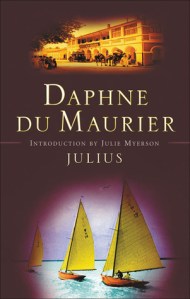
Julius is the life story of a ruthless man, driven by his lust for power, and his dedication to getting ‘something for nothing’. It’s a chilling tale about a man whose love for his daughter brings about his ruin. It was her third book written when she was twenty-six. It may lack that magic quality of her later books, but it is still compelling and disturbing reading, rich in detail and characterisation.

U is for Ultimate Prizes by Susan Howatch
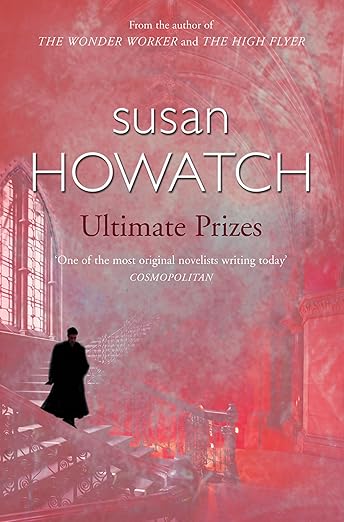
I read this book before I began blogging, so no review. It’s the third book in the Starbridge series, six self-contained yet interconnected novels that explore the history of the Church of England through the 20th century. I loved all six books. This one is about Neville Aysgarth, archdeacon, and right-hand man of the Bishop of Starbridge, who has spent his life chasing worldly success. In 1942 he has a perfect wife, a perfect family and a perfect future in the Church of England – all ultimate prizes.Then Aysgarth meets an attractive young socialite and is soon dangerously and chaotically involved in adultery, hypocrisy and obsession.

N is for No Further Questions by Gillian McAllister
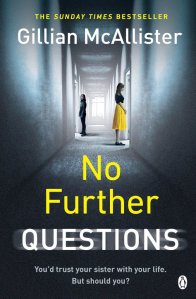
I was hooked right from the start of this book. It plunges straight into a trial as Martha sits in the courtroom listening to expert witnesses being questioned  and cross-examined about the death of her baby, Layla, just eight weeks old. Her sister Becky is accused of murdering her. Martha doesn’t want to believe Becky is guilty but as the trial proceeds, as medical and social worker witnesses as well as neighbours and a school teacher present their accounts it looks increasingly bad for Becky.This is a tense, tightly plotted book and I was gripped. I didn’t want to stop reading it and when I wasn’t reading it I was thinking about it, about the characters and their relationships, about how they had got themselves into such a terrible situation. 

E is for The Elopement by Gill Hornby
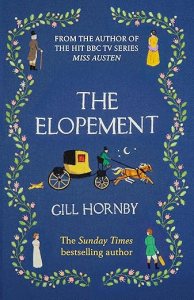
This is historical fiction about the life of Jane Austen’s niece Fanny Knight and Mary Dorothea Knatchbull, Fanny’s stepdaughter. Fanny’s father was Edward Austen, who was adopted by the wealthy Knight family. In 1820 Fanny married Sir Edward Knatchbull, a widower, with six children. Fanny and Mary Dorothea, the only daughter, had a difficult relationship right from the start. Fanny is not a warm character and Mary is reluctant to accept her as a substitute mother, but Fanny comes from a large, happy and sociable family and Fanny’s sisters become Mary’s first friends. Her aunt, Miss Cassandra Austen of Chawton, is especially kind. Her brothers are not only amusing, but handsome and charming, and when Mary and one of the Knight brothers fall in love and want to marry Fanny is not all happy.
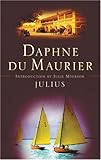
Julius by Daphne du Maurier

Daphne du Maurier’s Rebecca was one of the first adult books that I remember reading and it has remained a favourite ever since I first read it. It led me on to read more of her books and in my teens and twenties I read and re-read Jamaica Inn, Frenchman’s Creek, The Scapegoat, Mary Anne and The King’s General. They were the type of books that I loved.

Later on I discovered that she had written many more books and I’ve gradually been reading them, but, with perhaps the exception of My Cousin Rachel, they have not had the same magic quality that had kept me enthralled in the past. So I wasn’t quite sure what to expect when I began reading Julius, her third book written when she was twenty-six. It may lack that magic quality of her later books, but it is still compelling and disturbing reading, rich in detail and characterisation.

Julius (originally published in 1933 as The Progress of Julius) is the life story of a ruthless man, driven by his lust for power, and his dedication to getting ‘something for nothing’. It’s a chilling tale about a man whose love for his daughter brings about his ruin.

But that is jumping ahead in the story. It begins with his birth in Paris in 1860. Julius Levy grows up in a peasant family in a village on the banks of the Seine and caught up in the Franco-Prussian War, he escapes to Algeria, where he learns to swindle and manipulate. He moves on to London, all the time scheming and making money, getting richer, regardless of who he hurt, or indeed of whose death he caused as he built up his empire of cafés and married Rachel, the daughter of a diamond merchant.

It’s a dramatic story covering the years 1860 -1932, as the old century ended and the new one began:

Now came the close of the century and the death of the Queen followed by peace in South Africa, and these things also served as a milestone in the life of Julius Lévy. They marked the end of an era  showing him the path to greater prosperity than he had as yet achieved. It was the beginning of a new age – the age of progress and speed and efficiency that he had long foreseen and the dawn of mechanism in all things, electricity, motor-cars and soon flying-machines in the air. The spirit abroad was one he understood, the demon of restlessness unsatisfied stretching hungry fingers to the skies in a superhuman effort to conquer insatiable hunger, a spirit of rapacity and greed and excitement burning like a living flame. (page 195)

Julius is half-Jewish and the book veers on anti-Semitism, indeed in later years Daphne du Maurier considered excising those elements from the novel. But that would have meant the novel would have lacked depth as it is his Jewishness that lifts him from being a complete monster. As a mixed-up, lonely child he found in the temple that he was among his own people, and the music took hold of his heart, giving him peace. It is his tragedy that he lost that peace and struggled throughout the rest of his life trying to re-capture it.

His love for his daughter, Gabriel overwhelms him, but it is a possessive, suffocating love that leads him to extremes. His inability to love without the need to possess and control is shown early on in the book when forced to leave home and unable to take his cat he ties a stone around her neck and throws her in the Seine, rather than leave her to fend for herself or for someone else to take care of her. That made me shudder, but it is little compared to how he treated people.

I’ve read that Du Maurier based the character of Julius on that of her father, Gerald, that the possessiveness, the emotional demands and the sentiments Julius expresses were Gerald’s, and the words Gabriel speaks were her own thoughts. (Daphne du Maurier by Margaret Forster page 84)

At times melodramatic, this is a powerful novel, of a deprived, starving child who sold rats on the streets of Paris, and who dragged himself up from poverty and obscurity to become a man of  wealth and status and a cold-blooded sadist and murderer. I wrote about the beginning  of the book in an earlier post, describing how as a baby he was reaching for things beyond his grasp. The book ends as it began with Julius still reaching for the clouds:

He cried to them and they did not come. They passed away from him as though they had never been, indifferent and aloof, like wreaths of smoke they were carried away by the wind, born of nothing, dissolving into nothing, a momentary breath that vanished in the air. (page 308)

First Chapter First Paragraph: Julius

First chapterEvery Tuesday Diane at Bibliophile by the Sea hosts First Chapter First Paragraph Tuesday Intros, where you can share the first paragraph or (a few) of a book you are reading or thinking about reading soon.

One of the books I’m currently reading is Julius by Daphne du Maurier. The first chapter is called Childhood (1860-1872). It begins:

 His first instinct was to stretch out his hands to the sky. The white clouds seemed so near to him, surely they were easy to hold and to caress, strange-moving, things belonging to the wide blue space of heaven.

They floated just above his head, they almost brushed his eyelids as they passed, and he only had to grasp the long curling fringe of them with his fingers and they would belong to him instead, becoming part of him for ever. Something in him whispered that he must clutch at the clouds and bring them down from the sky. So he held out his hands to them and they did not come. He cried out to them and they did not come. They passed away from him as though they had never been, indifferent and aloof; like wreaths of white smoke they were carried away by the wind, born of nothing, dissolving into nothing, a momentary breath that vanished in the air.

What do you think? Would you keep reading?

I did and I’m finding it quite captivating. The ‘he’ in these first two paragraphs is Julius and right from his birth you can see him reaching out for things beyond his grasp.