Six Degrees of Separation: from Wolfe Island to Blue Lightning

It’s time again for Six Degrees of Separation, a monthly link-up hosted by Kate at Books Are My Favourite and Best. Each month a book is chosen as a starting point and linked to six other books to form a chain. A book doesn’t need to be connected to all the other books on the list, only to the one next to it in the chain.
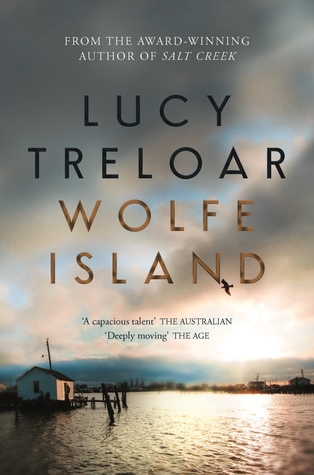
Wolfe Island

This month the chain begins with Lucy Treloar’s Wolfe Island. It is a book I have not read but one I think I’d like. It’s about Kitty Hawke, the last inhabitant of a dying island sinking into the wind-lashed Chesapeake Bay. She has resigned herself to annihilation… until one night her granddaughter blows ashore in the midst of a storm, desperate, begging for sanctuary.

I’m beginning my chain with a book by another LucyThe Book of Lost and Found by Lucy Foley. It’s the story of Tom and Alice beginning in 1928 in Hertfordshire and moving backwards and forwards in time and place to 1986, from Paris, to London, Corsica and New York. It all revolves around Kate, whose mother, June, had recently died in a plane crash.

The Flight by M R Hall is also about a plane crash. When Flight 189 plunges into the Severn Estuary, Coroner Jenny Cooper finds herself handling the case of a lone sailor whose boat appears to have been sunk by the stricken plane, and drawn into the mysterious fate of a ten year-old girl, Amy Patterson, a passenger on 189, whose largely unmarked body is washed up alongside his.

There is also a coroner in A Rustle of Silk by Alyis Clare – set in 1603 when former ship’s surgeon Gabriel Taverner has settled in Devon near his family and he is trying to set up a new practice as a physician. But it is not easy to gain the locals’ trust and someone is leaving gruesome little gifts on his doorstep. The local coroner, Theophilus Davey asks him to examine a partially decomposed body found beside the river.

Another book with the word ‘silk’ in the title is The House of Silk by Anthony Horowitz, a Sherlock Holmes continuation novel. It’s narrated by Watson as he looks back on two of the most puzzling and sinister cases he and Holmes had to solve November 1890 – that of The Man in the Flat Cap and The House of Silk. The first involves an art dealer, Mr Carstairs who is being threatened by a member of the American Flat Cap Gang, whereas the second concerns the murder of Ross, a new member of the Baker Street Irregulars.

The Sign of Four by Sir Arthur Conan Doyle is my next link – the second book about the original Sherlock Holmes. Holmes and Watson investigate the mystery Mary Morstan presents to them – it involves the murder of Bartholomew Sholto, the Agra treasure stolen during the Indian Mutiny of 1857 and a secret pact between the four thieves – the ‘Four’ of the title, resulting in a chase down the River Thames in a super-fast steam launch.  I listened to an audiobook of the novel, narrated by Derek Jacobi.

My last link is another audiobookBlue Lightning by Ann Cleeves, the fourth in her Shetland books, featuring Detective Jimmy Perez. It completes the chain too by linking back to Wolfe Island because it is set on another island, Fair Isle where Perez returns to his family home with his fiancée Fran. A woman’s body is discovered at the Fair Isle’s bird observatory, with feathers threaded through her hair, but as a storm sets in, Far Isle is cut off leaving Perez with no support from the mainland. 

My chain is a circle beginning and ending with books set on islands. They move from Chesapeake Bay in the Mid-Atlantic region through mainland Britain to Shetland in the Northern Atlantic covering a variety of genres and time periods, including contemporary fiction, historical and crime fiction.

Next month (4 April 2020), we’ll begin with Anna Funder’s ‘classic on tyranny and resistance’ – Stasiland the winner of the Samuel Johnson Prize for Non-Fiction 2004.
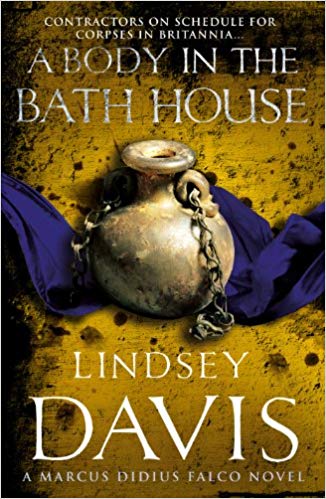
My Friday Post: A Body in the Bath House by Lindsey Davis

Book Beginnings Button

Every Friday Book Beginnings on Friday is hosted by Gillion at Rose City Reader where you can share the first sentence (or so) of the book you are reading, along with your initial thoughts about the sentence, impressions of the book, or anything else the opener inspires.

A body in the bath house

A Body in the Bath House by Lindsey Davis is one of my current library loans. It’s historical crime fiction, a Marcus Didius Falco novel, an ‘informer with a nose for trouble’.


But for Rhea Favonia, we might have lived there.

‘There’s a smell! There’s a horrible smell. I’m not going in there!’

I didn’t need to be an informer to know we were stuck. When a four-year-old girl reckons she has detected something nasty, you just give in and look for it.

Also every Friday there is The Friday 56, hosted by Freda at Freda’s Voice.

30879-friday2b56These are the rules:

  1. Grab a book, any book.
  2. Turn to page 56, or 56% on your eReader. If you have to improvise, that is okay.
  3. Find any sentence (or a few, just don’t spoil it) that grabs you.
  4. Post it.
  5. Add the URL to your post in the link on Freda’s most recent Friday 56 post.

Page 56:

‘Imagine Britain as a rough triangle.’ Helena had a letter in her hand, so well studied she hardly referred to it. ‘We are going to the middle of the long south coast. Elsewhere there are high chalk cliffs, but this area has a gentle coastline with safe anchorages in inlets. There are some streams and marshland but also wooded places for hunting and enough good farming land to attract settlers. The tribes have come down from their hillforts peacefully here. Noviomagus Regnensis – the New Market of the Kingdom Tribes – is a small town on the modern model.’

Noviomagus Regnensis was the Roman town which is today called Chichester, in the modern English county of West Sussex.

Blurb

AD 75. As a passion for home improvement sweeps through the Roman Empire, Falco struggles to deal with a pair of terrible bath-house contractors who have been causing him misery for months. Far away in Britain, King Togidubnus of the Atrebates tribe is planning his own makeover. His huge new residence (known to us as Fishbourne Palace) will be spectacular – but the sensational refurbishment is beset by ‘accidents’. The frugal Emperor Vespasian is paying for all this; he wants someone to investigate.

Falco has a new baby, a new house, and he hates Britain. But his feud with Anacrites the Chief Spy has now reached a dangerous level, so with his own pressing reasons to leave Rome in a hurry, he accepts the task. A thousand miles from home, he starts restoring order to the chaotic building site and realises that someone with murderous intentions is now after him…

~~~

Fishbourne Roman Palace is in the village of Fishbourne, Chichester in West Sussex. The palace is the largest residential Roman building discovered in Britain, dated 75 AD, around thirty years after the Roman conquest of Britain.

Have you read this book? What did you think?

The Sleepwalker by Joseph Knox

The Sleepwalker Knox

The Sleepwalker by Joseph Knox is the third Detective Aidan Waits novel. It has to be the most complicated book that I’ve read in a very long time. Two years ago I read the second book, The Smiling Man, even though I hadn’t read the first one, Sirens, and loved it, so I was keen to read the third one. It certainly didn’t disappoint me and although I think the books read well as stand-alones, it would probably be best to read them in order. To say that Waits has troubled background is an understatement. He is a disturbed and complex character, other police officers don’t trust him or want to work with him.  He plays very close to the edge and has little regard for his own safety. 

The Sleepwalker is dark, violent and absolutely brilliant. I just didn’t want it to end and at the same time I just had to know what happened next. There are so many strands that you have to keep in mind, so many characters to sort out where they fit into the story and it’s all so cleverly linked together. You think you have it sorted and then you realise there’s more to come. It’s perfectly paced throughout, culminating in an astounding and shocking conclusion that had me reeling.

Quite simply, I loved it.

My thanks to Transworld Publishers for a review copy via NetGalley.


Library Loans 27 February 2020

The mobile library van visit was this week and I borrowed these books:

Library bks Feb 2020

The Mystery of Princess Louise by Lucinda Hawksley, subtitled Queen Victoria’s Rebellious Daughter. On the back cover it says that this is ‘packed with intrigues, scandals and secrets’. I know very little about Princess Louise, Queen Victoria’s sixth child, so I’m keen to find out about her. From the opening page I’ve already found out she was a friend to artists, such as Dante Rossetti, James Whistler and John Millais and that she was a sculptor.

Caught Out in Cornwall by Janie Bolitho. I’ve read two of her books before. This is the seventh book in her Rose Trevelyan series of mysteries, in which she sees four year old Beth Jones being carried away from the beach at Marazion by someone she assumes is her father. But her mother insists he is a stranger.

A Body in the Bath House by Lindsey Davis the 13th book in her Marcus Didio Falco series of historical crime fiction mysteries. It’s set in Rome and Britain in AD 75. Falco is Britain and he hates it. A thousand miles from home he realises someone with murderous intentions is after him.

The Hunting Party by Lucy Foley. A while ago I kept seeing reviews of this book and wondered about reading it, so when I saw it on the library van shelves I decided to see what it’s like for myself. It’s a murder mystery set in a remote hunting lodge in the Scottish wilderness where old friends gather for New Year. The description makes me wonder if it is like In a Dark, Dark Wood by Ruth Ware about a group of friends who spend a weekend in a remote cottage and everything goes wrong. I’m not sure I’ll like it …

I think I’ll start with The Mystery of Princess Louise – a friend borrowed it before me and said it’s very good, but first I’ll have to finish The Sleepwalker by Joseph Knox, his latest instalment in the Detective Aidan Waits series.

The Year Without Summer by Guinevere Glasfurd

Year without summer

Two Roads| 6 February 2020| 416 pages| e-book| review copy via NetGalley| 5 stars

The Year Without Summer: 1816 – one event, six lives, a world changed by Guinevere Glasfurd is a most remarkable book, telling how the volcanic eruption of Mount Tambora on Sumbawa Island in Indonesia in 1815 had a profound and far reaching impact on the world. It led to sudden cooling across the northern hemisphere, crop failures, famine and social unrest in the following year, which became known as The Year Without Summer and in North America as Eighteen hundred and froze to death. But it wasn’t until the mid twentieth century that volcanic eruptions were shown to affect climate change.

Guinevere Glasfurd’s novel illustrates how the impact of the extreme weather conditions affected the lives of six people. They never meet, or know each other, but their stories are intertwined throughout the book in short chapters, giving what I think is a unique look at the events of 1816. I enjoyed all the stories.

Henry Hogg was the ship’s surgeon on the Benares, the ship sent to investigate the eruption of Mount Tambora in 1815. He discovered the sea full of floating pumice and charred bodies, whilst the decks of the ship were covered a foot thick with ashes. The immediate effects of the eruption were simply tremendous and horrific, within a hundred miles forests, towns were covered, deep valleys were filled in and the contours of the coast were changed.

In 1816 Mary Shelley travelled to Switzerland with Percy Shelley and her son Willmouse, her step-sister, Claire and Lord Byron and Dr Polidori and after a month of rain, Byron suggests that they should each write a ghost story and that led to her writing Frankenstein.

John Constable’s love of landscapes is deeply unfashionable and his hopes to marry Maria Rebow depend upon him gaining a commission from her parents. His father is near to death and as he has passed his business to Abram, John’s younger brother, John has few prospects other than to make a living from his painting.

Farmworker Sarah Hobbs in the Fens is finding work hard to get and has to settle for shovelling shit in the stables in her bare feet for a penny a day.  Always hungry and with work getting even more scarce she gets involved in the Littleport hunger riots. Her story is based loosely on a real person who was condemned to hang for her part in the riots, but her sentence was eventually commuted to transportation. The suppression of these riots was repeated in the 1819 Peterloo Massacre when protesters had gathered in Manchester demanding political reform

The other two people are fictional – preacher Charles Whitlock in Vermont is struggling, having persuaded his flock not to travel to Ohio to escape the draught, only to find that this is followed by periods of hard frost and snow in August. Their prospects are very bleak and death soon follows.

The other fictional character is Hope Peter, a soldier returned from the Napoleonic wars, who finds his mother has died, his family home demolished and a fence has gone up in its place, enclosing the land. He too ends up taking part in a riot – this one at Spa Fields at Islington.

 I thoroughly enjoyed this book. It’s more like a collection of short stories than a novel, but it works very well for me, highlighting the global connections. It is of course about climate change, showing the far-reaching effects of the Tambora eruption, which weren’t limited to 1815 and 1816. It led to hardships in 1817 and 1818 with the outbreak of cholera and typhoid epidemics triggered by the failure of monsoons. As Guinevere Glasfurd explains in her afterword the eruption is ‘credited with social change throughout the nineteenth century and with the pressure for social reform.’

This was the first book by Guinevere Glasfurd  that I’ve read, but it’s not her first book – that was The Words in My Hand, shortlisted for the Costa First Novel Award and Authors’ Club Best First Novel Award and was also longlisted in France for the Prix du Roman FNAC. She is currently working on her third novel, a story of the Enlightenment, set in eighteenth century England and France. I’ll be reading more of her work.

Many thanks to Two Roads for a review copy via NetGalley.

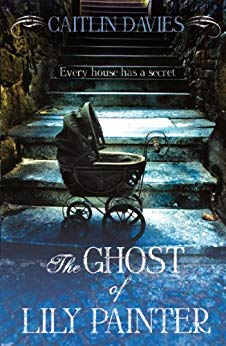
My Friday Post: The Ghost of Lily Painter by Caitlin Davies

Book Beginnings Button

Every Friday Book Beginnings on Friday is hosted by Gillion at Rose City Reader where you can share the first sentence (or so) of the book you are reading, along with your initial thoughts about the sentence, impressions of the book, or anything else the opener inspires.

The Ghost of Lily Painter is by Caitlin Davies and I want to read it because it looks good, a blend of fact and fiction based on true events. I also want to read it as I’ve recently read Happy Old Me by Hunter Davies and he mentions in it that his daughter, Caitlin, is an author (like his wife Margaret Forster), with ten books published. I love Margaret Forster’s books, so I thought I’d see what her daughter’s books are like.

The Ghost of Lily Painter

It is a bitter winter’s evening and the little girl is in her bedroom standing confidently before her mirror. The mirror is affixed to the wall at such a height that she has to tiptoe herself up to see her body entirely, but then, how dramatically she tilts her head. How regally she nods at her reflection as she pulls at the wispy black feathers of the wrap that hangs loosely around her shoulders.

Also every Friday there is The Friday 56, hosted by Freda at Freda’s Voice.

30879-friday2b56These are the rules:

  1. Grab a book, any book.
  2. Turn to page 56, or 56% on your eReader. If you have to improvise, that is okay.
  3. Find any sentence (or a few, just don’t spoil it) that grabs you.
  4. Post it.
  5. Add the URL to your post in the link on Freda’s most recent Friday 56 post.

Page 56:

I didn’t know she still had this lizard. Ben gave it to her from the inside of his Christmas cracker last year. It’s a tiny cheap thing, green and yellow with a rubbery stickiness, but she’s kept it all this time and here she is talking to it like it’s precious. She won’t talk to me about her day, but she will tell a little green lizard.

Blurb

The first time Annie Sweet sees 43 Stanley Road, the house is so perfect she almost feels as though it has chosen her. But with her husband seeming more distant, and her daughter wrapped up in her friends and new school, Annie is increasingly left alone to mull over the past.

She soon becomes consumed by the house and everyone who has lived there before her, especially a young music hall singer called Lily Painter, whose sparkling performances were the talk of London. As Annie delves further into the past she unravels the case of two notorious baby farmers, who cruelly preyed on vulnerable unmarried mothers. And until she solves the mystery at the heart of the scandal, the ghost of Lily Painter will never be able to rest.

Basing her story on true events, Caitlin Davies skilfully blends fact and fiction to bring to life part of our sinister past. Spanning an entire century, from the journals of an Edwardian police inspector to a doomed wartime love affair, The Ghost of Lily Painter is a gripping and poignant novel.

~~~

Have you read this book? What did you think?