Turn of the Tide by Margaret Skea

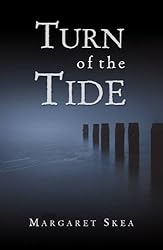
I have read some wonderful debut novels this year –  Turn of the Tide by Margaret Skea is one of them. I loved it. It’s historical fiction and it captivated me completely transporting me  back in time to 16th century Scotland. If you have ever wondered,  as I have, what it must have been like to live in a Tower House in the Scottish Borders then this book spells it out so clearly. And it puts you firmly in the middle of the centuries old feud between the Cunninghames and the Montgomeries, with all the drama of their battles, ambushes and schemes to further their standing with the young King James VI. It’s a tale of love, loyalty, tragedy and betrayal.
It’s no wonder that the book was  the Historical Fiction Winner in the 2011 Harper Collins / Alan Titchmarsh People’s Novelist Competition and won the Beryl Bainbridge Award for Best First Time Author 2014.

There is a map setting the scene in Ayreshire on the west of Scotland between the Firth of Clyde and the Solway Firth, showing the major sites in the book. I found both the map and the list of main characters most useful whilst following the story. And to complete my understanding there is a Glossary of Scottish words at the back of the book, although the meaning of most of them was clear from the context.

It begins in 1586  with an ambush in which several of the Montgomerie Clan, on their way to James VI’s court at Stirling are killed, followed by the Clan’s reprisal on the Cunninghames. James, anxious to settle the feud between his nobles, asks them to swear to bring their feud to an end, which brings an uneasy peace between them – for a while.

Most of the characters are real historical figures, includingJames VI, the Cunninghames – William, the Master of Glencairn and the Montgomeries – Hugh, the Master of Braidstane and their families. The feud is also a matter of fact. It began in 1488 when James IV gave control of the Balliewick of Cunninghame to a Montgomerie! It didn’t come to an end until the beginning of the 17th century.

The main characters,  Munro and his wife Kate and a few of the others are fictional. Munro is a minor laird who whilst owing allegiance to the Cunninghames, has increasing sympathy and liking for the Montgomeries. His dilemma only increases throughout the book.

Margaret Skea has done her research well, not just the feud and battles but also the domestic settings are detailed down to descriptions of the clothing, the food and so on – even how the town house rooms were finished with limewash, which involved carrying bucket-load after bucket-load up four flights of stairs to rejuvenate the attic chamber where the children slept. But it slots seamlessly into the story, adding colour and life to the scenes.

It’s all fascinating  – the hunt arranged for the king, the account of his journey across the North Sea to bring home his bride, Anne of Denmark, the scenes as the royal party lands at Leith and the coronation in Edinburgh, as well as the jockeying for positions, and the battles all culminating in a tense and dramatic finale.

Not only is this riveting history it is also so well written, beautifully descriptive:

Across the valley the castle reared against the skyline, the town tumbling down the slope below, wisps of smoke beginning to unfurl, first one, then another, then too many to count, as Stirling awoke.

The countryside was spread out before him like a map; the distant hills to the south west smudged against the watery sky; the river a dark ribbon snaking through the marshland below, cradling Cambuskenneth in a giant u-shaped loop. (pages 98-99)

and this – such a startling image:

Daylight slipped into their bedchamber like wraith; grey and insubstantial, filtered through the grime and soot that coated the outside of the windowpanes. (page 247)

And I’m delighted that Margaret Skea is writing a sequel as I really want to know what happened next to Munro and his family. The working title is A House Divided, continuing the story in the late 1590s.

  • Paperback: 416 pages – also available on Kindle
  • Publisher: Capercaillie Books Limited; first edition (22 Nov. 2012)
  • Language: English
  • ISBN-10: 1909305065
  • ISBN-13: 978-1909305069
  • Source: I bought my copy
  • Author’s website: Margaret Skea, Writing yesterday, today

Barchester Towers by Anthony Trollope

First published in 1857 Barchester Towers, is the second book in Anthony Trollope’s Chronicles of  Barchester series, following on from The Warden.

As I began reading this book I was thinking it’s really slow, very much set in its period detailing the religious and ecclesiastical controversies of its time, but then the story of who was going to succeed the old dean, who was going to be the warden, Mr Harding or Mr Quiverful (with his 14 children) and above all who was going to marry Eleanor, Mr Harding’s widowed daughter took hold of me. Not to mention the odious Mr Slope, chaplain to the new Bishop, the ambitious, but hen-pecked Dr. Proudie and his overbearing wife who would dearly like to be the Bishop herself; the Archdeacon Dr Grantly and his wife, Susan Mr Harding’s elder daughter; the Stanhope family including the entrancing cripple, Madeline, ‘a basilisk from whom an ardent lover of beauty could make no escape‘; and the Thornes of Ullathorne.

Barchester Towers provides a view of the class structure of society, in Victorian Britain. Miss Thorne and her brother, the local squire  hold a party, a gala day, inviting all the main characters and the local labourers, their wives and children. The guests are divided according to their place in society – the upper classes and the non-quality were to eat in separate marquees. The question arose as to who should go where amongst the lower class of yokels, with the Lookalofts and the Greenacres. The Lookalofts won’t sit among the bumpkins, nor will Mrs Lookaloft think Mrs Greenacres should sit next to her and talk about cream and ducklings. But neither is she a fit companion to the Thornes and Grantlys – what a dilemma for Miss Thorne! It’s scenes like these that make Barchester Towers such an entertaining novel.

This is a novel strong on character, less strong on plot, with strong female characters, power-hungry men, humour and pathos as the various battles for supremacy are played out. And throughout the book the narrator frequently expresses his opinion on the characters and on the novel itself. Here he describes Obadiah Slope:

I never could endure to shake hands with Mr Slope. A cold, clammy perspiration always exudes from him, the small drops are ever to be seen standing on his brow and his friendly grasp is unpleasant. (page 31)

The characters, however, are not portrayed as wholly good or wholly bad. Here Trollope indicates Mr Slope’s better (if you can call it that) side:

And here the author must beg it to be remembered that Mr Slope was not in all things a bad man. His motives, like those of most men were mixed, and though his conduct was generally different from that which we would wish to praise, it was actuated perhaps as often as that of the majority of the world by a desire to do his duty. (page 146)

He also comments on how he has made his characters withhold the truth from each other, causing such misunderstandings between them:

Everything would have been explained … had she but heard the whole truth … But then where would have been my novel? (page 337)

In his Autobiography Anthony Trollope wrote that he had taken great delight in writing Barchester Towers, the characters of the Bishop and Mrs Proudie were very real to him, as were the troubles of Dr Grantly, the archdeacon and the loves of Mr Slope. As they are to me too.

I thought this statement of his was very interesting:

It [Barchester Towers] achieved no great reputation, but it was one of those novels which novel readers were called upon to read. Perhaps I may be assuming more to myself than I have a right to do in saying now that Barchester Towers has become one of those novels which do not die quite at once, which live and are read for perhaps a quarter of a century; but if that be so, its life has been so far prolonged by the vitality of some of its younger brothers. Barchester Towers would hardly be so well known as it is had there been no Framley Parsonage and no Last Chronicle of Barset. (page 104)

and here we are over 150 years later still reading Barchester Towers.

The next book in the series is Doctor Thorne, which Trollope thought had a good plot and was, he believed, the most popular book he had written. I’m looking forward to reading it.

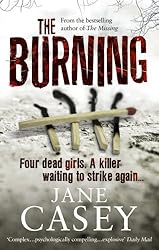
The Burning by Jane Casey

The Burning by Jane Casey is one of the books I selected for the TBR Pile Challenge 2015. It’s a book that I read about on other book blogs and thought I would like.  I was right – I really enjoyed it.

It’s the first the DC Maeve Kerrigan series. Maeve is on the murder task force investigating the case of the serial killer the media call The Burning Man. Four young women have been brutally murdered, beaten to death and their bodies burnt in secluded areas of London’s parks. When a fifth body is discovered that of Rebecca Haworth, it appears to be the work of The Burning Man – but is it, there are slight differences? The more that Maeve and her colleague Rob Langton check out the facts it appears it could be a copy-cat killing.

The pace of the book is quite slow at first as the characters are introduced and the story unfolds mainly through Maeve’s eyes  with some  chapters narrated by Rebecca’s friend Louise, and briefly by Rob. Because the pace is slow to begin with the main characters are fully rounded – Maeve in particular is a likeable character, intelligent and empathetic, working to impress her male colleagues and determined to catch the murderer. She’s new to the job, which both her boyfriend and her family criticises. Rebecca’s character is revealed through Louise’s eyes,  fleshed out as other friends give their versions of her past to Maeve and Rob. As the pace picks up, a complex  plot develops providing several suspects which kept me turning the pages right to the end.

I have the third Maeve Kerrigan book, The Last Girl, but I think I’ll postpone reading it until I’ve read the second book, The Reckoning. There are now six books in the series and Maeve has her own website!

As well as the TBR Pile Challenge The Burning completes one of the categories in the What’s In a Name challenge, that of a book title containg a word ending in ‘ing’, the My Kind of Mystery challenge and also the Mount TBR Reading Challenge (a book I’ve owned prior to 1 January 2015).

An Autobiography by Anthony Trollope

The primary object of a novelist is to please

2015 is the bicentenary of Anthony Trollope’s birth on 24th April 1815, and  the Trollope Society and other organisations (such as the British Library, the Post Office, the BBC, the Catholic University of Leuven and Oxford University) have planned a whole series of events to celebrate this anniversary.

But I didn’t know that when I began reading his Autobiography. I found it absolutely fascinating, even though I’ve only read two of his books, The Warden and The Way We Live Now, both of which I enjoyed.

Autobiography Trollope 001

(The link above is to the latest edition, edited by Nicolas Shrimpton and published in October 2014 which includes some of his other writings – my copy is a paperback in The World’s Classic series, edited by Michael Sadler and Frederick Page, first published in 1930, reprinted in 1989, shown above.)

I’d almost forgotten about his Autobiography because I’ve  had it for so long. Although it was new when I bought it the pages are now yellowed and the paperback a bit worn and damaged from moving house. I bought it when I was doing an Open University course and my tutor was an avid fan of Trollope. Part of the reason it has sat unread on my shelves is that when I bought it I hadn’t read any of Trollope’s books and I thought it would be better if I knew a bit about his work before reading about his life. So now I’ve read two and have started reading Barchester Towers I decided it was time to read it.

Anthony Trollope was the son of an unsuccessful barrister and had a miserable childhood, his family most often in debt and struggling to make ends met. It was his mother who supported the family through her writing. He was unhappy at school where he was bullied, always in disgrace and had no friends. When he was 19 he became a clerk in the London Post Office, eventually  becoming a Surveyor, working in both Ireland and England and he introduced the red pillar boxes to Britain.

I found it fascinating because it is not only his life story – his unhappy childhood, his work in the Post Office, including his work in Ireland and abroad, his marriage and family life and his love of hunting, but Trollope also writes a lot about his writing, criticises his own books and discusses his fellow writers in a chapter called ‘On English Novelists of the Present Day’, including – Thackeray, George Elliot, Dickens, Wilkie Collins, Charlotte Brontë to name but a few.

Remarkably whilst he was working full time he was also writing his novels. His practice was to get up at 5.30 am and work for 3 hours before dressing for breakfast. He wrote with his watch before him, writing 250 words every 15 minutes. But he didn’t confine his writing to the early hours he also wrote whilst travelling on trains, making a ‘tablet’ to write on and ‘found that after a few days’ exercise that I could write as quickly n a railway-carriage as I could at my desk. I worked with a pencil, and what I wrote my wife copied afterwards.’ He included a list of the books he had written with the dates of publication and the sums he had received for them, totalling £68, 959 17 shillings and 5 pence.

But he wasn’t just a remarkably disciplined writer, he was a writer who made his characters come alive – I can see that in just the two books I’ve read. When I went to see Hilary Mantel at the Borders Book Festival she said that she lives in a parallel world in the present and in the world of Cromwell and Henry VIII, plus all the characters, at one and the same time. It is always with her. So it was with Trollope. Here he writes about how an author can make characters ‘speaking, moving, living, human creatures’:

They must be with him as he lies down to sleep, and as he wakes from his dreams. He must learn to hate them and to love them. He must argue with them, quarrel with them, forgive them, and even submit to them. He must know of them whether they be cold-blooded or passionate, whether true or false, and how far true and how far false. The depth and the breadth, and the narrowness and the shallowness of each should be clear to him.

I have lived with my characters … I may say that I know the tone of voice, and the colour of the hair, every flame of the eye, and the very clothes that they wear. Of every man I could assert whether he would have said those words; of every woman, whether she would then have smiled or so have frowned. (page 233)

Here are some more passages I marked as I read the book that I thought interesting (there are many more!):

An author can hardly hope to be popular unless he can use popular language. (page 176)

His language must come from him as music comes from the rapid touch of the great performer’s fingers; as words come from the mouth of the indignant orator; as letters fly from the fingers of the trained compositor; as the syllables tinkled out by little bells form themselves to the ear of the telegraphist. (page 177)

Short novels are not popular with readers generally. Critics often complain of the ordinary length of novels, – of the three volumes to which they are subjected; but few novels which have attained great success in England have been told in fewer pages. (page 237)

And as my blog is called BooksPlease I was delighted to read this sentence:

The primary object of a novelist is to please … (page 248)

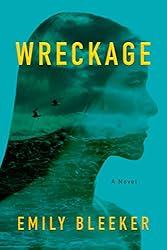
Wreckage by Emily Bleeker

When I downloaded Wreckage by Emily Bleeker I made the fatal mistake of just seeing how it began and before I knew it I was hooked, and had abandoned (just for the time being) the two novels I was already happily reading. I didn’t want to put it down – I really enjoyed it.

It’s the story of Lillian Linden and Dave Hall, who were being interviewed following their rescue from a deserted island in the South Pacific where they had spent two years after their plane crashed into the sea. The thing is their interviews are full of lies – they are desperate to keep what really happened a secret from their families.

Genevieve Randall, the TV interviewer is convinced that they are lying and tries to get them to tell the real story – how they had survived and what had happened to the other people who were on the plane, Kent, the pilot, Theresa, the flight attendant and Margaret, Lillian’s mother-in-law.

The narrative is told from Lillian’s and Dave’s point of view and moves between the present and the past. The two time periods are clearly set out and each character has a distinct voice. It worked very well, the fact that I guessed one of the big secrets early on only increased my curiosity and anticipation of what was to come next, and I was taken by surprise by the twist at the end.

It would spoil the story to say any more about this book, except to say it’s well written, full of suspense, tension and drama as well as love, loss and longing.

Wreckage is Emily Bleeker’s first novel. She is working on her second book, Beyond and I will most certainly be looking out for it. For more information see her website.

  • Format: Kindle Edition
  • File Size: 1301 KB
  • Print Length: 305 pages
  • Publisher: Lake Union Publishing (1 Mar. 2015)
  • Sold by: Amazon Media EU S.à r.l.
  • Language: English
  • ASIN: B00NAJZDIM
  • Source: My choice for February’s Kindle First Pick

The Raven’s Head by Karen Maitland

I loved Karen Maitland’s medieval mysteries, Company of Liars: a novel of the plague and The Owl Killers and although I didn’t think The Vanishing Witch had quite the same magic spark I still enjoyed it. So when Lovereading offered me a proof copy of The Raven’s Head for review I was keen to read it.

Publisher: Headline Review
Publication date: March 12, 2015
ISBN: 9781472215055

Summary from Karen Maitland’s website:

Vincent is an apprentice librarian who stumbles upon a secret powerful enough to destroy his master. With the foolish arrogance of youth, he attempts blackmail but the attempt fails and Vincent finds himself on the run and in possession of an intricately carved silver raven’s head.

Any attempt to sell the head fails ‘¦ until Vincent tries to palm it off on the intimidating Lord Sylvain ‘“ unbeknown to Vincent, a powerful Alchemist with an all-consuming quest. Once more Vincent’s life is in danger because Sylvain and his neighbours, the menacing White Canons, consider him a predestined sacrifice in their shocking experiment.

Chilling and with compelling hints of the supernatural.

My thoughts:

Set in 1224 in France and England this is a dark book. I found parts of it very uncomfortable and disturbing to read and yet also very compelling. Life in the medieval world was cruel and brutal and The Raven’s Head describes that world in minute detail, evoking the superstitious fear of the period.

The story is told from the three main characters point of view -Vincent, Wilky, a young boy taken from his family to live in a monastery in Norfolk where unspeakable terrors await him and the other young boys, and Gisa also living in Norfolk, working in her uncle’s apothecary’s shop. Their lives are connected through Lord Sylvain who is trying to find a way to bring the dead back to life and the abbot, trying to find the elixir of life – both experimenting with alchemy.

Karen Maitland provides a cast of characters and sets out the historical background and provides notes and a glossary on the practice of  alchemy during the Middle Ages, all of which I found indispensable. Each chapter is headed by a quotation taken from the writings of early Christian and Islamic alchemists – most of which I found incomprehensible.

She explains that alchemy was a dangerous practice, many chemical experiments could go horribly wrong – as in this book. Alchemists worked in secret. It was mystical, as they searched for the means to transform the base soul of man into pure incorruptible spirit, as well as physical, searching for the stone, elixir or tincture to turn base metals into precious metals.

Although long this is a fast-paced book and I read it quite quickly.  I enjoyed the historical setting and even though it took me right to the edge of my comfort zone as far as reading horrific detail the rest of the book made up for that in terms of a well constructed storyline and believable characters. Once I began I had to finish the book.