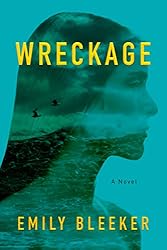
Wreckage by Emily Bleeker

When I downloaded Wreckage by Emily Bleeker I made the fatal mistake of just seeing how it began and before I knew it I was hooked, and had abandoned (just for the time being) the two novels I was already happily reading. I didn’t want to put it down – I really enjoyed it.
It’s the story of Lillian Linden and Dave Hall, who were being interviewed following their rescue from a deserted island in the South Pacific where they had spent two years after their plane crashed into the sea. The thing is their interviews are full of lies – they are desperate to keep what really happened a secret from their families.

Genevieve Randall, the TV interviewer is convinced that they are lying and tries to get them to tell the real story – how they had survived and what had happened to the other people who were on the plane, Kent, the pilot, Theresa, the flight attendant and Margaret, Lillian’s mother-in-law.

The narrative is told from Lillian’s and Dave’s point of view and moves between the present and the past. The two time periods are clearly set out and each character has a distinct voice. It worked very well, the fact that I guessed one of the big secrets early on only increased my curiosity and anticipation of what was to come next, and I was taken by surprise by the twist at the end.

It would spoil the story to say any more about this book, except to say it’s well written, full of suspense, tension and drama as well as love, loss and longing.

Wreckage is Emily Bleeker’s first novel. She is working on her second book, Beyond and I will most certainly be looking out for it. For more information see her website.

  • Format: Kindle Edition
  • File Size: 1301 KB
  • Print Length: 305 pages
  • Publisher: Lake Union Publishing (1 Mar. 2015)
  • Sold by: Amazon Media EU S.à r.l.
  • Language: English
  • ASIN: B00NAJZDIM
  • Source: My choice for February’s Kindle First Pick

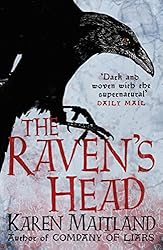
The Raven’s Head by Karen Maitland

I loved Karen Maitland’s medieval mysteries, Company of Liars: a novel of the plague and The Owl Killers and although I didn’t think The Vanishing Witch had quite the same magic spark I still enjoyed it. So when Lovereading offered me a proof copy of The Raven’s Head for review I was keen to read it.
Publisher: Headline Review
Publication date: March 12, 2015
ISBN: 9781472215055

Summary from Karen Maitland’s website:

Vincent is an apprentice librarian who stumbles upon a secret powerful enough to destroy his master. With the foolish arrogance of youth, he attempts blackmail but the attempt fails and Vincent finds himself on the run and in possession of an intricately carved silver raven’s head.

Any attempt to sell the head fails ‘¦ until Vincent tries to palm it off on the intimidating Lord Sylvain ‘“ unbeknown to Vincent, a powerful Alchemist with an all-consuming quest. Once more Vincent’s life is in danger because Sylvain and his neighbours, the menacing White Canons, consider him a predestined sacrifice in their shocking experiment.

Chilling and with compelling hints of the supernatural.

My thoughts:

Set in 1224 in France and England this is a dark book. I found parts of it very uncomfortable and disturbing to read and yet also very compelling. Life in the medieval world was cruel and brutal and The Raven’s Head describes that world in minute detail, evoking the superstitious fear of the period.

The story is told from the three main characters point of view -Vincent, Wilky, a young boy taken from his family to live in a monastery in Norfolk where unspeakable terrors await him and the other young boys, and Gisa also living in Norfolk, working in her uncle’s apothecary’s shop. Their lives are connected through Lord Sylvain who is trying to find a way to bring the dead back to life and the abbot, trying to find the elixir of life – both experimenting with alchemy.

Karen Maitland provides a cast of characters and sets out the historical background and provides notes and a glossary on the practice of  alchemy during the Middle Ages, all of which I found indispensable. Each chapter is headed by a quotation taken from the writings of early Christian and Islamic alchemists – most of which I found incomprehensible.

She explains that alchemy was a dangerous practice, many chemical experiments could go horribly wrong – as in this book. Alchemists worked in secret. It was mystical, as they searched for the means to transform the base soul of man into pure incorruptible spirit, as well as physical, searching for the stone, elixir or tincture to turn base metals into precious metals.

Although long this is a fast-paced book and I read it quite quickly.  I enjoyed the historical setting and even though it took me right to the edge of my comfort zone as far as reading horrific detail the rest of the book made up for that in terms of a well constructed storyline and believable characters. Once I began I had to finish the book.

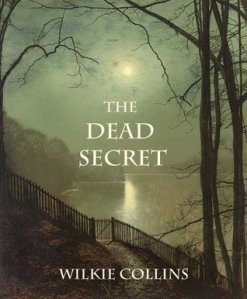
The Dead Secret by Wilkie Collins

I can imagine how intriguing Wilkie Collins’ novel The Dead Secret must have been when it was first serialised in weekly episodes in Household Words in 1857, every episode ending leaving the reader eager to know what happens next. It’s a sensation novel* (see my note below) , with many twists and turns, giving hints to the secret (which I did guess fairly early in the book) gradually and surely building up the suspense and with a final twist at the end (which I hadn’t forseen).  I’m reading Anthony Trollope’s Autobiography and this is what he had to say about his friend, Wilkie Collins:

 When I sit down to write a novel I do not all know, and I do not very much care, how it is to end. Wilkie Collins seems so to construct his that he not only, before writing, plans everything on, down to the minutest detail, from the beginning to the end; but then plots it all back again, to see that there is no piece of necessary dove-tailing, which does not dove-tail with absolutely accuracy. The construction is most minute and most wonderful.

And the plotting is like this in The Dead Secret – detailed and dove-tailed right from the powerful beginning at Porthgenna Tower in Cornwall in the 1820s, at the bedside of a dying woman, Mrs Treverton as she commands her maid, Sarah Leeson, to give her husband a letter confessing a great secret, to its end when all is revealed.

I think that to the modern reader the impact of this book is not the revelation of the secret but the manner of its style of delivery – the initial questions about the secret, what is in the letter, why has Sarah’s hair turned prematurely white, why she visits an an old grave set apart from others in the graveyard, why she talks to herself and why she disappears from Cornwall soon afterwards, having hidden the letter.

Fifteen years later, Rosamund, Mrs Treverton’s daughter returns to Porthgenna Tower to live in her old home. By an accident of circumstances, before Rosamund and her husband reach Cornwall, she gives birth a month earlier than expected and Sarah under an assumed name, is appointed to nurse Rosamund and the baby. Overcome by emotion Sarah cannot stop herself from warning Rosamund not to go into the Myrtle Room, which of course arouses Rosamund’s curiosity.

Trollope, however, says he ‘can never lose the taste of the construction’, feeling that Collins ‘books are ‘all plot’. I think this is a harsh judgement. In The Dead Secret, I think that on the whole the characters do come across as real people – I particularly like Rosamund and Sarah’s Uncle Joseph, both are sympathetically drawn – and there are other characters that add colour and interest. The settings and details of Victorian life are clearly described.  It also examines several social and moral issues of period, such as the role of women and respectability.

I don’t think The Dead Secret is in quite the same league as The Moonstone or The Woman in White, but it has all the elements of a good mystery story, drawing out the secret in tense anticipation of its revelation and making me as eager as Rosamund to know the secret and then almost as paranoid as Sarah that it should remain a secret!

*Sensation Novels*

I wrote about sensation novels,  in an earlier post and have reproduced the information here for ease of reference. It is a novel  with Gothic elements  ‘“ murder, mystery, horror and suspense ‘“ within a domestic setting. They have complicated plots, are set in modern times, and are reliant on coincidences, with plots hinging on murder, madness and bigamy. They exploited the fear that respectable Victorian families had of hidden, dark secrets and explored the woman’s role in the family. There is a pre-occupation with the law ‘“ wills, inheritance, divorce and women’s rights over property and child custody. They are emotional dramas about obsessive and disturbed mental states, with villains hiding behind respectable fronts, and bold assertive women, as well as passive, powerless and compliant women.

Reading Challenges: Mount TBR Challenge 2015, My Kind of Mystery Challenge, Victorian Bingo Challenge 2015 

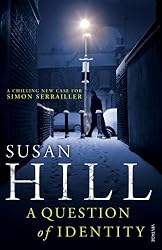
A Question of Identity by Susan Hill

I began reading A Question of Identity, the 7th Simon Serrailler book by Susan Hill immediately after I’d finished reading the 6th book, The Betrayal of Trust (see my previous post), which had left some issues unresolved. I was hoping to find out more in this book and I wasn’t disappointed – which is one reason for reading these books in order. Another reason is to follow the continuing story of Simon and his family. And a third reason is that Susan Hill always focusses on one or more psychological/moral/ ethical issues.

Summary (back cover):

How do you catch a killer who doesn’t exist?

One snowy night in the cathedral city of Lafferton, an old woman is dragged from her bed and strangled with a length of flex.

DCS Simon Serrailler and his team search desperately for clues to her murderer. All they know is that the killer will strike again, and will once more leave the same tell-tale signature.

Then they track down a name: Alan Keyes. But Alan Keyes has no birth certificate, no address, no job, no family, no passport, no dental records. Nothing.

Their killer does not exist.

I much preferred this book to the previous one. It is more balanced between the crime and the continuing story of the main characters. I suspect it may be incorrect in describing police procedures – I don’t know and really it doesn’t bother me, this is fiction after all and I have no difficulty in believing in the world of Serrailler and Lafferton that Susan Hill has created.

The main theme in this book, as the title indicates is ‘identity’ and its importance, how it is concealed, whether a personality can be changed convincingly and completely, or whether eventually the façade will crack and the real character reassert itself.

Susan Hill is also very good at creating tension and suspense. You know there are going to be murders (just as in Casualty you know there’s going to be a terrible accident etc), but that just increases the suspense. She builds up the setting and the characters and I was hoping against hope that one of the characters would not be a victim – and of course she was. I suspected the identity of the killer quite early on and hoped I was wrong about that too – but I wasn’t.  I began to feel very uncomfortable about the fate of the elderly, living on their own, frail and vulnerable …

It’s the psychological/social elements of A Question of Identity that appealed to me more than the crime, although these elements are inevitably so closely connected.

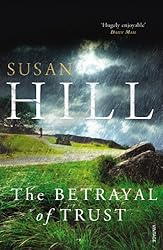
The Betrayal of Trust by Susan Hill

So far this year I’ve been reading from my own bookshelves – books I’ve owned before 1 January. I’ve had The Betrayal of Trust by Susan Hill, the 6th in the Simon Serrailler series, for nearly a year now. Like the earlier books, this one is  character-driven, concentrating on the people involved in the crime and Simon’s family, and also covering several ethical/moral/medical issues.

The crime element concerns a cold case, that of a teenager missing for 16 years. After flooding causes a landslip on the Moor her body comes to the surface together with that of an unknown female found in a shallow grave near by.The cold case is not a priority as the police force is struggling with staff shortages and cuts – Simon has to solve the cases mainly on his own, with the occasional help from DS Ben Vanek.

But the police investigations are not the main subject of this book. It focuses on the problems of ageing, hospice care, Motor Neurone Disease, assisted suicide, Parkinson’s Disease and Alzheimer’s Disease. A lot to cope with all at once and at times I found The Betrayal of Trust a deeply depressing book.

Having said that, as with Susan Hill’s other books, this is fluently written, looking at all sides of the issues, highlighting the dilemma facing those with terminal and debilitating illnesses, and those looking after dementia patients. The Serrailler family life has moved on from the last book, but Simon’s strained relationship with his father continues. He fails in love with a stunningly beautiful woman, which causes yet more complications – he just  doesn’t seem capable of having a happy relationship!

Although this is a quick read it’s also rather dark, with some dodgy and sinister characters and I was expecting it to be better than it is. It is a complex novel but the solution to the crime mystery soon becomes evident and is rather rushed at the end. There are several issues left unresolved and I hope they will be clarified in the next book in the series, A Question of Identity, which is next up for me to read.

Wilkie Collins by Peter Ackroyd

Wilkie CollinsOn Thursday I finished reading Wilkie Collins by Peter Ackroyd and it was also the anniversary of his birth – he was born in Marylebone at a house in New Cavendish Street on 8 January 1824.

I’ve read just two of Wilkie Collins’ books – The Moonstone and The Woman in White, and this year I hope to read more. I knew that he was a friend of Charles Dickens, but that was about all I knew of him. Peter Ackroyd’s biography looked as though it could be a good book to start with. And it is – it’s short, just over 200 pages, very readable and a clear and concise account of Collins’ life and work.

Wilkie’s father was William Collins, an English painter, a member of the Royal Academy, who specialised in landscapes and seascapes. He was christened William Wilkie – Wilkie after his godfather, the painter Sir David Wilkie.

Ackroyd’s account may be brief but he gives details of Wilkie’s childhood, his schooldays – the books he liked as a child – The Arabian Nights, Robin Hood and Don Quixote, books by Sir Walter Scott and he admired Byron. He moves on through Wilkie’s struggle to become a writer, his friendship with Charles Dickens, his travels abroad, his unconventional life style, never marrying but living with Caroline Graves for thirty years whilst having a liaison with Martha Rudd, his ill health and reliance on laudanum, his tour of America, his relationships with and views about women and their place in society, as well as discussing his short stories, articles, novels and plays.

Wilkie Collins died on 23 September 1889 after a year in which he had suffered from neuralgic attacks, a stroke that paralysed his life side and affected his brain, and a bout of bronchitis, but he  had still carried on writing.

I marked several passages as I was reading. Here are just a few of them:

He was essentially liberal in his social and political views, averse to coercion and conflict; he showed some sympathy with the principles of socialism as it was then understood, and was instinctively on the side of the oppressed. (page 46)

He might best be described as a Christian humanist who accepted Christ as his Saviour but detested all formal and outward shows of religion. He preserved his particular wrath for evangelicals. … he was not an atheist. He rarely entered a church, and his actual beliefs are hard, if not impossible, to unravel. (page 47)

He may have believed with Charles II that God would not punish him for a few sins of pleasure. (page 47)

He lived through a period in which the audience for fiction was rapidly widening, and the novels themselves were increasing in importance. … Novels had become the repository of dreams and ideals, the fantasies and the speculations, of the nation. (page 81)

One of the characters in ‘The Diary of Anne Rodway’ said -‘what I want is something that seizes hold of my interest, and makes me forget when it is time to dress for dinner – something that keeps me reading, reading, reading, in a breathless state to find out the end.’ That is precisely the excitement Collins conveys to his readers. (page 88)

Collins was writing about mysteries ‘deep under the surface’ three decades before Freud began his own enquiries. He was concerned with doubles and double identity, with monomania and delusion. He traced the paths of unconscious associations and occluded memories. (page 93)

It was believed that the ‘detective element’ disqualified the novel as a work of art, when in fact it opened up the way for an entirely new direction in English literature. There had been earlier exercises in the genre, but all of them are inconsiderable besides the over-whelming power and authority of ‘The Moonstone’. Collins’s novel, since its publication in 1868, has never been out of print. (page 132)

There is an awful lot packed into this short biography! And it’s an excellent stepping stone into Wilkie Collins’s novels.

  • Hardcover: 208 pages
  • Publisher: Chatto & Windus (23 Feb. 2012)
  • Language: English
  • ISBN-10: 0701169907
  • ISBN-13: 978-0701169909
  • Source: a Christmas present