My Friday Post: The Lake House by Kate Morton

Book Beginnings Button

Every Friday Book Beginnings on Friday is hosted by Gillion at Rose City Reader where you can share the first sentence (or so) of the book you are reading, along with your initial thoughts about the sentence, impressions of the book, or anything else the opener inspires.

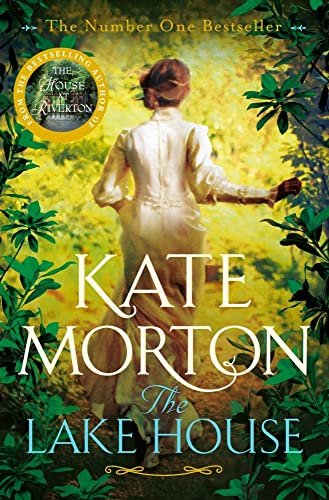
This week I’m featuring The Lake House by Kate Morton. This is one of my TBRs.

It begins in Cornwall in August 1933:

The rain was heavy now and the hem of her dress was splattered with mud. She’d have to hide it afterwards; no one could know that she’d been out.

Also every Friday there is The Friday 56, hosted by Freda at Freda’s Voice. These are the rules:

  1. Grab a book, any book.
  2. Turn to page 56, or 56% on your eReader.
  3. Find any sentence (or a few, just don’t spoil it) that grabs you.
  4. Post it.
  5. Add the URL to your post in the link on Freda’s most recent Friday 56 post.

Page 56

Sadie pictured the muddy lake and its eerie avian population. ‘Yes, that’s it. What happened there?’

‘A terrible business,’ Louise said, with a sad shake of her head. ‘Back in the thirties, before I was born. My mother used to talk about it, though – usually when she wanted to stop us kids from wandering too far. A child went missing on the night of a grand party. It was a big story at the time; the family was wealthy and the national press paid a lot of attention. There was a huge police investigation, and they even brought down the top brass from London. Not that any of it helped.

What a coincidence! I think these two extracts sum up what this book is about – an unsolved mystery of a child who disappeared without a trace.

I’ll be reading this book soon. What do you think? does it tempt you too?

Queen Victoria and John Brown


Victoria progress Jan 2018

I’ve been reading Victoria: a Life by A N Wilson and writing an occasional post as I’m reading this long book.

One of the things that interests me is Victoria’s relationships with the men around her – such as with Albert, Lord Melbourne, Gladstone and Disraeli. But there is also her relationship with John Brown. Years ago I saw the excellent film Mrs Brown with Judi Dench as Queen Victoria and Billy Connolly as John Brown and I was wondering what Wilson would make of their relationship.

She first met John Brown when he was one of the gillies at Balmoral in 1848. He also worked in the stables. In 1864, still grieving for Albert, Victoria found Balmoral a place that brought consolations. In the happy days of her marriage she had taken a great shine to John Brown.

By the end of 1864, Princess Alice, who had noticed that rides in the pony cart at Balmoral were almost the only things which made her mother half cheerful, recommended that they brought Brown to England. She put the idea to Dr Jenner and to Colonel Phipps, Keeper of the Privy Purse. They both agreed that it was an admirable idea. So it was, in December 1864, that John Brown came to Osborne House.

From now onwards, Brown would be he constant companion. At Osborne, he brought in her correspondence at 10 am, and took her for a morning ride. This was repeated in the afternoon. At Balmoral, he stayed with her while she did her correspondence and took it upon himself to post her letters. At Windsor, he would stand guard in the corridor outside her room, ‘fending off’, as one courtier put it, ‘even the highest in the land’.

The very qualities which others found irritating in Brown were ones which made him an ideal companion for Queen Victoria. (page 286)

Brown was humorous, abrasive with pompous courtiers, but above all he treated her like a human being and was devoted to her. But the amount of time he spent with the Queen alarmed the Establishment and the Court – his lack of side, his directness and his breeziness, all of which Victoria liked, offended them:

And of course they suspected him of sleeping with her. Lord Stanley, Foreign Secretary in his father Lord Derby’s Third Cabinet, asked in his journal, ‘Why is the Queen penny wise and pound foolish? Because she looks after the browns and lets the sovereigns take care of themselves.’ (pages 321-2)

Wilson considers that whatever the situation was between them, Victoria’s infatuation with Brown and his unruly behaviour at Court were enough to cause the scandal:

‘It was the talk of all the Household,’ said that notoriously unreliable tittle-tattler Wilfrid Scawen Blunt, ‘that he was “the queen’s stallion” … he was a fine man physically, though coarsely made and had fine eyes (like the late Prince Consort’s, it was said) and the Queen, who had been passionately in love with her husband, got it into her head that somehow the prince’s Spirit had passed into Brown and after four years of widowhood, being very unhappy allowed him all privileges … She used to go away with him to a little house in the hills where, on the pretence that it was for protection and to “look after the dogs”, he had a bedroom next to hers, ladies in waiting being put at the other end of the  building … [There could be] no doubt of his being allowed every conjugal privilege.’ (page 323)

Scawen Blunt’s tittle-tattle was not proven.

Despite having worked on the subject of Queen Victoria for many years Wilson concluded that he felt unable to make up his mind about the nature of the Queen’s relationship with Brown. His instinct is

to believe that it was what it appears in her letters to Vicky: namely an embarrassingly close monarch-and-servant relationship.Brown meant it when he said he would die for her, and the Queen meant it when she called him her ‘treuer’ Brown. If I were forced to say what did or did not happen, I would point out the impossibility of carnal relations between them in her early days of widowhood, when she was plainly fixated on the memory of Albert, and he was plainly no more than her Highland servant. (page 325)

But then Wilson records the words of Lewis Harcourt, who was the son of Gladstone’s Home Secretary and Chancellor of the Exchequer quoting from Lady Ponsonby in 1885 – wife of the Queen’s Private Secretary who

… ‘told the Home Secretary a few days ago that Miss Macleod declares that her brother Norman Macleod confessed to her on his deathbed that he had married the Queen to John Brown and … had always bitterly regretted it. Miss Macleod could have no object in inventing such a story, so that one is almost inclined to believe it, improbable as it sounds.  (page 326)

Norman Macleod was the Minister at Crathie, on the edge of the Balmoral estate, where the Royal Family worshipped.

However, the truth about their relationship remains a mystery – there was a file containing all the letters from John Brown to Queen Victoria  but they were destroyed (page 422). After Victoria’s death, her daughter Princess Beatrice copied her diaries and censored them as she did so and Bertie went round rooms at both Windsor and Buckingham Palace ‘destroying as he went‘. ‘Busts and statues of John Brown were smashed. (His statue at Balmoral was removed to a remote corner of the estate.)’ (page 574)

A – Z of TBRs: P, Q and R

I’m now up to P, Q and R in my A – Z of TBRs, a series of posts in which I take a fresh look at some of my TBRs to inspire me to read more of them, or maybe to decide not to bother reading them after all. This time I’ve included one e-book.

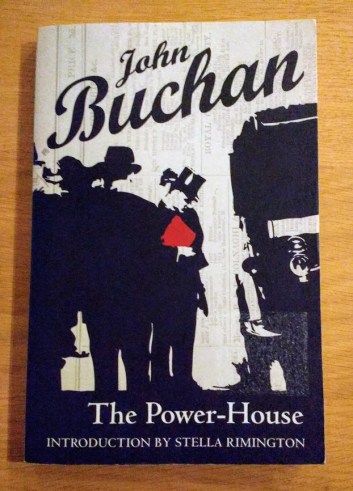
– is for The Power House by John Buchana book I’ve had since 2014. I bought this book because I’d read and enjoyed John Buchan’s The Thirty-Nine Steps.

The Power House

It’s a short book of just 108 pages and my copy has an introduction by Stella Rimington. She writes:

The Power House is one of the least known of Buchan’s mature works, a tale without a plot, and so full of holes that it calls to mind Samuel Johnson’s definition of a ‘network’ – ‘anything reticulated and desuccated at equal distances, with interstices between the intersections’. It is pure essence of Buchan – a demonstration of his magical power to weave a tale out of no materials but the threads and colours of his imagination.

When his friend Charles Pitt-Heron vanishes mysteriously, Sir Edward Leithen, MP, is at first only mildly concerned. But a series of strange events that follow Pitt-Heron’s disappearance convinces Leithen that he is dealing with a sinister secret society. Their code name is ‘The Power-House’.

I cast my mind back to gather recollections of Pitt-Heron, but all I could find was an impression of a brilliant, uncomfortable being, who had been too fond of the byways of life for my sober tastes. There was nothing crooked in him in the wrong sense, but there might be a good deal that was perverse. I remember consoling myself with the thought that, though he might shatter his wife’s nerves by his vagaries, he would scarcely break her heart.

To be watchful, I decided, was my business. And I could not get rid of the feeling that I might soon have cause for my vigilance. (page 9)

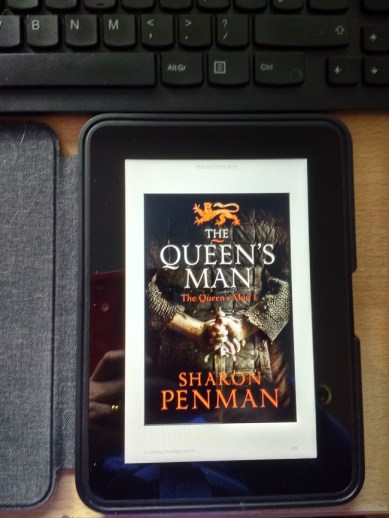
Q – is for The Queen’s Man by Sharon Penman (on my Kindle for two years). I bought this after reading her Sunne in Splendour, which I absolutely loved.

The Queen's Man

It’s set in AD 1183, when Richard the Lionheart is missing, thought to be dead and his brother Prince John is scheming to take the Crown. Justin de Quincy has just discovered his father is the Bishop of Chester. A dying man, a goldsmith, gives him a letter to deliver to Queen Eleanor, (Richard’s and John’s mother) which brings him into great danger as it reveals whether Richard is alive or dead.

Captured by Henry’s soldiers, she [Eleanor] was held prisoner for sixteen years, freed only by Henry’s death. Such a lengthy confinement would have broken most people. It had not broken Eleanor. The passionate young queen and the embittered, betrayed wife were ghosts long since laid to rest. Now in her seventy-first year, she was acclaimed and admired for her sagacity and shrewd counsel, reigning over England in her son’s absence, fiercely protective of his interests, proud matriarch of a great dynasty. A living legend. And this was the woman expecting a letter from a murdered goldsmith? Justin thought it highly unlikely. (location 323)

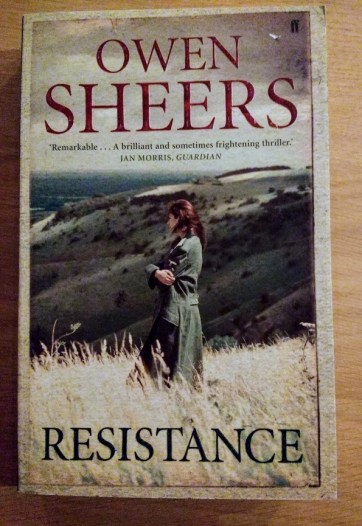
R– is for Resistance by Owen Sheers a book I’ve had for nearly ten years. One of the reasons I haven’t read this before now is that I couldn’t find it for a while until I discovered it out of order behind other books that I’d double-shelved. I can’t remember now what had prompted me to buy this book. Owen Sheers is an author, poet and playwright.

Resistance

Resistance gives an alternative outcome to World War Two, one in which the D-Day landings had failed in 1944 and the Nazis had invaded the UK. Sarah Lewis wakes to discover her husband and all the men in the Welsh border valley of Olchon have gone. It’s the story of a community under siege.

The meeting with Atkins had happened too quickly for George to think on the consequences yet. His head was light, open, and he swung his scythe with a renewed energy. He felt exposed, as if a layer of skin had been shaved from him, bringing him into closer contact with the world. The blade’s edge against the young stalks of bracken, the calligraphy of the swallows above him. Everything seemed clearer, brought into sharper focus. Just an hour ago the war was a different country, the contours of which he’d traced through the newspapers, in radio reports. But now he was involved, connected. He had the strange sensation of his life simultaneously diminishing and expanding under the impression of Atkins’s words and for the second time that week he felt older than his seventeen years. (page 25)

What do you think? Do you fancy any of them? Would you ditch any of them?

Turning for Home by Barney Norris

Love and loss, grief and guilt

Publication date 11 January 2018, Random House UK

Review copy from the publishers, via NetGalley

My rating:  4.5 stars (I’ve rounded this up to 5 on Goodreads)

Blurb:

Isn’t the life of any person made up out of the telling of two tales, after all? People live in the space between the realities of their lives and the hopes they have for them. The whole world makes more sense if you remember that everyone has two lives, their real lives and their dreams, both stories only a tape’s breadth apart from each other, impossibly divided, indivisibly close.’

Every year, Robert’s family come together at a rambling old house to celebrate his birthday. Aunts, uncles, distant cousins – it has been a milestone in their lives for decades. But this year Robert doesn’t want to be reminded of what has happened since they last met – and neither, for quite different reasons, does his granddaughter Kate. Neither of them is sure they can face the party. But for both Robert and Kate, it may become the most important gathering of all.

My thoughts:

Beautifully and lyrically written, I was soon totally absorbed in this book, alternating between Robert’s and Kate’s stories, as they reveal their thoughts and emotions, reflecting on their lives. It’s set on the day of Robert’s 80th birthday celebration. Still grieving after his wife’s recent death, he is finding it a sad, rather than a joyful occasion as the family gather together. His granddaughter, Kate is troubled at the thought of meeting her mother again after a three year estrangement. Then Robert’s day is interrupted by a phone call from Frank, a retired Oxford professor, whom he had known from his days as a civil servant working in Ireland, particularly at the time of the Remembrance Day bombing in Enniskillen in 1987.

The narration is split between Robert and Kate interspersed with extracts from the Boston Tapes, an oral history of the Troubles in Northern Ireland recording the recollections of combatants on both sides. What Frank reveals to Robert shocks him and he struggles to come to terms with it. In parts it moves slowly, particularly as Kate reflects on her life, revealing what caused the break-up with her mother and recounting the pain she had gone through with her anorexia and the guilt she feels over her boyfriend’s  car accident. I found it a moving book with emotional depth.

My thanks to the publishers for a review copy via NetGalley.

Amazon UK link
Amazon US link

First Chapter First Paragraph: The Midnight Line by Lee Child

eca8f-fistchapEvery Tuesday Diane at Bibliophile by the Sea hosts First Chapter First Paragraph Tuesday Intros to share the first paragraph sometimes two, of a book that she’s reading or is planning to read soon.

Last week I featured one of my Christmas presents, so I thought I’d follow that with another one of my Christmas presents, The Midnight Line by Lee Child.

The Midnight Line (Jack Reacher, #22)


It begins:

Jack Reacher and Michelle Chang spent three days in Milwaukee. On the fourth morning she was gone. Reacher came back to the room with coffee and found a note on his pillow. He had seen such notes before. They all said the same thing. Either directly or indirectly. Chang’s note was indirect. And more elegant than most. Not in terms of presentation. It was a  ballpoint scrawl on motel notepaper gone wavy with damp. But elegant in terms of expression. She had used a simile, to explain and flatter and apologize all at once. She had written, You’re like New York City. I love to visit, but I could never live there.

Blurb:

Jack Reacher takes an aimless stroll past a pawn shop in a small Midwestern town. In the window he sees a West Point class ring from 2005. It’s tiny. It’s a woman cadet’s graduation present to herself. Why would she give it up? Reacher’s a West Pointer too, and he knows what she went through to get it.

Reacher tracks the ring back to its owner, step by step, down a criminal trail leading west. Like Big Foot come out of the forest, he arrives in the deserted wilds of Wyoming. All he wants is to find the woman. If she’s OK, he’ll walk away. If she’s not … he’ll stop at nothing.

He’s still shaken by the recent horrors of Make Me, and now The Midnight Line sees him set on a raw and elemental quest for simple justice. Best advice: don’t get in his way.

∼ ∼ 

Lee Child is a new-to-me author, but by no means a new author and this is the 22nd Jack Reacher thriller. The thing that strikes me about this opening paragraph is the straight forward style of writing and the short sentences, almost staccato, which makes me think this will be a fast-paced book. When I wrote about it in my Christmas Books post I was encouraged by some of the comments about his books, so I’m looking forward to reading it very soon.

What do you think – would you read on?

Six Degrees from No. 1 Ladies Detective Agency to White Nights

I love doing Six Degrees of Separation, a monthly link-up hosted by Kate at Books Are My Favourite and Best. Each month a book is chosen as a starting point and linked to six other books to form a chain. A book doesn’t need to be connected to all the other books on the list, only to the one next to it in the chain.

This month the chain begins with Alexander McCall Smith’s No.1 Ladies Detective Agency, a book I haven’t read although I have watched the TV version.

The No. 1 Ladies' Detective Agency  (No. 1 Ladies' Detective Agency #1)

Precious Ramotswe is a kind, warm-hearted and large African lady. She is also the only female private detective in Botswana. Her agency – the No.1 Ladies’ Detective Agency – is the best in the country. With help of her secretary, Mma Makutsi, and her best friend, Mr JLB Matekoni, she solves a number of difficult problems. A missing husband, a missing finger and a missing child – she will solve these mysteries in her own special way.

Although I haven’t read No.1 Ladies Detective Agency I have read a few of Alexander McCall Smith’s books including The Careful Use of Compliments, an Isabel Dalhousie Novel, one of the Sunday Philosophy Club series, set in Edinburgh.

The Careful Use of Compliments (Isabel Dalhousie, #4)

Isabel has just had a baby, Charlie, and is in a relationship with his father, Jamie (14 years her junior) who is her niece’s, ex-boyfriend. There is a mystery about a painting, whether or not it is a forgery, but for me it’s the philosophical questions that are always uppermost in Isabel’s mind and conversations, her way of ‘interring’ in matters which she considers ‘helping’, and her kindhearted nature that was more interesting.

The next link in my chain is to an another book set in Edinburgh. The Inspector’s Daughter by Alanna Knight, the first in the Rose McQuinn Mystery series, set in Edinburgh in 1895, when the Forth Railway Bridge had just been opened.

The Inspector's Daughter

Rose, recently returned from America’s Wild West, steps into the shoes of her father, DI Faro. She lives in an isolated house at the foot of Arthur’s Seat and is helped by a wild deerhound who appears just when she needs him.

Arthur’s Seat, the extinct volcano within Holyrood Park, east of Edinburgh Castle is also mentioned in Ian Rankin’s The Falls, the 12th Inspector Rebus book.

The Falls (Inspector Rebus, #12)

Rebus investigates the disappearance of ‘Flip’ a university student. One lead is a carved wooden doll found in a tiny coffin. Rebus concentrates on the tiny coffin and finds a whole series of them had turned up over the years dating back to 1836 when 17 were found on Arthur’s Seat.

The Strange Case of Dr. Jekyll and Mr. Hyde and Other Tales of Terror

In The Falls Rankin also refers to Burke and Hare, the 19th century resurrectionists and this leads me on to the next link in my chain – to The Body Snatcher, which is one of the Tales of Terror by Robert Louis Stevenson, published in the same volume as The Strange Case of Dr. Jekyll and Mr Hyde. This is a traditional Christmas ghost story, beginning with four men gathered in an inn on a dark winter’s night telling tales of grisly deeds as they sit round the fireside. One of the stories is based on the activities of body snatchers, Burke and Hare in Edinburgh in the 1820s.

The next book, also by Robert Louis Stevenson is in contrast to his tale of terror  – it’s A Child’s Garden of Verses, poems I loved as a child.

This is one of my favourite poems – it brings to mind the power  and fury of the wind:

Windy Nights

Whenever the moon and stars are set,
Whenever the wind is high,
All night long in the dark and wet,
A man goes riding by.
Late in the night when the fires are out,
Why does he gallop and gallop about?

Whenever the trees are crying aloud,
And ships are tossed at sea,
By, on the highway, low and loud,
By at the gallop goes he;
By at the gallop he goes, and then
By he comes back at the gallop again.

The last link in my chain is to a book with Nights in its title – White Nights by Ann Cleeves, the second in her Shetland Quartet, featuring DI Jimmy Perez. The ‘white nights’ are the summer nights when the sun never really goes down.

White Nights (Shetland Island, #2)

It’s set mainly in Biddista, a fictional village where artist Bella Sinclair throws an elaborate party to launch an exhibition of her work at The Herring House, a gallery on the beach. The party ends in farce when one the guests, a mysterious Englishman, bursts into tears and claims not to know who he is or where he’s come from. The following day the Englishman is found hanging from a rafter, and Jimmy Perez is convinced that the man has been murdered.

From books about different detective series my chain moved through a tale of terror, then to a children’s book of poetry and back to another murder mystery –  from Botswana to Edinburgh and the Shetland Isles.

Next month (February 3, 2018),  the chain begins with the book that won the Man Booker Prize in 2017 – Lincoln in the Bardo by George Saunders.