Six Degrees of Separation from We Have Always Lived in the Castle to Ryan’s Christmas

This is a monthly link-up hosted by Kate at Books Are My Favourite and Best. On the first Saturday of every month, a book is chosen as a starting point and linked to six other books to form a chain. Readers and bloggers are invited to join in by creating their own ‘chain’ leading from the selected book.

Books can be linked in obvious ways – for example, books by the same authors, from the same era or genre, or books with similar themes or settings. Or, you may choose to link them in more personal ways: books you read on the same holiday, books given to you by a particular friend, books that remind you of a particular time in your life, or books you read for an online challenge.

A book doesn’t need to be connected to all the other books on the list, only to the ones next to them in the chain.
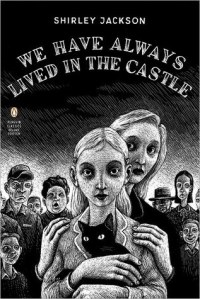
This month we are starting with We Have Always Lived in the Castle by Shirley Jackson is a fantastic book; a weirdly wonderful book about sisters, Merricat and Constance. They live in a grand house, away from the village, behind locked gates, feared and hated by the villagers. Merricat is an obsessive-compulsive, both she and Constance have rituals that they have to perform in an attempt to control their fears. Merricat is a most unreliable narrator.
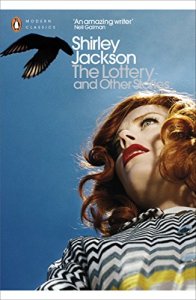
I’m starting my chain with The Lottery is a short story also written by Shirley Jackson. It was first published on June 25, 1948, in The New Yorker, (the link takes you to the story.) The lottery is an annual rite, in which a member of a small farming village is selected by chance. This is a creepy story of casual cruelty, which I first read several years ago. The shocking consequence of being selected in the lottery is revealed only at the end.
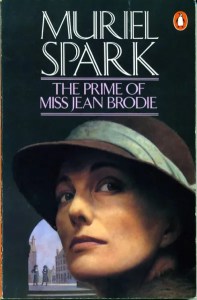
The Prime of Miss Jean Brodie by Muriel Spark, was first published in The New Yorker magazine on 14th October 1961. It is perhaps Muriel Spark’s most famous novel about the ‘Brodie set’. But which one of them causes her downfall and her loss of pride and self-absorption? What really impresses me about this book is the writing, so compact, so perceptive and so in control of the shifts in time backwards and forwards. It’s a joy to read.
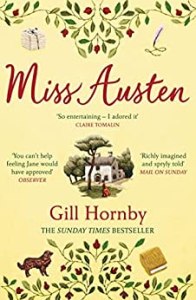
Another book that was a joy to read is Miss Austen by Gill Hornby. This is the untold story of the most important person in Jane’s life – her sister Cassandra. After Jane’s death, Cassandra lived alone and unwed, spending her days visiting friends and relations and quietly, purposefully working to preserve her sister’s reputation. Cassandra is convinced that her own and Jane’s letters to Eliza Fowle, the mother of Cassandra’s long-dead fiancé, are still somewhere in the vicarage. Eventually she finds the letters and confronts the secrets they hold, secrets not only about Jane but about Cassandra herself. Will Cassandra reveal the most private details of Jane’s life to the world, or commit her sister’s legacy to the flames?
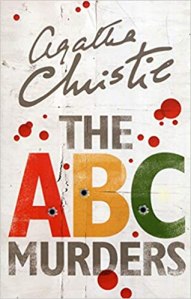
My next link is also a book in which letters play a key part. It’s The ABC Murders by Agatha Christie, a Golden Age of Detective Fiction novel first published in 1936. A series of murders are advertised in advance in letters to Poirot, and signed by an anonymous ‘ABC’. An ABC Railway guide is left next to each of the bodies. So the first murder is in Andover, the victim a Mrs Alice Ascher; the second in Bexhill, where Betty Barnard was murdered; and then Sir Carmichael Clarke in Churston is found dead. The police are completely puzzled and Poirot gets the victims’ relatives together to see what links if any can be found. Why did ABC commit the murders and why did he select Poirot as his adversary?
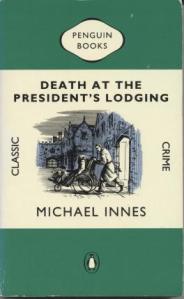
Another Golden Age murder mystery published in 1936 is Death at the President’s Lodging by Michael Innes. This is essentially a ‘locked room’ mystery. Dr Umpleby, the unpopular president of St Anthony’s College (a fictional college similar to an Oxford college)  is found in his study, shot through the head. His head was swathed in a black academic gown, a human skull beside his body and surrounding it, little piles of human bones. Inspector Appleby from Scotland Yard is in charge of the investigation, helped by Inspector Dodd from the local police force. 

Innes’s writing is intellectual, detailed, formal and scattered with frequent literary allusions and quotations. The plot is complex and in the nature of a puzzle. There are plenty of characters, the suspects being the dons of the college. 
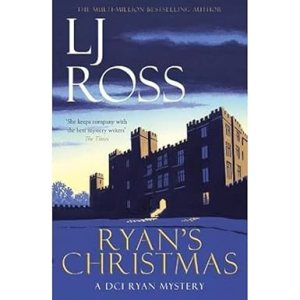
And my final link is Ryan’s Christmas by L J Ross, another ‘locked room mystery’. DCI Ryan, and DS Phillips and their wives are stranded in Chillingham Castle when a snowstorm forces their car off the main road and into the remote heart of Northumberland. Cut off from the outside world by the snow, with no transport, mobile signals or phone lines they join the guests who had booked a ‘Candlelit Ghost Hunt’. Then Carole Black, the castle’s housekeeper is found dead lying in the snow, stabbed through the neck. There’s only one set of footpaths in the snow, and those are Carole’s, so who committed the murder?

My chain includes books by the same author, books first published in the same magazine, letters, Golden Age murder mysteries, and ‘locked room’ mysteries.

‘Next month (December 6, 2025), we’ll start with a novella that you may read as part of this year’s Novellas in November – Seascraper by Benjamin Wood.

Hamlet, Revenge! by Michael Innes

A Golden Age Mystery

Hamlet, Revenge! by Michael Innes has been languishing on my TBR shelves for 9 years, mainly because it is in such a small font making it difficult for me to read. It was first published in 1937. My copy was published in 1961 in paperback with the cover shown in the photo above.

Synopsis:

A Scotland Yard detective probes a high-society house party for someone rotten when a government official is murdered in this classic British mystery.

Preparations are underway for a grand party at Scamnum Court, the sweeping English country estate of the fabulously wealthy Duke of Horton. Some of the nation’s elite are invited for dinner, and some are even set to star in a semi-amateur production of Hamlet on an authentic Elizabethan stage in the banqueting hall. No expense is spared, but one guest soon pays with his life. Before the play ends, a shot is fired, and the actor playing Polonius―Lord Auldearn, the Lord Chancellor of England―is dead.

With war looming on the horizon, suspicions arise over the possibility of espionage. Therefore, the prime minister sends Insp. John Appleby not only to investigate, but to also find a confidential government document. Appleby is lucky there’s a mystery novelist eager to lend a hand with the extensive guest list at Scamnum Court. He will need all the help he can get if he hopes to prevent the killer from making an encore performance . . .

My thoughts

This is the second Inspector John Appleby book. And like the first, Death at the President’s Lodging (my review) it is a most complex mystery. When Lord Auldearn, Lord Chancellor of England is murdered on stage during an amateur production of Hamlet at Scamnum Court the Prime Minister asks Appleby to investigate. Because there’s a possibility that espionage is involved, the PM tells Appleby not to trust anybody. It’s all very vague. The PM tells him there’s a document concerning

… the organization of large industrial interests on an international basis, in the event of a certain international situation. The general drift towards the matter such a document embodies cannot, you realize, well be secret; nothing big can be secret. But the details may be. And this document might be useful in two ways: the detailed information might be useful to one powerful interest or another: and accurate possession of the details, as circumstantial evidence of something already known in general terms, might be useful to an unfriendly government.

…War? said Appleby … (pages 83,84)

The book begins with a Prologue.which is is longer than most prologues. It sets the scene, describing Scamnum Court in detail. It’s the family seat of the Crispin family, described as ‘a big place: two counties away it has a sort of little brother in Blenheim Palace.’ All the characters are introduced, including Giles Gott, who was also in Death at the President’s Lodging. An eminent Elizabethan scholar, he is the director of the play. The other characters are also introduced; Lord Auldearn, the Lord Chancellor of England, who plays Polonius, and numerous other family members, guests and members of the Scamnum Court staff.

There are thirty people involved in the play, actors and those behind the scenes, plus twenty seven in the audience. I found this section too long (74 pages in my copy) and it took me more than a while to identify who was who! My attention was drooping as I read pages of long meandering, descriptive paragraphs and I wondered when there would be a murder. And there is a lot of information about the staging of the play and numerous Shakespearean references. Before the performance the murderer delivered a number of warning messages about revenge, so everybody is on edge.

Appleby doesn’t appear until the second section and then the pace picks up considerably as he and Gott question the suspects. It gets more complicated when a second murder, that of Mr Bose, the prompter who was on stage and who could possibly have seen who shot Lord Auldearn. I was puzzled for much of the time as I read – it’s a book that you can’t read quickly and it requires concentration. I had no idea who the culprit was as Appleby and Gott tried to eliminate the suspects and answer numerous questions, such as why was Lord Auldearn shot and not stabbed as Polonius the character he played was, why did the murderer come onto the stage to shoot him and risk being seen by Bose, why did he send the mysterious messages about revenge – what revenge was being sought, and was the possible espionage plot the reason behind the shooting? Or was the reason a personal one?

From being confused and overwhelmed by the puzzle I became thoroughly absorbed by the mystery and was eagerly turning the pages to find out all the answers. It’s a book I really need to re-read to get to grips with it – I’m sure I missed so much. My post falls far short of doing justice to the book!

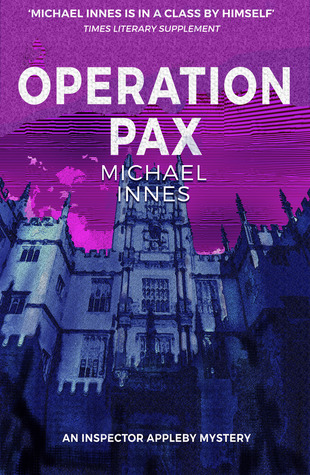
Operation Pax by Michael Innes

When people disappear, one hears talk of Milton Porcorum

Operation Pax

Agora Books|3 May 2018|384 pages|e-book|Review copy|4*

Operation Pax by Michael Innes, an Inspector Appleby mystery, was originally published in 1951, and in the United States as The Paper Thunderbolt.

I enjoyed Operation Pax much more than I expected I would when I began reading it. Almost the first third of the book is about a petty thief, Alfred Routh, an unpleasant little man, who for much of the time is confused and bewildered by his own thoughts and fears, which plunge him into utter panic. As his fears spiral into a engulfing and terrifying fantasy, he finds himself in the little village of Milton Porcorum and here is where his nightmare really begins. A tall man with square shoulders ushers him within the walls of Milton Manor, a most bizarre place where Routh fears for his life. A place where experiments are carried out in a sequence of laboratories and dangerous animals are kept in enclosures surrounding the house. A place with a mysterious and unnamed ‘Director’ who masterminds the whole operation.

After that rather surreal opening the action moves to Oxford and a rather more normal atmosphere – but strange and disturbing things are happening there too. An undergraduate, Geoffrey Ourglass, has disappeared and both his uncle, a university don and his fiancée, Jane, Sir John Appleby’s younger sister are concerned for his safety. Jane enlists her brother’s help to find Geoffrey – and so begins an adventure involving the dons of St Bede’s college, a group of boisterous children on bikes, European refugees as well as Appleby, Jane and her taxi-driver, Roger Remnant. It takes us from St Bede’s college into the depths of the Bodleian Library, on the trail of clues, around Oxford and out into the surrounding countryside in a thrilling chase against time to rescue Geoffrey. There are strange phone calls and most mysterious of all a formula written on a scrap of paper that threatens the safety of the whole world – it must be found and destroyed.

I loved a number of things about this book – the descriptions of the dons and their ‘erudite’ conversations, the setting in Oxford and particularly in the Bodleian library is brilliant, and the children are lively, argumentative and entertaining, providing comic relief.  It is pure escapism with an incredibly unbelievable plot and strange eccentric characters that wormed their way into my mind and made it a book I just had to finish. Once it got going it is fast- paced and it kept me guessing about the identity of the mastermind behind the threat to mankind – I was completely wrong!

The Author

Michael Innes is the pseudonym of John Innes Mackintosh Stewart (1906 – 1994), a British scholar and novelist. He was born near Edinburgh, the son of a Scottish professor, and attended Edinburgh Academy, then Oriel College, Oxford where he won the Matthew Arnold Memorial Prize in 1939 and honours in English. He was a Lecturer, then a Professor in English at different universities, including Adelaide University in South Australia from 1935 to 1945. He became an Oxford fellow in 1949 and finished his academic career in 1973 as a Student (Fellow) at Christ Church Oxford.

As Michael Innes, he published numerous mystery novels and short story collections, most featuring the Scotland Yard detective John Appleby.

My thanks to Agora Books for an e-book review copy via NetGalley

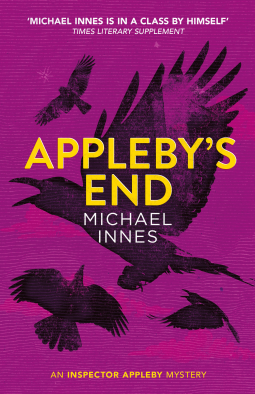
Appleby’s End by Michael Innes

3*

Appleby’s End was first published in 1945.

Description

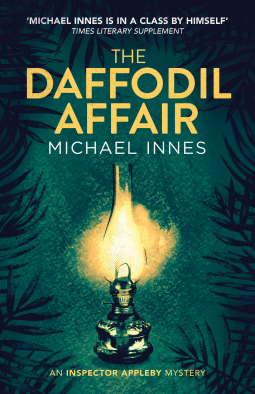
The Daffodil Affair by Michael Innes

‘A hodge-podge of fantasy and harumscarum adventure’

Ipso Books| 8 December 2017|269 pages|e-book|Review copy|3.5*

The Daffodil Affair was first published in 1942.

Description

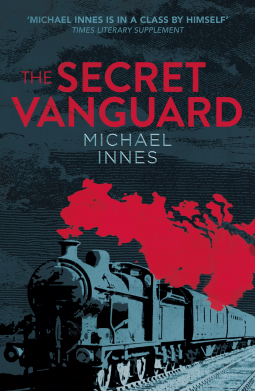
The Secret Vanguard by Michael Innes

A Golden Age Mystery

Ipso Books| 3 Oct. 2017|228 p|Review copy|4*

Nobody, she said to herself, is necessarily what he appears to be; nobody.

I enjoyed The Secret Vanguard very much. It’s the fifth in Michael Innes’ Inspector Appleby series and is very different from the first one Death at the President’s Lodging, which I read several years ago, a book that had little action, much description and a lot of analysis.  Set in 1939 on the edge of war, The Secret Adversary is full of action, a story of spies, kidnapping and a race through the Scottish Highlands to save a scientist. It reminded me in the Highlands section of John Buchan’s The Thirty-Nine Steps.

It begins with the murder of poet, Philip Ploss at his home in the Chilterns and Appleby is mystified wondering why anyone would have wanted to kill him. He had been shot in the middle of his forehead whilst in a gazebo with a magnificent view of the surrounding countryside.

It then moves to Sheila Grant, travelling by train to Scotland when she overhears a conversation about poetry as one of the passengers quotes from a poem by Swinburne. She thinks it is odd that he had added in four lines of his own and realises that the words were a sort of code that he was passing on. And, indeed this discovery leads her into danger but before she can alert anyone else she is captured and held prisoner, eventually escaping in a desperate search for assistance.

I liked all the twists and turns in this somewhat improbable story as Sheila, with much courage and luck scrapes through several dangerous escapades until Appleby comes to the rescue. I enjoyed the descriptions both of London and the Highlands as I raced through this book. I also really like Innes’ writing style, detailed, formal and scattered with frequent literary allusions and quotations. He has packed a lot into The Secret Vanguard.

My thanks to Ipso Books for a review copy via NetGalley.

Amazon UK link
Amazon US link