A regular visitor


Photos taken by my husband.
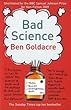 Bad Science is mainly about health issues, and how they are reported in the press which surprised me as I expected it to be more wide-ranging. It shouldn’t have been such a surprise as Ben Goldacre is a qualified doctor, working for the NHS. He also exposes the ‘tricks of the £30 billion food supplements industry and the evils of the £300 billion pharmaceuticals industry’.
It’s a splendid rant against the lack of education and knowledge about health with the inevitable result that we are unable to understand and judge for ourselves the effectiveness of the various treatments on offer. He describes how placebos work, just what homeopathy is, the misunderstandings about food and nutrition, and above all how to decide what works and what is quackery, scaremongering or downright dangerous. He is scathing about homeopathy, about Gillian McKeith’s lack of scientific knowledge and misleading claims, and dismisses Patrick Holford for the way he cherry-picks the data to suit his case, and makes extraordinary claims without evidence to back them up.
I very rarely read anything scientific but found this easy to understand, apart from the statistics, which cause my eyes to glaze over at the mere sight of a graph, tables or columns of figures. Fortunately there’s not a lot of that in this book.
There are disturbing chapters on such topics as the way some drugs trials are carried out – the distortion of evidence and the way harmful/negative effects are ignored or hidden. His chapters on health scares about MRSA and MMR are particularly interesting. Other topics were not so surprising, as I’ve always been sceptical about the value of taking food supplements and vitamins (even though I’ve taken vitamin C tablets for years).
Overall, even though I thought there was too much repetition and over explanation, I did learn quite a lot and it does provide food for thought.
The other day D and I went for a walk by the River Till. From where we parked the car the path ascends above the river along a tree-lined path.

The remains of an old chapel, St Mary’s Chapel are just below the path – only the outline of the chapel and a cross can be seen.

D recorded the route on his iPhone – this extract below shows the position of the chapel.

The path gradually descends to the river side.

Then we spied a heron motionless on the opposite bank.

It saw us too and flew away. Then I spotted it in the river.

Again we were seen and it flew away. I just pointed the camera and hoped to capture it flying – you can just see it over the water

and landing on the bank further upstream.

We continued our walk along the riverbank, meeting a group of cyclists struggling to ride on the stony surface (the route is Sustrans 68).
After a rest on this seat we turned round and walked back.

 This morning I’ve been reading The Border Line by Eric Robson, of interest because we live near the border – the one between England and Scotland. This is the account of Robson’s walk following the border line from the Solway Firth to Berwick-upon-Tweed. It’s also interesting because Robson includes anecdotes, snippets of history and personal memories as well. For all the disputes over the border and the reivers’ raids there is a similarity between English and Scottish Borderers:
For more than four centuries the Borderlands were seen as the scrag end of their respective countries, the frayed edges of monarchy. English borderers and Scottish borderers at least had that much in common. The Border was a remote battleground where national ambitions could be fought over. Northumberland, Cumberland and Westmorland were excluded from the Domesday Book. They were regarded as a military buffer zone. They became a bearpit. (page 51)
 The Reivers were romanticised by Sir Walter Scott, who gave them ‘the spit-and -polish treatment’ and a ‘romantic bearing and heroic stature.’ Robson also sheds light on the derivation of words, such as ‘reiver’: a ‘reef” in Old English meant a line, a Shire Reeve was a man who protected boundaries, thus the reiver raided across the Border Line. ‘Blackmail’ has two possible derivations – greenmail was agricultural rent and blackmail was money taken at night, or protection money. Alternatively it could be that it came from the fact that the reivers blacked their armour to ride as shadows in the moonlight (page 49). I prefer the alternative derivation.
Then I moved north of the Border Line into Scotland with my reading and finished Ian Rankin’s book The Falls, a book I first read a couple of years ago. I wrote about it at the time and I haven’t much to add to that post. The Falls combines so much of what I like to read – a puzzling mystery, convincing characters, well described locations, historical connections and a strong plot full of tension and pace. Rebus has morphed in my mind into a combination of the actors who’ve played him – John Hannah and Ken Stott – and his creator Ian Rankin. But there is no doubt that the books are far superior to the TV productions. The next Rebus book I’ll be reading is Resurrection Men.
 Bread is one of my favourite foods. I’ve been baking my own bread for about 4 years now, using a breadmaker. I’ve tried making it by hand but all that kneading just defeats me and it is so much easier with a machine. It is very simple – you just put all the ingredients in the bread tin, choose the appropriate setting, press start and leave it to knead, prove and bake. My breadmaker has a little dispenser so you can add nuts, or dried fruit. Or there is a dough setting – doing all the hard work for you – and then you can shape the dough into rolls, baguettes, plaits, croissants or whatever takes your fancy and bake them in the oven.
I vary what I make, sometimes using a packet mix, which does give a very good result. My favourites are Cheese and Onion, Ciabatta and Mixed Grain. Other times I use fast acting dried yeast and the Very Strong White or Wholemeal flour, sometimes making half white and half brown bread. I recently bought a Country Grain flour – with malted wheat flakes, rye flour and malted wheat and barley flour and mixed that with the very strong white flour to make this loaf:

For this I used 1 teaspoon of yeast, 250 grams of the Country Grain flour, 225 grams of strong white flour, I½ teaspoons of sugar, 1¼ teaspoons of salt, 25 grams of butter and 340 ml of water and set the breadmaker on the wholemeal setting. It took 5 hours to make and bake. There is a rapid setting as well but I find that the bread doesn’t rise as much and it takes more yeast.
Weekend Cooking is open to anyone who has any kind of food-related post to share: Book (novel, nonfiction) reviews, cookbook reviews, movie reviews, recipes, random thoughts, gadgets, fabulous quotations, photographs
 Friday Finds is hosted by Should Be Reading.
I have just one ‘find’ this week. I’ve only recently discovered how good Alexander McCall Smith’s Isabel Dalhousie novels are. There are seven in the series and I’ve read just two of them so far. The latest one in the series is due out in September. It is:

The Charming Quirks of Others
Description from the publishers Little, Brown Book Group:
Isabel Dalhousie, Edinburgh philosopher and curious observer of the behaviour of her fellow man, is approached by a friend at a local boarding school that is planning to appoint a new headmaster; an anonymous letter has arrived suggesting that one of the shortlisted candidates has a compromising past. But which one is it? Isabel is once again drawn into an investigation, and finds herself exploring dilemmas of human weakness and forgiveness. She turns to her fiancé Jamie for advice, but he too appears to have something to hide . . .
That gives me time to catch up reading the others in the series before this one is published (links to Alexander McCall Smith’s website):
 BooksPlease