Set in Darkness by Ian Rankin:Book Review

Set in darkness

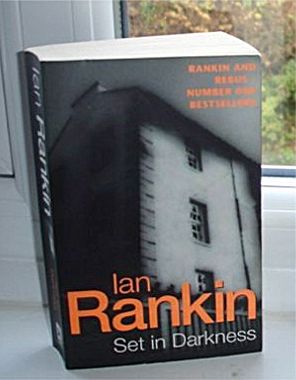
Set in Darkness was the first Inspector Rebus book I read, nearly three years ago. I’m currently reading all of them in sequence – this is the 11th in the series. I was pleased that I remembered so much about it and it didn’t spoil the tension at all, but then I hadn’t remembered all the details. I think I enjoyed it more the second time round as I knew the main characters and had seen them develop in the previous 10 books.

There are three cases Rebus and his colleagues are investigating. The first is the discovery of a corpse in one of the old fireplaces at Queensberry House, Edinburgh during the works to build the new Scottish Parliament building. The body, nicknamed Skelly by the police, had been bricked up around 1979, twenty years earlier. The second case is the murder of Roddy Grieve, a candidate for the Scottish Parliament, found in a summer house in the grounds of Queensberry House, and the third is the suicide of a tramp who had jumped off North Bridge over the deep gully that housed Waverley Station. The press nicknamed him Supertramp after a building society pass book was found in his belongings that revealed he owned £400,000. At the same time the police are investigating a rapist who is targeting singles clubs.

Rankin’s skill is in interweaving the cases. At no time does this seem contrived or forced, the links seem to unfold naturally as the investigation progresses. Rebus is out of favour with his boss, Farmer Watson, which is why he’d been seconded to the Policing of Parliament Liaison Committee to advise on security for the Scottish Parliament, but also why he was on the spot when Skelly was discovered. DS Siobhan Clarke is working on the rape case and on her way home from the singles club she witnesses Supertramp’s suicide, and is then assigned to his case. Siobhan is becoming more like Rebus, dedicated and obsessed cops, who like working on their own. The cop instinct defines them – always on the lookout, their lives not their own, but made up of other people’s lives (page 223 paraphrased).

This is a dark book; there is darkness within Rebus himself, as well as in the crimes he investigates. He doesn’t sleep at night, aand as one of the other characters says to him

‘We all come from the darkness, you have to remember that, and we sleep during the night to escape the fact. I’ll bet you have trouble sleeping at night, don’t you?’  He didn’t say anything. Her face grew less animated. ‘We’ll all return to darkness one day, when the sun burns out.’ (page 157)

He is a troubled soul, with ghosts in his life – past family and past friends who come to him as he sit sin darkness on long nights when he’s alone. He can see his career crumbling around him and ends up beaten and bloodied. He only survives with help from Big Ger Caffety, released from prison and still Edinburgh’s crime boss.

I loved this book.

Booking Through Thursday – Now or Then

btt button

Do you prefer reading current books? Or older ones? Or outright old ones? (As in, yes, there’s a difference between a book from 10 years ago and, say, Charles Dickens or Plato.)

About half the books I’ve read this year are current books – published within the last ten years. The other half date from the 1930s to the 1990s, the oldest being Why Didn’t They Ask Evans? by Agatha Christie. I also like older books by authors such as Jane Austen, the Brontes, George Eliot, Tolstoy, Thackeray and Dickens. I can’t say that I have a preference either way as I like to vary my reading. Sometimes I want to read older books and sometimes modern ones.

As for ‘outright old’ books I have read a few, books like the Cloud of Unknowing, Marcus Aurelius’s Meditations, and Dante’s Divine Comedy, which I haven’t finished yet! Coming forward a bit in time I also like Shakespeare, but prefer to see the plays, rather than read them. Thinking about this post has reminded me that I’ve been meaning to read Don Quixote for ages. My copy was published in the 1920s and I think I’d like a more modern translation, which would be an appropriate combination of old and new. Has anyone any suggestions about which one to choose?

The Right Attitude to Rain by Alexander McCall Smith

The Right Attitude to Rain is the third in the series of Isabel Dalhousie novels, set in Edinburgh and the Scottish Borders. It’s a pleasure to read but difficult to write about. Not a lot happens and reading it is like being inside Isabel’s head. She takes a great interest in the affairs of others and likes watching people. Some people might call this nosiness.

Some things do happen – Isabel is buying a flat for her housekeeper, Grace. Cat, her niece has a new boyfriend, Patrick, but Isabel doubts his possessive mother is happy about that. Meanwhile she is wondering if her love for Jamie, 14 years her junior and Cat’s ex-boyfriend, could ever be reciprocated:

There is no point in my loving this young man, she told herself, because it can never go anywhere. And yet did it matter if love was not reciprocated? Was it not possible to love somebody hopelessly, from a distance even, and for that love to be satisfying, even if never reciprocated, even if the object of one’s affections never even knew? (page 33)

A large part of the book is taken up with their developing relationship and the tensions it arouses. Then there is the American couple Isabel watches in the Scottish Gallery who turn out to be friends of her cousin Mimi, who is staying with her for a few weeks. This gives Isabel the opportunity to meet the couple and become involved in their lives. Mimi also has a revelation concerning Isabel’s ‘sainted American mother’, which causes Isabel some distress.

It’s a study of relationships, communication and misunderstandings as Isabel mulls over philosophical and moral dilemmas, and conducts internal debates instead of simply making a decision and acting upon it. Grace sums her up admirably:

Isabel’s life was a good one; she was a kind woman, and she felt for people, which was more than one could say about a lot of people in her position, Grace thought. But there were certainly areas of Isabel’s life where what was required was a little less thought and a bit more action. (page 125)

What about the rain? Well, it all depends on your attitude – any hint of warm weather and you’re optimistic about being outside:

… but resigned to being driven back in by rain, or mist, or other features of the Scottish summer. (page 10)

I’d add that it’s not only Scotland where it rains …

The Man Who Planted Trees by Jean Giono

I have always liked trees, particularly in spring when you can see the branches through the leaves and in autumn when the leaves change colour and fall to the ground. There are many trees in our garden and when we moved here last December the trees were bare and I couldn’t recognise many of them, having forgotten how to identify them by their shape and structure. As they began to grow leaves and blossom I still couldn’t identify all of  them (except the sycamores, silver birch and weeping willow) and so as usual turned to books and the internet for information. The best book I found is The Reader’s Digest Field Guide to the Trees and Shrubs of Britain. This has illustrations and photos of different ways to identify trees – by their bark, buds, flowers, leaves, twigs and shape. Some of the trees here are well established, predating the house and others are quite young – the history of the garden is probably more interesting than the history of the house.

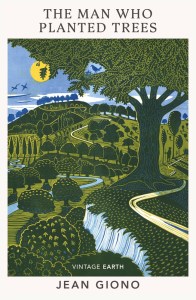
Given my interest in trees Simon’s review of The Man Who Planted Trees by Jean Giono intrigued me. Then I discovered that the local library actually had a copy. It’s very short book (a short story really), just over 50 pages, with illustrations – wood engravings by Michaell McCurdy, about a shepherd who transformed the land by planting trees. Not just a few trees, thousands of them over the years. Where once the earth was dry and barren the trees brought water back into the dry stream beds, seeds germinated, meadows blossomed and new villages appeared. Contrasted against a background of the destruction caused by war, the lonely shepherd, Elzeard Bouffier shows the power of nature to regenerate the land, planting oaks, birches and beech trees:

Creation seemed to come about in a sort of chain reaction. He did not worry about it; he was determinedly pursuing his task with all simplicity; but as we went back to the village I saw water in brooks that had been dry since the memory of man. This was the most impressive result of chain action that I’d seen. (page 25)

The wind too scattered seeds. As the water reappeared, so there appeared willows, rushes, meadows, gardens, flowers, and a certain purpose in being alive. (page 26)

In an Afterword by Norma L Goodrich, she recounts how she met Jean Giono in 1970 shortly before his death. His book was first published in Vogue in 1954 under the title The Man Who Planted Hope and Grew Happiness. His purpose in writing this story was to

… make people love the tree, or more precisely, to make them love planting trees. (page 45)

It’s a simple story, simply told of the harmony possible between man and nature.

Sunday Salon – Reasons for Not Reading

I’ve been thinking about books I own but haven’t read yet and wondering why I haven’t  even though some of them have been sitting on my bookshelves for a long time.

There are a number of reasons, apart from the fact that I keep getting more books before reading all the ones I’ve already got. They are:

  • Books that are part of a series and I haven’t read the earlier ones – such as Ian Rankin’s Exit Music
  • Books everyone else raves about and I can’t get into such as Cloud Atlas by David Mitchell
  • Books that are just so big, like A S Byatt’s The Children’s Book
  • Classic books – The Count of Monte Cristo by Alexandre Dumas
  • Books I’ve forgotten I’ve got – like Portrait of an Unknown Woman by Vanora Bennett – I don’t even remember seeing it before!
  • Books bought  to make up a 3 for 2 offer – such as Falling Angels by Tracy Chevalier
  • Books by an author I like, but haven’t got round to reading yet – The Death Maze by Ariana Franklin
  • Non fiction books that require concentrated time devoting to them – such as Jonathan Dimbleby’s Russia

Looking at them today I’d like to reading them all as soon as possible – well, maybe not Cloud Atlas for a while – I’ve started it twice in the past.