Crime Fiction Alphabet: W is for Dan Waddell

I’m not sure whether  The Blood Detective by Dan Waddell is historical crime fiction or genealogical crime fiction. One thing is certain it is crime fiction and one that I was thoroughly immersed in. If I gave books stars on this blog I would have given it 5 stars, if only the ending wasn’t so graphic. It’s the sort of scene that if I was watching it on TV it would have had me peeping through my fingers or even covering my eyes completely until it was over. There are bits of graphic violence earlier in the book, which I could just about cope with, but the grisly stuff at the end was a step too far for me.

That said it’s a fascinating fast-paced book linking the crimes of the past – the events of 1879 – to a series of murders in the present. DCI Grant Foster enlists the help of genealogist Nigel Barnes to track down the killer who has left cryptic clues carved into his victims’ bodies.

I used to work with archives, much of it helping people track down their family histories and so was very familiar with the sources Nigel uses to discover the original killer. I loved the way Waddell wove this into his story. Nigel Barnes is a convincing character and manages to solve both the modern day murders and the historical ones too, not only through family history but also through working out the topography of London through the years.  I loved that part of the book.

Dan Waddell as well as writing crime novels is the author of Who Do You think You Are?, the accompanying book of the TV series – one of my favourites, so it’s no surprise that The Blood Detective is so good on genealogy. He has his own website and also writes regularly on the Murder is Everywhere blog. His next book featuring Nigel Barnes is Blood Atonement and despite my phobia about graphic violence I’m planning to read that one too.

The Blood Detective

  • Paperback: 416 pages
  • Publisher: Penguin (7 Aug 2008)
  • Language English
  • ISBN-10: 9780141025650
  • ISBN-13: 978-0141025650
  • ASIN: 0141025654
  • Source: library book

The Crime Fiction Alphabet is hosted by Kerrie at Mysteries in Paradise. All you have to do is write a post relating to the letter of the week – either the first letter of the book title or of the author’s first or second name.

The Sunday Salon – Currently Reading …

The Sunday Salon is a place to talk about the books you’re currently reading.

My rate of reading has slowed down. I keep a record of books I’ve read on Goodreads with a target of reading 100 books this year. It’s not really my target but I just wanted to try out the widget on my blog (see the sidebar) and that meant I had to state a target. I’m not bothered if I don’t meet my ‘target’, but according to Goodreads I am now 3 books behind at my current pace, which does make me a bit self-conscious and think I’m not reading as fast as I should – which is ridiculous! My ‘slowness’ may have something to do with the fact I’ve got four books on the go at the moment and that two of them are long books – Titus Groan and The Bell, both of which I’ve read before.

[And I have been spending quite a lot of time bird-watching! Today I’ve been watching the baby collard dove being fed – video to follow later.]

On Friday I wrote about the beginning of The Bell, when I’d read about 25% of the book and I was full of enthusiasm for it. Reading on in the book since then my enthusiasm as waned as the action became bogged down in long descriptive passages on the characters’ thoughts and almost ground to a halt. This doesn’t seem to be the book I remember, or maybe those tedious passages went in one eye and out the other as rapidly as I read them. I’ll finish the book, though, to see if it improves towards the end. Maybe this is a book I shouldn’t have re-read!

Titus Groan, however, is standing up to the test of re-reading and is still as enjoyable as it was when I first read it. It too has long passages of description but they are far from tedious. I’m reading this as part of Farm Lane Books Readalong, where there’s an interesting discussion in progress. I shan’t be writing about this book each week, but reserving judgement until the end.

Other books I have on the go are lighter reads:

  • Gently by the Shore by Alan Hunter – the second Inspector Gently book. This isn’t as captivating as the first Gently book, but it’s ok. It’s really a period piece, originally published in 1956. A naked dead body is found on the shore, with no means of identification. Inspector Gently investigates, eating his peppermint creams and smoking his pipe.
  • The Doctor of Thessaly by Anne Zouroudi, the first book by this author that I’ve read. so far I’m finding it an excellent book if a little slow in getting to any action. The doctor who was supposed to be getting married didn’t turn up at the wedding ceremony in a little Greek village. Later on he’s found, having been blinded. It’s up to a mysterious fat man called Hermes Diaktoros to solve the crime.

I’m plodding along nicely with these books but still find myself thinking about what to read when I’ve finished them. I fancy an Agatha Christie and have a few to choose from, including this book which I bought last week:

Miss Marple and Mystery: the Complete Short Stories, some of which I’ve read in other collections, but still plenty of others I haven’t read.

I should be able to slot in a few of these this next week.

Book Beginnings: The Bell

I love starting a book. There’s such potential to find a book that really satisfies the imagination, that draws you into its world and also makes you think. It’s even better when you can start a book you’ve read before, knowing that you enjoyed it but not remembering all the details and have it unfold before you still with the power to enchant. Such a book is The Bell by Iris Murdoch.

I first read it in the early 199os (I think), so my memory of it is only of the outline story – a new bell is to be installed at an Abbey, which triggers the discovery of the old bell and then tragedy strikes. I also remember that it was peopled by some interesting characters, but I couldn’t have told you who they are.

Here is the opening paragraph:

Dora Greenfield left her husband because she was afraid of him. She decided six months later to return to him for the same reason. The absent Paul, haunting her with letters and telephone bells and imagined footsteps on the stairs had begun to be the greater torment. Dora suffered from guilt, and with guilt came fear. She decided at last that the persecution of his presence was to be preferred to the persecution of his absence. (page 7)

Now, that’s not a good marriage, but it is a great opening to this story of a lay community at Imber Court, a beautiful house outside Imber Abbey, the home of an enclosed order of nuns. Paul is a guest at Imber Court studying some 14th century manuscripts which belong to the Abbey. You know straight away that Dora and Paul’s marriage is a disaster area, that Paul is a man to be feared and that Dora is a mass of contradictions, a complex character – will she be able to stand living with Paul? My immediate reaction was that she is making a big mistake.

So far I’ve read about a quarter of the book and it’s just as good as I remember. Iris Murdoch’s writing is so good, full of description so that you can see the people and places as though you were there and also full of insights into the characters thoughts and feelings. There is an impending sense of evil  and menace, for below the peaceful surface stress and tension abound.

Book Beginnings is hosted by Katy at A Few More Pages, where you can leave a link to your own post on the opening lines of a book you’re currently reading.

ABC Wednesday: V is for Vincent

Vincent Van Gogh

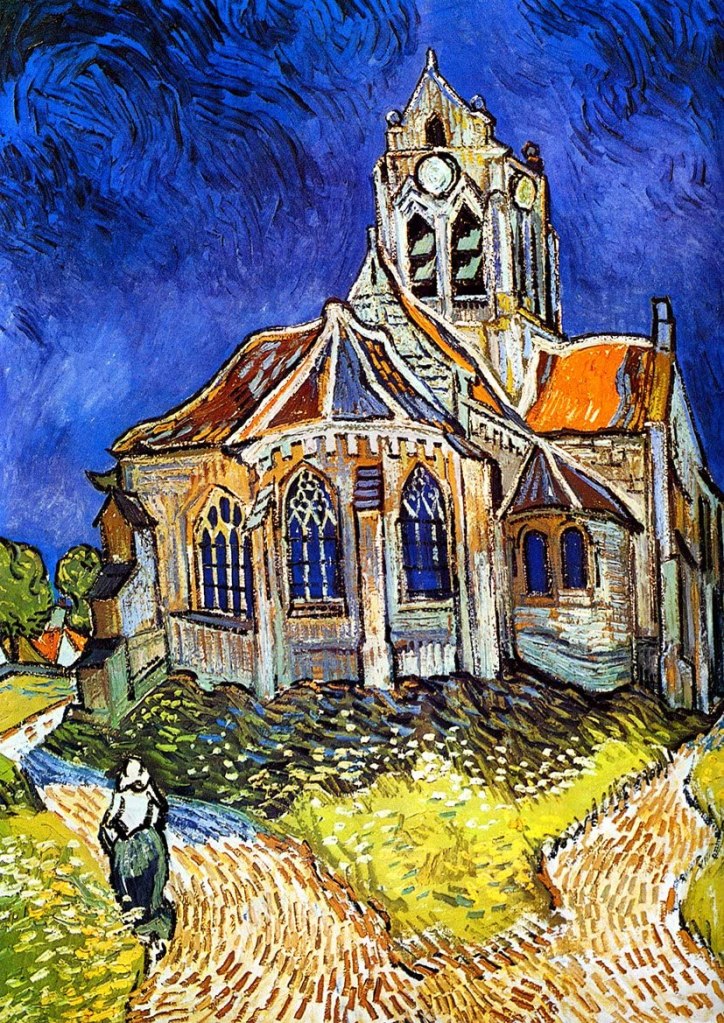
I’ve already posted one of Van Gogh’s paintings in the ABC Wednesday series – I for Irises.  Another painting of his that appeals to me is Church at Auvers-sur-Oise.

What I like about it are the colours and the contrast between the deep blue of the sky, the violet and orange roof of the church and the pastel colours of the divided path and grass in the foreground. I love the perspective, so wonky and wavy, and the details of the church.

This painting featured in the Doctor Who episode Vincent and the Doctor, in which the Doctor discovers a strange and malevolent figure in the painting peering out from one of the church window’s.  An interesting link, I thought – maybe Van Gogh’s depression had a supernatural cause!

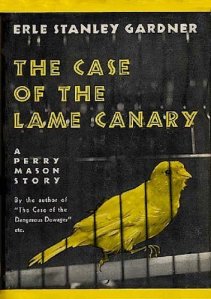
The Case of the Lame Canary by Erle Stanley Gardner

The Case of the Lame Canary was originally published in 1937. My copy is a Penguin green and white reprint of 1961. At that date Erle Stanley Gardner was in his sixties and was one of the world’s best-selling mystery writers. He had given up his career as a lawyer in California in 1935 and had taken a log cabin in the mountains to write his books full-time.

Perry Mason specialises in murder cases so when Rita Swaine arrives at his office with a tale of her sister’s matrimonial problems he isn’t interested. However, he is interested in the caged canary she has carried into his office, because it has a lame foot and he wants to know why it’s lame and why she brought it with her.

Rita tells him a complicated tale, which persuades Perry to represent her sister. Her sister Rosalind is married to Walter Prescott, but is still in love with Jimmy Driscoll, Walter had found out and threatened to kill her and so Rosalind had left and then asked her to get her things and the canary. Walter is later found murdered and the story gets even more complicated, especially as Rita just doesn’t tell Perry the truth. It appears that all three – Rita, Rosalind and Jimmy could have killed Walter.

Perry enlists Paul Drake’s help and together they ferret out yet more information – at times it felt like information overload and no clear way through to discover who killed Walter and why. And yet there is more because towards the end Perry says to his secretary, Della Street

… a solution of any crime which doesn’t account for all of the various factors involved is no solution at all. No, I’ve paid too much attention to the people the district attorney’s office suspect, and not enough to the victim. In the long run, Della, the essence of all successful detective work lies in reconstructing the life of the victim. That gives motivation, and motivation makes murders. (page 185)

There was no way I was able to work it all out, until almost the end and yet all the clues are there just so cleverly concealed within the text – and the lame canary does have a part to play!

Perry Mason acts more as a detective than a lawyer and works independently of the police to protect his clients, but he also has a very human side. Della, is anxious that he has a holiday and has planned a long trip around the world for the two of them. She’s booked their tickets and as the case gets more and more complicated she continues to urge him to start packing his things. In the end they just make it on board and they sail away. The book ends on a romantic scene as the other passengers watch:

… the tall, distinguished man, accompanied by the capable, good-looking young woman, parading around the deck, as though it were a ceremonial march, and, as they walked, whistling Hawaiian Paradise. (page 224)

A satisfying read and one I might read again, if only to see how it was all put together.