I sketched these trees a couple of weeks ago – not copied from life, but from a painting magazine. I’ll try sketching some of the trees in our garden soon. They are similar to these but without leaves right now – harder to draw!

I sketched these trees a couple of weeks ago – not copied from life, but from a painting magazine. I’ll try sketching some of the trees in our garden soon. They are similar to these but without leaves right now – harder to draw!
Here are a couple of photos taken in December 2010 when we were snowbound. I came into the kitchen early one morning and there on the decking outside was this little mouse, eating the bread we had put out for the birds:
 There were actually three mice climbing all over and round the back of the loaf nibbling it. I wasn’t the only one interested. Lucy came to the patio door and wanted to go out for a closer look.

See more Saturday Snapshots on Alyce’s blog, At Home With Books.
 I read Tony and Susan by Austin Wright last November and parts of it are still vivid in my mind, but a lot of it has faded away. I’d put a few markers in the book, which act as pointers to sections I found notable, and which have helped to refresh my memory.
It’s a novel within a novel. Susan receives a manuscript novel, Nocturnal Animals, from her ex-husband. This is the outer story, which is nowhere nearly as interesting or absorbing as the inner story, her husband’s fictional tale of a crime, an ambush on the highway that leads to murder. Each time Susan stopped reading I just wanted to get back to the story of Tony Hastings and his family. It made me nervous as I was reading it and even more nervous went we drove anywhere, because Tony, his wife Laura and their daughter Helen were travelling on an Interstate going to their summer cottage in Maine when two cars in front of them blocked the lanes and forced them off the road. This does happen in real life, and the description is tense and vivid enough to make me believe it. It is terrifying.
The rest of the inner story is about Tony trying to get justice/revenge for what subsequently happened. There are questions on the back cover about why Susan’s husband sent her the manuscript, but the book doesn’t resolve any of these questions, which was disappointing. But I found it compelling reading and strangely enjoyable, if a little drawn out. It was strange because that is Susan’s reaction as she reads about Tony:
This book has her in its grip, she can say that truly. The long, slow plunge into the evil night and Tony trying to brace himself by being civilised. The notion that being civilised conceals a great weakness.
…
She puts the manuscript back in the box, and even that seems like violence, like putting coffins into the ground: images from the book moving out into the house. Fear and regret. (page 110)
This is what this book is about – fear and regret – and also revenge. And it’s also about writing:
Once she asked him why he wanted to write. Not why he wanted to be a writer but why he wanted to write. His answers differed from day to day. It’s food and drink, he said. You write because everything dies, to save what dies. You write because the world is an inarticulate mess, which you can’t see until you map it in words. Your eyes are dim and you write to put your glasses on. No, you write because you read, to remake for your own use the stories in your life. You write because your mind is a babble, you dig a track in the babble to find your way around it. No, you write because you are shelled up inside your skull. You send out probes to other people in their skulls and you wait for a reply. (page 134)
There are more passages I could quote, but I think this one says a lot – and is long enough, anyway!
Tony and Susan was originally published in 1993. The author, Austin Wright was a novelist and Professor of English at the University of Cinncinnati. He died in 2003 at the age of 80.
I had a good time at Barter Books in Alnwick yesterday. Bartering books is a good way to recycle the books I’m not going to read again. I took in a box of books and came home with these. As I had built up a nice little sum over my last few visits, I was able to indulge myself!
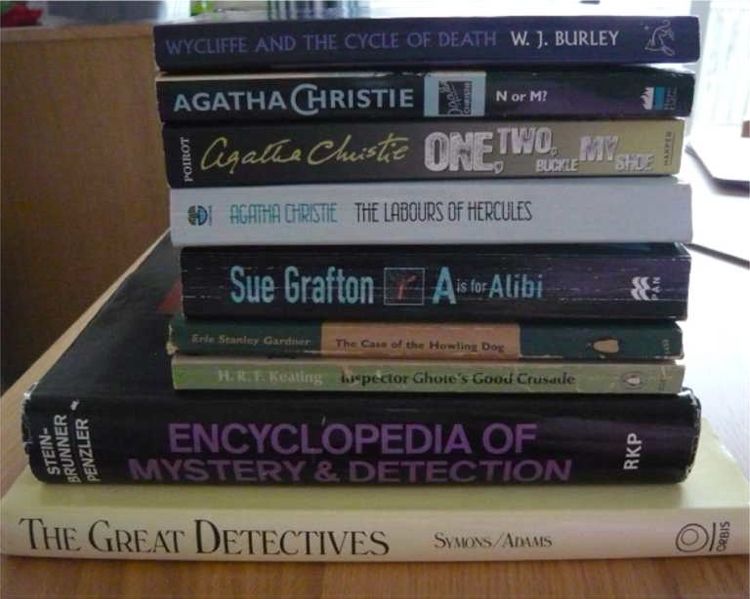
As you can see I was looking out for crime fiction and found three Agatha Christie’s I haven’t read:
I also got another Wycliffe book by W J Burley – Wycliffe and the Cycle of Death, in which he investigates the murder of a bookseller.
And another Perry Mason book by Erle Stanley Gardner- The Case of the Howling Dog – according to superstition a howling dog means a death in the neighbourhood, then both the dog and his owner are killed.
I’ve read one of H R F Keating’s books before but none of his Inspector Ghote’s books – this one caught my eye, Inspector Ghote’s Good Crusade, in which a millionaire philanthropist, the founder of a Bombay home for vagrants is murdered.
I’ve never read any of Sue Grafton’s books but have read reviews of a few, so I was pleased to find the first of her A-Z series – A is for Alibi. Kinsey Malone, Private Investigator has a cold case, hired by Nikki Fife, convicted of the murder of her husband eight years earlier, to find the real killer. If I like these there are plenty more in the series to look out for – and yesterday Barter Books had a shelf-full.
As I still had credit left I splashed out and bought two rather more expensive hardback books on crime fiction, which are at the bottom of the pile in my photo:
And because I do like to read other books than crime fiction I also got these two books:


I’ve been attempting to draw and paint and this book, How to Draw Anything by Angela Gair makes it look easy, which of course it isn’t. But I’m hoping it will help me improve.

I looked briefly at the many bookcases of general fiction and was drawn (pun not intended!) to Still Life by A S Byatt. Maybe my mind was still on art but this book certainly caught my eye. It’s a novel set in the 1950s. The cover is Still Life with Coffeepot by Vincent Van Gogh.
 I enjoyed The Highest Tide by Jim Lynch, even though it’s a change from the type of books I’ve been reading recently. It’s the story of a young teenage boy, Miles O’Malley who is thirteen. He finds a giant squid dying on the mudflats at Skookumchuck Bay, at the southern end of Puget Sound, near his house. Such a rare creature causes intense interest and Miles is the focus of attention as he is pursued by TV crews wanting to interview him. The question is why has the squid been beached on the shore? What is happening out at sea?
It’s an easy book to read, even though packed with information about marine life, the ocean and tides, which Miles is passionate about. It’s narrated by an adult Miles, looking back at that summer he found the giant squid, when he had a crush on Angie, his ex-babysitter and his best friend, old Florence was getting sicker each week.
I’d visited Florence a least weekly for the past three years, in part because she increasingly seemed like the person most like me. She was almost as short and skinny but with huge bottom-fish eyes, as if she was designed to read in the dark, which suited her seeing how her gloomy home overflowed with books to the point stacks had to be moved to offer seats to more than one visitor. The clutter also added to the assumption that she was nuts. Most people didn’t know what else to call someone who called herself a psychic. My mother did. She called Florence a crazy witch. (page 47)
Florence, who is suffering from a variation of Parkinson’s disease, lives in a small steel-roofed summer cabin standing on stilts, washed underneath by the high tides. She predicts a superhigh tide in September. Miles is sceptical because September was known for mild tides. But Florence tells him:
‘Even science goes haywire sometimes, Miles.’ (page 50)
I was moved by Miles’s compassion for Florence, an old lady at the end of her life and his passion for the sea, whilst worrying about his parents’ divorce and his own troubles. It’s a beautifully written book about life, growing up, relationships and love. I was just sorry that this book had sat unread on my bookshelves for the last few years, but glad I did eventually get round to reading it.
 This week’s musing asks’¦
What devices ‘“if any’“ do you read books on? Do you find it enjoyable, or still somewhat bothersome? Or: If you only read the print books, why haven’t you chosen to read on any devices?
I’ve had a Kindle for about a year now and have read several books on it. I’ve got more used to it now and don’t find it a bothersome way to read books. It’s just another way of reading, although with some disadvantages, as I still like the experience of reading a print book. I like the feel of a book, being able to flip over the pages easily, going backwards and forwards in the text, and looking at the cover and any illustrations – in colour.
But, I’m finding it easier and easier to read on my Kindle and that’s because I can enlarge the font, which makes it much easier to read in bed. My Kindle has its own light which makes it even better for reading in bed, or in poor light anywhere. I’ve picked up several print books recently and struggled to read them, because of the very small font – they would be much easier to read on a Kindle! Another bonus is the weight. For example, this month I’ve read The Woman in White by Wilkie Collins on my Kindle – this in a print book is around 700+ pages, making it a heavy and awkward book to read, but a doddle on the Kindle, no heavier or fatter than the slimmest paperback!
I also like the speed you can get a book – instantly, no more waiting for it to arrive in the post. This, of course, can also be a disadvantage, encouraging me to buy more books, but so far, I’ve been very strict with myself and the majority of books I’ve acquired have been free – another plus!
 BooksPlease