Saturday Snapshot: Horncliffe Bridge

The Union Chain Bridge links England and Scotland over the River Tweed at Horncliffe, just a few miles from where we live. Below is a view of the bridge seen from a footpath on the banks of the river. This was the first suspension bridge in Europe to carry road traffic. It still carries vehicular traffic.

Scotland is on the left as you look at the photo and England on the right.

Designed by Captain Samuel Brown, the bridge was opened in 1820, when it was the longest wrought iron suspension bridge in the world, with a span of 137 metres (449 ft). It is a Grade I listed building and Scheduled Ancient Monument.

I took the photo below standing on the bridge looking towards Scotland:

And a closer view of the bridge on the English side of the border:

Just up the road from the bridge is the Chain Bridge Honey Farm, a fascinating place where you can see a live colony of bees, behind glass, making honey, and where you can buy honey and other products such as candles made from beeswax. I’ll maybe write more about that in another Saturday Snapshot post.

The Visitor Centre at the Honey Farm also has a beautiful mural painted by local artist,Tony Johnson. My photo below shows a section of the map – my blue arrow points to the Chain Bridge. Also shown in this photo is Smailholm Tower (on the left of the photo as you look at it) which I featured in an earlier Saturday Snapshot post.

For more Saturday Snapshots see Alyce’s blog At Home with Books.

Dark Matter: a Ghost Story by Michelle Paver

Dark Matter

My first book for the R.I.P. VII Challenge is a chilling book, very chilling, both in the setting in the High Arctic and in atmosphere. I was glad I wasn’t reading Dark Matter by Michelle Paver in the dead of winter, snowbound and alone, because then it would have been terrifying. The isolation of the long, dark Arctic winter is oppressive and unrelenting.

It’s a ghost story in the form of a diary – that of Jack Miller who in 1937 was part of an expedition to the High Arctic to study its biology, geology and ice dynamics and to carry out a meteorological survey. Jack’s role is as radio operator, transmitting observations three times a day to the Government forecasting system.

From the start Jack is very reluctant to go, put off by the other members of the expedition, four ex-public schoolboys. But he’s stuck in a boring job, after giving up his plans to be a scientist and realises this is the only chance he’ll ever get to change his life. Right from the start things begin to go wrong, but Jack remains enthusiastic. Later when they meet Skipper Eriksson, the part owner and captain of the ship taking them to Gruhuken, a remote uninhabited bay where they’re setting up camp, Jack begins to feel increasingly uneasy. Eriksson is reluctant to take them to Gruhuken, but he doesn’t explain why merely saying he doesn’t think it’s ‘right’ for a camp.

Not long after they have set up camp Jack feels oppressed by the isolation brought on by the thought of the men who had been there before them:

Suddenly, I felt desolate. It’s hard to describe. An oppression. A wild plummeting of the spirits. The romance of trapping peeled away, and what remained was this. Squalor. Loneliness. It’s as if the desperation of those poor men had soaked into the very timber, like the smell of blubber on the Isbjørn. (page 65)

The trappers had left behind a ruined mine, a hut ‘crouched among the boulders  in a blizzard of bones‘ and in front of the hut a ‘bear post’ for luring bears to the trappers’ gun. It all makes Jack’s spirits sink. As the ship is leaving the camp, Jack sees a man standing in front of the cabin by the bear post and is relieved when he leaves. Now the members of the expedition are alone with the huskies and Jack’s unease grows. He is disturbed by the change in the weather, the increasingly shorter days and irritated by the other members, in particular by Algie and his insensitivity and cruelty towards the dogs.

Jack’s unease turns into dread as he realises that Gruhuken may be haunted, but his rational mind explains his feeling as an echo:

An echo from the past. … it’s called ‘place memory’, a well-known idea, been around since the Victorians. If something happens in a place – something intensely emotional or violent – it imprints itself on that place; maybe by altering the atmosphere, like radio waves, or by affecting matter, so that rocks, for example, become in some way charged with what occurred. Then if a receptive person comes along, the place plays back the event, or snatches of it. … What I saw was only an echo. (pages 111-2)

As the darkness descends, Jack is left alone at the camp and his nightmare really begins. The book is well-paced, the tension mounts, and paranoia sets in … or is it real, even the dogs are scared. It really is a page-turner and a good old-fashioned ghost story. The relationships between the characters are well drawn, and especially Jack’s relationship with Isaak, one of the huskies. I was most concerned about Isaak!

Jack describes ‘dark matter‘ of the title, as that part of the universe that cannot be seen or detected, but is there. He finds this idea

‘… unsettling. Or rather, not the idea itself, that’s merely an odd notion about outer space. What I don’t like is the feeling I sometimes get that other things might exist around us, of which we know nothing.’ (pages 94-5)

I don’t like that either. It’s scary.

  • Hardcover: 256 pages
  • Publisher: Orion; First Edition edition (21 Oct 2010)
  • Language: English
  • ISBN-10: 1409123782
  • ISBN-13: 978-1409123781
  • Source: I bought the book
  • My Rating: 4/5

Teaser Tuesday: Laurie Lee

Teaser Tuesdays is a weekly bookish meme, hosted by MizB of ‘˜Should Be Reading’.

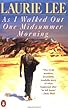
I’m currently reading As I Walked Out One Midsummer Morning by Laurie Lee, his autobiographical account of what he did after he left home in the Cotswolds in 1934 and walked through Spain. (He tells the story of his early years in Cider With Rosie, which I read and wrote about over three years ago.) Initially he had travelled to London, where he worked as a labourer on a building site, then knowing just one Spanish phrase for ‘Will you please give me a glass of water?’, he decided to go to Spain.

This passage shows how that phrase came in useful in one of the hottest days of that Spanish summer when he set out in the morning to walk to Valladolid:

After a while, being out-doors became a hallucination, and I felt there was no longer any air to breathe, only clinkered fumes and blasts of sulphur that seemed to rise through cracks in the ground. I remember stopping for water at silent farms where even the dogs were too exhausted to snarl, and where the water was scooped up from wells and irrigation  ditches and handed to me warm and green.

By mid-morning I was in a state of developing madness, possessed by deliriums of thirst, my brain running and reeling through all the usual obsessions that are said to accompany the man in the desert. Fantasies of water rose up and wrapped me in cool wet leaves, or pressed the thought of cucumber peel across my stinging eyes and filled my mouth with dripping moss. (page 72)

Just like Cider With Rosie, this book is beautifully written, lyrical and poetic capturing Spain as it was in the 1930s before the Civil War, beautiful countryside, both dazzling and squalid.

A book to savour.

Crime Fiction Alphabet: Q

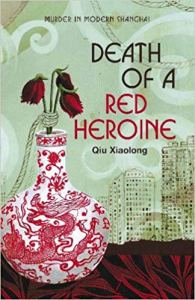
For the letter Q in Kerrie’s Crime Fiction Alphabet I’ve chosen Death of a Red Heroine by Qiu Xiaolong.

Death of a red heroineQX

I  ‘discovered’ Qiu Xiaolong in 2010 during a previous series of the Crime Fiction Alphabet when I wrote about his second book, A Loyal Character Dancer. Death of Red Heroine is his first book featuring Chief Inspector Chen. It won the Anthony Award for Best First Crime Novel in 2001.

Synopsis from the back cover

Shanghai in 1990. An ancient city in a Communist country: looking to the future for its survival. Chief Inspector Chen, a poet with a sound instinct for self-preservation, knows the city like few others. 

When the body of a prominent Communist Party member is found, Chen is told to keep the party authorities informed about every lead. And he must keep the young woman’s murder out of the papers at all costs. When his investigation leads him to the decadent offspring of high-ranking officials, he finds himself instantly removed from the case and reassigned to another area.

Chen has a choice: bend to the party’s wishes and sacrifice his morals, or continue his investigation and risk dismissal from his job and from the party. Or worse . . .

My thoughts:

I think this is as much historical fiction as it is crime fiction. There is so much in it about China, its culture and its history before 1990 – the Communist regime and then the Cultural Revolution in the 1960s – as well as the changes brought about in the 1990s after the massacre of Tiananmen Square. This does interfere with the progress of the murder investigation as Chen has to cope with the political ramifications and consequently there are several digressions and the pace is slow and lacking tension. As Chen is a poet as well as a policeman there are also references to Chinese literature which although interesting, don’t move the murder mystery forward. A fair amount of concentration is needed both to understand the background and work out the plot.

Chen is a reluctant policeman, he has a degree in  English literature and is a published poet and translator. However, he is a good detective and helped by Detective Yu begins to unravel the mystery. Having found a suspect it is really the motive that provides a stumbling block, that and the constant need to keep in mind the ‘interests of the Party’ that prevents a quick resolution.

I like the characterisation, Chen and Yu in particular are clearly drawn, distinctive characters, and the setting is superb. I also like the many descriptions of food (as there are in A Loyal Character Dancer), such as this dinner menu Chen lays on for a party in his new apartment:

For the main dishes, there were chunks of pork stomach on a bed of green napa, thin slices of smoked carp spread on fragile leaves of jicai, and steamed peeled shrimp with tomato sauce. There was also a plate of eels with scallions and ginger, which he had ordered from a restaurant. He had opened a can of Meiling steamed pork and added some green vegetables to make it another dish. On the side, he placed a small dish of sliced tomatoes, and another of cucumbers. When the guests arrived, a soup would be made from the juice of the canned pork and canned pickle. (page 12)

It’s a fascinating book on several levels and one I enjoyed reading. I’m a bit late catching up with reading Qiu Xiaolong’s books as there are now seven Inspector Chen books:

1. Death of a Red Heroine (2000)
2. A Loyal Character Dancer (2002)
3. When Red Is Black (2004)
4. A Case of Two Cities (2006)
5. Red Mandarin Dress (2007)
6. The Mao Case (2009)
7. Don’t Cry, Tai Lake (2012)

Saturday Snapshot: Duddo Stone Circle

Stone circles fascinate me. They have done ever since I was a young teenager and went to Stonehenge. It was dawn as we were travelling to the New Forest for our annual Girl Guide camp there. The coach driver stopped so we could get out and see the sun rising over the stones. This was in the days when the stones were open and we ran across so we could be in the circle when the sun came up – it was magical. These days Stonehenge is fenced off and going there is just not the same experience.

There is a small stone circle not very far from where we live and we went to see it last Saturday. Duddo Stone Circle is a group of five Neolithic/Bronze Age stones – radiocarbon dating indicates they were erected around 2000BC. Originally there were seven stones. Excavations in the 1890s revealed the socket holes of the missing stones and also the cremated human remains in the central pit.

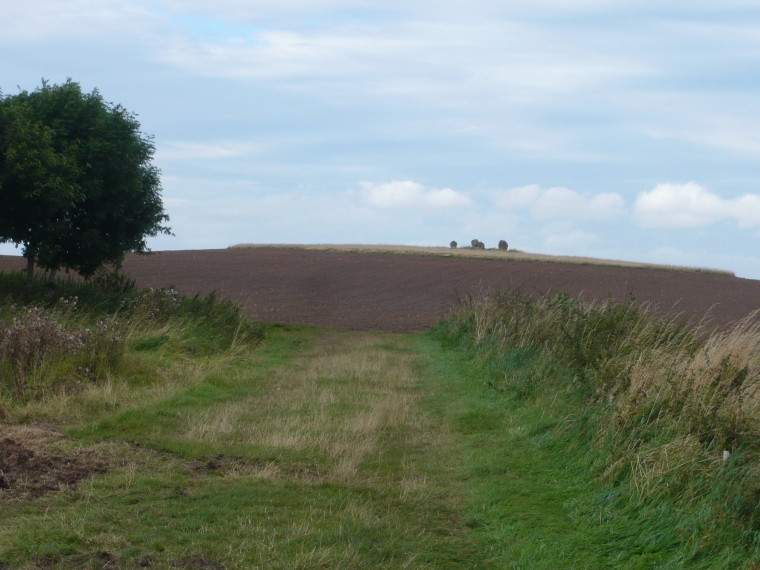
This is the view of the stone circle standing proud on a low hill next to the small Northumberland village of Duddo as you approach the stones along a permissive path:

P1060985

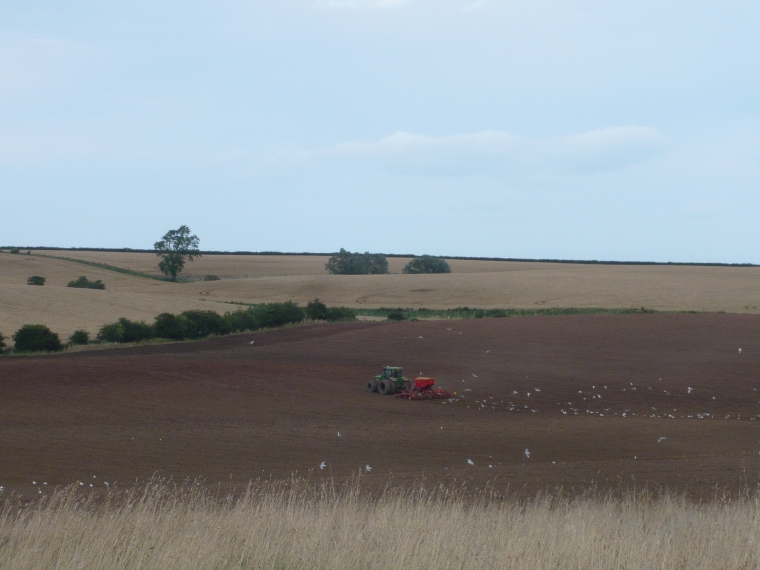
Farmers used to plough across the inside of the circle.These days they don’t, but farm all around the circle:

P1060992

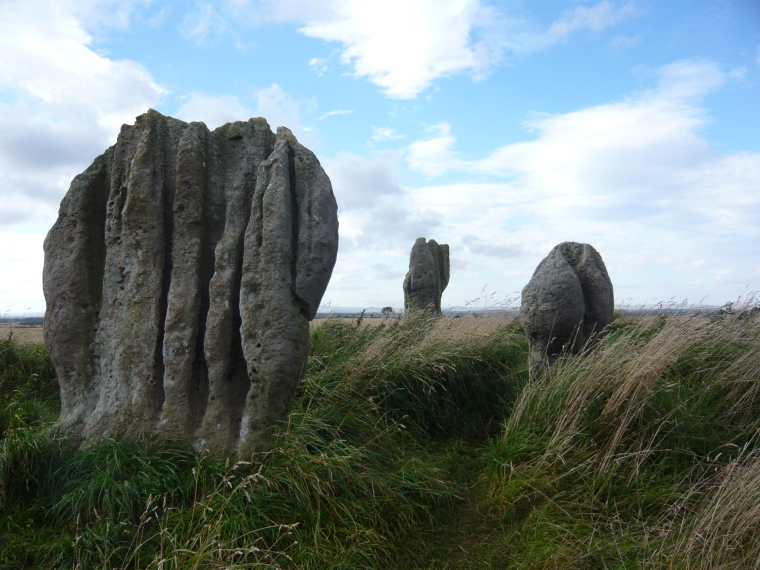
It’s fantastic up inside the stone circle. Unlike Stonehenge (which is of course much bigger) you can walk right up to the stones and go inside the circle. The stones are sandstone, varying in height from 1.3 metres to 2.3 metres. The site is listed on the Schedule of Ancient Monuments – No. 1006622.

It was very windy last Saturday and I found it hard to keep my camera steady, but I did manage to get some close ups of the stones. Stones that have been sculpted by the wind into weird shapes.

P1060995

We had the stones to ourselves and it was easy to imagine what it must have been like up there on the hill all those years ago, with views all round to the Cheviots and the Eildon Hills in Scotland and to wonder just why the stones were there and what they had meant to the people who erected them. The Defra information board below the stones indicated that the fragments of human bones found in the central pit dated from 1740 – 1660 BC suggesting that the use of the site for burial was a later event. Its original purpose remains a mystery – I like that.

Also in Duddo are the remains of a medieval tower house. We didn’t have time to look at it last Saturday, but we’ll go there another day.

For more Saturday Snapshots see Alyce’s blog At Home With Books.