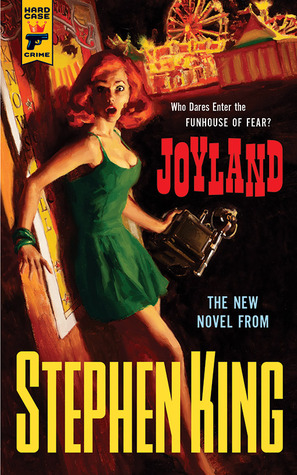
Joyland by Stephen King

I’m so glad I read Joyland by Stephen King – it’s so good.
13596166

I nearly didn’t buy it, put off by the cover (you should never judge a book by its cover!) and by the publishers, Hard Case Crime – it was the word ‘hard‘ that really made me pause, especially when I looked at their site and saw they publish ‘the best in hardboiled crime fiction‘. Not being quite sure just what ‘hard boiled crime fiction‘ is, I looked it up. This is Encyclopedia Britannica’s definition:

Hard-boiled fiction, a tough, unsentimental style of American crime writing that brought a new tone of earthy realism or naturalism to the field of detective fiction. Hard-boiled fiction used graphic sex and violence, vivid but often sordid urban backgrounds, and fast-paced, slangy dialogue.

Not my sort of book, at all! But it’s by Stephen King and I like his books, so I did buy it. It’s not ‘hard boiled fiction‘ as defined above. The only way it fits that definition is that there is a lot of slang in it – ‘carny’ slang, which King explains in his Author’s Note is what he calls in this book ‘the Talk‘. It is ‘carnival lingo, an argot both rich and humorous’. So not ‘hard boiled’ at all!

Joyland is a ghost story, a love story, a story of loss and heartbreak. It’s also a murder mystery and utterly compelling to read.

It’s narrated by Devin Jones, looking back forty years at the time he was a student, suffering from a broken heart, as his girlfriend had just rejected him and he spent a summer working at Joyland, in North Carolina, an amusement park with ‘a little of the old-time carny flavor‘.

Along with various rides, ‘Happy Hounds’, and a palm-reader, there is the Horror House, a ‘spook’ house which is said to be haunted by the ghost of Linda Gray, whose boyfriend cut her throat in the Horror House. The boyfriend had not been found and it appears he may be a serial killer as there had been four other similar murders in Georgia and the Carolinas.

It’s also a story of friendship, of Tom and Erin, of children with the ‘sight’, a young boy in a wheelchair and his mother, and Dev’s search for the killer.

I loved the setting of the funfair, Dev’s nostalgia for his youth, his sensitivity, and the images the story evokes – it’s not just the story but the way King tells his tale, with just a touch of horror and the supernatural.

Who knows – maybe I should read some more of Hard Case Crime’s publications!

Reading ChallengesReaders.Imbibing.Peril XI.

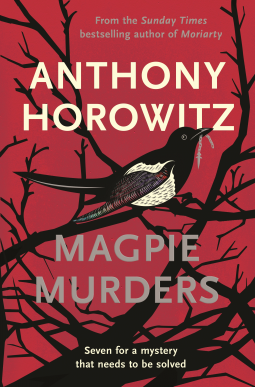
Magpie Murders by Anthony Horowitz

I previously enjoyed The House of Silk by Anthony Horowitz, so when I saw Magpie Murders  on NetGalley I was keen to read it and delighted when I received an uncorrected proof. I think it is an outstanding book by a master story-teller, with a wonderfully intricate plot. It’s a prime example of a puzzle-type of crime fiction combining elements of the vintage-style golden age crime novel with word-play and cryptic clues and allusions to Agatha Christie and Arthur Conan Doyle. It’s also a novel within a novel, with mystery piled upon mystery. I loved it.

The outer story and the contemporary mystery is that of Alan Conway, the author of the Atticus Pund Mysteries. His editor, Susan Ryeland is reading a manuscript of his latest novel Magpie Murders, expecting to enjoy it as much as his earlier books, even though she really couldn’t stand Conway himself. What she wasn’t prepared for is that this book would change her life.

The inner story, that told in Conway’s novel is a whodunnit, a murder mystery full of twists and turns with plenty of red herrings. I was enjoying it as much as Susan as she read of the death of Mary Blakiston in the little village of Saxby-on-Avon in 1955. Mary was an unpleasant character. She had been found dead at the bottom of the stairs at Pye Hall where she was the cleaner for the owner, Sir Magnus Pye. It appeared that she had tripped and fallen down the stairs.Then Magnus is also found dead, but this was obviously murder as he had been beheaded.

So back to the outer story. When Susan came to the end of the manuscript she found it wasn’t finished – there was no denouement. And she couldn’t contact Conway to get the final chapters of the book and then she discovered that he was dead. So, she sets out to find the missing chapters and in so doing discovers even more mysteries – was Conway’s death an accident, suicide or murder? Like Mary Blakiston in his novel, he was not a popular man, and there are a number of other parallels between his novel and his real life.

Magpie Murders is a really satisfying read, with believable characters, set in beautifully described locations, tantalisingly mysterious and so, so readable. I also particularly liked the use of the rhyme of ‘One for Sorrow’ in the chapter headings of Conway’s novel in the same way that Agatha Christie used ryhmes in some of her books. It’s quite long, but the pages sped by as I was drawn into both stories and keen to find the answers to all the questions all the mysteries it had posed.

Many thanks to NetGalley and the publishers Orion Books for an ARC.

Mount TBR: Checkpoint #3


It’s time for the third quarterly checkpoint for Bev’s Mount TBR Reading Challenge. Bev says:

1.Tell us how many miles you’ve made it up your mountain (# of books read).

I’m nearly at the top of Mt Vancouver, having read 35 books. So it’s looking doubtful that I’ll reach my target of getting to the top of Mt Ararat (48 books)!

2. Complete ONE (or more if you like) of the following:
  • A. Who has been your favorite character so far? And tell us why, if you like.
  • B. Pair up two of your reads. But this time we’re going for opposites. One book with a male protagonist and one with a female protagonist. One book with “Good” in the title and one with “Evil.” Get creative and show off a couple of your books.
  • C. Which book (read so far) has been on your TBR mountain the longest? Was it worth the wait? Or is it possible you should have tackled it back when you first put it on the pile? Or tossed it off the edge without reading it all?
  • D. Choose 1-4 titles from your stacks and using a word from the title, do an image search.  Post the first all-eyes-friendly picture associated with that word.

I think my favourite character has to be Richard III in The Sunne in Splendour by Sharon Penman, one of the best historical novels that I’ve read. It is full of detail, but her research sits very lightly in this book, none of it feels like a history lesson, and it all brings Richard’s world to life. Penman portrays a very likeable Richard, from his childhood onwards he comes across as a kind, generous and brave man, a skilled leader on the battlefield, a loving husband to his wife, Anne, and devoted and loyal to his brother, Edward IV, who was by no means a saint.

For book pairs I’ve picked In Bitter Chill by Sarah Ward and  Heat Wave by Penelope Lively – opposite weather conditions!

The book that has been on my TBR mountain the longest is still The Voyage Out by Virginia Woolf as I said in the last Checkpoint post. I’m not sure when I bought it, but it was one of the books I listed when I first joined LibraryThing in 2007.  I do wish I’d read it before this year but I enjoyed it so it was worth the wait.


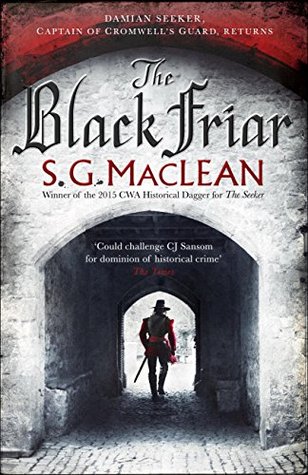
The Black Friar by S G MacLean

The Black Friar by S G MacLean is one of those books that has the power to transport me to another time and place. I was totally absorbed, convinced I was back in England in the 17th century.

The Black Friar (Damian Seeker, #2)

It is the second book in the Damian Seeker series, historical crime fiction set in 1655 during the Interregnum under Oliver Cromwell, the Lord Protector. Damian Seeker, Captain of Cromwell’s Guard, works for Thurloe, Cromwell’s Chief Secretary and spy master, in charge of the security of the regime. It’s a complex mystery, particularly as there are various factions and religious sects plotting rebellion against Cromwell.

A body, presumed by his black robe to be that of a Dominican friar, is found bricked up in a wall in Blackfriars, once a monastery and now a derelict building gradually falling into the River Fleet. But this was no friar, as Seeker recognised him as Carter Blyth one of Thurloe’s undercover agents, who had been working in the Netherlands, observing the Royalists colluding with foreign powers. As far as Seeker knew he had been killed in Delft three months earlier. Seeker’s task is to find why he had been killed and who killed him. He discovers that Blyth under Thurloe’s orders had in fact infiltrated a group of Fifth Monarchists who wanted to overthrow Cromwell and had been living with the Crowe family, members of the group, under the name of Gideon Fell.

It’s a complicated and intricate tale as Seeker, helped by Nathaniel Crowe, tries to discover what Blyth had been doing, and what trail he was following. There are missing children, whose whereabouts Blyth had been investigating, and plots to overthrow Cromwell as well as plots to reinstate Charles Stuart as King.

Although The Black Friar is the second book in the series, (the first is The Seeker, which I haven’t read) I think it works well as a stand-alone book. The characterisation is strong and I particularly like Damian Seeker, a man both respected and feared, and a man to trust.

I also like the way S G MacLean has based her book on solid historical research (she has an M.A. and Ph.D. in History from the University of Aberdeen) and weaves real historical figures into the story, such as the poet John Milton, now an old blind man, the Secretary of Foreign Tongues and the diarist Samuel Pepys, an Exchequer clerk, who though very personable was ‘prone to drink and some lewdness.’ It all brings to life the atmosphere and tenor of the 1650s. I loved it.

My thanks to Netgalley and Quercus books for my copy of this book. It is due to be published on 6 October.

The Classics Club Spin Result

The result of the Classics Club Spin is No. 1 which for me is Silas Marner by George Eliot. I am so pleased – I wanted a short book and lo and behold this is a short book!

Although the shortest of George Eliot’s novels, Silas Marner is one of her most admired and loved works. It tells the sad story of the unjustly exiled Silas Marner – a handloom linen weaver of Raveloe in the agricultural heartland of England – and how he is restored to life by the unlikely means of the orphan child Eppie.

Silas Marner is a tender and moving tale of sin and repentance set in a vanished rural world and holds the reader’s attention until the last page as Eppie’s bonds of affection for Silas are put to the test.

First published in 1861 as Silas Marner: the Weaver of Raveloe, George Eliot described it as ‘a story of old-fashioned English life’.

Classics Club Spin

The Classics Club

I was just thinking another Classics Club Spin would be nice and it appeared!

The Spin rules:

  •  List any twenty books you have left to read from your Classics Club list.
  • Number them from 1 to 20.
  • On Monday the Classics Club will announce a number.
  • This is the book to read by 1 December 2016.

I decided to organise my list in page number order from short to enormous.  I want to read all of them at some time but right now as I have a backlog of other books that I want to read before December, I hope that one of the shorter books (that is numbers 1 – 4) is chosen!

  1. Silas Marner by George Eliot – 176 pages
  2. All Quiet on the Western Front by Erich Maria Remarque
  3. Sweet Thursday by John Steinbeck
  4. Orlando by Virginia Woolf
  5. North and South by Elizabeth Gaskell
  6. The Black Robe by Wilkie Collins
  7. Love in the Time of Cholera by Gabriel Garcia Marquez
  8. The Forsyte Saga (The Man of  Property) by John Galsworthy
  9. Oliver Twist by Charles Dickens
  10. The Return of the Native by Thomas Hardy
  11. Far from the Madding Crowd by Thomas Hardy
  12. One Hundred Years of Solitude by Gabriel Garcia Marquez
  13. Framley Parsonage (Barsetshire Chronicles, #4) by Anthony Trollope
  14. Mary Barton by Elizabeth Gaskell
  15. Wives and Daughters by Elizabeth Gaskell
  16. Lorna Doone: A Romance of Exmoor by R D Blackmore
  17. Martin Chuzzlewit by Charles Dickens
  18. Nicholas Nickleby by Charles Dickens
  19. Little Dorrit by Charles Dickens
  20. Parade’s End by Ford Maddox Ford – 914 pages