Dolly by Susan Hill

Dolly

Profile Books|October 2012|153 pages|Library book|4*

Dolly: A Ghost Story is a small book – in size and in length and I read it very quickly. Although I think it is a supernatural tale I don’t think it is a ghost story. But it does have an uneasy foreboding and melancholic atmosphere, mainly set in a mysterious isolated country house in the Fens.

There is not much to say about it really. It’s the story of two children, cousins Edward and Leonora who spend a summer with their Aunt Kestrel at her house, Iyot Lock, a large decaying house in the Fens. Edward tries to get on with Leonora, an insufferably mean and spiteful child. Expecting a birthday present of a doll from her aunt, she has a tantrum when she is given a baby doll totally unlike the doll she wanted and breaks its head. From that point on strange things begin to happen with disastrous consequences.

It is well written and I relished the descriptive writing of the landscape, that oppressive feeling that the sky above is falling in on you that I’ve experienced in that area. The tension is there from the start and it gradually builds as events unfold and the storm clouds gather.  There are hints of evil as well as spite and malice, in Leonora and what happens to the doll and the cousins is where the supernatural element comes in. 

But I think the plot is too formulaic and I could easily foretell what was going to happen. To say what it reminded me of would be too much of a spoiler. The ending, as so often in short stories and novellas comes too quickly, but nevertheless I did enjoy reading it. There is a certain satisfaction in predicting what would happen and being right as opposed to getting to the end and expecting more. It made a pleasurable change as it filled a gap between longer and more demanding books.

Reading challenge: Virtual Mount TBR as it is a library book.
Blood on the Tracks: Railway Mysteries edited by Martin Edwards (British Library Crime Classics)

I’ve said before that I’m not a big fan of short stories, often finding them disappointing. So I’m glad to say that I enjoyed this anthology edited by Martin Edwards: Blood on the Tracks: Railway Mysteries. Some stories, of course, are better than others.

Blood on the tracks

There are fifteen railway themed stories in the collection and an introduction on classic railway mysteries by Martin Edwards. He has also prefaced each story with a brief biographical note, which I found useful as some of the authors were new to me. I read the collection slowly over a few months, which I find is the best way to approach a short story collection.

Train travel provides several scenarios for a mystery – the restriction of space on trains, with or without a corridor, means that there are a limited number of suspects and they can also provide an ideal place for a ‘locked room’ crime or an ‘impossible crime’ story. This collection also includes a couple of crimes with a supernatural element.

The mysteries are presented in roughly chronological order from 1898 up to  the 1950s. The ones I enjoyed the most are by R Austin Freeman, Roy Vickers, Dorothy L Sayers, F Tennyson Jesse and Freeman Crofts Willis.

  1. The Man with the Watches by Arthur Conan Doyle featuring an un-named sleuth, ‘a well-known criminal investigator’, about a man shot through his heart on the London to Manchester train. He had no ticket on him but had six valuable gold watches in his possession. This was first published in The Strand Magazine in 1898.
  2. The Mystery of Felwyn Tunnel by L T Meade and Robert Eustace. This was also first published in 1898 in which a signalman is found dead at the mouth of the tunnel. When another man dies in in the same place it looks as though something very strange is the cause of their deaths.
  3. How He Cut His Stick by Matthias McDonnell Bodkin. In this story Lady Detective Dora Myrl investigates the theft of £5,000 in gold and notes from a locked railway carriage.
  4. The Mysterious Death on the Underground Railway (1901) by Baroness Orczy, featuring the Old Man in the Corner, an ‘armchair detective’ as he sits in a teashop and tells journalist Polly Burton the solution to the murder of a young woman on the Underground, whilst he fiddles with a piece of string.
  5. The Affair of the Corridor Express by Victor L Whitechurch featuring the railway detective Thorpe Hazell. He investigates the kidnapping of the son of a millionaire.
  6. The Case of Oscar Brodski by R Austin Freeman, an ‘inverted’ detective story, in which the reader knows everything, whereas the detective knows nothing and it all hinges on the significance of trivial details, including fragments of glass, biscuit crumbs, a piece of string and threads of fabric.
  7. The Eighth Lamp by Roy Vickers – an underground mystery about switching off the station lamps after the last train had gone down the line, with a rather spooky supernatural ending.
  8. The Knight’s Cross Signal Problem by Ernest Bramah, in a steam engine crashes into a light train, killing twenty seven people and injuring forty plus. The cause of the accident is a mix up with the signals. I think this is one of the less successful stories for me.
  9. The Unsolved Puzzle of the Man with No Face (1928) by Dorothy L Sayers (a Lord Peter Wimsey story), . The body of a man is found on a lonely beach, his face slashed, and with no means of identification. Wimsey’s discussion of the crime with his fellow passengers as they travel into London, helps D I Winterbottom to solve the mystery – a most intriguing story.
  10. The Railway Carriage by F Tennyson Jesse (1931) – this is possibly my favourite story in the collection. It’s a supernatural mystery in which Solange Fontaine, a female sleuth with a ‘feeling for evil’ features meets two passengers on a train. Both the elderly woman, dressed in shabby black and the insignificant-looking man in a grey felt hat seem to be locked in their own thoughts and she feels very ill at ease. Then the train crashes. An excellent story.
  11. Mystery of the Slip-Coach by Sapper (1933), the creator of ‘Bulldog’ Drummond – an example of an ‘impossible crime’ in which the clue of a raw egg supplies the solution to the murder – I wasn’t convinced by this story.
  12. The Level Crossing by Freeman Crofts Willis ( 1933) in which a man is found dead, lying near an unmanned railway crossing. A mystery that shows the effects of unforeseen circumstances even on a well planned murder.
  13. The Adventure of the First-class Carriage by Ronald Knox (1947) a Sherlock Holmes pastiche with an ‘impossible crime’ scenario.
  14. Murder on the 7.16 by Michael Innes, a John Appleby mystery in which he investigates a murder in a railway carriage on trestles, not on wheels, as it is part of a film set.
  15. The Coulman Handicap by Michael Gilbert (1950s). I found this rather confusing as the police follow a woman passing on stolen goods as she uses the Underground to give them the slip. I think this is possibly the one story in the collection that failed to hold my interest.

My thanks to the publishers for my review copy via NetGalley.

  • Paperback: 358 pages
  • Publisher: Poisoned Pen Press (3 July 2018) in association with the British Library
  • Language: English
  • ISBN-10: 1464209693
  • ISBN-13: 978-1464209697
  • My rating: 3*

My Friday Post: Clouds of Witness by Dorothy L Sayers

Book Beginnings Button

Every Friday Book Beginnings on Friday is hosted by Gillion at Rose City Reader where you can share the first sentence (or so) of the book you are reading, along with your initial thoughts about the sentence, impressions of the book, or anything else the opener inspires.

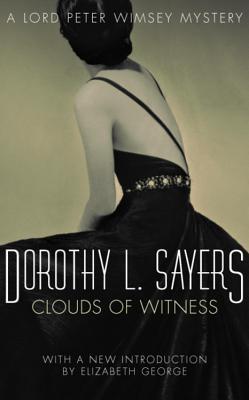
I’m currently reading Clouds of Witness by Dorothy L Sayers, the second Lord Peter Wimsey book and one of my 20 Books of Summer.

Clouds of witness


Lord Peter Wimsey stretched himself luxuriously between the sheets provided by the Hôtel Meurice.

Also every Friday there is The Friday 56, hosted by Freda at Freda’s Voice.

30879-friday2b56These are the rules:

  1. Grab a book, any book.
  2. Turn to page 56, or 56% on your eReader. If you have to improvise, that is okay.
  3. Find any sentence (or a few, just don’t spoil it) that grabs you.
  4. Post it.
  5. Add the URL to your post in the link on Freda’s most recent Friday 56 post.

Page 56:

From amid the mud and the fallen leaves he retrieved a tiny glittering object – a flash of white and green between his finger-tips.

It was a little charm such as women hang upon a bracelet – a diminutive diamond cat with eyes of bright emerald.

Blurb:

The Duke of Denver, accused of murder, stands trial for his life in the House of Lords.
Naturally, his brother Lord Peter Wimsey is investigating the crime – this is a family affair. The murder took place at the duke’s shooting lodge and Lord Peter’s sister was engaged to marry the dead man.
But why does the duke refuse to co-operate with the investigation? Can he really be guilty, or is he covering up for someone?

What do you think? Would you keep reading?

Library Loans

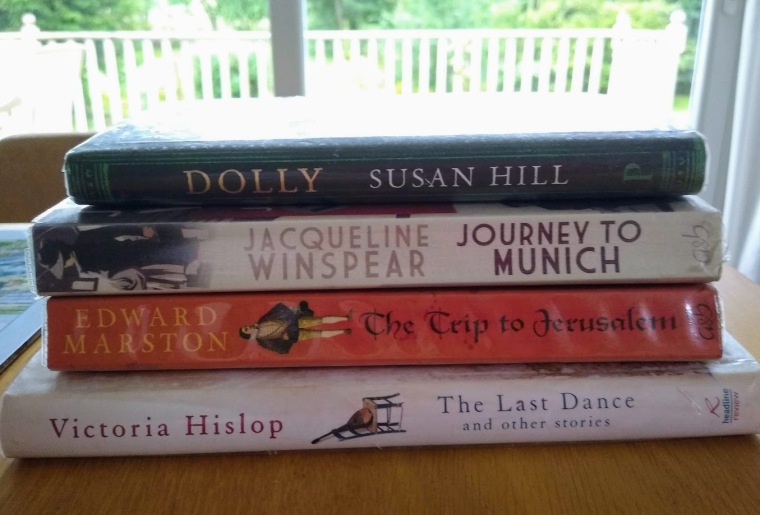
Here are some of my current library books

Lib bks July 2019

  • Dolly by Susan Hill, sub-titled ‘A Ghost Story’, a novella set in the Fens where two young cousins, Leonora and Edward spend a summer at Iyot Lock, a large decaying house, with their ageing aunt.  I’ll be writing more about this book soon.
  • Journey to Munich by Jacqueline Winspear, a Maisie Dobbs novel. This is no. 12 in the series (I’m not reading them in order). This one is set in 1938 when Molly travels into the heart of Nazi Germany.
  • The Trip to Jerusalem: an Elizabethan Mystery by Edward Marston, the 3rd book in the Nicholas Bracewell series about a troupe of players travelling England – not  to Jerusalem but to an ancient inn called The Trip to Jerusalem – whilst the Black Plague rages.
  • The Last Dance and other stories by Victoria Hislop. Ten stories set in Greece, described on the book cover as ‘bittersweet tales of love and loyalty, of separation and reconciliation’. I’ve recently enjoyed reading her latest book, Those Who Are Loved, also set in Greece, so my eye was drawn to this book.

The library van used to visit here once a fortnight, but now it only comes once a month. I hope it continues coming, but I fear that its days are numbered, so I make sure I use it whilst I still can.

Top Ten Tuesday: Auto-Buy Authors

top-ten-tuesday-new

Top Ten Tuesday is a weekly meme created by The Broke and the Bookish and now hosted by Jana at That Artsy Reader Girl. For the rules see her blog.

This week’s topic: Auto-Buy Authors. These days I don’t automatically buy books by any of my favourite authors, but I do add them to a list of books to check with a view to buying or borrowing them. The ten authors listed below are just the tip of the iceberg of my favourites.

I’ve included a book for each author to illustrate their work, but I’ve enjoyed all their books! They are a mix of crime fiction and historical fiction.

  1. Kate Atkinson – When Will There Be Good News?
  2. Sharon Bolton – Blood Harvest
  3. Tracy Chevalier – At the Edge of the Orchard
  4. Ann Cleeves – Raven Black 
  5. Martin Edwards – The Golden Age of Murder
  6. Jane Harper – Force of Nature
  7. Hilary Mantel – Wolf Hall
  8. Ian Rankin – Saints of the Shadow Bible
  9. C J Sansom – Tombland
  10. Andrew Taylor – The King’s Evil

Who Killed Ruby? by Camilla Way

Who killed Ruby

Harper Collins|30 May 2019|403 pages|Review e-book copy|3.5*

Ruby was murdered 32 years ago but her death still affects her family – Stella her mother, Vivienne her younger sister, and Cleo, Vivienne’s 13 year old daughter. Who Killed Ruby?  begins in a house in Peckham, London where the three of them are in shock, as a man lies dead on the kitchen floor. Whilst they wait for the police to arrive, Vivienne asks what they should tell them and Stella replies that they will tell them it is the man who murdered Ruby. This rather begs the question – is it?

The novel then rewinds two months describing the events that led up to that first scene and also reveals the events that led up to Ruby’s murder. It’s a complex tale told mainly from Vivienne’s point of view. She was just a child of eight when the murder happened and it was largely her testimony that convicted Jack Delaney, Ruby’s boyfriend. She had been alone in the house when she found her sister’s pregnant body splayed out on her bedroom floor. Jack has always protested his innocence and now he has been released from prison. But Vivienne is vague about the details of the murder, having blocked out her memories of what had happened and what she had seen. Plagued by nightmares ever since Ruby was killed, she is now terrified that Jack will come looking for her, wanting revenge.

The second viewpoint is Cleo’s. She is excited about the messages she’s exchanging online with Daniel, who she met on a gaming site. He tells her he is 14 and lives in Leeds. She lies to Vivienne about it and says that she is texting her friend Layla. Gradually Vivienne begins to remember what happened the day that Ruby died, but when Cleo disappears she becomes frantic, certain that Jack has taken her.

It is a tense and emotional mystery that kept me guessing to the very end. My suspicions about Cleo turned out to be partly correct, but as for who killed Ruby I was thrown off track by all the different characters who could be the culprit and I just couldn’t decide who I thought it could be. When the identity of the killer was revealed I was so surprised as it was someone I’d not even considered. I wasn’t convinced by some of the characters and thought they were too obviously there to confuse the reader. But overall I did enjoy the book. And I liked the emphasis on family relationships – particularly on the mother/daughter relationships.

Many thanks to the publishers, Harper Collins, for my review copy via NetGalley.