My Friday Post: An April Shroud by Reginald Hill

Book Beginnings Button

Every Friday Book Beginnings on Friday is hosted by Gillion at Rose City Reader where you can share the first sentence (or so) of the book you are reading, along with your initial thoughts about the sentence, impressions of the book, or anything else the opener inspires.

An April Shroud by Reginald Hill is one of my 20 Books of Summer that I’ll be reading soon. It’s the 4th book in his Dalziel and Pascoe series.

April Shroud


No one knew how it came about that Dalziel was making a speech. Pascoe had with great reluctance let himself be persuaded into a church wedding, partly by the argument sentimental (Mum’s looking forward to it), partly by the argument economic (Dad’s paying for it), but mainly by the suspicion, hotly denied but well supported by circumstantial evidence, that Ellie herself wanted it.

Also every Friday there is The Friday 56, hosted by Freda at Freda’s Voice.

30879-friday2b56These are the rules:

  1. Grab a book, any book.
  2. Turn to page 56, or 56% on your eReader. If you have to improvise, that is okay.
  3. Find any sentence (or a few, just don’t spoil it) that grabs you.
  4. Post it.
  5. Add the URL to your post in the link on Freda’s most recent Friday 56 post.

Page 56:

‘So you’re not too worried about the boy?’

‘In the sense that he is too sensible to contribute willingly to his own harm, no. But as you say, the weather is appalling and, in addition, we live in troubled times, Mr Dalziel.’

Blurb:

Superintendent Dalziel falls for the recently bereaved Mrs Fielding’s ample charms, and has to be rescued from a litter of fresh corpses by Inspector Pascoe.

Superintendent Andy Dalziel’s holiday runs into trouble when he gets marooned by flood water. Rescued and taken to nearby Lake House, he discovers all is not well: the owner has just died tragically and the family fortunes are in decline. He also finds himself drawn to attractive widow, Bonnie Fielding.

But several more deaths are to follow. And by the time Pascoe gets involved, it looks like the normally hard-headed Dalziel might have compromised himself beyond redemption.

What do you think? Would you keep reading?

This is one of the early Dalziel and Pascoe novels, first published in 1975. Although it begins with Pascoe’s wedding, the main story is centred around Dalziel, my favourite character in these books. I like to have a few books lined up to read and as I’ve nearly finished The Adventures of Maud West, Lady Detective, I think I’ll start An April Shroud today.


Katharina: Fortitude by Margaret Skea

Historical fiction at its best

‘We are none of us perfect, and a streak of stubbornness is what is needed in dealing with a household such as yours, Kat… and with Martin.’ 

Katharina fortitude

Sanderling Books|23 July 2019|print length 446 pages|e-book review copy|5*

My thoughts:

I loved this book; beautifully written and meticulously researched Katharina: Fortitude by Margaret Skea it presents a vivid portrait of Katharina von Bora from the beginning of her married  life with Martin Luther in 1525 to her death in 1552. It is the conclusion to Katharina: Deliverance, which covered the early years of her life from 1505 up to her wedding to Luther.

They both work well as standalone novels but I think reading both gives a fully rounded picture of her life. Margaret Skea is a skilful storyteller and seamlessly blends historical fact into her fiction. She is an award winning author both for her short stories and her historical novels – and Katharina: Deliverance was Runner-up in the Historical Novel Society Novel Award 2018.

Just as in Katharina: Deliverance, I was transported back in time and place to Reformation Germany, and in particular to Wittenberg in Saxony, experiencing the social, cultural and political situation. It’s also an intensely personal novel and I feel I really came to know Katharina and Martin very well. They lived through turbulent times, suffering outbreaks of plague, political and religious conflict as well as coping with the death of two of their children. Their marriage, initially one of convenience, opposed by some of his friends and fellow reformers, eventually became full of their love for each other and Martin came to value Katharina’s candid opinions and the support she gave him.

I felt immense admiration for Katharina, for her strength of character, resilience and courageous spirit. She gave birth to six children, whilst looking after Martin, who was often ill and suffered from depression. And in addition she also managed the daily life of the Lutherhaus in Wittenberg, often under financial difficulties because of Martin’s generosity towards others. She catered for the students and all the visitors and boarders, as well as working in the garden, with its vegetable beds and herb garden, the brewhouse, stable and piggery. Luther continued to be involved in religious controversy, whilst lecturing students, and holding his Table Talk sessions discussing a variety of topics ranging from theology and politics to diseases and their remedies.  He also translated the Bible into German, composed hymns, catechisms and treatises. 

I have often written in my reviews that I am not a fan of novels written in the present tense, but I had no issues with it in either of these books about Katharina and I think it fits the story perfectly. I was totally immersed in the story, enhanced by the richly descriptive writing, which made it compulsively readable for me.

In her Author’s Note Margaret Skea states that her book, based on a research trip in Saxony, ‘is a work of fiction, and though based on extensive research, the Katharina depicted here is my own interpretation’. There is a list of the main characters, a glossary of German terms and a map showing Saxony and Surroundings to help with the locations. It is a remarkable story, full of drama, centred on Katharina, a strong and courageous woman who never gave up no matter the difficulties that life with Luther brought her. I loved it.

With many thanks to Margaret Skea for sending me an advance review copy.


Top Ten Tuesday: Books with a Seaside Connection

top-ten-tuesday-new

Top Ten Tuesday is a weekly meme created by The Broke and the Bookish and now hosted by Jana at That Artsy Reader Girl. For the rules see her blog.

This week’s topic: It’s a ‘freebie this week and so inspired by the new edition of Jane Austen’s Sanditon I’ve chosen Books with a Seaside connection. I am spoilt for choice but here are just ten of them (I have plenty more). Most of them are crime fiction:

  • Sanditon by Jane Austen – possibly the first seaside novel, set in the fictitious Sanditon, a place on the Sussex coast between Hastings and Eastbourne.
  • A Cure for All Diseases by Reginald Hill – I have to include this both because I love Hill’s books and because he was inspired to write it by Sanditon. He set this Dalziel and Pascoe mystery in Sandytown, a pleasant seaside resort devoted to healing.
  • I Found You by Lisa Jewell – Alice Lake finds a man on the beach outside her house. He has no name, no jacket, no idea what he is doing there. Against her better judgement she invites him in to her home. But who is he, and how can she trust a man who has lost his memory?
  • Evil Under the Sun Poirot is on holiday in Devon staying in a seaside hotel – a seaside mystery. Sun-loving Arlena Stuart lies, stretched out on the beach, face down. But she wasn’t sunbathing – she had been strangled.
  • Have His Carcase by Dorothy L Sayers. Harriet Vane is on a walking holiday when she comes across a dead man, his throat cut from ear to ear, lying on the top of a rock, called locally the Flat-Iron, on a deserted beach.
  • Gently by the Shore by Alan Hunter George Gently is called in to investigate a murder in Starmouth, a British seaside holiday resort. An unidentified body was found on the beach. The victim was naked, punctured with stab wounds.
  • The House at Seas End by Elly Griffiths – Ruth Galloway investigates the discovery of the bones of six people, found in a gap in the cliff, a sort of ravine, where there had been a rock fall at Broughton Seas End. Seas End House stands perilously close to the cliff edge above the beach.
  • The Body on the Beach by Simon Brett, set in a fictitious village on the south coast of England. It’s the first in the Fethering mystery series, in which Carole and her neighbour Jude investigate the murder of man found dead on the beach.
  • The Sea, the Sea by Iris Murdoch – As the title suggests, the sea plays a major role in the book. When Charles Arrowby retires from his glittering career in the London theatre, he buys a remote house on the rocks by the sea. He hopes to escape from his tumultuous love affairs but unexpectedly bumps into his childhood sweetheart and sets his heart on destroying her marriage.
  • On Chesil Beach by Ian McEwan,  set on Chesil Beach on the Dorset coast where a newly married couple struggle to suppress their fears of their wedding night to come.

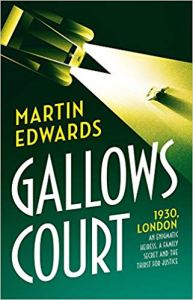
My Friday Post: Gallows Court by Martin Edwards

Book Beginnings Button

Every Friday Book Beginnings on Friday is hosted by Gillion at Rose City Reader where you can share the first sentence (or so) of the book you are reading, along with your initial thoughts about the sentence, impressions of the book, or anything else the opener inspires.

I’ve just started Gallows Court by Martin Edwards, the first in a series set in 1930s London.

Gallows Court

‘Jacob Flint is watching the house again.’ The housekeeper’s voice rose. ‘Do you think he knows about …?’

Also every Friday there is The Friday 56, hosted by Freda at Freda’s Voice.

30879-friday2b56These are the rules:

  1. Grab a book, any book.
  2. Turn to page 56, or 56% on your eReader. If you have to improvise, that is okay.
  3. Find any sentence (or a few, just don’t spoil it) that grabs you.
  4. Post it.
  5. Add the URL to your post in the link on Freda’s most recent Friday 56 post.

Page 56:

‘I told you last night not to threaten me, Mr Flint. You should heed my advice. There are worse fates than the misfortune that befell Thomas Betts.’

Blurb:

London, 1930.
A headless corpse; an apparent suicide in a locked room; a man burned alive during an illusionist’s show in front of thousands of people. Scotland Yard is baffled by the sequence of ghastly murders unfolding across the city and at the centre of it all is mysterious heiress Rachel Savernake. Daughter of a grand judge, Rachel is as glamorous as she is elusive.

Jacob Flint, a tenacious young journalist eager to cover the gruesome crimes, is drawn into Rachel’s glittering world of wealth and power. But as the body count continues to rise, Jacob is convinced Rachel is harbouring a dark secret and he soon becomes part of a dangerous game that could leave him dancing at the end of the hangman’s rope if he pursues the truth.

What do you think? Would you keep reading?

I have high expectations of this book as I’ve thoroughly enjoyed all of Martin Edwards’s books that I’ve read, particularly his Lake District murder mysteries. Gallows Court has been on my radar since it was published last year so it’s time I read it, especially as now I see that his next book, due out in March next year, is to be Mortmain Hall, a sequel to Gallows Court. 

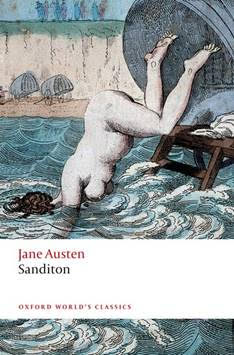
Sanditon by Jane Austen, edited by Kathryn Sutherland

Sanditon

Jane Austen has long been one of my favourite authors so I was delighted when Georgie Malcolm at the Oxford University Press contacted me to see if was interested in a review copy of a new edition of Jane Austen’s final, incomplete work Sanditon, edited with an introduction and explanatory notes on the text by Austen expert and Oxford University lecturer Kathryn Sutherland. 

In Sanditon, Jane Austen writes what may well be the first seaside novel: a novel, that is, that explores the mysterious and startling transformations that a stay by the sea can work on individuals and relationships. Sanditon is a fictitious place on England’s south coast and the obsession of local landowner Mr Thomas Parker. He means to transform this humble fishing village into a fashionable health resort to rival its famous neighbours of Brighton and Eastbourne. 

In this, her final, unfinished work, the writer sets aside her familiar subject matter, the country village with its settled community, for the transient and eccentric assortment of people who drift to the new resort, the town built upon sand. If the ground beneath her characters’ feet appears less secure, Austen’s own vision is opening out. Light and funny, Sanditon is her most experimental and poignant work.

I first read Sanditon only four years ago, in a combined publication of  Lady Susan, The Watsons and Sanditon and reviewed it in this post. I thoroughly enjoyed Sanditon, even in its unfinished state. It’s the last fiction that Jane Austen wrote, beginning it in January 1817, the year she died.

I’m looking forward to reading this new edition with great interest, particularly the introduction and the notes explaining literary allusions, references to diseases and contemporary medical treatments, Regency fashions, quasi-specialist language, etc. It certainly looks excellent!

And I see that ITV has a new adaptation by Andrew Davies of Sanditon that will air in eight parts this autumn.

  • Paperback: 128 pages
  • Publisher: OUP Oxford (25 July 2019)
  • Language: English
  • ISBN-10: 0198840837
  • ISBN-13: 978-0198840831

Top Ten Tuesday: Settings I’d Like to See More Of

top-ten-tuesday-new
I’m a day late with this post!

Top Ten Tuesday is a weekly meme created by The Broke and the Bookish and now hosted by Jana at That Artsy Reader Girl. For the rules see her blog.

This week’s topicSettings I’d Like to See More Of. One of the joys of reading is that you can be transported in time and place to anywhere in the world. I love to read about places I’ve visited as well as those I never have.

Places I’ve visited:

Wales is one of my favourite countries within the UK. . I Bought a Mountain by Thomas Firbank is just one of the books I’ve read, set in Snowdonia, or more precisely the Dryffyn Valley where on the south slopes of the Glyders Thomas Firbank bought a sheep farm in 1931. It’s a book that made me want to move to Wales immediately. 

Oxford – the City of Dreaming Spires is one of my favourite places and is captured in Colin Dexter’s Inspector Morse books. The Dead of Jericho (not the Jericho in Israel, although I have been there too – I haven’t read any books set in that Jericho) is an area of Oxford near the Oxford Canal, just outside the original Oxford City wall. It was originally a place for travellers to rest if they had reached the city after the gates had closed

Martin Edwards’s Lake District Mystery series  are novels based in various locations in the Lakes, one of the most beautiful areas of England – one of my favourites is The Arsenic Labyrinth in which Edwards explains that although the crime scene is imaginary, arsenic was mined at Caldbeck.

Appin between Oban and  Ballachulish is in a beautiful area of Scotland. Castle Stalker, a 15th century tower house built by the Stewarts of Appin is on a small island in Loch Linnhe, just north east of Port Appin. It’s the setting for Robert Louis Stevenson’s Kidnapped, a fictionalised account of the “Appin Murder” of 1752.  Castle Stalker is the location of Castle Aaaaarrrrrrggghhh in the 1975 film Monty Python and the Holy Grail.

The Cairngorms are in another beautiful part of Scotland. A book that tells of real-life mountain rescues is Cairngorm John by John Allen who was a Team Leader in the Cairngorm Mountain Rescue Team. ‘Cairngorm John’ was his call sign when in contact with Search and Rescue helicopters.

Cambridge – there must be many books set in Cambridge, but the only one I’ve read in recent years is Ninepins by Rosy Thornton set in the Cambridgeshire Fens. I’ve visited Cambridge, but not the Fens, but I learnt a lot about them in this book.

Rome – I’ve been there a few times inspired by my love of history, reading about Ancient Rome, for example in Colleen McCullough’s Master’s of Rome series of novels, and more recently in Mary Beard’s SPQR: A History of Ancient Rome.

Paris – I have plenty of books set in Paris to choose from, including Simenon’s Maigret books, Claude Izner’s Murder on the Eiffel Tower set in 1889 when the Tower was newly opened, but my favourites have to be Fred Vargas’s Commissaire Jean-Baptiste Adamsberg novels. The first one, The Chalk Circle Man is set in Paris where strange blue chalk circles start appearing on the pavements.

Pompeii and Mount Vesuvius, Italy – Robert Harris’s novel, Pompeii begins just two days before the eruption of Mount Vesuvius and builds up to a climax. A wonderful book.

Places I haven’t visited but would love to are:

Shetland Isles – to see in person the locations shown in the BBC TV Shetland series based on Ann Cleeves Perez novels with their beautiful descriptions of the landscape, conveying a real sense of place. They are all excellent, an example is Dead Water, the fifth in the series.

Another place I’d love to visit is Venice. I’ve read a few books set in Venice and amongst them are Donna Leon’s excellent Commissario Guido Brunetti detective series, for example in Drawing Conclusions. Venice comes to life for me in the descriptions of the locations. I want to read more of these books and am on the lookout for other books set in Venice.