Calendar of Crime Challenge 2020

One of the reading challenges I’ve loved doing this year is Bev’s Calendar of Crime, so I am delighted to see that she is hosting it again in 2020. This may be the only challenge I take part in next year!

This is a reading challenge that allows mystery readers to include any mystery regardless of publication date. If it falls in a mystery category (crime fiction/detective novel/police procedural/suspense/thriller/spy & espionage/hard-boiled/cozy etc.), then it counts and it does not matter if it was published in 1892 or 2019.

The Challenge runs from January 1, 2020 to December 31, 2020. All books should be read during this time period and you can sign up on Bev’s blog at any time.

I have summarised the rules below – for all the details see Bev’s sign up post.

  • All books must be mysteries.
  • Twelve books, one representing each month, are required for a completed challenge. Each month comes with several categories (see chart above) that may be selected to fulfil the month’s reading.
  • The “wild card” book is exactly that.
  • For the category that says “Book title contains a word that starts with the letter A,” the following do not count: “A” and “An.”
  • Books may only count for one month and one category, but they may count for other challenges.
  • Books do not have to be read during the month for which they qualify. So–if you’re feeling like a little “Christmas in July” (or May or…), then feel free to read your book for December whenever the mood strikes.
  • A wrap-up post/comment/email will be requested that should include a list of books read and what category they fulfilled. [Example: January: The House of Sudden Sleep by John Hawk (original pub date January 1930)]
WWW Wednesday: 27 November 2019

IMG_1384-0

WWW Wednesday is run by Taking on a World of Words.

The Three Ws are:

What are you currently reading?
What did you recently finish reading?
What do you think you’ll read next?

a beautiful corpse

Currently I’m reading A Beautiful Corpse, crime fiction by Christi Daugherty, set in Savannah, Georgia. A beautiful law student has been killed and three men close to the victim are questioned. All of them claim to love her. All of them say they are innocent of her murder.  As journalist Harper McClain unravels a tangled story of obsession and jealousy, the killer turns his focus onto her. I’ve read over half the book and it is growing on me – I’m enjoying it more and more as I read on.
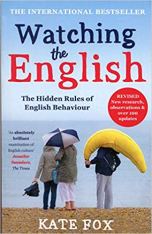
Watching the EnglishI’m also reading Watching the English by Kate Fox, a nonfiction book about the ‘Hidden Rules of English Behaviour’. I’ve only just started reading and so far it is really interesting as the author sets out her parameters and defines what she considers to be  ‘Englishness’ and why it is different from ‘Britishness’, which I think is a very tricky question and one that I have been puzzling over for years.

She refers in some instances to Jeremy Paxman (and I see from the index there are several references to him in this book) and she lists his book The English: A Portrait of a People, which I read about 5 years ago. I decided from reading his book that I didn’t really feel any clearer about what is is to be ‘English’ and it seemed there really is no such thing as ‘the English’ – we’re a mixture of all sorts, or as Paxman puts it, The English are a mongrel race‘. (page 59)

Furious hours

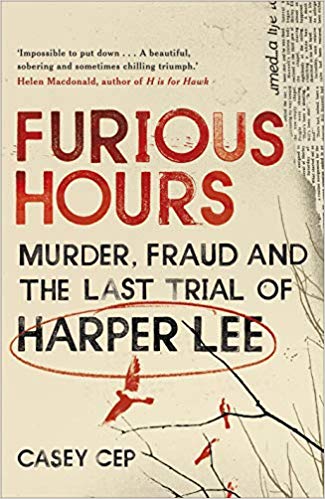
I’ve recently finished Furious Hours: Murder, Fraud, and the Last Trial of Harper Lee by Casey Cep, a nonfiction book about Willie Maxwell, an Alabama serial killer and the true-crime book that Harper Lee worked on obsessively in the years after To Kill a Mockingbird. I found this a fascinating book and posted my review yesterday

As for my next book I don’t know right now. I’m torn between wanting to read several, including A Pinch of Snuff by Reginald Hill, the 5th Dalziel and Pascoe novel, A Lovely Way to Burn by Louise Welsh, the 1st in her Plague Trilogy, Go Set A Watchman by Harper Lee and In Cold Blood by Truman Capote (the last two as I’ve just finished reading Furious Hours).

Have you read any of these books?  Do any of them tempt you? 

Furious Hours by Casey Cep

The stunning story of an Alabama serial killer and the true-crime book that Harper Lee worked on obsessively in the years after To Kill a Mockingbird

Furious hours

Cornerstone|May 2019|311 pages|e-book via NetGalley|Review copy|4*

In the first half of the book Casey Cep tells the story of the Reverend Willie Maxwell, who murdered members of his own family in the 1970s and held his rural community in Alabama, in fear and dread as they believed he was practising voodoo. He was shot dead at the funeral of his step-daughter by a relative, Robert Burns. Maxwell’s lawyer, Tom Radney, who had successfully defended Maxwell for years, then defended Burns, who confessed to the shooting, on the grounds of temporary insanity.

The second half is about the author, Harper Lee, who decided to write a book about all three men. In doing so Cep has written a remarkable biography of Harper Lee, her friendship with Truman Capote, her part in writing his book, In Cold Blood and her attempts to follow up the success of her book, To Kill a Mockingbird.

My favourite part of the book is without doubt the part about Harper Lee. All I knew about her before is that she wrote To Kill a Mockingbird, thought to be her only book until Go Set a Watchman was published in 2015. Cep explains that Watchman was an early version of Mockingbird, that Lee hadn’t edited or revised, and although it appears to be a sequel it isn’t  – it is the story she wrote first.

The section on Lee’s work in helping Capote  research his ‘nonfiction novel’ set in Kansas, In Cold Blood is equally as fascinating. They had lived next door to each other in Monroeville and as Cep phrased it ‘before Nelle was out of toddlerhood, she and Truman had become partners in crime and just about everything else.‘ (‘Nelle’ is her first name, the name she was known by for the first thirty-four years of her life, pronounced Nell, not Nellie.) Once they ran out of stories to read they started writing them. Cep goes into detail about the development of crime writing, and how Capote applied the techniques of fiction to nonfiction. Not everyone was happy with this novelisation of crime, not did they believe that Capote’s book was strictly factual, accusing him of  producing a sensational novel. Harper Lee minded very much about his fabrications, although she never objected publicly and this caused a rift between them.

So, this presented her with a challenge when it came to writing her book about Maxwell and his crimes, determined it would be based strictly on facts and she spent many years researching and writing her book, provisionally called The Reverend, but never finished it.

The sheer detail of Furious Hours made it quite a difficult book to read in some parts, digressing from the bare bones of the story into details such as the history of insurance, for example. But I was impressed by that detail and by Cep’s meticulous research. The book has an extensive Acknowledgements section, Notes and Bibliography, citing numerous books, journal articles and documentary films. And it has made me keen to read Go Set a Watchman, which although I bought a copy I have not read yet fearing it would spoil my love of To Kill a Mockingbird. I also must get round to reading Capote’s In Cold Blood, which I bought earlier this year, without knowing of Harper Lee’s involvement in the book.

My thanks to Cornerstone for an e-book review copy via NetGalley

Nonfiction November: Week 5 New To My TBR

nonficnov 19

I’ve been taking part in Nonfiction November 2019 again this year. It has now come to the end and this is the final topic!

The host this week is Rennie @ What’s Nonfiction who says ‘It’s been a month full of amazing nonfiction books! Which ones have made it onto your TBR? Be sure to link back to the original blogger who posted about that book’.

It certainly has been an amazing week in which I’ve read other book bloggers’ posts about many nonfiction books, most of them books that were completely new to me. These are just a few of the many that caught my imagination.

From Helen @She Reads Novels

  • The Wicked Boy by Kate Summerscale  – Victorian true crime
  • Decoding the Bayeux Tapestry by Arthur C. Wright – looks at the often-ignored images in the margins of the Tapestry and discusses what they add to our knowledge of the period.

From RennieWhat’s Nonfiction

From Kate @ Books Are My Favourite and Best

From Hopewell’s Library of Life

1947: Where Now Begins by Elizabeth Asbrink – a year that defined the modern world, intertwining historical events around the globe with key moments from the author’s personal history. I already have 1946: the Making of the Modern World by Victor Sebestyen, so it’ll be interesting to compare these books.

Many thanks to all the hosts of this year’s Nonfiction in November

The North Yorks Moors

October and November have been unusual months as we’ve been away a couple of times – in October we went to the  the North Yorks Moors and at the beginning of November we were in the Lake District, where amazingly we had such beautiful sunny weather, cold but sunny with a brilliant blue sky.

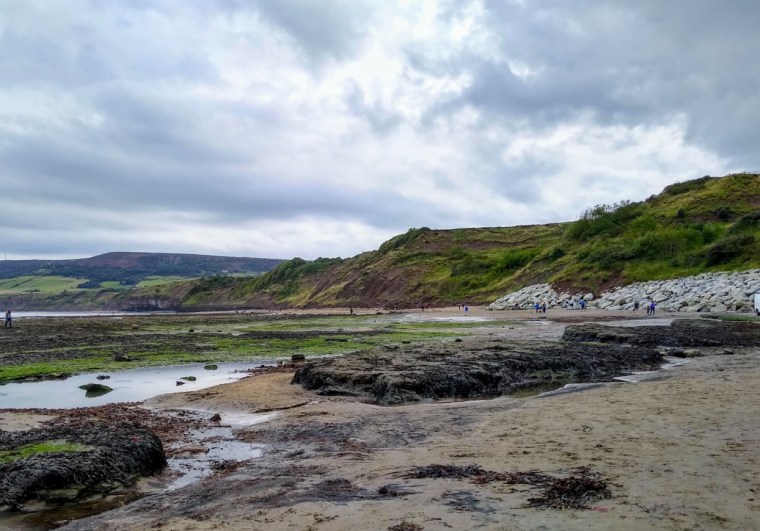
Here are a few photos of some of the places we visited whilst staying in an isolated converted barn on the North Yorks Moors. Runswick Bay, and Robin Hood’s Bay are on the east coast near Whitby Abbey. 

Runswick Bay IMG_20191002_155100773_HDR
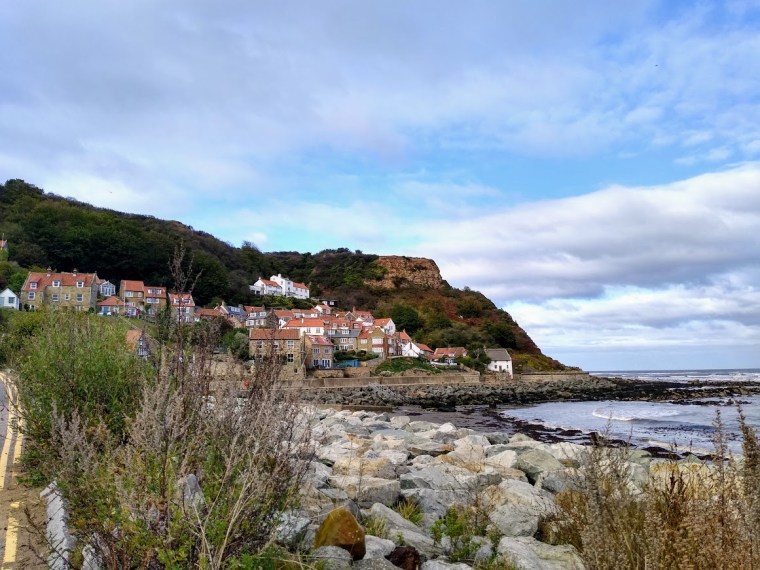
Runswick Bay

There a few red-roofed houses and cottages clinging to the cliff at Runswick Bay looking down on a long arc of beach. As the east coast is eroding the village is steadily creeping closer to the shore. The AA Mini Guide book – North Yorks Moors records that the village of Runswick, one of the ‘lost’ villages of Yorkshire’s coast, fell into the sea in 1682. The whitewashed house on the headland was the coastguard cottage.

Runswick Bay IMG_20191002_154946600
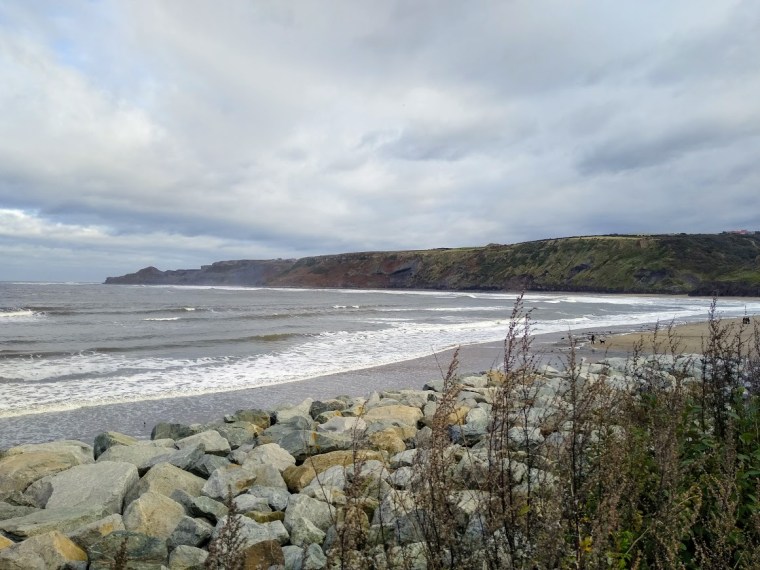
Runswick Bay

Robin Hood’s Bay is further down the coast. It’s a little fishing village, with a long, steep access road down to the bay, a long stretch of sandy beach with a rocky foreshore.

Robin Hood's Bay IMG_20190930_144925574_HDR
Robin Hood’s Bay

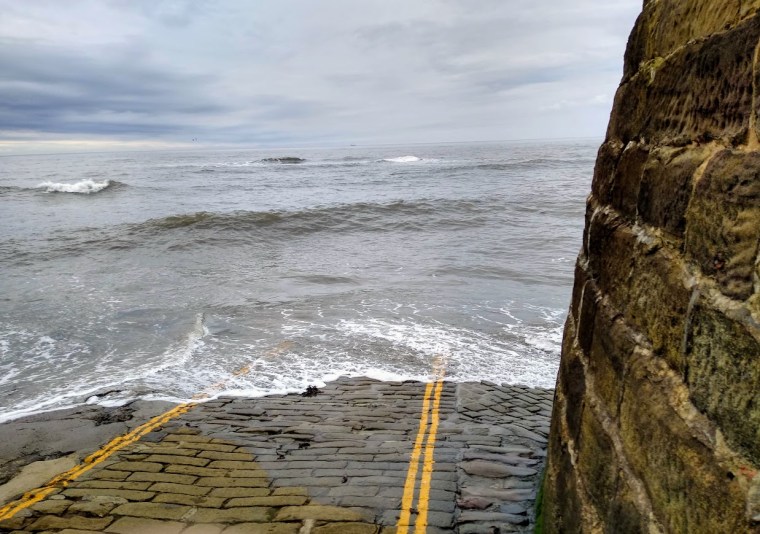
The tide comes in very quickly and we had to dash back to avoid being caught. I did get my feet a bit wet though.

Robin Hood's Bay incoming tide
Robin Hood’s Bay – the tide nearly caught me.

We had a quick look at Whitby Abbey and Whitby itself, but really need to go back to see it properly.

Whitby Abbey IMG_2899
Whitby Abbey

On the way home we stopped at the Angel of the North at Gateshead. I’d seen the Angel of the North from the A1, but we had never stopped to see it up close. It was created by Sir Anthony Gormley. Completed in 1998, it is a steel sculpture of an angel, 20 metres tall, with wings measuring 54 metres across. It is immense – the person walking up to the sculpture gives some idea of just how enormous it is.

Angel of the North IMG_20191003_132615303_HDR
Angel of the North, Gateshead

I zoomed in to have a look at its head.

Angel of the North close up

Of course, all this holidaying and travelling around has meant I am now so very behind with writing about the books I read!

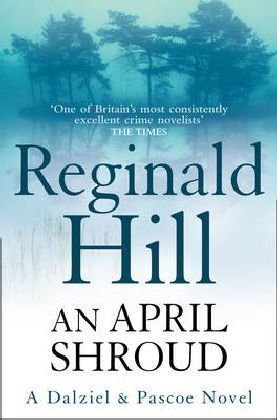
An April Shroud by Reginald Hill

April Shroud

HarperCollins|2011|326 pages|Paperback|my own copy| 3* 

An April Shroud is Reginald Hill’s fourth Dalziel and Pascoe novel, first published in 1975, in which Dalziel is on holiday and Pascoe is on his honeymoon.

From the back cover:

Inspector Pascoe may take holidays but Death never does – and neither, it seems, does Superintendent Dalziel. A watery accident on a solitary country holiday leads to the Fat Man drying off in Lake House, a nearby mansion well past its prime.

The same cannot be said for its owner, the fulsome Mrs Fielding. She has only recently buried her husband, but seems more concerned with her future. Dalziel’s curiosity is aroused – purely professionally of course – and by the time Pascoe’s honeymoon is over, there have been several more deaths and Dalziel might have compromised himself beyond redemption …

Whereas in the previous book, Ruling Passion Dalziel’s character was more of a caricature, on An April Shroud Hill develops his character more fully, in fact I think the book is primarily a superb character study of Dalziel.  He is rude, coarse and insensitive, but his capacity for getting to the bottom of a mystery is shown to be immense.

Although on holiday he cannot help but ferret out what really happened to Conrad Fielding, when he meets the Fielding family on their way back home after Conrad’s funeral. He was rescued by them when his journey south was brought to an abrupt end by floods. The police had decided that Conrad’s death had been an accident – he had fallen off a ladder onto the drill he had been using and it had pierced his heart. Mrs Fielding invites Dalziel to stay at their home, Lake House, where it soon becomes apparent to him that the family have plenty of secrets they would rather he didn’t discover.

I couldn’t easily distinguish who was who in the family, except to realise that they were all rather odd. The plot seemed over complicated and in parts I thought I was reading a farce as more bodies turned up dead. I had little idea who was guilty and the identity of the culprits took me by surprise. Dalziel’s ‘interlude’ with the widow, Bonny Fielding, was entertaining as well as revealing about Dalziel’s personal life – he is sensitive and vulnerable beneath his boorish exterior. 

Overall, I enjoyed the book, although for me it was far from Hill’s best Dalziel and Pascoe book and I’m looking forward to reading book 5, A Pinch of Snuff, as I know that the later books are much better. Reginald Hill wrote 24 Dalziel and Pascoe novels. I’ve read some of them and currently I’m reading my way through the rest.

These are the Dalziel and Pascoe books I’ve read so far:

1. A Clubbable Woman (1970) 
2. An Advancement of Learning (1971)
3. Ruling Passion (1973)
4. An April Shroud (1975) 
8. Exit Lines (1984)
11. Bones and Silence (1990) 
14. Pictures of Perfection (1993) – read, no post
17.On Beulah Height (1998) 
20. Death’s Jest Book (2002) 
21. The Death of Dalziel (2007)

Reading Challenges: Mount TBR 2019 (a book I’ve owned for four years) and the Calendar of Crime 2019 challenge (for the month of April – a book with the month in the title).