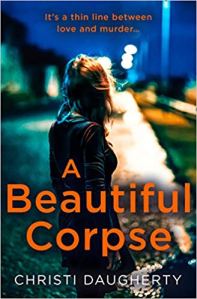
The Christmas Card Crime and Other Stories edited by Martin Edwards (British Library Crime Classics)

Here is another collection of short stories from the Golden Age of Murder edited by Martin Edwards: The Christmas Card Crime and Other Stories.
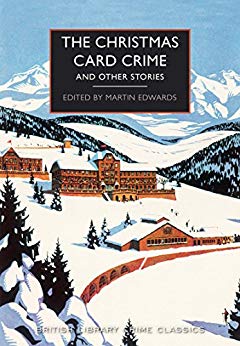
Christmas Card Crime

Poisoned Pen Press, in association with the British Library|1 October 2019|Print length 240 pages|e-book |Review copy|4*

There are eleven stories all set during the Christmas season in this collection and an introduction by Martin Edwards. In it he points out the differences between a short story and a novel. It’s not just the length, but it is also the fact that in a short story there is little space to develop the characters in depth or for lengthy descriptions, so ‘every word must be made to earn its keep‘. He has also prefaced each story with a biographical note, which I found useful as some of the authors were new to me.

The mysteries range in date of publication from 1909 up to 1965. I’ve read stories by some of the authors before, such as Baroness Orczy, John Dixon Carr, Ronald Knox, E C R Lorac, John Bude and Julian Symons, but others were new to me. The ones I enjoyed the most are:

The Motive  Ronald Knox. This story first appeared in The London Illustrated News in November 1937 and is about an attempted murder in a smart hotel on the English Riviera, by a character named ‘Westmacott’ (a pen name used by Agatha Christie).. On Christmas Day after a party the guests decided to play a version of ‘blind man’s buff’ in the swimming pool, which didn’t go as planned.

Another version of ‘blind man’s buff‘, this time called ‘blind man’s bluff‘, is played in the next story also with disastrous consequences.

Blind Man’s Hood by John Dickson Carr writing as Carter Dickson. This first appeared in the Christmas edition of The Sketch in 1937 and is a story inspired by the unsolved Peasonhall murder case of 1902. It is a strange tale about a young couple arriving to spend Christmas with friends, only to find the house empty – except that is for a young woman carrying a white bag, who tells them about a game of ‘Blind Man’s Bluff’ that went very wrong, years ago. It’s a variation on a locked room mystery, with a touch of the supernatural.

Crime at Lark Cottage by John Bingham – this first appeared in the 1954 Christmas Number of The London Illustrated News. Bingham was the 7th Earl of Clanmorris, a journalist who was recruited into MI5, where he worked with David Cornwell, who later wrote spy novels under the name of John Le Carré. This story and the next are my two favourites in the book. It is the story of an escaped convict and an isolated country cottage occupied by a young woman and her little daughter one snowy Christmas. Very atmospheric and tense with an unexpected ending. I’d like to read more of John Bingham’s work.

‘Twixt the Cup and the Lip by Julian Symons – this first appeared in Ellery Queen’s Mystery Magazine in January 1965). Longer than the other stories in this collection it is the tale of Mr Rossiter Payne, a meticulous bookseller who plans a perfect robbery – to steal the jewels, that had once belonged to the Russian royal family, on display in a London department store at Christmas. But Mr Payne had made an uncharacteristic error …

Overall, I enjoyed reading this collection, with a mix of excellent short stories and some that I thought  were too short and had disappointing or predictable endings.

My thanks to the publishers for my review copy via NetGalley.
Two Crime Fiction Titles

I’m behind with reviewing the books I’ve read, so here are short reviews of two crime fiction novels I’ve read recently:

Broken ground

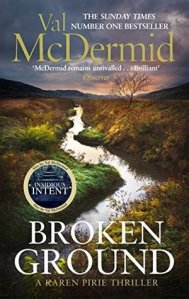
Broken Ground by Val McDermid, the 5th Karen Pirie book. 4*

This begins in 1944 when two men bury a couple of wooden crates in a peat bog in Wester Ross in the Scottish Highlands. Seventy four years later Alice and her husband Will are on a treasure hunt, following a map Alice’s grandfather had left her. But they are astonished when discover the body of a man in the peat bog together with one of the crates. Perfectly preserved it appeared at first that this was a case for Karen’s friend Dr River Wilde, the forensic anthropologist. But the fact that the man was wearing a pair of Nikes, dating the body back to the 1990s ruled out that idea, which made it a case for Karen Pirie and her Historic Cases Unit.

This is a very readable book, moving swiftly along, that I really enjoyed. Karen has to cope with the unwelcome addition to her team of DS Gerry Mcartney. The ACC, Ann Markle and Karen just don’t get on and Karen suspects Markle is using McCartney to keep tabs on her and find a way to close the Unit down. It is a complicated case as attention switches back to events in 1944, the 1990s and the present day, although the actual murder mystery isn’t that difficult to work out.

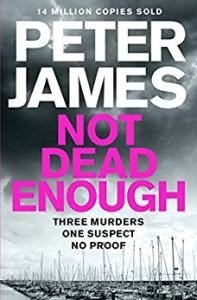
Not Dead EnoughNot Dead Enough by Peter James, the 3rd Detective Superintendent Roy Grace book. 4*

It’s set in Brighton and begins with the murder of Katie Bishop. The immediate suspect is her husband Brian, but it appears that he couldn’t be the murderer unless he could have been in two places at once. Then Sophie Harrington is killed. She had been having an affair with Brian thus intensifying the police investigation into his movements and background.

Grace’s wife, Sandy, had disappeared nine years earlier and he is still wondering what happened to her even though he is now involved with Cleo Morey, the Chief Mortician and he takes a quick trip over to Munich when his friends tell him they had seen her there.

This is a re-read. I first read it in January 2014 and it was only when I reached the part about Sandy that I realised I had read it before. I think that this is because the two murders are particularly gruesome and either I’d scan read them before or had blocked them out of my mind. Apart from the gruesome murders I enjoyed this book and intend to carry on reading the Roy Grace books.

Top Ten Tuesday: Holiday Reading

top-ten-tuesday-new

Top Ten Tuesday is a weekly meme created by The Broke and the Bookish and now hosted by Jana at That Artsy Reader Girl. For the rules see her blog.

This week’s topic: is Books you love reading during the holiday season. Here are some Christmas themed books I’ve read in the past and one I want to read this year.

  1. A Christmas Carol by Charles Dickens, I often re-read this around Christmas time. This was the first Dickens I read. My Great Aunt gave me this for Christmas one year when I was a child and I’ve loved it ever since.
  2. The Big Book of Christmas Mysteries:The Most Complete Collection of Yuletide Whodunits Ever Assembled edited by Otto Penzler is a big book of 647 pages – so I have an e-book version and dip into into it each Christmas.
  3. A Maigret Christmas by Georges Simenon –  the Inspector receives two unexpected visitors on Christmas Day.
  4. Hercule Poirot’s Christmas by Agatha Christie – Christmas Eve with the Lee family and Poirot.
  5. The Christmas Train by David Baldacci – part detective story, part disaster movie, part romance.
  6. The Santa Klaus Murder  by Gladys Mitchell, a classic locked room murder mystery.
  7. The Christmas Mystery by Jostein Gaarder is a good book to read during Advent.
  8. A Feast for Advent Delia offers help in escaping for a few minutes each day to contemplate the meaning of Christmas, providing a journey through Advent, illustrated with photographs.
  9. Skipping Christmas by John Grisham. This is not the usual Grisham legal thriller, but a very funny little book about the horrors, commercialisation and expense of Christmas.
  10. Snow on the Cobbles by Maggie Sullivan – to read. Christmas on Coronation Street at the end of  the Second World War.


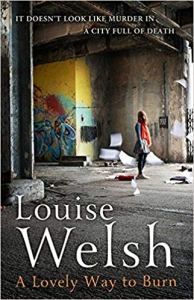
A Lovely Way to Burn by Louise Welsh: Mini Review

A Lovely Way to Burn

John Murray|2004|358 pages|Hardback| Library book|4*

I’ve read a few of Louise Welsh’s books and enjoyed each one so when I saw this on the library shelves I borrowed it. I agree with Val McDermid’s description of it on the back cover: ‘a terrifying journey into the possible, this is dystopia for today. Feral, frightening and fascinating, A Lovely Way to Burn gripped and chilled me in equal measure.

Once I started reading I just didn’t want to stop. I was gripped as Stevie Flint, a presenter on a TV show, Shop TV, finds her boyfriend, surgeon Simon Sharkey, lying dead in his apartment. At first it appeared that he had died of natural causes and then that he had killed himself. But he had left a hidden note for her with instructions to deliver his laptop to Malcolm Rhea, a colleague at St Thomas’s Hospital. Under no circumstances was she to take it to the police or to entrust it anyone except Rhea. Stevie is determined to find out what happened to him. Her search takes her into the most dangerous situations.

It is a horrifying vision of what could happen when a new and unidentified virus, known as ‘the sweats’ sweeps the globe. London quickly descends into chaos – supermarkets are looted, roads are gridlocked as people try to flee the infection, then society just crumbles as people look out only for themselves, rioting and eventually succumbing to the mysterious illness and dying. 

After quite a leisurely start the pace picks up, and the tension rises rapidly before reaching a nightmare scenario as decay and disintegration set in. It’s a mix of murder mystery and a surreal and frightening story of a plague. This is the first in Louise Welsh’s Plague Trilogy, but it is complete in itself. I have the second book, Death is a Welcome Guest and it looks as though it has a new set of characters – I’m looking forward to reading it!

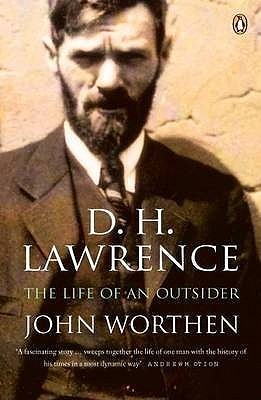
D H Lawrence: The Life Of An Outsider by John Worthen

D H Lawrence

Penguin Books|2006|518 pages|5*

In April I began reading  D. H. Lawrence: the Life of an Outsider by John Worthen, a biography. It is one of my TBRs as I bought it in 2008 when I visited D H Lawrence’s birthplace at Eastwood, 8 miles from Nottingham.

He was born in 1885 in a row of miners’ houses, a two up, two down redbrick house. The adjoining end terrace house is now a museum and shop (where I bought the book).

I find writing about biographies difficult. This book, in particular, is hard to summarise. I read the book slowly in short sections, reading it most days. It’s a detailed portrait of his life from his birth in 1885 in Eastwood in Nottinghamshire to his death at the age of 44 in 1930. An ‘outsider’, he always felt he didn’t fit in or belong either with his family, or his work colleagues, or the literary elite of the times.

By 1908 writing had become a necessity to him – writing poetry, but he was too insecure to send any of it to a publisher. At that time he was working in Croydon as an elementary teacher. He began writing his first novel, which by October 1910 he was calling ‘Paul Morel‘ . It later became ‘Sons and Lovers.’  It was in 1912 that he first met Frieda Weekley, whom he later married. She was then married to Ernest Weekley, a Nottingham University professor of modern languages.

Once he had left Eastwood he travelled in search of a place where he could be himself, but despite staying in different places, with friends, in hotels and in rented accommodation he felt he was really unable to find a place of his own. The maps at the beginning of the book illustrate this with maps of Lawrence’s Eastwood, of the places he lived in England, in Italy and in America and Mexico. Part of his need to find a place of his own was purely physical – he suffered from tuberculosis and he was searching for a climate where he could breathe easily. His final months were full of pain and suffering and he died in Bandol, France on 2 March 1930.

Worthen writes in depth about Lawrence’s personal life, his relationship with his family and in particular with his mother, Lydia and then his wife, Frieda, as well as his numerous friends and acquaintances, because although he thought of himself as an outsider he needed his friends. Lawrence was prolific, writing novels, short stories, plays, poems, letters, essays, nonfiction books, travel literature, and so on, as well as producing numerous paintings (some of which were on display at his Birthplace Museum).

D H Lawrence photos

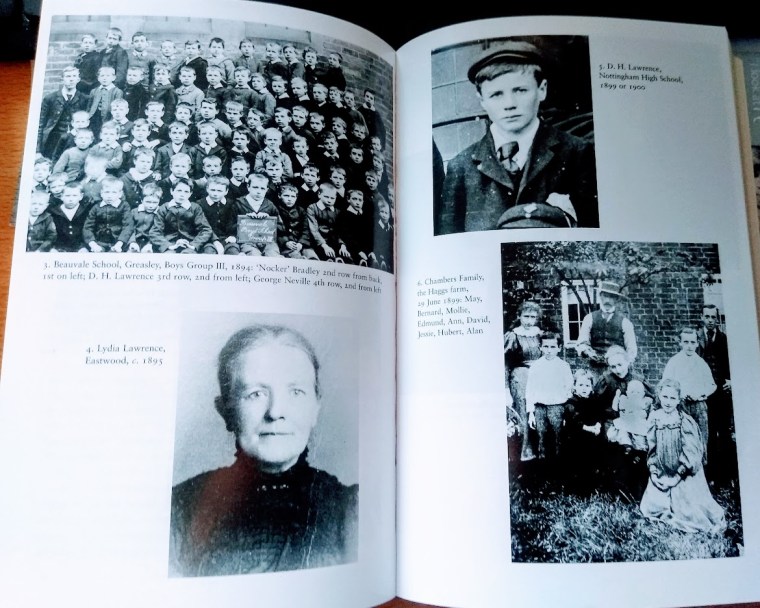
Worthen writes in great detail about his work, quoting from original sources, and tracing his development as a writer. There are 38 photographs, the first taken c.1886 of Lawrence as a baby in a pram to a photo of a clay head of him made in 1930 by Jo Davidson. I found it all fascinating, giving a portrait of a man often misunderstood by his contemporaries and criticised for being sexist, racist, a misogynist, a fascist and a colonialist. Worthen, however, writes:

He was in reality generous to women and men alike, and to all races and colours. He wrote wonderfully all his life about his experience of the natural world; he was more perceptive than almost any writer, before or since, about the effects of civilisation upon instinct and desire. He has constantly been attacked because his writing constantly thought things through in public. But it is, uncannily, as if Lawrence knew where both his contemporaries and those after him would be most sensitive and anxious, and concentrated his writing on those very subjects: sex, gender roles, the exercise of power. He intuitively worked his way into the concerns and anxieties of his contemporaries, though by doing so he also confirmed his alienation from his own age and (now) perhaps from ours. (pages xxv – xxvi)

I have read just a few of Lawrence’s novels – Women in Love, Sons and Lovers, The Virgin and the Gypsy, St Mawr, and The Man Who Died. I haven’t read Lady Chatterley’s Lover yet, but when I do I’ll look back at Worthern has to say about it.

About the author:

John Worthen  taught at universities in North America and Wales before becoming Professor of D. H. Lawrence Studies at the University of Nottingham, where he remains Emeritus Professor. His career as Lawrence’s biographer began in the 1980s, resulting in the first of a three-volume Cambridge biography – D. H. Lawrence: The Early Years 1885 – 1912. In 2001 Yale University Press brought out his group biography The Gang: Coleridge, the Wordsworth and the Hutchinsons in 1802. His newest biography is a life of the great German composer Robert Schumann, while he also plans to write a biography of Frieda von Richthofen, concentrating wholly on her life before she met D. H. Lawrence.

A Beautiful Corpse by Christi Daugherty

a beautiful corpse

Harper Collins|March 2019|384 pages|e-book via NetGalley|Review copy|5*

I saw A Beautiful Corpse by Christi Daugherty on NetGalley and thought I would like it from the description, but not expecting to enjoy it as much as I did. I didn’t realise that it’s the 2nd in the Harper McClain series but I think it works very well as a standalone.

I liked a lot about it – it is well written, has a fast-paced plot, but not at the expense of the characters, and it’s set in Savannah, with its historic buildings, parks and ancient oak trees covered in Spanish moss.

Harper McLain is a crime reporter with the Savannah Daily News. The book begins late one evening as she is playing pool in the Library Bar with her friend and bartender, Bonnie. The crime photographer rings her, telling her about a murder on downtown River Street, a narrow cobblestoned lane between the old wharves and warehouses and the Savannah River. And she is shocked to discover that the young woman sprawled on the uneven cobbles is Naomi, a law student, who had worked with Bonnie at the Library Bar. She had been shot dead.

There are three men who are all suspects, but her current boyfriend Wilson Shepherd is the prime suspect. The Library Bar owner, Fitz, is also a suspect especially as no one has seen him after the shooting. And then there is her ex-boyfriend Peyton Anderson, the powerful DA’s son. The police are convinced that Wilson is the killer, but after Harper talked to him, she just can’t believe that it was him. There were no witnesses to the shooting and when Harper talks to Jerrod, Naomi’s father, she realises that Peyton’s alibi may not be as solid as the police maintain it to be. 

This a story of obsession and jealousy and the tension rises as the killer’s focus shifts on to Harper herself. She is a strong determined character, determined to find out the truth. But as well as the murder investigation Harper has her own personal problems to contend with. Her job as a reporter is under threat, someone is breaking into her apartment and her personal relationship with Detective Luke Walker seems about to be revived, but she is wary where it will end. On top of all that she is desperate to find out who had killed her mother twelve years earlier. 

I loved it and it has made me eager to read the first book, The Echo Killing, to find out more about Harper and her background and also to read the next book in the series – Revolver Road due to be published in March next year – to find out what happens next.