The Last Protector by Andrew Taylor

London, 1668 – A dangerous secret lies beneath Whitehall Palace…
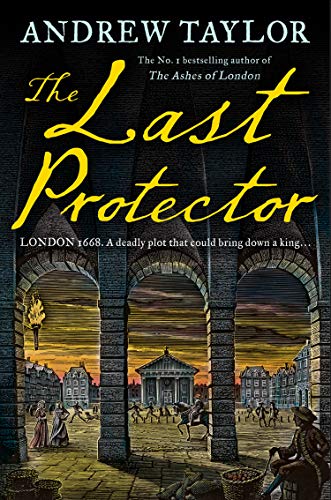
The Last Protector HarperCollins|2 April 2020|419 pages|ebook |Review copy via NetGalley|4* The Last Protector is the fourth book in Andrew Taylor’s series featuring James Marwood, a government agent and Cat (Catherine) Lovett, set in Restoration England. The year is 1668 and the exiled Richard Cromwell, son of Oliver, heavily in debt, has returned in disguise to England. Charles’ extravagant life style and licentious behaviour has now lost him the support of the people and many are hankering after the old days under Oliver Cromwell and then his son, Richard as Lord Protectors. He needs Parliament to vote him the funds to pay off his debts, maintain his court and fund the expansion of the navy and is relying on the Duke of Buckingham for support. However Marwood’s masters suspect that Buckingham is secretly conspiring against the King and assign him to spy on him.  Cat, a regicide’s daughter, is married to Simon Hakesby, an elderly and ailing surveyor and architect. She knew Richard’s daughter Elizabeth as a child and finds herself drawn into the Cromwells’ plan to recover a package Richard’s mother had hidden in the Cockpit in the gardens of the Palace of Whitehall just before her death; a package Richard hopes would be sufficient to clear his debts. He turns to the Duke of Buckingham for support in gaining access to the Cockpit. Buckingham is keen to use Richard in his plans to gain power. Cat, who now is unhappy in her marriage, resentful of Simon’s demands on her, is reluctant to get involved but unfortunately for her Simon is eager to help, and they soon find themselves in great danger. She is reluctant to ask for Marwood’s help fearing they could be charged with treason. Like the earlier books in the series this is a gripping story, full of historical detail, complications, intrigue and danger. The characterisation is brilliant with memorable characters such as Ferrus, a mazer-scourer’s labourer, who lives a terrible life, forced to sleep in a kennel with Windy, a vicious dog that guards the kitchen yard at the Cockpit. Treated brutally by his master, Ezra Reeves, his job is to clean the sewers. He is starved so he can squeeze himself down unto the foul stinking mess of the sewers, bending his long thin arms and legs. The stench of London comes across very vividly in this novel. Then there is Chloris, the kind-hearted prostitute, who helps Marwood.  This is a book full of action too, with a swiftly moving plot and a climatic ending. It is full of suspense and surprises. Andrew Taylor is a supreme storyteller, combining fact and fiction – his novels are full of historical details that slot seamlessly into his stories. I’ve read all  the earlier books and loved them too – The Ashes of London (set in 1666, six years after Charles II was reinstated as King) and The Fire Court (set in 1667, eight months after the Great Fire of London), and The King’s Evil (set seven months later). It is not necessary to read the earlier books as I think they all work well as standalones, but I think it really helps if you do. Many thanks to the publishers, HarperCollins for my review copy.

When Are You Reading? Challenge 2019

The When Are You Reading? Challenge for 2019, hosted by Sam at Taking on a World of Words has now ended. It involved reading a book predominantly set in each of the twelve time periods. I didn’t manage to read a book for each time period, missing the earliest two, that is Pre 1300 and 1300 -1499.

For the period 1500 – 1699 I have divided it into 1500 – 1599 and 1600 – 1699 as I read books set in both centuries. And for some of the periods I have read several books but have chosen just one to include in my list:

Pre-1300:

1300-1499:

1500-1599: The Man on a Donkey by H F M Prescott

1600-1699: The Seeker by S G Maclean

1700-1799: The Potter’s Hand by A N Wilson (a re-read my link takes to the review when I first read it in 2014)

1800-1899: The Doll Factory by Elizabeth Macneal

1900-1919: Greenmantle by John Buchan

1920-1939:  The Tea Planter’s Wife by Dinah Jefferies

1940-1959: Dear Mrs Bird by A J Pearce

1960-1979: Ask Again, Yes by Mary Beth Keane

1980-1999: The Lost Letter from Morocco by Adrienne Chinn

2000-Present: 2013 The Ruin by Dervla McTiernan

The Future: The Passengers by John Marrs

Links from the titles will take you to my reviews.

The Adventures of Maud West, Lady Detective by Susannah Stepleton

Narrative Non-Fiction 4*

Adventures of Maud West

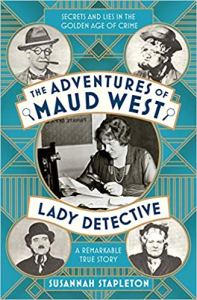
The Adventures of Maud West, Lady Detective, by Susannah Stapleton and published by Picador, is subtitled ‘Secrets and Lies in the Golden Age of Crime‘. With a title like that I thought it sounded just the sort of book I would like – and I did.

It is so intriguing – was Maud West really who she said she was? Susannah Stapleton discovered that she really did exist and was indeed a private investigator with her own detective agency, based in London in the early part of the twentieth century, from 1905 onwards.  The book gives plenty of extracts from Maud West’s own accounts of her investigations under Golden Age crime fiction titles such as The Lady Vanishes, The Body in the Library, and They Do It With Mirrors, for example. But these accounts had me wondering just what was the truth and what was fiction. They are so incredible! Maud was truly an amazing person – a master of disguise, equally able to pass herself off as a man, or a fortune teller, or a parlour maid, and skilled with a revolver, able to face down blackmailers. There are photographs of Maud – at work in her office and in a number of disguises. And it was not just in Britain – she worked all over the place including  New York, Cape Town, Brazil, and Jakarta. 

But what makes the book so good, and what kept me glued to the pages are the details of how Susannah Stapleton went about her research, included within the main narrative of her book. I haven’t come across this before – usually  an author lists the sources used at the end – and there is just such a list (a very long and comprehensive list) at the end of this book.  I was more intrigued by Stapleton’s own methods of research into finding out about Maud than I was by Maud herself.

 I also loved all the details of the changing society in which Maud lived – the role of women in the struggle for equality, details of the living and working conditions and of the crimes that real life private detectives investigated – divorces, missing persons, adultery and theft.

It more than lived up to my expectations, but I am still wondering did she really do what she said she did? Whatever the truth she was a complex woman and a very private one at that.

Many thanks to the publishers, Picador, for my review copy via NetGalley.

The Bear Pit by S G MacLean

Bear Pit

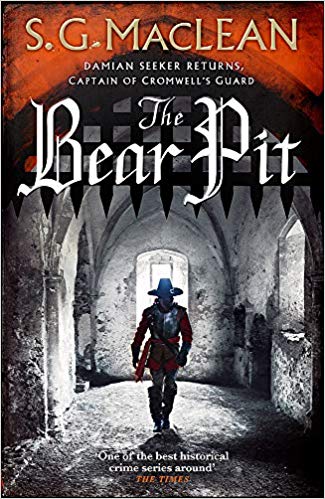
Quercus/ 11 July 2019/Paperback/ 416 pages/ Review copy/ 5*

S G MacLean is one of my favourite authors of historical fiction, so I was delighted to read her latest book, The Bear Pit.  It is the fourth book in her Damien Seeker series, set during the Interregnum under Oliver Cromwell, the Lord Protector. I’ve read the previous three books. Reading them takes me back to England in the 17th century, a time and a place full of danger and unrest, teeming with spies, exiles and assassins. Whilst I  was happy to read them as standalones, I think it would help to follow the progression of events if they are read in order.

This one begins in September 1656 as three men are waiting for Oliver Cromwell to emerge from Westminster Abbey on his way to the State Opening of Parliament in Parliament House. Their plan to assassinate Cromwell had been in preparation in Cologne and Bruges for a year and a half, but that day it was thwarted. However, they will not give up.

Damian Seeker, Captain of Cromwell’s Guard, works for John Thurloe, Cromwell’s Chief Secretary and spy master, in charge of the security of the regime, running a virtual secret service. Thurloe is floundering under all the reports from the Continent about plots against Cromwell’s life and to reinstate Charles Stuart as King. He tells Seeker until they have corroboration of the rumours they don’t have the time or capability to look into the matter. Not wanting to go against Thurloe’s orders, Seeker decides to take part in a raid on an illegal gaming house which ends with the discovery of the body of an elderly man chained to the wall by his neck and half eaten, obviously ravaged by a bear. But bear baiting had been banned and all the bears had been shot recently – or so it was claimed. Where had the bear come from and why was the man killed? And what connection, if any, does the murder have to the plots to kill Cromwell?

Like all good historical fiction The Bear Pit blends historical fact and fiction. There was indeed a plot to assassinate Cromwell in the autumn and winter of 1656 as described in the novel, whereas the mystery of the man killed by a bear and the subsequent search for the bear’s whereabouts are fictional. 

Some of the things I enjoy in this book are the return of characters from the earlier books -Sir Thomas Faithly, Lawrence Ingoldby, Manon, Marie Ellingworth, to mention just a few, and the glimpses we see of other historical figures – such as John Evelyn, a young Samuel Pepys, the poet Andrew Marvell as well as John Milton and one of my favourite historical figures when I was at school – Prince Rupert of the Rhine. I was fascinated by the details of The Cabinet of Curiosities, assembled by John Tradescant and his son, in Tradescant’s Garden in South Lambeth. In her Author’s Note S G MacLean states that these were indeed, very much in existence and were open for business as well as being a public attraction. The remains of the collection are held in Oxford’s Ashmolean Museum. 

S G MacLean is a wonderful storyteller and her books are full of authentic detail skilfully interwoven in the stories without holding up the action. The Bear Pit is a fast-paced book, full of action and danger and wonderful characters, especially in the figure of Damien Seeker. He is the hero of the book – strong, dedicated to his work, indefatigable in his search of the truth and loyal to his friends and colleagues. The atmospheric setting complements the plot – the streets of London in winter, the cold, fog and damp and in particular Bankside in Southwark and the eerie atmospheric wastes of Lambeth Marsh. I was completely absorbed in the book. I found it compelling reading both the murder mystery and the assassination plot gripped me and I raced through it, eager to find out what happened. I was absolutely incredulous at the ending though, but it does give me hope that there may be fifth Damian Seeker novel.

Many thanks to the publishers, Quercus, for my review copy via NetGalley.

A Snapshot of Murder by Frances Brody

A Snapshot of Murder (Kate Shackleton #10)


Crooked Lane Books |19 April 2019|Print length 339 pages|e-book review copy|3*

Blurb (Amazon):

Yorkshire, 1928. Indomitable sleuth Kate Shackleton is taking a well-deserved break from her detective work and indulging in her other passion: photography. When her local Photographic Society proposes an outing, Kate jumps at the chance to visit Haworth and Stanbury, in the heart of Brontë country, the setting for Wuthering Heights.

But when an obnoxious member of their party is murdered, the group is thrown into disarray. Is the murderer amongst them, or did the loud-mouthed Tobias have more enemies than they might have imagined?

Armed with her wit and wiles, and of course her trusty camera, it’s up to Kate to crack the case, and get that perfect shot too . . .

A Snapshot of Murder by  Francis Brody is the 10th in her Kate Shackleton series. I’ve read three of her earlier books and I have to say that I didn’t enjoy this one as much. I think, though, that the setting is excellent, particularly in Haworth when the Bronte Parsonage Museum was opened in 1928. But I was disappointed to find that the murder could have taken place anywhere – it no connection to the Brontes, or to the opening of the Museum, apart from the fact that the murderer took advantage of being in a crowd of people and managed to slip away unnoticed. 

I like Kate Shackleton – she’s a competent private investigator, but the murder mystery was too easy to solve. It began well but it was obvious who was going to end up dead and although there are several suspects, it soon became obvious who the culprit was and my interest waned. And any sympathy I had for the murderer had just disappeared by the end of the book.

My thanks to the publishers, Crooked Lane Books for my review copy via NetGalley.

The Seeker by S G MacLean

The Seeker (Damian Seeker, #1)

Quercus/ 9 May 2016/Paperback/ 432 pages/ Library Book/ 4*

The Seeker by S G MacLean is the first book in her Damian Seeker series, historical crime fiction set during the Interregnum under Oliver Cromwell, the Lord Protector. This one is set in 1654. I’ve read the second and third books in the series and whilst I  was happy to read them as standalones now I’ve read the first one I think it would have better if I had read them in order.

Damian Seeker, Captain of Cromwell’s Guard, works for John Thurloe, Cromwell’s Chief Secretary and spy master, in charge of the security of the regime, running a virtual secret service. He is an enigmatic character, and very little is revealed about his background until very near the end of the book. In the later books, particularly in the third, Destroying Angel, I learnt a lot more about him.

Like the later books The Seeker transported me to another time and place. It was as though I was back in England in the 17th century, a place of unrest, teeming with spies, exiles and assassins. Agents, sometimes clergymen or merchants, working for Cromwell, infiltrated the Royalists abroad supporting the future Charles II; the universities too were useful with dons expert at deciphering coded messages, and there was a highly effective postal service intercepting mail to suspect individuals before being resealed and delivered. And in London, bookshops, taverns and coffee houses were places where conversations were overheard and reported to the authorities.

England in 1654 is a Republic in name only, Parliament had been dissolved in 1653 and Cromwell was appointed as Lord Protector – King in all but name, he lived in the former Palaces of Whitehall and Hampton Court and his generals imposed even greater restrictions on the freedoms of the public.

It’s a complex novel, as Seeker investigates the murder of Lieutenant John Winter, one of Cromwell’s favoured officers in his New Model Army. He had found Elias Ellingworth, a radical lawyer and journalist, and an outspoken critic of Cromwell’s regime, standing over the bleeding body clutching a knife. But Seeker is not convinced of his guilt and thus the search for the real culprit begins. It takes in royalist plots, the slave trade, dodgy merchants’ deals and an attempt on Cromwell’s life. There are many characters and I had little idea who had killed Winter until right at the end, so I read eagerly trying to work it all out.

Having read three of  the series I particularly like Damian Seeker. He is definitely a man to have on your side, a man both respected and feared, and a man to trust. The books are based on solid historical research (S G Maclean has an M.A. and Ph.D. in History from the University of Aberdeen) bringing the atmosphere and tenor of the 1650s to life before my eyes. I particularly liked all the detail about Kent’s Coffee House. I thoroughly enjoyed it and wanting to know more about the period and Cromwell I’ve bought Antonia Fraser’s book, Cromwell: Our Chief of Men.

The Bear Pit, the fourth book in the Seeker series, is due out on 11 July this year.