Books I Enjoyed But Rarely Talk About

top-ten-tuesday-new

Top Ten Tuesday is a weekly meme created by The Broke and the Bookish and now hosted by Jana at That Artsy Reader Girl. For the rules see her blog.

This week’s topic is Books I Enjoyed but Rarely Talk About (This is for the books you liked, but rarely come up in conversation or rarely fit a TTT topic, etc.)

These are books I read before I began blogging. First is book I bought in an airport bookshop waiting to board a plane:

It’s Fortune’s Rocks by Anita Shreve. I had never heard of Anita Shreve, but I liked the look of this book – and the fact that it’s a chunky book of nearly 600 pages, so, good to read on holiday. It’s set in the summer of 1899 when Olympia Biddeford and her parents are on holiday at the family’s vacation home in Fortune’s Rocks, a coastal resort in New Hampshire. She is fifteen years old and this is the story of her love affair with an older man. I read more by her later and whilst I enjoyed her early books, I wasn’t so taken with her later ones.

Carol Shields is another author I’d never heard of until picked up Happenstance whilst at Gatwick Airport, waiting for another plane to go on holiday. I began reading it in the departure lounge, then on the plane and round the hotel pool, then passed it on to my husband. It’s written in two halves – one telling the wife’s story, then you turn the book round and upside down and there is the second half  telling the husband’s. Both tell their stories of a certain period in their lives from their own point of view. I read the wife’s side first. I didn’t talk about it to my husband just gave him the book and he read the husband’s side first. Then we discussed it and of course we both had different views on it. I’ve since read and enjoyed several more of her books

The Memory Box – Margaret Forster – A young woman leaves a sealed memory box for her baby daughter before she dies. Years later, as a young woman herself, Catherine finds her mother’s box full of unexplained, even bizarre objects. Finding out what the objects represent is her only chance to find out about the mother she never knew. A lovely book.

The Thornbirds – Colleen McCullough. I read this many years ago and have never forgotten it. In the rugged Australian Outback, three extraordinary generations of Cleary’s live through joy and sadness, bitter defeat and magnificent triumph – driven by their dreams, sustained by remarkable strength of character…and torn by dark passions, violence and a scandalous family legacy of forbidden love.

The Falls – Joyce Carol Oates. this was the first of Oates’ books I read and I loved it. A man climbs over the railings and plunges into Niagara Falls. He’s a newly-wed, and his bride has been left behind in the honeymoon suite the morning after their wedding. For two weeks, Ariah, the deserted bride, waits by the side of the roaring waterfall for news of her husband’s recovered body.

Possession – A S Byatt is an exhilarating novel of wit and romance, at once a literary detective novel and a triumphant love story. It is the tale of a pair of young scholars investigating the lives of two Victorian poets. Following a trail of letters, journals and poems they uncover a web of passion, deceit and tragedy, and their quest becomes a battle against time.

Miss Garnet’s Angel by Salley Vickers combines two stories, that of Julia Garnet, a retired school teacher, who goes to Venice prompted by the death of a friend, and that of  Tobias and the Angel, which she sees in the Guardi panels in the Chiesa dell’ Angelo Raffaele. This is a beautiful book.

The Soldier’s Return – Melvyn Bragg, a novel about the aftermath of the Second World War. Sam Richardson returns home to Wigton in Cumbria where he finds the town little changed. But the war has changed him. His six year old son barely remembers him and his wife has gained a sense of independence from her wartime jobs. There are two further books to complete the story – A Son of War and Crossing the Lines. All three books are outstandingly good.

Glittering Images – Susan Howatch. The first in her Church of England series. I loved the whole series when I read them years ago. This book is set in 1937 and beneath the smooth surface of an episcopal palace lurks the sordid breath of scandal. Charles Ashworth, a Canon to the Archbishop of Canterbury is sent to untangle the web of corruption, only to become involved himself. I’m not an Anglican so I was fascinated by the description of the hierarchy within the church as well as all the scandals.

An Alien at St Wilfred’s by Adrian Plass is another book about an Anglican church, but this is very different from Susan Howatch’s series. It’s very funny, about a small alien, calling himself Nunc who comes to live in a parish church and learns to speak Prayer Book English. His effect on the vicar and the congregation is hilarious.

Top Ten Tuesday: Books I Bought/Borrowed Because…

top-ten-tuesday-new

Top Ten Tuesday is a weekly meme created by The Broke and the Bookish and now hosted by Jana at That Artsy Reader Girl. For the rules see her blog.

This week’s topic is Books I Bought/Borrowed Because… (Fill in the blank. You can do 10 books you bought for the same reason, i.e., pretty cover, recommended by a friend, blurbed by a favorite authors, etc. OR you could do a different reason for each pick.) 

These are some books I’ve bought:

  • All Change by Elizabeth Jane Howard – because this is the last book in her Cazalet series and I’d read all the others. I’d love to re-read the whole series sometime.
  • Bleak House by Charles Dickens after watching the TV series. I much prefer to watch a dramatised version before reading a book – the other way round can be so disappointing.
  • The Help by Kathryn Stockett  after watching the film. Both were good – in different ways.
  • The Murder of Roger Ackroyd by Agatha Christie because I was reading all her books for The Agatha Christie Reading Challenge run by Kerrie at Mysteries in Paradise.
  • The Unlikely Pilgrimage of Harold Fry by Rachel Joyce because I was browsing in a bookshop and saw that it’s about Harold’s journey on foot from one end of the country to the other – from South Devon to Berwick-upon-Tweed and I was intrigued. I wondered which places he went through.
  • L S Lowry: A Life by Shelley Rhode because I love his paintings, so when I saw this book at an exhibition of his work I bought it.

And some books I’ve borrowed:

  • The Little Stranger by Sarah Waters – this is just one of the many books I’ve bought/borrowed because so many other bloggers had praised it, so when I saw at at the library I borrowed it.
  • Quite Ugly One Morning by Christopher Brookmyre – because I went to his author event and then borrowed this book from my son.
  • The Hand That First Held Mine by Maggie O’Farrell because I read her book, Instructions for a Heatwave for book group and as I loved that book one of the other members lent it to me.
  • The Mystery of Princess Louise by Lucinda Hawksley, subtitled Queen Victoria’s Rebellious Daughter. I’ve borrowed it from the library as a friend had borrowed it before me and said it’s very good – and it is.

Top Ten Tuesday: Historical Mysteries

top-ten-tuesday-new

Top Ten Tuesday is a weekly meme created by The Broke and the Bookish and now hosted by Jana at That Artsy Reader Girl. For the rules see her blog.

This week’s topic is Genre Freebie and I’ve chosen Historical Mysteries, a combination of two of my favourite genres Historical Fiction and Crime Fiction. I’ve read lots of historical mysteries, so these ten are just a selection – and just see how people coped in the past with the ‘plague’ and new diseases in the 19th century:

Alias Grace by Margaret Atwood – based on the true story of the murder of Thomas Kinnear and his housekeeper in Canada in 1843. Grace and fellow servant James are found guilty of the murders. James was hanged and Grace imprisoned for life. The question, never answered to my satisfaction, all through the book is, was Grace guilty?

The Art of Dying by Ambrose Parry, a combination of historical fact and fiction; the social scene, historical and medical facts slotting perfectly into an intricate murder mystery.  It is mainly set in 1850 in Edinburgh, when a mysterious illness baffles doctors, who are unable to identify the disease, let alone cure their patients. When Dr Simpson is blamed for the death of a patient in suspicious circumstances, Dr Will Raven attempts to clear his name and in doing so uncovers more unexplained deaths.

Arthur and George by Julian Barnes – based on the true story of Arthur Conan Doyle and George Edalji, a solicitor from Birmingham. In 1903, George was found guilty of a terrible crime and sentenced to seven years’ imprisonment. Desperate to prove his innocence, he recruited Sir Arthur Conan Doyle, creator of Sherlock Holmes, to help solve his mysterious case and win him a pardon.

Asta’s Book by Barbara Vine,  published as Anna’s Book in the USA. It begins in 1905. There’s a murder, a missing child, a question of identity and overarching it all are the stories of two families – the Westerbys and the Ropers and all the people connected to them.

The Plague Charmer by Karen Maitland, a fascinating medieval tale full of atmosphere and superstition, set in Porlock Weir in 1361 where a village is isolated by the plague when the Black Death spreads once more across England. It’s a complex story, told from different characters’ perspectives, following the lives of Will, a ‘fake’ dwarf, Sara, a packhorse man’s wife and her family, Matilda, a religious zealot, and Christina at nearby Porlock Manor amongst others. It’s also a tale of murder and of love.

The Daughter of Time by Josephine Tey. Inspector Alan Grant of Scotland Yard, recuperating from a broken leg, becomes fascinated with a contemporary portrait of Richard III that bears no resemblance to the Wicked Uncle of history. He determines to find out, with the help of the British Museum and an American scholar, what kind of man Richard III really was and who killed the Princes in the Tower.

Dissolution by C J Sansom – the first in his Tudor murder mystery series featuring lawyer Matthew Shardlake. This is set in 1537 – Shardlake investigates the death of a Commissioner during the dissolution of the monasteries.

The House at Riverton by Kate Morton, a novel split into two time zones, 1924 and 1999. The novel opens in 1999 with Grace’s dream of the night in 1924 when Robbie Hunter, a poet, committed suicide at Riverton Manor. Grace’s memories are revived after Ursula, an American film director who is making a film of the suicide had asked for her help as the only person involved who was still alive.

Mistress of the Art of Death by Ariana Franklin, set in Cambridge in 1170 during the reign of Henry II. A child has been murdered and others have disappeared (also found murdered). Adelia is a female doctor, who specialises in studying corpses. Running the risk of being accused of witchcraft, she cannot openly carry out her investigations in England in the 12th century and has to pretend that Mansur, a Muslim eunuch (her bodyguard) is the doctor.

The Name of the Rose by Umberto Eco, set in 1327. Franciscans in a wealthy Italian abbey are suspected of heresy, and Brother William of Baskerville arrives to investigate.When his delicate mission is suddenly overshadowed by seven bizarre deaths, Brother William turns detective.


Top Ten Tuesday: Books On My Spring 2020 TBR

top-ten-tuesday-new

Top Ten Tuesday is a weekly meme created by The Broke and the Bookish and now hosted by Jana at That Artsy Reader Girl. For the rules see her blog.

This week’s topic is Books On My Spring 2020 TBR. Some of these books have been on my shelves unread for a long time, some are new additions and others are e-books from NetGalley. These are just the tip of the iceberg and when the time comes to start a new book it might be one of these – or any of the other TBRs on shelves.

First the physical books

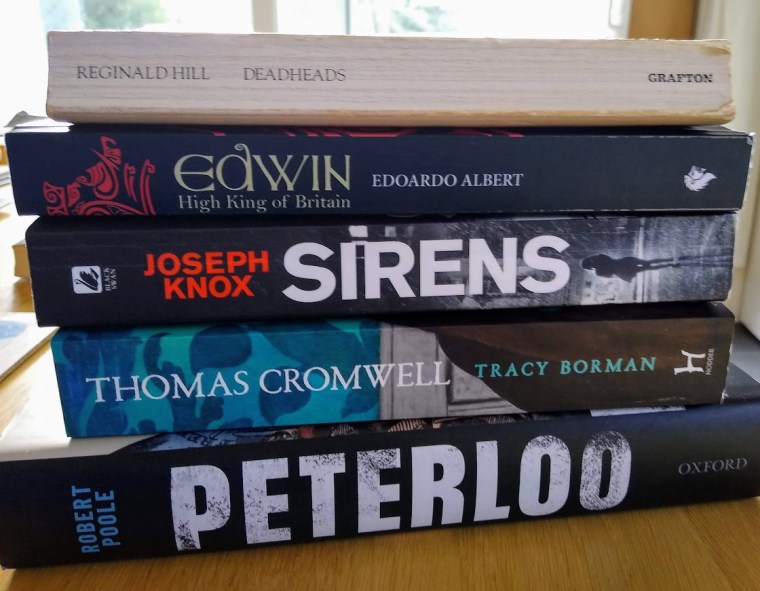
Spring 20 tbr

Deadheads by Reginald Hill, the 7th Dalziel and Pascoe novel. Patrick Alderman’s Great Aunt Florence collapsed into her rose bed leaving him Rosemont House with its splendid gardens. But was it murder?

Edwin: High King of Britain by Edoardo Albert, book 1 of 3 in the Northumbrian Thrones series. Historical fiction set in the 7th century-  Edwin, the deposed king of Northumbria, seeks refuge at the court of King Raedwald of East Anglia. But Raedwald is urged to kill his guest by Aethelfrith, Edwin’s usurper.

Sirens by Joseph Knox, the first Detective Aidan Waits thriller, set in Manchester. I’ve read books two and three, so it’s about time I read the first. It’s described on the back cover as a powerhouse of noir by Val McDermid.

The next two books are historical nonfiction:

As I’m currently reading Hilary Mantel’s third book in her Thomas Cromwell trilogy, it reminded me that I haven’t read historian, Tracy Borman’s biography of him – Thomas Cromwell: the untold story of Henry VIII’s most faithful servant.

Peterloo: the English Uprising by Robert Poole, about the ‘Peterloo massacre’ in St Peter’s field, Manchester on 16th August 1819 when armed cavalry attacked a peaceful rally of some 50,000 pro-democracy reformers. This is described on the back cover as a landmark event in the development of democracy in Britain – the bloodiest political event of the nineteenth century on English soil.

Next e-books

The Last Protector by Andrew Taylor, book 4 in his James Marwood & Cat Lovett series, historical crime fiction set in Restoration England. I loved the first three books, so I have high hopes that I’ll love this one too. It will be published on 2 April.

The Lost Lights of St Kilda by Elisabeth Gifford, historical fiction, a love story that crosses oceans and decades. It’s set on a Scottish island in 1927 and in worn-torn France in 1940.

Fresh Water for Flowers by Valérie Perrin and translated from the French by Hildegarde Serle, to be published in June. A funny, moving, intimately told story of Violette, the caretaker of a cemetery who believes obstinately in happiness.

The Measure of Malice: Scientific Detection Stories edited by Martin Edwards. A collection of classic mystery stories using scientific methods of detection.

The Deep by Alma Katsu, historical fiction set on the Titanic and its sister ship The Britannic. It’s a sinister tale of the occult. Anna Hebbley was a passenger on the Titanic who survived the 1912 disaster and four years later was a nurse on the Britannic, refitted as a hospital ship.

Top Ten Tuesday: Books with One Word Titles

Top Ten Tuesday 2020

Top Ten Tuesday is a weekly meme created by The Broke and the Bookish and now hosted by Jana at That Artsy Reader Girl. For the rules see her blog.

The topic this week is: Books With One Word Titles. I’m not a fan of quirky long word titles – I much prefer one word titles, brief and to the point. These are all books I’ve read – except for the last one:

Atonement by Ian McEwan, a book I love and have read twice and seen the film.  I am often disappointed seeing the film of a book as it rarely matches the book . In this case the film is mostly faithful to the book, with minor alterations, except for the ending. I prefer the book’s ending. It’s a love story and a war novel, and also a mystery and a reflection on society and writing and writers. I loved it.

Awakening by Sharon Bolton – If you don’t like snakes this book won’t help you get over your phobia! Clare Benning is a wildlife vet who’d rather be with animals than with people. When a man dies following a suspicious snake bite she investigates his death. As more, and more snakes surface it gets really scary.  I enjoyed it immensely.

Blacklands by Belinda Bauer, her debut novel about Arnold, a serial killer and a twelve year old boy, Stephen. Nineteen years earlier Billy, Stephen’s uncle then aged eleven had disappeared. It was assumed that he had been one of  Arnold’s victims but his body had never been found. Stephen is determined to find where Arnold had buried his body and writes to him in prison.

Blonde by Joyce Carol Oates – this is a tragic story, intense and shocking in parts, a work of fiction, not a biography of Marilyn Monroe. It follows Norma Jeane Baker’s life in chronological sections from The Child 1932 – 1938 to The Afterlife 1959 – 1962. It switches from one narrator to the next, and from third person to first person perspective throughout. It’s brutal, tender and both lyrical and fragmented. I think this is one of Joyce Carol Oates best books, although I have by no means read all her books.

Chocolat by Joanne Harris. I saw the film first then read the book. Vianne Rocher arrives in Lansquenet-sous-Tannes, a place that is ‘no more than a blip on the fast road between Toulouse and Bordeaux’ on Shrove Tuesday. She takes over the old bakery and transforms it into La Celeste Praline Chocolaterie Artisanale – in other words the most enticing, the most delicious and sensuous Chocolaterie. It’s a fabulous book.

Dracula by Bram Stoker. I knew the story of Dracula from film and TV versions – with most notably Christopher Lee and later Louis Jourdan as Dracula, but the book surprised me – mainly by how much I enjoyed it. It is composed of letters, journal entries, newspaper articles and transcripts of phonograph diary entries, from several characters, so the story is told from several different viewpoints. And it’s a very sensual and melodramatic novel, full of religious references. There is the question of life after death, the existence of the soul, the triumph of good over evil, the nature of sexuality,  fear and superstition. Vampires are at the same time appealing and repulsive.

Ferney by James Long. This book is a love story, balancing historical fact and imagination, a sort of time-slip novel. When Gally and her husband Mike buy a derelict cottage in Somerset they meet Ferney, an old man of 80 who knows the history of the cottage.  A bond grows between Gally and Ferney but Mike is a historian and he finds it hard to believe Ferney’s stories of the past and insists on having proof.

Macbeth by Jo Nesbo, a dark, gritty and violent tale that had me completely enthralled and I loved it. It’s retelling of Shakespeare’s Macbeth and I think it sticks well to Shakespeare’s version (which itself wasn’t original!) – it has the same themes and plot lines. The setting is rather vague – it is somewhere in the 1970s in a fictional Scotland in a lawless town full of drug addicts, where there is a titanic struggle for control between the police force, corrupt politicians, motorbike gangs and  drug dealers.

Tombland by C J Sansom – I could have chosen any of Sansom’s Shardlake books as they all have one word titles. Tombland is the 7th in the series, set mainly in Norwich in 1549, two years after Henry VIII’s death and England is sliding into chaos as rebellion spreads in protest against the landowners’ enclosures of the common land. It’s a murder mystery too. I loved the attention to detail and the descriptive writing which placed me precisely at the scenes.

Ulysses by James Joyce – I have started this book and given up several times. I’d love to say I’ve finished it, but I haven’t. It deals with the events of one day in Dublin, 16th June 1904, now known as “Bloomsday”. The principal characters are Stephen Dedalus, Leopold Bloom and his wife Molly. Loosely modelled on the wanderings of Homer’s Ulysses as he travelled homewards to Ithaca, Joyce’s novel follows the interwoven paths of Stephen, estranged from his father and Leopold, grieving for his dead infant son. Ulysses was made into a film, of the same title in 1967, starring Milo O’Shea as Bloom and in 2003, another version, Bloom was released starring Stephen Rea and Angeline Ball. I haven’t seen either of them – maybe I’d get on better with the book if I did watch one of them.


Top Ten Tuesday: Books with ‘Love’ in the Title

Top Ten Tuesday 2020

Top Ten Tuesday is a weekly meme created by The Broke and the Bookish and now hosted by Jana at That Artsy Reader Girl. For the rules see her blog.

The topic this week is: a Love Freebie and I’ve chosen books with the word love in the title. I haven’t read all of them, but I’ve linked the titles to my posts, for those I have read and reviewed. In no particular order they are:

  • Enduring Love by Ian McEwan – I read this many years ago. One windy spring day in the Chilterns Joe Rose’s calm, organised life and his love for his wife is shattered by a ballooning accident.
  • The Dance of Love by Angela Young –  a brilliant book, that is both a heart-rending love story and a dramatic story, as the sinking of the Titanic in 1912 and the devastating and tragic effects of the First World War impact on the characters’ lives.
  • The Tapestry of Love by Rosy Thornton –  a gentle book and yet it’s about the drama of real life, its joys and tragedies. There is romance and so much more as the story of Catherine Parkstone and her move to the Cevennes mountains in southern France, reveals.
  • Those Who Are Loved by Victoria Hislop –  Themis, a great grandmother tells her life story,  beginning from when she was a small child in the 1930s – a moving tale of an ordinary woman compelled to live an extraordinary life.
  • The Book of Love by Sarah Bower – one of my TBRS – set against the glittering background of the court of Ferrara in the early sixteenth century, this is the heart-breaking story of what happens to an innocent abroad in the world of the Borgias.
  • Love is Blind by William Boyd – one of my TBRs. Set at the end of the 19th century, it follows the fortunes of Brodie Moncur, a young Scottish musician, about to embark on the story of his life.
  • Love in the Time of Cholera – another TBR. Florentino has fallen into the arms of many delighted women, but has loved none but Fermina. Having sworn his eternal love to her, he lives for the day when he can court her again.
  • For the Love of Books by Graham Tarrant – a book to dip into, this is treasure trove of compelling facts, riveting anecdotes and extraordinary characters, that is every book-lover’s dream.
  • Women in Love by D H Lawrence – I read this many years ago. It’s about the love affairs of two sisters, Ursula with Rupert, and Gudrun with Gerald. As a sequel to The Rainbow, the novel develops experimental techniques which made Lawrence one of the most important writers of the Modernist movement – which is probably why I  found it challenging.
  • Speaking of Love by Angela Young – a novel about what happens when people who love each other don’t say so. It deals passionately and honestly with human breakdown.