Every Friday Book Beginnings on Friday is hosted by Gillion at Rose City Readerwhere you can share the first sentence (or so) of the book you are reading. You can also share from a book you want to highlight just because it caught your fancy.
One of the books I’m currently reading is The Summer That Never Was by Peter Robinson, the 13th Inspector Banks book, following on from Aftermath. I am really enjoying it, so far, which is a relief as I really disliked Aftermath.
My Book Beginning:
Trevor Dickinson was hung over and bad-tempered when he turned up for work on Monday morning
Also every Friday there is The Friday 56, hosted by Freda at Freda’s Voice, where you grab a book and turn to page 56 (or 56% of an eBook), find one or more interesting sentences (no spoilers), and post them.
Page 56:
‘Did he have many friends?’
‘He made quite a few around here,’ Joan answered. She looked at her mother. ‘Who was there Mum?’
‘Let me remember. There was the Banks lad, of course, they were very close, and David Grenfell and Paul Major. And Steven Hill.’
Blurb
A skeleton has been unearthed. Soon the body is identified, and the horrific discovery hits the headlines.
Fourteen-year-old Graham Marshall went missing during his paper round in 1965. The police found no trace of him. His disappearance left his family shattered, and his best friend, Alan Banks, full of guilt.
That friend has now become Detective Chief Inspector Alan Banks, and he is determined to bring justice for Graham. But he soon realizes that in this case, the boundary between victim and perpetrator, between law-guardian and law-breaker, is becoming more and more blurred.
What do you think, does it appeal to you? What are you currently reading?
Pan Macmillan, Mantle| 19 January 2021 | 562 pages|e-book |Review copy|4*
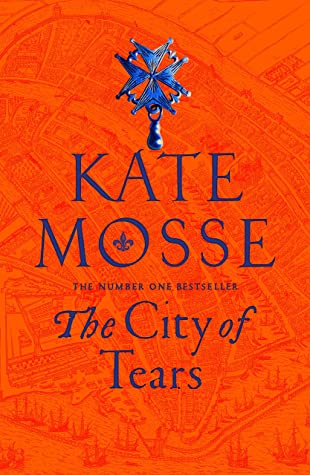
Kate Mosse sets out in her Historical Note the history of the French Wars of Religion that took place between Huguenots (Protestants) and Catholics from 1562 and 1598 and explains that The City of Tears is the second book in The Burning Chambers series of novels set against the backdrop of 300 years of history from 16th century France and Amsterdam to the Cape of Good Hope in the 18th and 19th centuries. And there is a useful list of the principal characters and the historical characters at the beginning of the book, that helps in remembering who was who and how they were connected.
It’s been four years since I read The Burning Chambers, the first book in The Burning Chambers series, and time has moved on ten years since the events in that first book. You don’t have to read the first book before reading The City of Tears as with four years between the two books I didn’t find it hard to pick up the story, but I do think you need to read the Historical Note to get the background details of the French Wars of Religion first.
There is now a precarious peace in the French Wars of Religion and it looks as though that peace could be maintained as the queen mother, Catherine de Medici, has negotiated a marriage between her Catholic daughter Margot and the Huguenot Henri of Navarre. But that union is opposed by the hardline Catholic faction led by the Duke of Guise. As the novel opens Minou Joubert and Piet Reydon, now married and living in their castle in south west France, are preparing for their visit to Paris for the wedding.
This is a complicated story centred on Minou and Piet Reydon and their family. The wedding took place followed by the St Bartholomew’s Day Massacre on 24 August 1572 when thousands of Protestants were murdered by Catholic troops, in Paris and across France. I’m not going to go into any more detail about the story other than to say it’s a compelling story of chaos and fear as Minou and her family escape, though suffering dreadful losses, including the disappearance of her seven year old daughter, and almost losing their lives. There’s murder, conspiracies, stolen relics and innumerable secrets are brought to light.
It is an enjoyable book, but because of its length it does lose pace in parts. It is not a book you can or would want to read quickly. The strength of the book for me is in the characterisation and the settings. Kate Mosse has thoroughly researched the period and the locations, rooting it firmly in the time it was set. What I particularly like is that she identifies that the characters and their families, apart from the historical ones, are imagined, inspired by ‘the kind of people who might have lived: ordinary women and men , struggling to live, love and survive against a backdrop of religious war and displacement.’ Just as devastating today, as it was then.
It is also a book that is strong on developing the characters, so that you feel for them as they struggle to survive all that is thrown at them, as it is certainly a tragic story. Having said that the ending is a positive one, except for cliff hanger on the last page that hints at what is to come in the third book, The Ghost Ship, a sweeping historical epic about love in a time of war, due out in July this year.
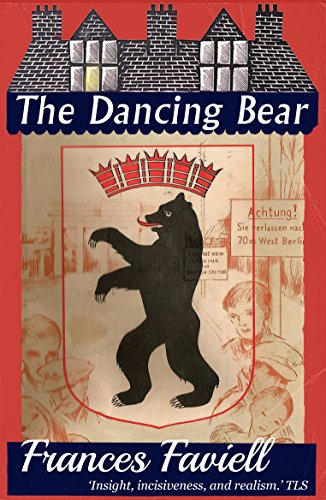
The Dancing Bear by Frances Faviell took me by surprise by how much I enjoyed it. I wasn’t expecting it to be so good.
Frances Faviell (1905-1959) was the pen name of Olivia Faviell Lucas, painter and author. After the war, in 1946, she went with her young son, John, to Berlin where Richard Parker, her second husband, had been posted as a senior civil servant in the post-war British Administration. It was here that she befriended the Altmann family, which prompted her first book The Dancing Bear (1954), a memoir of the Occupation seen through the eyes of both occupier and occupied. She later wrote three novels, A House on the Rhine (1955), Thalia (1957), and The Fledgeling (1958). These are now all available as Furrowed Middlebrow books.
The Dancing Bear covers the years from Autumn 1946 to Autumn 1949, with an Epilogue dated Autumn 1953 and, in this edition, an Afterword by John Parker, Faviell’s son. Her memoir is mainly about her friendship with the Altmann family – Frau Maria Altmann, her husband, Oskar and her children, Ursula, who works for a group of American service men, Lilli, a ballet dancer and son, Fritz, who was a member of the Hitler Youth and is now involved in the Black Market. Their eldest son. Kurt. is missing in Russia. Berlin had been divided into four sectors by the Allies – Britain, the United States, France and the Soviet Union – and Frances is horrified by the conditions she found. There were deaths from hunger and cold as the winter approached and queues for bread, milk, cigarettes, cinemas, buses and trams.
The complete and utter devastation of Berlin had shaken me profoundly. Nothing … had prepared one for the dead horror of this city. (page 15)
…
The complete absence of shops was something the Allied and German women felt. There was scarcely a single shop left standing in Berlin. The great stores and emporiums lay in dust, as did the great blocks of flats. One could not get the simplest articles except on the Black Market, and then only in exchange for cigarettes and coffee which had taken the place of money. (page 166)
The Altmanns live on the ground floor of a large ruined house – the upper storeys had disappeared and just the twisted iron girders remained, sticking up grotesquely against the sky. The ground floor looked very shaky and the windows were covered in cardboard and the door had been repaired from odd pieces of wood. It was freezing cold, and although they had a stove they had no fuel to light it and because electricity was rationed they had to use candles. There were two bedrooms, a small kitchen, a sitting room and a bathroom. With the help of her driver, Stampie, she does what she can to help them.
The British, unlike the Americans were forbidden to be friendly with the Germans, or to allow them in their homes or any of their buildings, clubs or messes and also to give them lifts, but these rules were frequently broken. At night Berlin ‘became a whirl of revelry’:
But if Berlin was a tragic city by day; at night it became a whirl of revelry. The Allies entertained on a scale which was extraordinary in a starving town, and if one went down to the Kurfurstendamm or the Kaiserdamm at night every cafe and night club was packed with revellers. (page 63)
I have only touched the surface of this book in this short post. It’s a moving memoir and I was fascinated by it all – the people, their situations, and their morale and attitudes as well as the condition of Berlin in the aftermath of World War Two. The realities of living under occupation are clearly shown, as well as the will to survive despite all the devastation and deprivation. I now want to read more of Frances Faviell’s books.
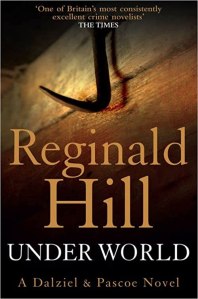
Deadheads is the 10th Dalziel and Pascoe novel first published in 1988, set in the small mining town of Burrthorpe (a fictional town) in Yorkshire. The setting is excellent and Hill paints a compelling account of the mining community and gives a convincing insight into the period a few years after the Miners’ Strike of 1984. The majority of the book is about the miners, their families, their hatred of the bosses, and their distrust and dislike of the police.
There are two mysteries facing Dalziel and Pascoe. One is current and the other is a case that had appeared to have been resolved several years earlier, when Tracy Pedley, a young girl disappeared. Her body was never discovered and some of the residents believed that Billy Farr, who was the last person to see her alive, was responsible for her death. But then Donald Pickford committed suicide leaving a letter confessing to killing several young girls in the area and although he hadn’t mentioned Tracy by name, she was counted as a probable victim. Even so, some people still thought Billy was guilty and their suspicions were confirmed when later on it appeared that he committed suicide when he fell to his death in an abandoned mineshaft.
Matters are brought to boiling point when the local newspaper serialises the memoirs of ex-Deputy Chief Constable Neville Whatmough, who had been in charge of the Pickford case. This incenses Colin Farr, Billy’s son. And then another man is found dead in the mine …
Dalziel has just a minor role as Pascoe leads the investigation. Ellie, Pascoe’s wife, also plays a major role. Her involvement comes about when she tutors some of the miners as part of the union-sponsored day release courses and meets Colin Farr, Billy’s son. He is an angry young man and Ellie is attracted both to his intelligence and his physical masculinity, despite the strength of her feminist views. She really is an irritating character, an angry young woman and for most of the book it looked as though the Pascoes’ marriage was about to come to an end. It’s left to Dalziel to bring a touch of humour to the book and his down to earth approach to the miners gets more results than Pascoe’s middle class attempts to understand them.
I thoroughly enjoyed Underworld.
Note:
The title appears as ‘Under World‘ in some editions and as ‘Underworld‘ on others. On the front cover of the paperback I read it is ‘Under World‘ but on the title page it is one word -‘Underworld‘. The Underworld or Hades in ancient Greek and Roman Mythology was where the souls of the dead resided. Hill divides Underworld into three parts and begins each part with verses from Dante’s The Divine Comedy, thus equating the mine with hell.
The age of myths and legends has given way to the world of men. In the front rank stands Pericles, Lion of Athens. Behind Pericles lies the greatest city of the ancient world. Before him, on land and at sea, stands the merciless Persian army. Both sides are spoiling for war.
Though still a young man, Pericles knows one thing: to fight a war you must first win the peace
It’s time for a hero to rise.
For his enemies to tremble.
And for Athens, a city of wisdom and warriors, to shine with glory . . .
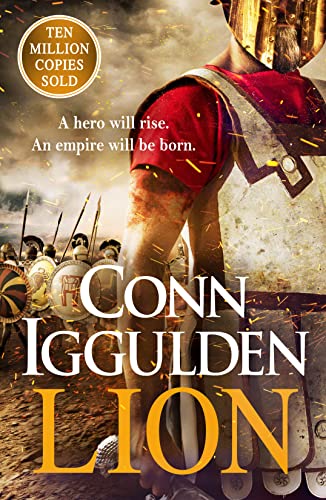
I was so pleased when I started reading Lion as I realised straight away I was going to enjoy it. It’s been a long time since I read anything set in Ancient Greece, so a lot was new to me, including the characters as well as the historical setting. This is the first book in Conn Iggulden’s Golden Age series set in the 5th century BCE. I thoroughly enjoyed it which surprised me as generally speaking I’m not keen on reading battle scenes and the book starts and ends with battles. But I had no problem with following the action of the battles between the Greeks and the Persians, and was able to visualise what was going on without any difficulty. The characters’ names took me a little while to get clear in my mind but I soon got used to them.
The two main characters are both young men, Cimon the older of the two has more authority than Pericles, the younger man. Lion is the story of their early careers. Iggulden covers the capture of Eion under Cimon’s leadership of the Delian League, an alliance of Greek states, and of Scyros where Cimon found the bones of Theseus and returned them to Athens. He then captured Cyprus and destroyed a Persian fleet on the Eurymedon River. Below the age of thirty little is known of Pericles’ life, but the likelihood is that he was with Cimon for these events.
The middle section of Lion forms an interlude between the battles and is about Pericles’ marriage to Thetis, and his involvement in the theatre in Athens and the Festival of Dionysus. Pericles was the ‘choregos’ (producer) of Aeschylus’ plays made up of three tragedies and a ‘satyr’ play. I found this part of the book just as fascinating as the battle scenes.
Iggulden adds a useful historical note and recommends reading Pericles: a Biography in Context by Thomas R Martin for more information.
The next book in the Golden Age series is Empire, which will be released on May 25, 2023.
My thanks to the publishers for a review copy via NetGalley.
After the loss of her father, Una sees a chance to escape Reykjavík to tutor two girls in the tiny village of Skálar – population just ten – on Iceland’s storm-battered north coast.
But city life hasn’t prepared her for the unforgiving weather nor inhospitable village life. Worse, the creaky old house where she lives is playing on her already fragile mind when she’s convinced she hears the ghostly sound of singing.
Then, at midwinter, a young girl is found dead. And one of the villagers must have blood on their hands . . .
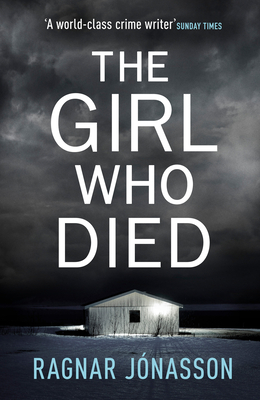
The Girl Who Died is Icelandic noir, a mix of horror and psychological thriller, with a strong sense of place. Skálar is a close-knit community that doesn’t welcome newcomers, keeping its secrets well hidden. The only person who welcomes Una, to the village is Salka, the mother of Edda, one of the two girls Una is to teach. But even her welcome is short lived.
When Una arrived she had the feeling that it was like being a folk tale, an ominous supernatural tale set in a vague shifting world where nothing was solid or real, almost like a ghost town. The feeling grows stronger when she sees a little girl with long, pale hair in the window of Salka’s house – but Salka tells her that Edda was in bed. Later she discovers that the ghost of a young girl who had died fifty years earlier was said to haunt the house.
The supernatural elements of the story and the dark brooding atmosphere add to the mystery, but it is not quite as creepy or chilling as I’d thought it would be, mainly because of the slow plodding pace. Also I’m in two minds about Una as I really didn’t find her a very interesting character. And I began to care less and less about what was happening to her. Overall I found it a bit disappointing, and I found the ending puzzling.
However, the Author’s Note is interesting. Jonasson explains that Skálar is a real place. But it was abandoned in the mid 1950s, so the setting is real, but the buildings and the characters are fictitious. However, he has tried to give an accurate representation of the history of Skálar that describes in the book. He has also used the folk tales in Sigfús Sigfússon’s collections of Icelandic tales and legends.
My thanks to the publishers for a review copy via NetGalley.

 BooksPlease